At the point this photo was taken, this cheetah was stalking a young gazelle, but an eland wandered by. Click the photo to find more cheetah photos.
Saturday, August 13, 2005



Friday, August 12, 2005
Duma
Bonnie and I were lucky, for we got to see Duma at a theater last night. If you have not heard, Duma is a movie directed by Carroll Ballard (Fly Away Home) that features a cheetah that is orphaned and raised by a family. It is a really beautifully made movie, which Warner Brothers is not really promoting to theaters. It was test marketed on a small budget without television ads in April in San Antonio, Phoenix, and Sacramento and did poorly at the box office. Because it was given a really good review by a critic in Los Angeles, the studio decided to give it another chance. It is currently showing at five theaters in the Chicago area, again with no television advertising. The ticket sales have not been good, according to Mark Caro of the Chicago Tribune. Our theater was about half full Friday night.
Bonnie thinks that Warner Brothers sees its profit on this film coming from DVD sales. It would make a nice family film to watch over and over again with the kids. So I looked around to see if a sales date is set. Amazon is already taking orders for the DVD, but no date is mentioned for release. One of the articles I saw said that the DVD goes on sale in the U.K. on September 26. The U.S. sales probably will not be set until after the studio decides whether to distribute the film to theaters. Whenever it does go on sale, libraries should buy it.
Warner Brothers has gone to the trouble of setting up a nice web site for the movie. It even has study sheets for students and teachers, buddy icons, and downloadable wallpapers. There must be some plan to promote the film to youth.
If you are anywhere near Chicago this week, you should try to see Duma at a theater. It may be your only chance. The cheetah on the run should be on the big screen.
Bonnie thinks that Warner Brothers sees its profit on this film coming from DVD sales. It would make a nice family film to watch over and over again with the kids. So I looked around to see if a sales date is set. Amazon is already taking orders for the DVD, but no date is mentioned for release. One of the articles I saw said that the DVD goes on sale in the U.K. on September 26. The U.S. sales probably will not be set until after the studio decides whether to distribute the film to theaters. Whenever it does go on sale, libraries should buy it.
Warner Brothers has gone to the trouble of setting up a nice web site for the movie. It even has study sheets for students and teachers, buddy icons, and downloadable wallpapers. There must be some plan to promote the film to youth.
If you are anywhere near Chicago this week, you should try to see Duma at a theater. It may be your only chance. The cheetah on the run should be on the big screen.
Thursday, August 11, 2005
Weeding Clinton and Bush
One of the realities of life in a medium small public library is that the amount of shelf space for books is always limited. The promise of electronic books freeing up space has not come true for us as yet. Like many other libraries, we have gotten to the point that we need to withdraw a book for every book we add. It has certainly come to that point with all of our books about the Clinton and Bush II presidential administrations. Books are being piled on top of books. Having just placed orders for some more new titles that are forecasted to generate reading interest this fall, I decided that I had to weed 973.929 and 973.931.
How did I do?
973.929 was pretty easy. I found eight books about the Clinton administration that had not been out in two or more years that I doubt will be requested in the future. Some were from early in the administration and later books tell more up-to-date stories. Some focused on cabinet members. One was about how Gingrich would be stirring up more trouble. It was easy to let these go. I kept anything by or about Hillary Clinton, including Dear Socks Dear Buddy. The “long tail” of public interest of which I hear may whip these items back into currency. I kept twenty-four books in the area, so I withdrew twenty-five percent.
973.931 was harder. The covers of many of the books still shine. Most of the titles that had not been out recently were about September 11, 2001 terrorist attacks and still seemed relevant. The books about the president’s character (pro and con) had all been out recently, as had the books about the conduct of the war in Iraq, but some had only been out two or three times total. I would think that these books should be jumping off the shelves. While I would like to free up some space, I could not decide which titles would not be read soon. I would still like to get some value out of all of them. I withdrew nothing.
My thoughts return to the books I am ordering. I do not want to get caught without books that are going to be demanded, but I do not want to waste our limited funds (and shelving space) on titles that will mostly sit. What am I to do? I have to accept the reality that I can not perfectly predict which books will be well read and buy the potentially hot books and shift other books to make a little more room. Still, it bugs me.
How did I do?
973.929 was pretty easy. I found eight books about the Clinton administration that had not been out in two or more years that I doubt will be requested in the future. Some were from early in the administration and later books tell more up-to-date stories. Some focused on cabinet members. One was about how Gingrich would be stirring up more trouble. It was easy to let these go. I kept anything by or about Hillary Clinton, including Dear Socks Dear Buddy. The “long tail” of public interest of which I hear may whip these items back into currency. I kept twenty-four books in the area, so I withdrew twenty-five percent.
973.931 was harder. The covers of many of the books still shine. Most of the titles that had not been out recently were about September 11, 2001 terrorist attacks and still seemed relevant. The books about the president’s character (pro and con) had all been out recently, as had the books about the conduct of the war in Iraq, but some had only been out two or three times total. I would think that these books should be jumping off the shelves. While I would like to free up some space, I could not decide which titles would not be read soon. I would still like to get some value out of all of them. I withdrew nothing.
My thoughts return to the books I am ordering. I do not want to get caught without books that are going to be demanded, but I do not want to waste our limited funds (and shelving space) on titles that will mostly sit. What am I to do? I have to accept the reality that I can not perfectly predict which books will be well read and buy the potentially hot books and shift other books to make a little more room. Still, it bugs me.
Tuesday, August 09, 2005
Book Shop at Bristol Renaissance Fair
I think I missed the Bristol Renaissance Fair last year. When I attended over the past weekend, I found a book shop that I had not seen before. To my surprise it really had a good selection of Medieval and Renaissance histories, biographies, and historical novels, as well as a children's book section. There was a range of shelves with Renaissance music books, another on period weapons and armor, several shelves on women in the Renaissance, and a section on the Tudor monarchs. All the topics of everyday life, such as cooking and clothing, also had sections. I hope the shop prospers. It provides an interesting shady retreat. Visit it when you attend the fair.
Click on the photo to find more photos from the fair.
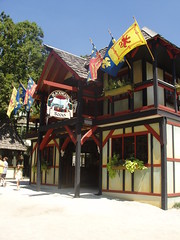
Click on the photo to find more photos from the fair.
Monday, August 08, 2005
Hybrid Librarians
I read and enjoyed “Architect of Learning,” an article by Sam Allis in the July 30, 2005 issue of the Boston Globe, which discusses the bright future of college libraries. It is reassuring to read an optimistic forecast, and I wonder how the trends for college libraries transfer to public libraries. What struck me as strange in the story was the description of “hybrid personnel with technology and content expertise” helping students in the new libraries.
Because many college libraries have more money and specialized technical staffs, I think they are often ahead of most public libraries with technological innovations. They have more computers and more databases, write their own software, try and abandon gadgets, and study their services with the intent of writing scholarly reports. I attend LITA Forums to see what might work its way down to public libraries. When I read about these “hybrid personnel” I thought, “Hey, public libraries are ahead on this one.”
I know colleges have often been able to have specialists. One librarian might focus on acquiring Latin American documents, while another might be a bibliographic instructor. We have never been able to do this in smaller public libraries. We have always been “hybrid personnel.”
I am old enough to remember when we first got computers for the public in our community libraries. There seemed to be a lot of debate about how much we could help computer users, for many of us had few technical skills at that point. I remember libraries with signs saying that users were responsible for knowing how to use the machines. Library staff would give only minimal help, according to the signs. Thankfully that did not last long. We are born to help people. Those of us who were not already became “hybrid personnel with technology and content expertise” at that point.
Today it is hard for me to imagine a librarian is not a “hybrid.” Of course, the list of necessary skills keeps increasing. I am not keeping up with Jenny Levine, but I have her list of twenty five skills that librarians need (20 from T.H.E Journal and five of her own). I had better sign off and work on three or four skills before she adds another.
Because many college libraries have more money and specialized technical staffs, I think they are often ahead of most public libraries with technological innovations. They have more computers and more databases, write their own software, try and abandon gadgets, and study their services with the intent of writing scholarly reports. I attend LITA Forums to see what might work its way down to public libraries. When I read about these “hybrid personnel” I thought, “Hey, public libraries are ahead on this one.”
I know colleges have often been able to have specialists. One librarian might focus on acquiring Latin American documents, while another might be a bibliographic instructor. We have never been able to do this in smaller public libraries. We have always been “hybrid personnel.”
I am old enough to remember when we first got computers for the public in our community libraries. There seemed to be a lot of debate about how much we could help computer users, for many of us had few technical skills at that point. I remember libraries with signs saying that users were responsible for knowing how to use the machines. Library staff would give only minimal help, according to the signs. Thankfully that did not last long. We are born to help people. Those of us who were not already became “hybrid personnel with technology and content expertise” at that point.
Today it is hard for me to imagine a librarian is not a “hybrid.” Of course, the list of necessary skills keeps increasing. I am not keeping up with Jenny Levine, but I have her list of twenty five skills that librarians need (20 from T.H.E Journal and five of her own). I had better sign off and work on three or four skills before she adds another.
What's This?
Where is this truckload of giant pumpkins going? Laura took this while I was driving on I88 on Sunday.

Saturday, August 06, 2005
Are Bloggers Defined as Unhealthy?
On Thursday, Laughing Squid reported that the dictionary on Apple’s Tiger operating system defines a blog as a pursuit of twenty-somethings with “an unhealthy interest in computers.” The author later modified the report to say that the definition actually came from the New Oxford American Dictionary, 2nd edition, which Apple uses.
I do not have a copy of the new edition of the dictionary, but I found that the ResourceShelf posted a complete list of the new words and definitions. Looking at the entry for blog, it appears to me that the slight to bloggers is not in a definition, but in an example showing word usage. When the italics are lost, as they are in some of the postings of this dictionary entry, it is not clear that the OAD was just showing how to use the word.
So, OAD did not actually define us as unhealthy. The definition writer was probably trying to be funny, much as I tried in junior high school when writing sentences using vocabulary words.
By the way, I can only wish I were twenty-something.
I do not have a copy of the new edition of the dictionary, but I found that the ResourceShelf posted a complete list of the new words and definitions. Looking at the entry for blog, it appears to me that the slight to bloggers is not in a definition, but in an example showing word usage. When the italics are lost, as they are in some of the postings of this dictionary entry, it is not clear that the OAD was just showing how to use the word.
So, OAD did not actually define us as unhealthy. The definition writer was probably trying to be funny, much as I tried in junior high school when writing sentences using vocabulary words.
By the way, I can only wish I were twenty-something.
Friday, August 05, 2005
The Old Ball Game by Frank Deford
I enjoyed The Old Ball Game by Frank Deford. He tells his story well, including enough tidbits to keep readers entertained. Did you know that baseball fans used to be called “cranks?” Deford quotes headlines like “20,000 Cranks Fill Polo Grounds.” (Does that make you want to go to a game?) It also gets into the serious topic of gambling and dishonest players. Even the revered Mathewson bet on games. Gambling was a way some players made ends meet. Some of those who failed literally died in gutters and slums.
How important is a subtitle on a book? On both the cover and on the title page of this new book I see How John McGraw, Christy Mathewson, and the New York Giants Created Modern Baseball. Having now read this book, I wonder if the author or some marketing editor wrote the subtitle. The book is about McGraw and Mathewson and their relationship, but Deford never really makes the case that they created the modern game. They were innovators and important figures in the history of the game, but the subtitle is an overstatement. I think I would have used "Unlikely Friends" in the subtitle. There is more about relationships than baseball in this work.
The Old Ball Game captures the flavor of the early twentieth century well. Both general readers and cranks will enjoy this book.
Deford, Frank. The Old Ball Game: How John McGraw, Christy Mathewson, and the New York Giants Created Modern Baseball. New York: Atlantic Monthly Press, 2005. ISBN 0871138859
How important is a subtitle on a book? On both the cover and on the title page of this new book I see How John McGraw, Christy Mathewson, and the New York Giants Created Modern Baseball. Having now read this book, I wonder if the author or some marketing editor wrote the subtitle. The book is about McGraw and Mathewson and their relationship, but Deford never really makes the case that they created the modern game. They were innovators and important figures in the history of the game, but the subtitle is an overstatement. I think I would have used "Unlikely Friends" in the subtitle. There is more about relationships than baseball in this work.
The Old Ball Game captures the flavor of the early twentieth century well. Both general readers and cranks will enjoy this book.
Deford, Frank. The Old Ball Game: How John McGraw, Christy Mathewson, and the New York Giants Created Modern Baseball. New York: Atlantic Monthly Press, 2005. ISBN 0871138859
Tuesday, August 02, 2005
How to Be a (Bad) Birdwatcher by Simon Barnes
Would you want to be a “bad” birdwatcher? If you define “bad” as disregarding the rules drawn up by competitive birders and just watching and enjoying birds, the answer is “yes.” You do not have to rush about checking off as many species as you can on a lifelist. You do not have to seek out the rare birds at the expense of enjoying the common birds, which sometimes do extraordinary things. You do not have to have fancy equipment or join any groups or take expensive trips to exotic places. All that you have to do is take time to observe the birds around you everyday. You do not “go” bird watching. You “are” bird watching wherever you are.
How to Be a (Bad) Birdwatcher by Simon Barnes is a bit of a memoir as well as a bit of a guidebook. Readers learn about Barnes’ relationship with his father, his career as a sportswriter, and his learning to love the simple pleasure of observing birds. Every chapter is a well-formed essay on a birding topic.
Barnes is a good story teller and relates several adventures that make the point that it is still okay to go all out to see birds, so long as you are really having fun. He tells about going on numerous assignments to cover sporting events and seeking out local Audubon experts who take him to good birding sites. Birders like to share. He always finds someone to guide him to the birds.
Don’t just read with envy. Get out and see some birds.
Barnes, Simon. How to Be a (Bad) Birdwatcher. New York: Pantheon Books, 2004. ISBN 0375423559
Birding note: Bonnie and I saw a bunch of first summer American redstarts from the observation deck of Mount Baldhead (called Mount Baldy) in Saugatuck, Michigan last Friday. They were cute little birds that flitted around the shrubs. Their yellow patches will be orange next year. We needed The Sibley Guide to Birds by David Allen Sibley to verify their identity.
How to Be a (Bad) Birdwatcher by Simon Barnes is a bit of a memoir as well as a bit of a guidebook. Readers learn about Barnes’ relationship with his father, his career as a sportswriter, and his learning to love the simple pleasure of observing birds. Every chapter is a well-formed essay on a birding topic.
Barnes is a good story teller and relates several adventures that make the point that it is still okay to go all out to see birds, so long as you are really having fun. He tells about going on numerous assignments to cover sporting events and seeking out local Audubon experts who take him to good birding sites. Birders like to share. He always finds someone to guide him to the birds.
Don’t just read with envy. Get out and see some birds.
Barnes, Simon. How to Be a (Bad) Birdwatcher. New York: Pantheon Books, 2004. ISBN 0375423559
Birding note: Bonnie and I saw a bunch of first summer American redstarts from the observation deck of Mount Baldhead (called Mount Baldy) in Saugatuck, Michigan last Friday. They were cute little birds that flitted around the shrubs. Their yellow patches will be orange next year. We needed The Sibley Guide to Birds by David Allen Sibley to verify their identity.
Sunday, July 31, 2005
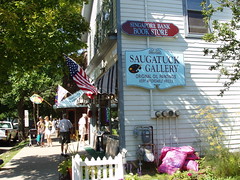
Singapore Bank Book Store
The old bank building from the ghost town Singapore was moved into Saugatuck years ago. Upstairs is a small book store with both new and used books. There are many local history and Michigan nature guides, as well as a nice collection of mysteries and fantasies. There are also bestsellers and children's titles. Some of the books are artfully piled onto tables and on the floor. Watch out! Don't hit your head on the swag lamp.
Sunday, July 24, 2005
International Rooms at Cathedral of Learning in Pittsburgh
If you have time when you are in Pittsburgh, you should tour the International Rooms in the Cathedral of Learning at the University of Pittsburgh. The rooms, many decorated in the 1930s, are used as classrooms but are open for visitor seven days a week when not in use. You may get a key and an audiotour at the shop on the first floor. I particularly like looking at the small details, like this detail from the room decorated by Japan.

Saturday, July 23, 2005
Chicago Apartments: A Century of Lakefront Luxury by Neil Harris
My library recently added Chicago Apartments: A Century of Lakefront Luxury by Neil Harris to its local history collection. It is a big, heavy book, and I was uncertain how interesting it would be to read. The introductory chapters look rather flat at a glance, and most of the buildings included in the book get a fairly standardized two-page spread. I need not have worried. The author includes a good mix of factual details and human interest notes to keep the reader’s attention, and all the photographs and apartment floor plans tell a story of their own.
The later half of the 1920’s, just before the Stock Market Crash and the Great Depression, was the great era of the luxury apartment building in Chicago. All along the shores of Lake Michigan, from south of Jackson Park to north of Lincoln Park, developers were erecting taller and grander apartment buildings, most of which survive today. Nearly three quarters of the buildings in this book date from that era. Some are even older. A few are newer.
I have favorites in this book.
Jackson Towers (page 60) is a Spanish Renaissance influenced apartment building with an 18-story tower and two 15-story wings that faces the Museum of Science and Industry. Some of the duplex apartments have two-story living rooms with great arched windows. Former White sox owner Charles Comisky once lived there.
The plans for the Jackson Shore Apartments at 5490 South Shore Drive show that many of the residences included a library, an orangerie, and two rooms for the live-in maids. $500 a month was lot of money in 1916.
Sterling Morton’s duplex apartment at 1260 North Astor Street had huge bathrooms. He also had three maids’ rooms. Did maids get private rooms?
On page 120 is a photograph of a really nice library with lots of bookshelves in the Bradley Apartments at 20 East Cedar Street. Readers will soon discover that almost all nice apartments from the 1920s include libraries with comfy chairs for reading. That’s real luxury!
The plan for the Stewart Apartments at 1200 North Lake Shore Drive has five bedrooms for servants and one for the house keeper. All the plan labeling is in French, i.e. chambre de domestique, la sale a manager des domestiques, le petit salon, and of course, le biblioteque.
The book does show some modest apartments that were significant in the development of Chicago residential history. Page 125 shows how the Hotel St. Benedict Flats were subdivided in the 1980s. The kitchen of one apartment is only 3 by 12!
Look at page 254 to see where Mies van der Rohe, noted for his modern architectural design, lived. Many critics agree that he made an ironic choice.
There are so many interesting buildings in Chicago. Whenever we drive along Lake Shore Drive, we pass by many of them so quickly that we never get a good look. I would now like to take a Chicago apartment tour.
People who like architectural history will enjoy this book, as will those who like to peak into the homes of the wealthy.
Harris, Neil. Chicago Apartments: A Century of Lakefront Luxury. New York: Acanthus Press, 2004. ISBN 0926494252
The later half of the 1920’s, just before the Stock Market Crash and the Great Depression, was the great era of the luxury apartment building in Chicago. All along the shores of Lake Michigan, from south of Jackson Park to north of Lincoln Park, developers were erecting taller and grander apartment buildings, most of which survive today. Nearly three quarters of the buildings in this book date from that era. Some are even older. A few are newer.
I have favorites in this book.
Jackson Towers (page 60) is a Spanish Renaissance influenced apartment building with an 18-story tower and two 15-story wings that faces the Museum of Science and Industry. Some of the duplex apartments have two-story living rooms with great arched windows. Former White sox owner Charles Comisky once lived there.
The plans for the Jackson Shore Apartments at 5490 South Shore Drive show that many of the residences included a library, an orangerie, and two rooms for the live-in maids. $500 a month was lot of money in 1916.
Sterling Morton’s duplex apartment at 1260 North Astor Street had huge bathrooms. He also had three maids’ rooms. Did maids get private rooms?
On page 120 is a photograph of a really nice library with lots of bookshelves in the Bradley Apartments at 20 East Cedar Street. Readers will soon discover that almost all nice apartments from the 1920s include libraries with comfy chairs for reading. That’s real luxury!
The plan for the Stewart Apartments at 1200 North Lake Shore Drive has five bedrooms for servants and one for the house keeper. All the plan labeling is in French, i.e. chambre de domestique, la sale a manager des domestiques, le petit salon, and of course, le biblioteque.
The book does show some modest apartments that were significant in the development of Chicago residential history. Page 125 shows how the Hotel St. Benedict Flats were subdivided in the 1980s. The kitchen of one apartment is only 3 by 12!
Look at page 254 to see where Mies van der Rohe, noted for his modern architectural design, lived. Many critics agree that he made an ironic choice.
There are so many interesting buildings in Chicago. Whenever we drive along Lake Shore Drive, we pass by many of them so quickly that we never get a good look. I would now like to take a Chicago apartment tour.
People who like architectural history will enjoy this book, as will those who like to peak into the homes of the wealthy.
Harris, Neil. Chicago Apartments: A Century of Lakefront Luxury. New York: Acanthus Press, 2004. ISBN 0926494252
Thursday, July 21, 2005
Lucky Child: A Daughter of Cambodia Reunites with the Sister She Left Behind
Survival is not “and they lived happily ever after.” At the end of First They Killed My Father, which I reviewed in May, Loung Ung, her sister Chou, and three brothers had survived the years of slaughter of Cambodians by the Khmer Rouge. Vietnamese forces had captured much of the country and the Khmer Rouge had fled into isolated areas. The family, minus their parents and two sisters who had died, still faced many hardships.
Lucky Child: A Daughter of Cambodia Reunites with the Sister She Left Behind by Loung Ung continues the story. Ten year old Loung escapes with her brother Meng and his wife to a refugee camp in Thailand, where they stay until they are sponsored by a church in Vermont. They move into an apartment over a small shop, her brother and sister-in-law get jobs, and she starts school. Her sister Chou remains in a village in Cambodia with an uncle, hauling water, gathering firewood, and tending to her younger cousins, always afraid that the Khmer Rouge or the Vietnamese will harm her.
One of the most incredible stories in the book tells how her brother Kim escaped Cambodia, hid out in Thailand, and was smuggled into France.
While Lucky Child is not as intense a book as First They Killed My Father, it is still a compelling story about longing and reunion, that reminds us that wounds do not easily heal. It is a good book for adults and teens.
Ung, Loung. Lucky Child: A Daughter of Cambodia Reunites with the Sister She Left Behind. New York: HarperCollins, 2005. ISBN 0060733942
Use rickindex to find reviews of books, movies, music, and the web.
Lucky Child: A Daughter of Cambodia Reunites with the Sister She Left Behind by Loung Ung continues the story. Ten year old Loung escapes with her brother Meng and his wife to a refugee camp in Thailand, where they stay until they are sponsored by a church in Vermont. They move into an apartment over a small shop, her brother and sister-in-law get jobs, and she starts school. Her sister Chou remains in a village in Cambodia with an uncle, hauling water, gathering firewood, and tending to her younger cousins, always afraid that the Khmer Rouge or the Vietnamese will harm her.
One of the most incredible stories in the book tells how her brother Kim escaped Cambodia, hid out in Thailand, and was smuggled into France.
While Lucky Child is not as intense a book as First They Killed My Father, it is still a compelling story about longing and reunion, that reminds us that wounds do not easily heal. It is a good book for adults and teens.
Ung, Loung. Lucky Child: A Daughter of Cambodia Reunites with the Sister She Left Behind. New York: HarperCollins, 2005. ISBN 0060733942
Use rickindex to find reviews of books, movies, music, and the web.
Wednesday, July 20, 2005
The Wild Braid: A Poet Reflects on a Century in the Garden by Stanley Kunitz
Stanley Kunitz will be 100 years old on July 29, and he is still tending to his garden in Provincetown, Massachusetts. He is also still writing poetry. In The Wild Braid: A Poet Reflects on a Century in the Garden, his newest book, he tells about his life with nature and gardening and how his poetry draws from these sources. Accompanying the reflections are several of his poems and a collection of photographs of Kunitz by Marnie Crawford Samuelson.
Like Frederick Law Olmstead, Kunitz avoids splashy color in his gardens. He is more interested in shapes, textures, and space, wanting to create quiet living places for meditation. To him, plants are not finished once the flowers are spent. His interests are more long-term. His poetry also is not finished. It is deliberately mysterious, giving readers room for thought and speculation.
Like most serious poets, Kunitz reflects on death. A conversation between Genine Lentine and the poet in a hospital at a time when he was near death is included, as is his poem “The Long Boat.” He observes what a terribly crowded place earth would be if all generations were still living, not surrendering power to the young, yet he is reluctant to depart.
I recommend The Wild Braid as an easy introduction to the poetry of Stanley Kunitz.
Kunitz, Stanley, with Genine Lentine. The Wild Braid: A Poet Reflects on a Century in the Garden. New York: Norton, 2005. ISBN 0393061418
Like Frederick Law Olmstead, Kunitz avoids splashy color in his gardens. He is more interested in shapes, textures, and space, wanting to create quiet living places for meditation. To him, plants are not finished once the flowers are spent. His interests are more long-term. His poetry also is not finished. It is deliberately mysterious, giving readers room for thought and speculation.
Like most serious poets, Kunitz reflects on death. A conversation between Genine Lentine and the poet in a hospital at a time when he was near death is included, as is his poem “The Long Boat.” He observes what a terribly crowded place earth would be if all generations were still living, not surrendering power to the young, yet he is reluctant to depart.
I recommend The Wild Braid as an easy introduction to the poetry of Stanley Kunitz.
Kunitz, Stanley, with Genine Lentine. The Wild Braid: A Poet Reflects on a Century in the Garden. New York: Norton, 2005. ISBN 0393061418
Tuesday, July 19, 2005
Phipps Conservatory in Pittsburgh
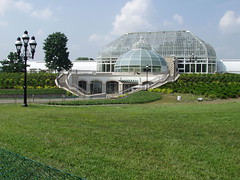
I think my favorite place in Pittsburgh is the Phipps Conservatory, near the Carnegie Library and the Cathedral of Learning at the University of Pittsburgh. The collection of plants inside and outside the conservatory is outstanding. There is even a palm tree that is believed to be from the 1893 Columbian Exposition in Chicago. Click on the photo to get to more photos of the conservatory.
Pittsburgh would be a good city for a library conference. Perhaps PLA or LITA would like to go there. There is a conference center that appears to be close to a cultural district. The streets are confusing, but nothing is really very far away. The Carnegie Library is a pretty important institution in library history. Pittsburgh has my recommendation.
Pittsburgh would be a good city for a library conference. Perhaps PLA or LITA would like to go there. There is a conference center that appears to be close to a cultural district. The streets are confusing, but nothing is really very far away. The Carnegie Library is a pretty important institution in library history. Pittsburgh has my recommendation.
Wednesday, July 13, 2005
Far from the Madding Crowd by Thomas Hardy
We are going to Pittsburgh for a wedding, and I am taking Far from the Madding Crowd by Thomas Hardy on audiobook read by Nathaniel Parker. I enjoyed listening to The Mayor of Casterbridge read by Pamela Garelick last fall and thought I would try another Hardy classic. I started it while watering our drought parched flower beds and have finished five of twelve discs already and am liking it well enough to continue, but I do find some of the scenes with the country folk somewhat annoying. I have not decided yet whether it is the dialogue as Hardy wrote it or the way Parker reads the lines, but there is an excess of bumpkin comedy. The scenes in the alehouse run long without advancing the story much and Hardy pokes too much fun at the farmhands.
What I like most are Hardy’s descriptions of the countryside and the buildings. I am sure my vocabulary will expand just having listened. I am also enjoying the story, which I know from having read the book and seen the BBC adaptation in the past.
I am taking a stack of books on the trip, so there may soon be an outburst of book reviews here soon.
Hardy, Thomas. Far from the Madding Crowd. Hampton, N.H.: BBC Audiobooks America: Chivers CD Audiobooks, [2003?]. ISBN 075408745X
What I like most are Hardy’s descriptions of the countryside and the buildings. I am sure my vocabulary will expand just having listened. I am also enjoying the story, which I know from having read the book and seen the BBC adaptation in the past.
I am taking a stack of books on the trip, so there may soon be an outburst of book reviews here soon.
Hardy, Thomas. Far from the Madding Crowd. Hampton, N.H.: BBC Audiobooks America: Chivers CD Audiobooks, [2003?]. ISBN 075408745X
Tuesday, July 12, 2005
The Chase by Zizou Corder
Much is revealed in The Chase, the second book in the Lion Boy trilogy by Zizou Corder. Charlie Ashanti discovers why so many children have asthma, something his parents knew all along. His mother finds a long lost relative. King Boris learns something about his security advisor. The lions learn how far Charlie will go to help them. Of course, readers learn even more, including more details about the state of the environment in a post-fossil fuel world.
Unlike the first book, just called Lion Boy, the second book has a more ending-like ending, but the author adds a postscript that Charlie better stay alert, for an even greater challenge is coming. Book three of this imaginative series is due out this September.
Corder, Zizou. The Chase. New York: Dial Books, 2004. ISBN 0803729847
Book on CD. Minneapolis, Mn.: HighBridge Audio, p2004. ISBN 1565119126
Use rickindex to find book, movie, music, and website reviews.
Unlike the first book, just called Lion Boy, the second book has a more ending-like ending, but the author adds a postscript that Charlie better stay alert, for an even greater challenge is coming. Book three of this imaginative series is due out this September.
Corder, Zizou. The Chase. New York: Dial Books, 2004. ISBN 0803729847
Book on CD. Minneapolis, Mn.: HighBridge Audio, p2004. ISBN 1565119126
Use rickindex to find book, movie, music, and website reviews.
Foetry: American Poetry Watchdog
Does your library receive requests to post on its bulletin boards announcements for poetry contest? We do. If the board is fairly clear of other matter, I post them for a week or so. Supporting literature and poetry writing seems a worthy cause. I now see, via an email from Library Link of the Day, that we should be screening these announcements.
“Angry Librarian's Darts Sting the World of Poetry” is an article, first in the Los Angeles Times and reprinted in the San Francisco Chronicle, that reports on the website Foetry, which tells about fraud in what appear to be major poetry contests. Some major universities, publishers, and well-known poets are involved in contests that the librarian Alan Cordle of Portland Community College claims are rigged so students, friends, and lovers win. The article and the website are interesting reading.
Tizon, Tomas Alex. "Angry Librarian Darts the World of Poetry" San Francisco Chronicle. July 10, 2005. Page unknown.
“Angry Librarian's Darts Sting the World of Poetry” is an article, first in the Los Angeles Times and reprinted in the San Francisco Chronicle, that reports on the website Foetry, which tells about fraud in what appear to be major poetry contests. Some major universities, publishers, and well-known poets are involved in contests that the librarian Alan Cordle of Portland Community College claims are rigged so students, friends, and lovers win. The article and the website are interesting reading.
Tizon, Tomas Alex. "Angry Librarian Darts the World of Poetry" San Francisco Chronicle. July 10, 2005. Page unknown.
Monday, July 11, 2005
How to Find Conference Reports from ALA Updated
The list of bloggers at the American Library Association Annual Conference on the unofficial conference wiki was a very successful service. The page was accessed over 2200 times. I bet 20 or 30 of those were mine, as I have made my way through the reports of other bloggers.
There are some other ways of finding the reports now.
An alphabetic list of the reports can be found at http://meredith.wolfwater.com/wiki/index.php?title=Category:Conference_reports. This is good because the bloggers have mostly gone on to other topics now. If you want a report on a specific program, this is the page to use.
If you are looking for reports sponsored by units of ALA, such as PLA or LITA or RUSA, go to http://meredith.wolfwater.com/wiki/index.php?title=Conference_Reports. Look at the bottom of the page under "index of reports, by unit." There are your links.
There are some other ways of finding the reports now.
An alphabetic list of the reports can be found at http://meredith.wolfwater.com/wiki/index.php?title=Category:Conference_reports. This is good because the bloggers have mostly gone on to other topics now. If you want a report on a specific program, this is the page to use.
If you are looking for reports sponsored by units of ALA, such as PLA or LITA or RUSA, go to http://meredith.wolfwater.com/wiki/index.php?title=Conference_Reports. Look at the bottom of the page under "index of reports, by unit." There are your links.
Sunday, July 10, 2005
A Look at the Website Wondir
As a reference librarian who has been to numerous classes and workshops on the reference interview (taught a few), I have often heard it said that there are no stupid questions. I have said this many times myself. Having looked at the website Wondir, I now wonder whether I should rethink this statement.
The idea behind Wondir is not bad. People who have questions post them on the website and other people who know the answers reply. According to the creators of the service, answers come from “experts, tutors, mentors, enthusiasts, and peers” who volunteer their services. They emphasize that the service is open to all for asking and answering questions, and all communications are public. The creators do not interfere.
Librarians often worry that people are too afraid to ask questions, afraid that they will ask something that will cause the librarian to think less of them. Librarians work hard to be approachable, but do not always succeed. Wondir seems to have the opposite problem. Because everyone is unseen and unknown, people ask anything.
In my view, some of the problem questions result from the open license for mischief. “Would you like to spank me?” seems to be a frequent question. Looking at the question board, it appears this kind of query often gets three of four responses. It is hard to take a service that leads to this kind of conversation seriously.
The service also gets many poorly formed queries. I know I am old fashioned in that I like complete sentences and correctly spelled words (I misspell a few myself), but I do instant message and virtual reference successfully, so I can interpret slapdash questions. I find some questions on Wondir particularly unformed and incomprehensible, but even the most mysterious queries get responses. Looking at these exchanges, I think there should have been reference interviews.
There are many serious information queries. How should one clean a stainless steel sink? What is the major export of Nicaragua? How does one worm a cat? What happened to Sunkist? How does one upgrade an old computer? Many get fairly quick replies, but “I think” is often appended to the answers.
Other questions ask for relationship help or career advice. Should I dump my boyfriend? Should I hit my sister? Should I get a new job? Do these people have trouble asking people they know for advice? A whole community of amateur counselors has risen up to help them, but the quality of the answers varies.
The people who answer the questions are interesting. Some have registered profiles, which tell you whether they have qualifications or “just like to help people.” If you click on “Best of Wondir”, you find a list of the screen names of the people who have answered the most queries. A couple of people had logged nearly 6000 answers in 90 days. That’s over 60 replies per day!
At the American Library Association Annual Conference in Chicago last month, the panel at the Reference Interactions in the Digital Age program mentioned and quickly dismissed the website. It certainly is a disturbing phenomenon for library professionals who are devoted to a higher quality of service based on trusted resources that answer the clients’ real needs discovered through interviews.
Perhaps Wondir does some good. I am glad the mischievous questions are asked on the website and not at my library’s reference desk. Still, I wish many of the other queries came to our libraries. I know we have better answers.
To find reviews of books, media, and websites go to rickindex.
The idea behind Wondir is not bad. People who have questions post them on the website and other people who know the answers reply. According to the creators of the service, answers come from “experts, tutors, mentors, enthusiasts, and peers” who volunteer their services. They emphasize that the service is open to all for asking and answering questions, and all communications are public. The creators do not interfere.
Librarians often worry that people are too afraid to ask questions, afraid that they will ask something that will cause the librarian to think less of them. Librarians work hard to be approachable, but do not always succeed. Wondir seems to have the opposite problem. Because everyone is unseen and unknown, people ask anything.
In my view, some of the problem questions result from the open license for mischief. “Would you like to spank me?” seems to be a frequent question. Looking at the question board, it appears this kind of query often gets three of four responses. It is hard to take a service that leads to this kind of conversation seriously.
The service also gets many poorly formed queries. I know I am old fashioned in that I like complete sentences and correctly spelled words (I misspell a few myself), but I do instant message and virtual reference successfully, so I can interpret slapdash questions. I find some questions on Wondir particularly unformed and incomprehensible, but even the most mysterious queries get responses. Looking at these exchanges, I think there should have been reference interviews.
There are many serious information queries. How should one clean a stainless steel sink? What is the major export of Nicaragua? How does one worm a cat? What happened to Sunkist? How does one upgrade an old computer? Many get fairly quick replies, but “I think” is often appended to the answers.
Other questions ask for relationship help or career advice. Should I dump my boyfriend? Should I hit my sister? Should I get a new job? Do these people have trouble asking people they know for advice? A whole community of amateur counselors has risen up to help them, but the quality of the answers varies.
The people who answer the questions are interesting. Some have registered profiles, which tell you whether they have qualifications or “just like to help people.” If you click on “Best of Wondir”, you find a list of the screen names of the people who have answered the most queries. A couple of people had logged nearly 6000 answers in 90 days. That’s over 60 replies per day!
At the American Library Association Annual Conference in Chicago last month, the panel at the Reference Interactions in the Digital Age program mentioned and quickly dismissed the website. It certainly is a disturbing phenomenon for library professionals who are devoted to a higher quality of service based on trusted resources that answer the clients’ real needs discovered through interviews.
Perhaps Wondir does some good. I am glad the mischievous questions are asked on the website and not at my library’s reference desk. Still, I wish many of the other queries came to our libraries. I know we have better answers.
To find reviews of books, media, and websites go to rickindex.
Friday, July 08, 2005
Wednesday, July 06, 2005
The King's English: Adventures of an Independent Bookseller by Betsy Burton
Independent booksellers, as portrayed by Betsy Burton of the King’s English Bookstore in Salt Lake City, have much in common with librarians. They love books in a big way and recommend them to their readers. They create public performance programs around the books they stock. They hire employees based on their public service attitudes. They fight against the U.S. Patriot Act provisions that allow federal agents to secretly examine their client records. They have a lot of fun and often feel very satisfied at the end of the day. See the affinity?
Betsy Burton appears to have written The King’s English: Adventures of an Independent Bookseller to celebrate the bookstore’s twenty-fifth anniversary in 2003, though the book was just published in 2005. Many of the chapters end with booklists highlighting favorite fiction, mystery, poetry, nonfiction, western, natural history, and children’s’ titles from the stores first twenty-five years. I am copying some of these lists myself for personal reading and checking whether my library still has the books. She ends the book with more lists from fellow independent booksellers across the country, including Powell’s City of Books in Portland, Elliott Bay Book Company in Seattle, and Anderson’s Bookshops in Naperville and Downers Grove.
Every chapter of the book deals with a genre of books and with bookstore management topics that correspond in some way. The relationship can at times be rather loose, as Burton includes some interesting stories about her problems with business partners, about attempts by fanatics to censor books in Utah schools, and about employees’ romances (employee-employee and employee-customer). She includes many stories about arranging and holding author book signings and public readings in the store or in borrowed auditoriums. Some of the stories, especially the tale of the snowy weekend driving mystery writer John Mortimer around in her mother’s car, are quiet funny. Isabelle Allende, E. L. Doctorow, Sue Grafton, Elizabeth George, Tony Hillerman, and Tomie de Paola are just a few of the authors who have visited the King's English.
What librarians and other readers should note are the creative solutions Burton and her staff apply to their unforeseen problems, such an important shipment of Harry Potter books being delayed the day before release. I enjoyed The King’s English and am eager to read some recommended books.
Burton, Betsy. The King’s English: Adventures of an Independent Bookseller. Salt Lake City: Gibbs Smith, 2005. ISBN 1586856871
Betsy Burton appears to have written The King’s English: Adventures of an Independent Bookseller to celebrate the bookstore’s twenty-fifth anniversary in 2003, though the book was just published in 2005. Many of the chapters end with booklists highlighting favorite fiction, mystery, poetry, nonfiction, western, natural history, and children’s’ titles from the stores first twenty-five years. I am copying some of these lists myself for personal reading and checking whether my library still has the books. She ends the book with more lists from fellow independent booksellers across the country, including Powell’s City of Books in Portland, Elliott Bay Book Company in Seattle, and Anderson’s Bookshops in Naperville and Downers Grove.
Every chapter of the book deals with a genre of books and with bookstore management topics that correspond in some way. The relationship can at times be rather loose, as Burton includes some interesting stories about her problems with business partners, about attempts by fanatics to censor books in Utah schools, and about employees’ romances (employee-employee and employee-customer). She includes many stories about arranging and holding author book signings and public readings in the store or in borrowed auditoriums. Some of the stories, especially the tale of the snowy weekend driving mystery writer John Mortimer around in her mother’s car, are quiet funny. Isabelle Allende, E. L. Doctorow, Sue Grafton, Elizabeth George, Tony Hillerman, and Tomie de Paola are just a few of the authors who have visited the King's English.
What librarians and other readers should note are the creative solutions Burton and her staff apply to their unforeseen problems, such an important shipment of Harry Potter books being delayed the day before release. I enjoyed The King’s English and am eager to read some recommended books.
Burton, Betsy. The King’s English: Adventures of an Independent Bookseller. Salt Lake City: Gibbs Smith, 2005. ISBN 1586856871
Tuesday, July 05, 2005
When We Were Orphans by Kazuo Ishiguro
I listened to this book on CD while painting our kitchen, the last 5 hours with only a break for lunch. I had to keep listening.
Christopher Banks is one of London’s most noted private detectives, fulfilling one of his childhood dreams. His other dream is that he can use his skills of detection to find his parents who disappeared in Shanghai when he was only nine.
When We Were Orphans is a novel set in the 1920s and 1930s by Kazuo Ishiguro, author of the Booker Prize winner The Remains of the Day. Christopher Banks is the child of an employee of a British mercantile firm operating out of Shanghai, where he was born. His family lives in the international compound and his best friend and playmate is Akira Yamashita, the Japanese boy next door. When his mother discovers that his father’s company, like many prominent European firms in the Orient, is secretly importing opium, she begins a campaign to stop the trade. Christopher’s father then disappears and his mother is kidnapped weeks later. Family friends send Christopher back to England to live with his aunt while Shanghai’s best detectives work on the case.
Ishiguro tells the story through a series of lengthy journal entries written by Christopher at important points in his quest. While still in England he solves several mysterious murder cases and researches his parents’ disappearance from the British Library. After he receives a correspondence triggering a memory of the Shanghai warlord Wang Ku visiting his mother, he returns to the city, where the British community welcomes him as a celebrity. He looks for his parents, for his lost friend Akira, and for the intentions of Sarah Hemmings, a socialite who has come to the city with her aged husband. He leaves the safety of the international compound, venturing into the battle zone between Chinese and Japanese forces, where he sees what most Europeans never see.
When We Were Orphans reminds me of The Quiet American by Graham Greene in that Christopher represents the English attitude toward its colonies much as Alden Pyle represented American commercial attitudes in French-ruled Vietnam in Greene’s novel. In both books the history of nations is told through the actions of characters. Both belong in all public libraries.
Ishiguro, Christopher. When We Were Orphans. New York: Knopf, 2000. ISBN 0375410546
Audiobook: Books on Tape, 2000. ISBN 0060824891
Christopher Banks is one of London’s most noted private detectives, fulfilling one of his childhood dreams. His other dream is that he can use his skills of detection to find his parents who disappeared in Shanghai when he was only nine.
When We Were Orphans is a novel set in the 1920s and 1930s by Kazuo Ishiguro, author of the Booker Prize winner The Remains of the Day. Christopher Banks is the child of an employee of a British mercantile firm operating out of Shanghai, where he was born. His family lives in the international compound and his best friend and playmate is Akira Yamashita, the Japanese boy next door. When his mother discovers that his father’s company, like many prominent European firms in the Orient, is secretly importing opium, she begins a campaign to stop the trade. Christopher’s father then disappears and his mother is kidnapped weeks later. Family friends send Christopher back to England to live with his aunt while Shanghai’s best detectives work on the case.
Ishiguro tells the story through a series of lengthy journal entries written by Christopher at important points in his quest. While still in England he solves several mysterious murder cases and researches his parents’ disappearance from the British Library. After he receives a correspondence triggering a memory of the Shanghai warlord Wang Ku visiting his mother, he returns to the city, where the British community welcomes him as a celebrity. He looks for his parents, for his lost friend Akira, and for the intentions of Sarah Hemmings, a socialite who has come to the city with her aged husband. He leaves the safety of the international compound, venturing into the battle zone between Chinese and Japanese forces, where he sees what most Europeans never see.
When We Were Orphans reminds me of The Quiet American by Graham Greene in that Christopher represents the English attitude toward its colonies much as Alden Pyle represented American commercial attitudes in French-ruled Vietnam in Greene’s novel. In both books the history of nations is told through the actions of characters. Both belong in all public libraries.
Ishiguro, Christopher. When We Were Orphans. New York: Knopf, 2000. ISBN 0375410546
Audiobook: Books on Tape, 2000. ISBN 0060824891
Friday, July 01, 2005
Les Choristes
My family will soon host a French student for three weeks, who wrote in her profile that she enjoys “cinema.” Moi aussi! I find nothing as pleasurable as watching a good film where all the actors speak French and I read subtitles. Bonnie knows my film tastes and brought home Les Choristes, also known in the US as The Chorus.
Like many French films, Les Choristes is narrated by someone remembering events from the past. The twist in this case is that the narrator, a successful symphony conductor, is actually reading a journal written by another character, a prefect who taught in a prison-like boarding school for boys in 1949. The principal and the boys are essentially at war when the prefect arrives. The principal’s main tactic to counter disobedience is locking boys in isolation cells. “Action, reaction,” the cruel man often says. The prefect senses that the boys are miscast as delinquents, and when he hears them singing naughty songs, he starts a chorus.
At the American Library Association Annual Conference in Chicago last week, I attended a program titled Film Programs for Adults: Kicking It Up a Notch, at which Brian Newman, who was director of the Atlanta Film Festival, urged libraries to show films that the public does not see at the local multiplex. Foreign films are especially good for library film series, he said. Les Choristes is just what he had in mind.
Use rickindex to find book, movie, music, and Internet reviews.
Like many French films, Les Choristes is narrated by someone remembering events from the past. The twist in this case is that the narrator, a successful symphony conductor, is actually reading a journal written by another character, a prefect who taught in a prison-like boarding school for boys in 1949. The principal and the boys are essentially at war when the prefect arrives. The principal’s main tactic to counter disobedience is locking boys in isolation cells. “Action, reaction,” the cruel man often says. The prefect senses that the boys are miscast as delinquents, and when he hears them singing naughty songs, he starts a chorus.
At the American Library Association Annual Conference in Chicago last week, I attended a program titled Film Programs for Adults: Kicking It Up a Notch, at which Brian Newman, who was director of the Atlanta Film Festival, urged libraries to show films that the public does not see at the local multiplex. Foreign films are especially good for library film series, he said. Les Choristes is just what he had in mind.
Use rickindex to find book, movie, music, and Internet reviews.
Thursday, June 30, 2005
Hear Here; Audiobook Trends in Libraries
What is the future of audiobooks in public libraries? They are certainly very popular, but there are several formats competing in the marketplace. There was disagreement among the panelists and vocal members of the audience at the Public Library Association’s program Hear Here: Audiobook Trends in Libraries held Saturday at the American Library Association Conference.
Robin Whiten of Audiofile Magazine, which she started in 1992, said public libraries are the leading advocates for audiobooks, and the survival of the industry relies on libraries, which buy a large portion of the products sold. Most individual listeners do not want to own their audiobooks (unlike movie fans who like to own DVDs) and must borrow their titles from public libraries. Bookstores now carry some abridged audiobooks, but most unabridged audiobooks are found only in libraries.
Whiten said the future of audiobook formats will be decided by listener preferences and cited an Audiofile online survey that polled its website visitors. While 36 percent of these listeners preferred books on CD, 27 percent still like cassettes, 25 percent want digital downloads, and 10 percent want MP3 CDs. I question Whiten’s suggestion that the general public would split along these same lines. Many of the users at my library, especially older adults, are not web savvy, and I doubt they would chose the digital downloads at this time. I’m sure they were not represented in the survey.
Jim Peterson from Recorded Books may have surprised some of the audience with his belief that cassettes are more durable than CDs. He said that children’s audiobooks are his company’s top selling category and that children damage more CDs than cassettes. Recorded Books has stockpiled blank tape and will continue to make books on cassettes as long as they sell, which Peterson suggests will be a long time.
Recorded Books has also gotten into the digital audiobook market, vending its annual subscription library instead of selling individual titles. The books can be downloaded remotely by library users who are authenticated by library card number. There is unlimited borrowing of titles, so there is no waiting for titles that are checked out. The books can be played on PCs or downloaded to MP3 devices, but not IPods. The audiobooks will not burn to CDs.
Claudia Weisman of Overdrive presented a very different model for digital audiobooks from that of Recorded Books. Libraries chose individual titles to buy (and own forever) and loan to listeners one at a time. Library users visit the website Overdrive creates for the library to download books. The titles come from a variety of audiobook publishers and can be burned to CDs.
Jenny Levine from the Metropolitan Library System spoke about ListenIllinois, a consortium of libraries loaning digital audiobooks on library owned MP3 players. Levine told how the program has been popular in the participating libraries, but development is being slowed by Audible.com’s digital rights management concerns. She is working to add titles from other vendors and to get the rights for libraries to download audiobooks to user owned digital devices. Until the downloading rights are settled, ListenIllinois will be a demonstration project, not the major service she wants it to be.
The final speaker was Scott Brink, a narrator who records for Books on Tape. He told the audience about his daily routine and the celebrity of being an audiobook narrator. People in bars recognize his voice. He often speaks with the authors to verify pronunciations and accents. All the work he did to prepare for recording Dune by Frank Herbert will become an online glossary with sound files. (He did not give a URL.)
The meeting ended with questions and another disagreement. Jim Peterson stated in one of his answers that his company wrote off MP3 CDs because there were no players in automobiles, which led a BBC Audio salesperson in the back of the room to cry out that new model cars do have such players and her company is selling audiobooks in the format. It is hard to foresee the future when even the present is disputed.
Visit rickindex to find reviews of books, websites, movies, and music.
Robin Whiten of Audiofile Magazine, which she started in 1992, said public libraries are the leading advocates for audiobooks, and the survival of the industry relies on libraries, which buy a large portion of the products sold. Most individual listeners do not want to own their audiobooks (unlike movie fans who like to own DVDs) and must borrow their titles from public libraries. Bookstores now carry some abridged audiobooks, but most unabridged audiobooks are found only in libraries.
Whiten said the future of audiobook formats will be decided by listener preferences and cited an Audiofile online survey that polled its website visitors. While 36 percent of these listeners preferred books on CD, 27 percent still like cassettes, 25 percent want digital downloads, and 10 percent want MP3 CDs. I question Whiten’s suggestion that the general public would split along these same lines. Many of the users at my library, especially older adults, are not web savvy, and I doubt they would chose the digital downloads at this time. I’m sure they were not represented in the survey.
Jim Peterson from Recorded Books may have surprised some of the audience with his belief that cassettes are more durable than CDs. He said that children’s audiobooks are his company’s top selling category and that children damage more CDs than cassettes. Recorded Books has stockpiled blank tape and will continue to make books on cassettes as long as they sell, which Peterson suggests will be a long time.
Recorded Books has also gotten into the digital audiobook market, vending its annual subscription library instead of selling individual titles. The books can be downloaded remotely by library users who are authenticated by library card number. There is unlimited borrowing of titles, so there is no waiting for titles that are checked out. The books can be played on PCs or downloaded to MP3 devices, but not IPods. The audiobooks will not burn to CDs.
Claudia Weisman of Overdrive presented a very different model for digital audiobooks from that of Recorded Books. Libraries chose individual titles to buy (and own forever) and loan to listeners one at a time. Library users visit the website Overdrive creates for the library to download books. The titles come from a variety of audiobook publishers and can be burned to CDs.
Jenny Levine from the Metropolitan Library System spoke about ListenIllinois, a consortium of libraries loaning digital audiobooks on library owned MP3 players. Levine told how the program has been popular in the participating libraries, but development is being slowed by Audible.com’s digital rights management concerns. She is working to add titles from other vendors and to get the rights for libraries to download audiobooks to user owned digital devices. Until the downloading rights are settled, ListenIllinois will be a demonstration project, not the major service she wants it to be.
The final speaker was Scott Brink, a narrator who records for Books on Tape. He told the audience about his daily routine and the celebrity of being an audiobook narrator. People in bars recognize his voice. He often speaks with the authors to verify pronunciations and accents. All the work he did to prepare for recording Dune by Frank Herbert will become an online glossary with sound files. (He did not give a URL.)
The meeting ended with questions and another disagreement. Jim Peterson stated in one of his answers that his company wrote off MP3 CDs because there were no players in automobiles, which led a BBC Audio salesperson in the back of the room to cry out that new model cars do have such players and her company is selling audiobooks in the format. It is hard to foresee the future when even the present is disputed.
Visit rickindex to find reviews of books, websites, movies, and music.
Wednesday, June 29, 2005
Answer to My Quiz
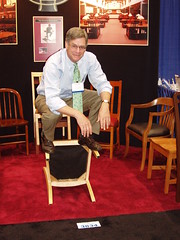
This is Frederic G. Eustis, the president of Eustis Enterprises Inc., one of the small booth exhibitors at ALA in Chicago, demonstrating how strong his chairs are. When I noticed him, he was bouncing on the legs, telling a librarian about his chairs. He really believes in them. He told me later that he has slipped and slightly injured himself doing these demonstrations, but the chairs do not break. I hope we can discourage people from doing this in our libraries.
Thoughts on the American Library Association Annual Conference
The American Library Association Annual Conference returned to Chicago this year. I enjoyed attending programs and wandering through the exhibits, as I always do. I collected some new ideas about library buildings and services, discovered a few new reference resources, identified some new books to read, and heard several authors speak, so it was a successful conference for me. Still, I would like to offer a critique.
Registration was curiously inconvenient. Instead of being in one of the wide open areas of McCormick Place, somewhere close to where attendees entered the building, it was way, way down a long hall and up an escalator in an area that was not really adequate for the numbers of people who lined up to register. It was also time consuming for those who had pre-registered because the association wanted to look at everyone’s ID and swipe their electronic card. No one could get a badge holder and conference packet without going through the process. Because there were only six stations and thousands of people checking in, the lines got very long. I spoke to one friend who waited in line for an hour and a half to get the badge holder and conference guides. Security had to block the entrance to the registration area at times to control the numbers, which also blocked one entrance to the exhibits.
The small Conference-at-a-Glance: A Guide to Programs and Events was the only guide I found that had all events at one time listed together. Everything else (print and online) divided the programs into tracks. Because it was hard to know the track of a program from looking at Conference-at-a-Glance, it was hard finding the description in the Program Guide. Referring page numbers would have helped.
I live in the Chicago suburbs, know lots of area librarians, and the conference had high attendance, over 25,000. Why did I see few people that I knew?
McCormick Place has some great public spaces with pretty stone surfaces and public art, but I wish it were closer to downtown Chicago. I would enjoy dashing out of the conference center to get tastier food than was offered on site. Also, I would have liked to go to a program at a hotel and still been able to get back to the conference center for the next program on time. I just stayed at McCormick Place, as did some other librarians with whom I spoke. I wonder how well attended were the programs in hotels. Were there librarians who just attended programs in hotels and never got to McCormick Place?
I liked that there was a shortcut escalator from the exhibits to the meeting rooms on the fourth level.
I enjoyed seeing the authors on the Live @ the Library stage in the back of the exhibit hall, but some were hard to hear over the roar from the exhibit hall. It reminded me of being at the Chicago Botanical Gardens, where the flowers and landscaping are beautiful but the constant roar of trucks on the Edens Expressway lessens the experience. Can these author presentations be near the exhibits in a quieter place in the future?
I really did enjoy the conference, as my other blog entries attest. I still have a couple of reports coming. I look forward now to the LITA Forum in San Jose at the end of September.
Visit rickindex to find ricklibrarian reviews of books, movies, music, and the Internet.
Registration was curiously inconvenient. Instead of being in one of the wide open areas of McCormick Place, somewhere close to where attendees entered the building, it was way, way down a long hall and up an escalator in an area that was not really adequate for the numbers of people who lined up to register. It was also time consuming for those who had pre-registered because the association wanted to look at everyone’s ID and swipe their electronic card. No one could get a badge holder and conference packet without going through the process. Because there were only six stations and thousands of people checking in, the lines got very long. I spoke to one friend who waited in line for an hour and a half to get the badge holder and conference guides. Security had to block the entrance to the registration area at times to control the numbers, which also blocked one entrance to the exhibits.
The small Conference-at-a-Glance: A Guide to Programs and Events was the only guide I found that had all events at one time listed together. Everything else (print and online) divided the programs into tracks. Because it was hard to know the track of a program from looking at Conference-at-a-Glance, it was hard finding the description in the Program Guide. Referring page numbers would have helped.
I live in the Chicago suburbs, know lots of area librarians, and the conference had high attendance, over 25,000. Why did I see few people that I knew?
McCormick Place has some great public spaces with pretty stone surfaces and public art, but I wish it were closer to downtown Chicago. I would enjoy dashing out of the conference center to get tastier food than was offered on site. Also, I would have liked to go to a program at a hotel and still been able to get back to the conference center for the next program on time. I just stayed at McCormick Place, as did some other librarians with whom I spoke. I wonder how well attended were the programs in hotels. Were there librarians who just attended programs in hotels and never got to McCormick Place?
I liked that there was a shortcut escalator from the exhibits to the meeting rooms on the fourth level.
I enjoyed seeing the authors on the Live @ the Library stage in the back of the exhibit hall, but some were hard to hear over the roar from the exhibit hall. It reminded me of being at the Chicago Botanical Gardens, where the flowers and landscaping are beautiful but the constant roar of trucks on the Edens Expressway lessens the experience. Can these author presentations be near the exhibits in a quieter place in the future?
I really did enjoy the conference, as my other blog entries attest. I still have a couple of reports coming. I look forward now to the LITA Forum in San Jose at the end of September.
Visit rickindex to find ricklibrarian reviews of books, movies, music, and the Internet.
Tuesday, June 28, 2005
One Book, One Community: A Look at the Future of This Growing Trend
Nanette Alleman of Chicago Public Library shared very practical advice about the creation and management of community-wide reading programs, such as the One Book, One Chicago, as the first presenter at the
Working with a publisher has advantages, especially providing a contact with the author. The publisher can also provide study guides and may even help design brochures and advertising.
Perrault recommended shorter books that would appeal to teens when possible. He also thought one of the best publicity vehicles that he has seen were paper tray liners at McDonalds.The author recommended chosing well written books that are available in various formats (large print, audio) with living authors who can come. He also said that it helps to choose books that “stir people up,” as they lead to the best discussions. He believes that reading programs help communities discover themselves through discussions.
Haruf recommended that librarians know what they wish authors to do before they contact them. On one occasion he became involved with a program were the role he was asked to play kept changing. This is not fair to the authors who are in many cases volunteering their time. Do not expect authors to just volunteer. Some do want to be paid.
He has found participating in the programs very rewarding and has enjoyed meeting his readers.
Juli Janovicz of the Winnetka-Northfield Public Library (
Winnetka-Northfield chooses two books for each program, one for adults and one for children. One of the most successful events was a brunch with an author.
David Stone of the National Endowment for the Arts announced that his agency will be offering ten $30,000 grants for community reading programs for 2006. Details for this three year effort should be announced formerly soon. In the first year, only single city programs will be funded. In year two, the agency expects to offer 100 grants (smaller amounts) and will consider regional and state programs. In the third year, it hopes to offer 1000 grants.
Monday, June 27, 2005
The Creators of Unshelved
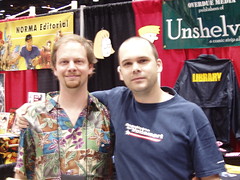
Some of the authors signing books in the exhibits hall at the American Library Association conference in Chicago were scheduled for an hour. Bill Barnes and Gene Ambaun had their own Unshelved booth (with all the graphic novels) and were signing and talking all day, Saturday through Tuesday. You can find Unshelved on the web at www.overduemedia.com.
Reference Interactions in the Digital Age: Revising the RUSA Behavioral Guidelines
My report on Reference Interactions in the Digital Age: Revising the RUSA Behavioral Guidelines, a RUSA program held on Sunday, is posted on the LITA blog. It was a long two hours and poorly attended. Much more was said about remote reference and roving than about the topics of staff training and evaluation. Still, there were some very interesting comments about the directions reference services are going.
Knowledge for Sale: An Article in the July-August 2005 Utne
This has no direct connection to the annual conference of the American Library Association, but the July-August issue of Utne has a five page article on the state of the public library in the United States. Look on page 73 or click here if you have Adobe Reader. The author Chris Dodge (who worked for Sandford Berman) expresses deep concerns about how the economic and political world is forcing public libraries to adjust to mainstream culture at the express of alternative culture. This is essential reading for librarian and library lovers.
Dodge, Chris. "Knowledge for Sale: Are America's Public Libraries on the Verge of Losing Their Way?" Utne, July-August 2005, pages 73-77.
Dodge, Chris. "Knowledge for Sale: Are America's Public Libraries on the Verge of Losing Their Way?" Utne, July-August 2005, pages 73-77.
Taking the Guesswork Out of Nonfiction Readers' Advisory
“The renaissance of readers’ advisory services in public libraries is spilling over to narrative nonfiction,” according the Robert Burgin, Professor at North Carolina University's School of Library and Information Sciences and editor of Nonfiction Readers’ Advisory. Burgin spoke to an overflow crowd of librarians on Sunday morning at the RUSA program Taking the Guesswork Out of Nonfiction Readers’ Advisory.
Burgin presented twelve reasons to do nonfiction readers’ advisory in libraries.
1. Many people read nonfiction books. On average one third of adult library circulation of books is nonfiction. Best seller lists on the Amazon website always include many nonfiction titles. Look right now and you will see 1776, Freakonomics, The World is Flat, and You: The Owner’s Manual at the top of the list.
2. People read nonfiction for pleasure. Burgin read Into Thin Air with no intention of climbing mountains. Many narrative nonfiction books have exciting, compelling stories. A reader’s interest in a subject, say Japan or the Civil War, can be more important than whether a book is fiction or nonfiction.
3. The distinction between fiction and nonfiction can be blurry. Some fiction includes much factual material, while some nonfiction authors have speculated on truth in their books. Some nonfiction authors change personal names, story locations, and incident facts to protect people involved in the story.
4. Nonfiction has genres and subgenres, just like fiction. Later in the program the audience was divided into discussion groups to identify many of these.
5. There are fiction and nonfiction read-a-likes. Readers who enjoy Western novels might also like books about the West. Someone who enjoyed the baseball history Eight Men Out might enjoy the novel Shoeless Joe.
6. Historically most readers’ advisory was recommending nonfiction. In the early twentieth century libraries were central to the self-improvement movement and found books on nonfiction topics for readers.
7. Some readers like to read what others read. It does not matter whether the books were fiction or nonfiction.
8. The readers’ advisory transaction is the same for nonfiction as fiction. Librarians ask what books readers enjoy and try to recommend other books. If people enjoy Bill Bryson’s travel stories, they might also enjoy Tim Cahill’s books.
9. Nonfiction books have all the appealing qualities readers enjoy in fiction: good storylines, interesting characters, unfamiliar places, drama, and mystery. Even dictionaries and cookbooks can appeal factors.
10. The lessons we learn in nonfiction readers’ advisory can be applied back to fiction readers’ advisory.
11. Improving our nonfiction readers’ advisory skills improves our reference skills.
12. Providing nonfiction readers’ advisory gives us insights for improving our reference tools.
After Burgin’s presentation, the audience (already sitting at round banquet tables) discussed nonfiction genres. My table discussed the sports story genre. Other tables covered spiritual memoirs, narrative science, political stories, historical narratives, humor, biography, immigration stories, true adventure, cooking, travel, and memoirs. In the table reports, “vicarious experience” was often reported as a reason readers like nonfiction.
The results of the discussions will be posted at the RUSA/CODES website.
After the discussions and reports, Neal Wyatt of Chesterfield County Public Library, Virginia, who writes for Library Journal and Booklist, presented practical tips for nonfiction readers’ advisory. She insisted that we have to read nonfiction to advise well. She recommended writing annotations of everything we read, listening to book programs on radio and television, and looking for appeal terms in the book reviews that we read. She said that a good way to start making nonfiction genre lists is to take award book lists and divide them into categories. She also recommended making book displays that mix fiction and nonfiction. Finally, she described creating reading maps that show how books in many fields connect.
Burgin, Robert, ed. Nonfiction Readers’ Advisory. Libraries Unlimited, 2004. ISBN 159158115X
Burgin presented twelve reasons to do nonfiction readers’ advisory in libraries.
1. Many people read nonfiction books. On average one third of adult library circulation of books is nonfiction. Best seller lists on the Amazon website always include many nonfiction titles. Look right now and you will see 1776, Freakonomics, The World is Flat, and You: The Owner’s Manual at the top of the list.
2. People read nonfiction for pleasure. Burgin read Into Thin Air with no intention of climbing mountains. Many narrative nonfiction books have exciting, compelling stories. A reader’s interest in a subject, say Japan or the Civil War, can be more important than whether a book is fiction or nonfiction.
3. The distinction between fiction and nonfiction can be blurry. Some fiction includes much factual material, while some nonfiction authors have speculated on truth in their books. Some nonfiction authors change personal names, story locations, and incident facts to protect people involved in the story.
4. Nonfiction has genres and subgenres, just like fiction. Later in the program the audience was divided into discussion groups to identify many of these.
5. There are fiction and nonfiction read-a-likes. Readers who enjoy Western novels might also like books about the West. Someone who enjoyed the baseball history Eight Men Out might enjoy the novel Shoeless Joe.
6. Historically most readers’ advisory was recommending nonfiction. In the early twentieth century libraries were central to the self-improvement movement and found books on nonfiction topics for readers.
7. Some readers like to read what others read. It does not matter whether the books were fiction or nonfiction.
8. The readers’ advisory transaction is the same for nonfiction as fiction. Librarians ask what books readers enjoy and try to recommend other books. If people enjoy Bill Bryson’s travel stories, they might also enjoy Tim Cahill’s books.
9. Nonfiction books have all the appealing qualities readers enjoy in fiction: good storylines, interesting characters, unfamiliar places, drama, and mystery. Even dictionaries and cookbooks can appeal factors.
10. The lessons we learn in nonfiction readers’ advisory can be applied back to fiction readers’ advisory.
11. Improving our nonfiction readers’ advisory skills improves our reference skills.
12. Providing nonfiction readers’ advisory gives us insights for improving our reference tools.
After Burgin’s presentation, the audience (already sitting at round banquet tables) discussed nonfiction genres. My table discussed the sports story genre. Other tables covered spiritual memoirs, narrative science, political stories, historical narratives, humor, biography, immigration stories, true adventure, cooking, travel, and memoirs. In the table reports, “vicarious experience” was often reported as a reason readers like nonfiction.
The results of the discussions will be posted at the RUSA/CODES website.
After the discussions and reports, Neal Wyatt of Chesterfield County Public Library, Virginia, who writes for Library Journal and Booklist, presented practical tips for nonfiction readers’ advisory. She insisted that we have to read nonfiction to advise well. She recommended writing annotations of everything we read, listening to book programs on radio and television, and looking for appeal terms in the book reviews that we read. She said that a good way to start making nonfiction genre lists is to take award book lists and divide them into categories. She also recommended making book displays that mix fiction and nonfiction. Finally, she described creating reading maps that show how books in many fields connect.
Burgin, Robert, ed. Nonfiction Readers’ Advisory. Libraries Unlimited, 2004. ISBN 159158115X
Sunday, June 26, 2005
What is this man doing at ALA?
I am still writing my reports for the programs that I attended at the American Library Association Annual Conference in Chicago. There were several really interesting sessions. I posted one about the reference behavior guidelines meeting today at litablog.org, but the rest will be here at ricklibrarian. I will also explain what this man in doing to his chair. Come back in a couple of days.
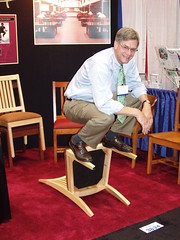
Chitra Divakaruni: Live @ Your Library
Born in Calcutta, Chitra Divakaruni (author of Sister of My Heart and other books) came to Chicago twenty-five years ago to attend graduate school, just in time to get stranded when her family’s wealth failed. She took a job in a shop in a mall and tried to save every penny possible for her education. She would not even spend forty-five cents for an ice cream cone because it would set slow her savings. One evening as she was walking home, she decided to enter the local library to read. When she asked the librarian how many books she could borrow, she said “Honey, you can take as many books as you can carry.” In Calcutta, the limit had been two at a time. She said this was turning point. For the first time she felt she belonged in America.
Divakaruni read two excerpts from her new book Queen of Dreams, which features a secretive mother and her daughter, who spies on her. Like most of her writings, the author writes about the struggles of immigrant women.
I heard Divakaruni at the Live @ Your Library stage in the back of the exhibit hall at the American Library Association Annual Conference in Chicago. The ALA Public Programs Office sponsors the stage on which authors read every thirty minutes. Divakaruni was followed by Elizabeth Berg and Kent Haruf. Today I hope to hear U. S. Poet Laureate Ted Kooser.
Divakaruni read two excerpts from her new book Queen of Dreams, which features a secretive mother and her daughter, who spies on her. Like most of her writings, the author writes about the struggles of immigrant women.
I heard Divakaruni at the Live @ Your Library stage in the back of the exhibit hall at the American Library Association Annual Conference in Chicago. The ALA Public Programs Office sponsors the stage on which authors read every thirty minutes. Divakaruni was followed by Elizabeth Berg and Kent Haruf. Today I hope to hear U. S. Poet Laureate Ted Kooser.
Saturday, June 25, 2005
Diagram of McCormick Place South
The American Library Association Conference is on many levels of the McCormick Place conference center and in hotels across downtoen Chicago. Maps are essential.
The ALA Conference in Chicago Begins
The American Library Association Annual Conference has begun, and I attended my first day of meetings. It was a very hot day in Chicago, and the power had been out over night in the convention center, so it was warm inside too at the beginning of the day. The air did soon kick in and I saw people in sweater by day's end.
In the next few days, I will post reports on many of the meetings I attend either here or on the LITA blog. The LITA blog has already posted a list of my technology trends.
I started the day at Changing Technology/Changing Services/Changing Design, a program sponsored by LAMA, the Library Administration and Management Association. You can read this report on the LITA blog, but I do have a few additional comments.
The Queens Public Library must have a lot of public support. It is starting many very ambitious projects, including a really cool children’s library that includes displays from four museums mixed in with the books and other library materials. I also am impressed by the effort the library is making to go out to the unserved, putting mini-branches in many train stations, retail and residential developments, and the museums.
Some of the branch libraries in Queens with RFID (radio-frequency identification in library materials) and self-checkout stations were smaller than my small public library.
I was also struck by how there were no squared corners in any of the furniture shown by the architects Jeffrey Hoover and Elizabeth Martin. Everything was rounded. The idea was that the interior design in the library would flow.
Several speakers mentioned the library as a “third place.” If a person’s home is first, and the library is third, what is second?
Look for my reports on One Book, One Community and Hear Here – Audiobook Trends in Libraries on this site soon.
In the next few days, I will post reports on many of the meetings I attend either here or on the LITA blog. The LITA blog has already posted a list of my technology trends.
I started the day at Changing Technology/Changing Services/Changing Design, a program sponsored by LAMA, the Library Administration and Management Association. You can read this report on the LITA blog, but I do have a few additional comments.
The Queens Public Library must have a lot of public support. It is starting many very ambitious projects, including a really cool children’s library that includes displays from four museums mixed in with the books and other library materials. I also am impressed by the effort the library is making to go out to the unserved, putting mini-branches in many train stations, retail and residential developments, and the museums.
Some of the branch libraries in Queens with RFID (radio-frequency identification in library materials) and self-checkout stations were smaller than my small public library.
I was also struck by how there were no squared corners in any of the furniture shown by the architects Jeffrey Hoover and Elizabeth Martin. Everything was rounded. The idea was that the interior design in the library would flow.
Several speakers mentioned the library as a “third place.” If a person’s home is first, and the library is third, what is second?
Look for my reports on One Book, One Community and Hear Here – Audiobook Trends in Libraries on this site soon.
Thursday, June 23, 2005
Summer Reading Advice from National Public Radio
National Public Radio has been featuring advice for summer reading on several of its programs recently. For fans awaiting the next Harry Potter book, Seattle librarian Nancy Pearl has been on Morning Edition recommending adventure books that both young and old readers will enjoy. Alan Cheuse has been commenting on fiction, short stories, poetry, and nonfiction on All Things Considered. Long time anchor Susan Stanberg has admitted that she is now reading “bodice rippers,” and foreign correspondent Alan Watson has discussed comic books. Critics from Talk of the Nation and listeners of all the programs have been submitting recommendations.
NPR is posting all this summer reading advice at its website Summer Reading 2005. For the website, food blogger Heidi Swanson lists new cookbooks and John Kelly, founding editor of KidsPost at the Washington Post, recommends “A Cure for Kids’ Summer Reading Doldrums.” There are ideas for nearly any reader. Be ready to make your own list.
NPR is posting all this summer reading advice at its website Summer Reading 2005. For the website, food blogger Heidi Swanson lists new cookbooks and John Kelly, founding editor of KidsPost at the Washington Post, recommends “A Cure for Kids’ Summer Reading Doldrums.” There are ideas for nearly any reader. Be ready to make your own list.
Tuesday, June 21, 2005
Thinking Beyond Our Own Web Pages
LITA launched its new blog last week, just in time to allow volunteers from the organization to blog the ALA conference in Chicago. It can be found at litablog.org. So far, there are three entries, including one titled "Eric Lease Morgan's Top Technology Trends, 2005."
Morgan's fifth trend is as follows:
5. You can decreasingly expect people to come to your website for content.Instead, explore ways to integrate your content and services into the working environments of your patrons.
I can give evidence to this trend already in a small way. On most days, especially the last couple of weeks, more people read my blog via Bloglines than actually visit this website.
This is not true of my library’s website as yet. Our news feed can be picked up through Bloglines, but our public does not seem to have discovered this. (I know because there is a subscriber count on Bloglines feeds.) We could tell them. They would see all our new content posted to all our pages if they had our feed. I use Bloglines to watch what is added to our library's website.
I did not realize it, but we are starting to integrate into other environments, too. We have placed links to our reference instant messaging onto our local historical society’s website. Perhaps we should put links to our databases onto the village government website. Users would still have to enter their library card numbers. It might increase our service to the community. Maybe there are other ways for us to send our library out onto other websites so we can be found.
Look for book, movie, music, and cyberspace reviews at rickindex.
Morgan's fifth trend is as follows:
5. You can decreasingly expect people to come to your website for content.Instead, explore ways to integrate your content and services into the working environments of your patrons.
I can give evidence to this trend already in a small way. On most days, especially the last couple of weeks, more people read my blog via Bloglines than actually visit this website.
This is not true of my library’s website as yet. Our news feed can be picked up through Bloglines, but our public does not seem to have discovered this. (I know because there is a subscriber count on Bloglines feeds.) We could tell them. They would see all our new content posted to all our pages if they had our feed. I use Bloglines to watch what is added to our library's website.
I did not realize it, but we are starting to integrate into other environments, too. We have placed links to our reference instant messaging onto our local historical society’s website. Perhaps we should put links to our databases onto the village government website. Users would still have to enter their library card numbers. It might increase our service to the community. Maybe there are other ways for us to send our library out onto other websites so we can be found.
Look for book, movie, music, and cyberspace reviews at rickindex.
Monday, June 20, 2005
Central Michigan Avenue
Many librarians attending the American Library Association Annual Conference in Chicago later this week will be staying in hotels along Michigan Avenue. As they walk to their meetings, they will pass much architectural history. Should they want to know more, they can stop in the Chicago Architecture Foundation at 224 South Michigan Avenue. Known originally as the Railway Exchange Building, 224 South Michigan was designed by Frederick Dinkelberg of D. H. Burnham and Company and completed in 1904. Inside the store are many books on Chicago Architecture. They may also buy tickets for architecture tours.
One good book choice is Central Michigan Avenue by Ellen Christensen and the Chicago Architecture Foundation, which includes history and many photos of the avenue and Grant Park dating from the early 1860s to 2003. Being moderately light, it is easy to carry around town and will fit well in carry-on luggage. An index would have made the book more useful for sightseers. All the buildings from the Sherwood Conservatory of Music to the Chicago Cultural Center are identified on pages 6 and 7 and are shown in color photos in the final chapter.
Christensen, Ellen. Central Michigan Avenue. Chicago, Ill.: Arcadia, c2003. ISBN 0738520241
Go to rickindex for more book, movie, music, and Internet reviews.
One good book choice is Central Michigan Avenue by Ellen Christensen and the Chicago Architecture Foundation, which includes history and many photos of the avenue and Grant Park dating from the early 1860s to 2003. Being moderately light, it is easy to carry around town and will fit well in carry-on luggage. An index would have made the book more useful for sightseers. All the buildings from the Sherwood Conservatory of Music to the Chicago Cultural Center are identified on pages 6 and 7 and are shown in color photos in the final chapter.
Christensen, Ellen. Central Michigan Avenue. Chicago, Ill.: Arcadia, c2003. ISBN 0738520241
Go to rickindex for more book, movie, music, and Internet reviews.
Sunday, June 19, 2005
The Young Visiters, or Mr. Salteena's Plan
Bonnie often brings home wonderful surprises from the Downers Grove Public Library. Last night it was the DVD of The Young Visiters. The spelling is correct, or at least that is the way that nine-year-old Daisy Ashford spelled the title of her first novel in 1890, when she wrote the book in twelve days and presented it to her parents. The manuscript stayed in the family until 1919, when it was discovered and published with Daisy’s spelling. According to the narrator, the book has never been out of print.
There was a time a few years ago that Jim Broadbent was in nearly every Masterpiece Theater and British film that we saw. I first remember noticing him in Mike Leigh’s Life is Sweet, in which he played an out-of-work cook who buys a broken down lunch wagon with a ne’er-do-well friend. Enchanted April, The Crying Game, Topsy-Turvy, and Moulin Rouge are just a few of his many movies. In The Young Visiters he plays “an elderly man of 42” named Alfred Salteena, who wishes to marry the young Ethel Monticue, played by Lyndsey Marshal, whom he meets on a train. To win her heart, he promises to introduce her to English lords and ladies, a foolish promise for a lonely ironmonger to make. His one upper crust acquaintance is Lord Bernard Clark, played by Hugh Laurie. If you know Broadbent and Laurie, you know to expect some silliness. The scene in which the unmannerly Mr. Salteena tries to eat lobster is hilarious.
Broadbent is quoted on the BBC Drama on TV website as saying the author Daisy Ashford was “startlingly perceptive” for a nine year old. I now want to read the book.
If you have not heard of The Young Visiters, which Broadbent produced it for BBC Television, you are not alone. It was shown on BBC America, but our SWAN catalog shows that few libraries own the book or the DVD. I just ordered the book and will ask Aaron to order the DVD for my library. I know a lot of people who will enjoy it.
Ashford, Daisy. The Young Visiters, or Mr. Salteena’s Plan. Chicago, Ill.: Academy Chicago Publishers, 1991. ISBN 0897333659
The Young Visiters, or Mr. Salteena’s Plan. BBC Video, 2004. ISBN 0790717476
There was a time a few years ago that Jim Broadbent was in nearly every Masterpiece Theater and British film that we saw. I first remember noticing him in Mike Leigh’s Life is Sweet, in which he played an out-of-work cook who buys a broken down lunch wagon with a ne’er-do-well friend. Enchanted April, The Crying Game, Topsy-Turvy, and Moulin Rouge are just a few of his many movies. In The Young Visiters he plays “an elderly man of 42” named Alfred Salteena, who wishes to marry the young Ethel Monticue, played by Lyndsey Marshal, whom he meets on a train. To win her heart, he promises to introduce her to English lords and ladies, a foolish promise for a lonely ironmonger to make. His one upper crust acquaintance is Lord Bernard Clark, played by Hugh Laurie. If you know Broadbent and Laurie, you know to expect some silliness. The scene in which the unmannerly Mr. Salteena tries to eat lobster is hilarious.
Broadbent is quoted on the BBC Drama on TV website as saying the author Daisy Ashford was “startlingly perceptive” for a nine year old. I now want to read the book.
If you have not heard of The Young Visiters, which Broadbent produced it for BBC Television, you are not alone. It was shown on BBC America, but our SWAN catalog shows that few libraries own the book or the DVD. I just ordered the book and will ask Aaron to order the DVD for my library. I know a lot of people who will enjoy it.
Ashford, Daisy. The Young Visiters, or Mr. Salteena’s Plan. Chicago, Ill.: Academy Chicago Publishers, 1991. ISBN 0897333659
The Young Visiters, or Mr. Salteena’s Plan. BBC Video, 2004. ISBN 0790717476
Friday, June 17, 2005
The Fish Can Sing by Halldor Laxness
I enjoy a novel with a sense of place, especially if that place is strange to me. In The Fish Can Sing by Halldor Laxness, the setting is Iceland in the early years of the twentieth century, a time when farmers are burning peat and dung and the citizens of the capital Reykjavik are heating and cooking with coal and whale oil. The merchants and government officials, the latter were all appointed by the Danes, aspire to modernize and put the island in the European mainstream economically and culturally. Some even want independence from Denmark. Naturally, they have great pride in their internationally renowned opera singer, who never actually sings when he visits his homeland.
The central character in The Fish Can Sing is Alfgrimur, who is abandoned by his mother and raised by an older couple who operate a boarding house full of unusual people. His adoptive grandfather is a fisherman with his own sense of economic values unfazed by the rules of supply and demand. His prices never change. His regular customers buy his fish when they are both the cheapest and the most expensive at the market because he is considered always fair and honest. He teaches the boy his immovable beliefs, including that a Bible is worth a cow.
Alfgrimur is asked by Pastor Snorri to sing at funerals for the poor, for which he is paid a few coins. Add these to the coins that the kind people outside the capital give him because he is a good orphan and he is always able to buy a few cream cakes. He is sent to school and some of the adults who watch him grow hope that he too will become an opera singer for the glory of Iceland.
I can imagine The Fish Can Sing as a small budget foreign film with subtitles and no special effects or background music. Only patient viewers will appreciate the slow unwinding of the plot, which does have some big surprises. Until the movie is made, look for this book at your library. It may have to be borrowed through interlibrary loan.
Laxness, Halldor. The Fish Can Sing. Translated from the Icelandic by Magnus Magnusson. London: Harville Press, 1966. ISBN 1860466877
The central character in The Fish Can Sing is Alfgrimur, who is abandoned by his mother and raised by an older couple who operate a boarding house full of unusual people. His adoptive grandfather is a fisherman with his own sense of economic values unfazed by the rules of supply and demand. His prices never change. His regular customers buy his fish when they are both the cheapest and the most expensive at the market because he is considered always fair and honest. He teaches the boy his immovable beliefs, including that a Bible is worth a cow.
Alfgrimur is asked by Pastor Snorri to sing at funerals for the poor, for which he is paid a few coins. Add these to the coins that the kind people outside the capital give him because he is a good orphan and he is always able to buy a few cream cakes. He is sent to school and some of the adults who watch him grow hope that he too will become an opera singer for the glory of Iceland.
I can imagine The Fish Can Sing as a small budget foreign film with subtitles and no special effects or background music. Only patient viewers will appreciate the slow unwinding of the plot, which does have some big surprises. Until the movie is made, look for this book at your library. It may have to be borrowed through interlibrary loan.
Laxness, Halldor. The Fish Can Sing. Translated from the Icelandic by Magnus Magnusson. London: Harville Press, 1966. ISBN 1860466877
Tuesday, June 14, 2005
Chicago Cultural Center
Visitors coming to Chicago for the American Library Association Annual Conference will want to wander around the city to see great buildings, including the old Chicago Public Library. Click on the photo to find more photos of the city.
Advice to the hungry. Get your fast food before 10:00 p.m. Most of the eating places in downtown close by then.
Advice to the hungry. Get your fast food before 10:00 p.m. Most of the eating places in downtown close by then.
Monday, June 13, 2005
Examples of Corporate Thinking: A Danger to Libraries
I have been reading some newspaper articles that I find disturbing/ridiculous. One was “Weather Service Braces for Storm” by Dawn Withers in the May 29 issue of the Chicago Tribune, section 1, page 11. Senator Rick Santorum, a Republican from Pennsylvania, wants much of the information that the National Weather Service produces to go only to private weather services, who can then sell that information to media outlets. There is no question whether the National Weather Service is doing a good job. It is doing a great job. Many people go directly to its website for weather. Santorum thinks the government agency should stop public reporting of weather for the sake of the private weather services and is pushing a bill to aid his corporation friends. It does not matter to him that the American public pays for the National Weather Service in the first place. For him, it is corporate business first.
“Debate Sizzles on the Wiring of U.S. Towns - Telecommunications Firms like SBC and Verizon Want to Pull the Plug on Municipal Networks” by Leon Razaloff from the Friday, May 27 issue of the Chicago Tribune, section 1, page 8 has similar thinking. Municipal governments have been getting into broadband Internet access business. The reason in many of the rural communities is that the commercial companies have ignored them, saying that it is not cost effective to take broadband into these area. Forward thinking people in rural government, thinking of their local businesses, schools, and themselves, have created their own broadband networks. The corporations are now crying “fowl” and claiming their profits are threatened by these local initiatives. They are asking legislatures in states throughout the country to shutdown the municipal broadband services. Their many lobbyists are very busy and the legislators are listening to them.
People who love public libraries should find both of these stories disturbing. It does not take a very big stretch to apply this corporate thinking to public library services. Having a couple of dozen people read a bestseller threatens corporate publishing. Subscriptions to magazines and newspapers threaten corporation profits. Having free wireless threatens commercial Internet providers. Forget that the libraries do pay for these books, periodicals, and Internet service. Corporations are threatened.
There is evidence of this thinking already. Bob Brinker will not sell his investment newsletter to public libraries; he does not want to miss a single sale. Also, some publishers are reluctant to sell e-books to vendors that sell to public libraries, which might share them more than they would like.
People do still support public libraries. Most politicians still claim to agree, but people who love libraries should keep their eyes on them. Their corporate friends might suggest legislation to help their profits. Librarians must watch the news, lobby the legislators, and speak out for similar causes.
Go to rickindex to find book, music, and movie reviews.
“Debate Sizzles on the Wiring of U.S. Towns - Telecommunications Firms like SBC and Verizon Want to Pull the Plug on Municipal Networks” by Leon Razaloff from the Friday, May 27 issue of the Chicago Tribune, section 1, page 8 has similar thinking. Municipal governments have been getting into broadband Internet access business. The reason in many of the rural communities is that the commercial companies have ignored them, saying that it is not cost effective to take broadband into these area. Forward thinking people in rural government, thinking of their local businesses, schools, and themselves, have created their own broadband networks. The corporations are now crying “fowl” and claiming their profits are threatened by these local initiatives. They are asking legislatures in states throughout the country to shutdown the municipal broadband services. Their many lobbyists are very busy and the legislators are listening to them.
People who love public libraries should find both of these stories disturbing. It does not take a very big stretch to apply this corporate thinking to public library services. Having a couple of dozen people read a bestseller threatens corporate publishing. Subscriptions to magazines and newspapers threaten corporation profits. Having free wireless threatens commercial Internet providers. Forget that the libraries do pay for these books, periodicals, and Internet service. Corporations are threatened.
There is evidence of this thinking already. Bob Brinker will not sell his investment newsletter to public libraries; he does not want to miss a single sale. Also, some publishers are reluctant to sell e-books to vendors that sell to public libraries, which might share them more than they would like.
People do still support public libraries. Most politicians still claim to agree, but people who love libraries should keep their eyes on them. Their corporate friends might suggest legislation to help their profits. Librarians must watch the news, lobby the legislators, and speak out for similar causes.
Go to rickindex to find book, music, and movie reviews.
Sunday, June 12, 2005
Blogging the ALA National Conference
I'm looking at a calendar and I see that the big ALA conference in Chicago is only two weeks away. I will be there with thousands of other librarians. I hope you will be too, if you are so inclined, but if you are far away, you can still follow the action through blogs. No longer will you have to wait a couple of months for the delivery of American Libraries and Library Journal to read about the conference. Many bloggers are anxious to tell you right away, if you can just find their blogs.
Meredith Farkas has come to the rescue and has started a list of conference bloggers that is growing daily. I recommend checking out the blogger now to get a sense of who they are and which might cover the topics that interest you. You will see a good cross section of the library world represented in these blogs. Several of the blogs are joint efforts still seeking volunteer reporters, including the PLA blog. Here is your opportunity. I have an assignment for LITA blog and will report here as well. Enjoy the conference from near or far.
Meredith Farkas has come to the rescue and has started a list of conference bloggers that is growing daily. I recommend checking out the blogger now to get a sense of who they are and which might cover the topics that interest you. You will see a good cross section of the library world represented in these blogs. Several of the blogs are joint efforts still seeking volunteer reporters, including the PLA blog. Here is your opportunity. I have an assignment for LITA blog and will report here as well. Enjoy the conference from near or far.
Friday, June 10, 2005
Aaron Has a New Bike That Is Old
Aaron has an old bicycle that is new. It is a 1971 Schwinn Collegiate and it is new to him. Also, he put a lot of work into restoring it, so it looks like new. I saw it the other day and was quite impressed. It is wonderful to see something older getting attention in this everything-has-got-to-be-new world. I enjoyed seeing him ride away on a bike that is older than he is.
Sometimes when I am weeding our book collection, I come upon older books that are looking a little dull on the outside but still look pretty good on the inside. It may be that the plastic on the jacket is cloudy or torn, but the book itself is in good shape. If the content is still of interest and the scholarship is not antiquated, especially art and history books, I will ask Susan or Beth in the technical services department in our library to replace the plastic cover. Like Aaron, they do nice work. The old book comes back to me looking bright and shiny. If possible, I like to put these books out where our readers can see them. They often look a little different than the books that really are new, but they look good. They look like someone cares for the books. I enjoy it when I see readers taking them home.

Sometimes when I am weeding our book collection, I come upon older books that are looking a little dull on the outside but still look pretty good on the inside. It may be that the plastic on the jacket is cloudy or torn, but the book itself is in good shape. If the content is still of interest and the scholarship is not antiquated, especially art and history books, I will ask Susan or Beth in the technical services department in our library to replace the plastic cover. Like Aaron, they do nice work. The old book comes back to me looking bright and shiny. If possible, I like to put these books out where our readers can see them. They often look a little different than the books that really are new, but they look good. They look like someone cares for the books. I enjoy it when I see readers taking them home.
Thursday, June 09, 2005
ReadThisNow in Ohio: Virtual Reference for Readers' Advisory
At yesterday’s Zone 1-4 Reference Librarians Meeting at the Indian Prairie Public Library in Darien, Illinois, we discussed the successes of MyWebLibrarian and what libraries in the Metropolitan Library System should be doing about virtual reference. I mentioned that one area of virtual reference that we are not promoting much in
Tracy Strobel and Richard Fox from the Cleveland Public Library then spoke about Clevnet’s ReadThisNow service (which appears to have now gone statewide) which is a readers’ advisory spin off from the library system’s KnowItNow24X7 virtual reference service. The speakers said that the idea for ReadThisNow came from the library director, and that the reference librarians on the general virtual reference service, who felt that they did not handle readers’ advisory questions well, welcomed the idea. This service, which launched in July 2003, has three components. First is live chat readers’ advisory service. The second component is a menu of reading lists grouped by genre (much like the lists at Fiction_L created by the Reader's Service staff of the Morton Grove Public Library). The third is “Book Tracker,” an online reading management system readers can use to record books that they have read and keep wish lists with links to the library catalog.
I spoke briefly with Joyce Saricks (who is famous in the arena of readers’ advisory) after this presentation. She thought that our area libraries should also be starting virtual readers’ advisory services. Some of us are members of MyWebLibrarian, which has the Tutor.com platform which Clevnet uses. We also have the human and intellectual resources of the Adult Reading Round Table. We should look at this is
Tuesday, June 07, 2005
London: A History by A. N. Wilson
In London: A History, A. N. Wilson presents a condensed history of a city that he knows very well. Beginning as an outpost of the Roman Empire around 50 A.D., London has a long history difficult to squeeze into 221 pages or roughly 5 and ¾ hours worth of audiobook, and this book may not satisfy a reader wanting a detailed chronicle of the city. Wilson admits as much in his introduction, calling his book an arbitrary account, his view of the social and architectural events that have built the city.
I chose the audiobook for listening during gardening, which worked well for me, as I enjoyed the flowing narration very much. The reader is Christopher Kay, who is an actor and singer with experience announcing for British radio and television. Kay reads the text as though the words were his won. When he expresses Wilson’s opinions about Christopher Wren’s church spires (positive) or Victorian civil engineering (mostly negative), I forget that he is reading and believe every statement is his.
Wilson’s text is strong throughout the book, but I think it excels with his account of the twentieth century. While the chapter “The End of the Bowler Hats” describes the transformation of London from a city of labor and manufacturing to a post-industrial center for entertainment and spending easy money, it could be read as an indictment of international economic reality. Chicago has many of the same problems. Despite the poverty and bad architecture, Wilson finds much hope in the London melting pot of the 21st century, where peoples from all continents are congregating. London: A History is a good choice for history readers and travelers.
Wilson, A. N. London: A History. New York: Modern Library, 2004. ISBN 0679642668
Go to rickindex to find more book, movie, and music reviews.
I chose the audiobook for listening during gardening, which worked well for me, as I enjoyed the flowing narration very much. The reader is Christopher Kay, who is an actor and singer with experience announcing for British radio and television. Kay reads the text as though the words were his won. When he expresses Wilson’s opinions about Christopher Wren’s church spires (positive) or Victorian civil engineering (mostly negative), I forget that he is reading and believe every statement is his.
Wilson’s text is strong throughout the book, but I think it excels with his account of the twentieth century. While the chapter “The End of the Bowler Hats” describes the transformation of London from a city of labor and manufacturing to a post-industrial center for entertainment and spending easy money, it could be read as an indictment of international economic reality. Chicago has many of the same problems. Despite the poverty and bad architecture, Wilson finds much hope in the London melting pot of the 21st century, where peoples from all continents are congregating. London: A History is a good choice for history readers and travelers.
Wilson, A. N. London: A History. New York: Modern Library, 2004. ISBN 0679642668
Go to rickindex to find more book, movie, and music reviews.
Monday, June 06, 2005
Just the Right Sound: The Association Anthology
When I was just becoming a teen, one of my favorite rock bands was the Association. From 1966 to 1967 the group was quite popular, reaching high positions on the Billboard charts with “Along Comes Mary,” “Cherish,” “Windy,” and “Never My Love.” The band appeared on The Smothers Brothers Comedy Hour, The Ed Sullivan Show, American Bandstand, and other variety television programs. In 1968 “Everything That Touches You” just cracked the top ten briefly. No song every came close again. The group did not immediately disappear, issuing singles and albums through 1973, but they were harder to find.
Allmusic suggests the popularity of the group waned because popular culture went in one direction and the group’s choice of material in another. I would agree, but there were other factors. Warner Brothers Records had other artists who were getting most of their promotional attention, the television appearances disappeared, and the disc jockeys did not play the new songs. I also think it is significant that the band members never became celebrities as individuals. There was no MTV or Internet to keep the group in the public eye, and only outrageous behavior got attention of the press. When Brian Cole died of a drug overdose in 1972, the group was already mostly forgotten.
In 1972 the band recorded Waterbeds in Trinidad for Columbia Records. As a single the company released “Darling Be Home Soon,” which had already been a big hit by the Lovin’ Spoonful. I always wonder if bad management was a major reason for the groups’ fading. Perhaps it was just time to stop.
For a long time it was hard to find much of the Association’s music at the record shops. Warner Brothers kept only the Greatest Hits album in vinyl through the 1970s and 1980s, and it was the only album released on CD until late 2002 when Rhino Records issued Just the Right Sound: The Association Anthology.
Just the Right Sound has 51 songs chronologically arranged on 2 discs, and includes some early recordings and 1980s reunion pieces that I had never heard. I recommend “One Too Many Mornings,” “On a Quiet Night,” “Requiem for the Masses,” “Goodbye, Columbus,” “Yes, I Will,” “What Were the Words,” and “Across the Persian Gulf.” to listeners who only know the big hits. These songs include rich and sometimes complicated vocal harmonies and sound very fresh to someone tired of the same old oldies on radio play lists. The set also includes an interesting booklet filled photos, history, and discography.
Allmusic suggests the popularity of the group waned because popular culture went in one direction and the group’s choice of material in another. I would agree, but there were other factors. Warner Brothers Records had other artists who were getting most of their promotional attention, the television appearances disappeared, and the disc jockeys did not play the new songs. I also think it is significant that the band members never became celebrities as individuals. There was no MTV or Internet to keep the group in the public eye, and only outrageous behavior got attention of the press. When Brian Cole died of a drug overdose in 1972, the group was already mostly forgotten.
In 1972 the band recorded Waterbeds in Trinidad for Columbia Records. As a single the company released “Darling Be Home Soon,” which had already been a big hit by the Lovin’ Spoonful. I always wonder if bad management was a major reason for the groups’ fading. Perhaps it was just time to stop.
For a long time it was hard to find much of the Association’s music at the record shops. Warner Brothers kept only the Greatest Hits album in vinyl through the 1970s and 1980s, and it was the only album released on CD until late 2002 when Rhino Records issued Just the Right Sound: The Association Anthology.
Just the Right Sound has 51 songs chronologically arranged on 2 discs, and includes some early recordings and 1980s reunion pieces that I had never heard. I recommend “One Too Many Mornings,” “On a Quiet Night,” “Requiem for the Masses,” “Goodbye, Columbus,” “Yes, I Will,” “What Were the Words,” and “Across the Persian Gulf.” to listeners who only know the big hits. These songs include rich and sometimes complicated vocal harmonies and sound very fresh to someone tired of the same old oldies on radio play lists. The set also includes an interesting booklet filled photos, history, and discography.
Friday, June 03, 2005
Fidelity: Five Stories by Wendell Berry
In his novels and short stories, Wendell Berry writes about the people of Port William, Kentucky, a farming community that you will not find on any map. Fidelity is one of several volumes adding to the story of the Coulters, Feltners, Catletts, Rowanberrys, Penns, and other families who settle on the hills and in the valleys of the small rivers feeding into the Ohio River. These books take readers back to the nineteenth century and up through the twentieth, revealing how life in rural America has changed.
Fidelity starts with “Pray Without Ceasing,” a story in which the narrator receives an old newspaper clipping, which sparks his memory of his grandmother telling him about his grandfather, who was shot to death by a close friend. Many of the families are involved.
The embroidery on the book jacket refers to the second story, “A Jonquil for Mary Penn.” Not wanting to delay her husband who is going to help a neighbor, Mary tries to hide an illness. After he leaves for the day, alone and isolated, in a time before the party-line telephone, she finds her illness more serious than she would admit.
I read “Making It Home” on Memorial Day, which was very appropriate. Art Rowanberry returns from his service in World War II, having received a medical discharge. As he nears his home, hiking in because there was no bus, sleeping overnight in an abandoned barn, he remembers his experiences of combat.
In “Fidelity” Berry tells the story of the death of Burley Coulter, a character who appears in many of the Port William stories. His son Danny can not stand to see his father full of tubes and tied to monitors in the hospital and removes him in the night. The story ends with a scene that reminds me of a Miss Marple mystery, with family and friends gathered in a lawyer’s office to unravel the events for a young police detective.
The collection ends with “Are You All Right?” in which Andy Catlett worries about the elderly Rowanberry brothers, who are isolated by flooding. He and his friend Elton go out in the night to see if they can help.
The books of Wendell Berry do not have to be read in any order. I especially recommend the Hannah Coulter, a novel with many connections to this wonderful short story collection.
Berry, Wendell. Fidelity: Five Stories. New York: Pantheon Books, 1992. ISBN 0679416331
Go to rickindex to find more book, movie, and music reviews.
Fidelity starts with “Pray Without Ceasing,” a story in which the narrator receives an old newspaper clipping, which sparks his memory of his grandmother telling him about his grandfather, who was shot to death by a close friend. Many of the families are involved.
The embroidery on the book jacket refers to the second story, “A Jonquil for Mary Penn.” Not wanting to delay her husband who is going to help a neighbor, Mary tries to hide an illness. After he leaves for the day, alone and isolated, in a time before the party-line telephone, she finds her illness more serious than she would admit.
I read “Making It Home” on Memorial Day, which was very appropriate. Art Rowanberry returns from his service in World War II, having received a medical discharge. As he nears his home, hiking in because there was no bus, sleeping overnight in an abandoned barn, he remembers his experiences of combat.
In “Fidelity” Berry tells the story of the death of Burley Coulter, a character who appears in many of the Port William stories. His son Danny can not stand to see his father full of tubes and tied to monitors in the hospital and removes him in the night. The story ends with a scene that reminds me of a Miss Marple mystery, with family and friends gathered in a lawyer’s office to unravel the events for a young police detective.
The collection ends with “Are You All Right?” in which Andy Catlett worries about the elderly Rowanberry brothers, who are isolated by flooding. He and his friend Elton go out in the night to see if they can help.
The books of Wendell Berry do not have to be read in any order. I especially recommend the Hannah Coulter, a novel with many connections to this wonderful short story collection.
Berry, Wendell. Fidelity: Five Stories. New York: Pantheon Books, 1992. ISBN 0679416331
Go to rickindex to find more book, movie, and music reviews.
Thursday, June 02, 2005
Fresh Air with Terry Gross: Writers Speak
Terry Gross can talk to anybody about anything, and most of the people she interviews seem to enjoy the conversation as much as she does. Most listeners do not realize that Gross and her guest are usually in radio studios in different cities connected by satellite. I imagine them in comfy chairs in a cozy living room having a nice chat, and I am lucky to be in the room. If I am in the car at the right time, I tune in to her National Public Radio program Fresh Air.
Fresh Air is thirty years old, so there are many memorable conversations in the NPR vault. Fresh Air with Terry Gross: Writers Speak includes parts of interviews with thirteen authors, beginning with Stephen King telling about the accident that nearly ended his life and ending with Billy Collins reading from his poem about the Victoria’s Secret mail order catalog. I especially liked listening to Maurice Sendak talking about his book In the Night Kitchen, Joyce Johnson describing her relationship with Jack Kerouac, and Fran Lebowitz telling about writer's block. James Baldwin, Norman Mailer, Allen Ginsberg, Richard Price, Philip Roth, John Updike, David Rakoff, and David Sedaris are the other authors.
There is no print equivalent of this audiobook, but Gross did publish a compilation of interviews titled All I Did Was Ask: Conversations with Writers, Actors, Musicians, and Artists in 2004. Only Updike, Sendak, and Johnson are in both the audiobook and the book.
If you have trouble catching Fresh Air at its local broadcast time, you can listen on the web. Go to www.whyy.org/freshair/. Many older programs are also available for listening.
Fresh Air with Terry Gross: Writers Speak. HighBridge, 2004. ISBN 1565119185
Fresh Air is thirty years old, so there are many memorable conversations in the NPR vault. Fresh Air with Terry Gross: Writers Speak includes parts of interviews with thirteen authors, beginning with Stephen King telling about the accident that nearly ended his life and ending with Billy Collins reading from his poem about the Victoria’s Secret mail order catalog. I especially liked listening to Maurice Sendak talking about his book In the Night Kitchen, Joyce Johnson describing her relationship with Jack Kerouac, and Fran Lebowitz telling about writer's block. James Baldwin, Norman Mailer, Allen Ginsberg, Richard Price, Philip Roth, John Updike, David Rakoff, and David Sedaris are the other authors.
There is no print equivalent of this audiobook, but Gross did publish a compilation of interviews titled All I Did Was Ask: Conversations with Writers, Actors, Musicians, and Artists in 2004. Only Updike, Sendak, and Johnson are in both the audiobook and the book.
If you have trouble catching Fresh Air at its local broadcast time, you can listen on the web. Go to www.whyy.org/freshair/. Many older programs are also available for listening.
Fresh Air with Terry Gross: Writers Speak. HighBridge, 2004. ISBN 1565119185
Wednesday, June 01, 2005
Shunned Cambodian War Amputees Build Home, Future Together
I am catching up on my newspapers and just found an article that would be of interest to many people who read First They Killed My Father by Loung Ung. Readers of that book might wonder how veterans from the opposing forces in Cambodia’s civil war could ever reconcile and live together after all of the attrocities. Some have. On page 4 of section 1 of the Friday, May 27, 2005 issue of the Chicago Tribune (Near West Edition) is an article by Ker Munthit of the Associated Press, which the newspaper has titled “Shunned Cambodian war amputees build home, future together.” The correspondent reports about Veal Thom, a village where men and women who lost limbs in the wars now live and work side-by-side, bonded by their disabilities. It is an inspiring story.
As a blogger and librarian, I wondered how best to direct readers to the article. All the pertinent data for placing a photocopy request is in the paragraph above, but many people reading a blog will not want to go to the nearest library and place a request. Linking to the Chicago Tribune website is not a good option either because few people will want to pay $2.95 to read the article. So I decided to see if the article could be found through subscription databases commonly found at libraries and on their websites.
Ker Munthit’s article ran in the Chicago Tribune, but he is identified as a reporter for the Associated Press. I thought it likely the article ran in other newspapers and would be easy to find through databases. I was wrong. I looked in Ebsco’s Newspaper Sources and MasterFile Elite; FirstSearch’s Articles First, Periodical Abstracts, and Wilson Select; Infotrac’s General Reference Center Gold; Proquest’s National Newspapers; the New York Times; and SIRS Researcher. I found a handful of stories (mostly from the 1990s) about the continuing danger of land mines in Cambodia, but I did not find the Veal Thom article. Perhaps the story is too new to appear. Some sources insist that their articles not appear in databases right away.
So I turned to the World Wide Web at large. I typed Cambodia amputees “Veal Thom” into the Google search box and pressed “enter.” Eureka! Many websites have posted the full text of the article. The article did run in other newspapers, and some people and organizations have copied the text onto their blogs. I am still not sure which link is best to provide, as newspapers do not keep articles on their free pages for long. The unauthorized versions on blogs might be longer lasting. I am choosing Yahoo News with the hope that the link will last long enough.
I would not want to draw too many conclusions about using subscription databases from this one example. It would be easy to say that our libraries do not need to shell out so much money for the subscriptions, but the databases are more stable than the web at large. We need to keep them. We also need to look beyond them.
The Google search pointed me to some other resources. More information about Veal Thom and its people can be found at the World Rehabilitation Fund website.
As a blogger and librarian, I wondered how best to direct readers to the article. All the pertinent data for placing a photocopy request is in the paragraph above, but many people reading a blog will not want to go to the nearest library and place a request. Linking to the Chicago Tribune website is not a good option either because few people will want to pay $2.95 to read the article. So I decided to see if the article could be found through subscription databases commonly found at libraries and on their websites.
Ker Munthit’s article ran in the Chicago Tribune, but he is identified as a reporter for the Associated Press. I thought it likely the article ran in other newspapers and would be easy to find through databases. I was wrong. I looked in Ebsco’s Newspaper Sources and MasterFile Elite; FirstSearch’s Articles First, Periodical Abstracts, and Wilson Select; Infotrac’s General Reference Center Gold; Proquest’s National Newspapers; the New York Times; and SIRS Researcher. I found a handful of stories (mostly from the 1990s) about the continuing danger of land mines in Cambodia, but I did not find the Veal Thom article. Perhaps the story is too new to appear. Some sources insist that their articles not appear in databases right away.
So I turned to the World Wide Web at large. I typed Cambodia amputees “Veal Thom” into the Google search box and pressed “enter.” Eureka! Many websites have posted the full text of the article. The article did run in other newspapers, and some people and organizations have copied the text onto their blogs. I am still not sure which link is best to provide, as newspapers do not keep articles on their free pages for long. The unauthorized versions on blogs might be longer lasting. I am choosing Yahoo News with the hope that the link will last long enough.
I would not want to draw too many conclusions about using subscription databases from this one example. It would be easy to say that our libraries do not need to shell out so much money for the subscriptions, but the databases are more stable than the web at large. We need to keep them. We also need to look beyond them.
The Google search pointed me to some other resources. More information about Veal Thom and its people can be found at the World Rehabilitation Fund website.
Subscribe to:
Posts (Atom)


