Showing posts with label nonfiction. Show all posts

Wednesday, August 26, 2015

Where Courage is Like a Wild Horse: The World of an Indian Orphanage by Sharon Skolnick (Okee-Chee) and Manny Skolnick

I have read several good books from the University of Nebraska Press, including the memoirs The Days are Gods by Liz Stephens and Works Cited: An Alphabetical Odyssey of Mayhem and Misbehavior by Brandon R. Schrand. While inventorying our books on Native Americans last week, I found a somewhat older memoir, Where Courage is Like a Wild Horse: The World of an Indian Orphanage by Sharon Skolnick (Okee-Chee) and Manny Skolnick.

While the very well selected memoirs, biographies, histories, and nature books from the University of Nebraska Press are mostly regional, they are not limited to Nebraska. Sharon Skolnick's book is an account of a year with her younger sister in the Murrow Indian Orphanage, now known as the Murrow Indian Children's Home, on the outskirts of Muskogee, Oklahoma. At the time, the author was known as Linda Lakoe. The woman who adopted her gave her the name Okee-Chee, meaning little bluebird, which as an adult she has used as an artist and owner of a gallery for American Indian art.

The setting of Where Courage is Like a Wild Horse is 1950s Oklahoma, when there was still blatant discrimination against Indians by whites. In one chapter, Linda and her sister are twice denied service in local ice cream shops, both owners saying "We don't serve their kind." Being Apaches, the sisters also find themselves shunned by girls from other tribes. They have to fight to survive the bullies in the orphanage where the tough-love headmistress doled out communally-owned dresses in the morning. Girls hoped to be rewarded by getting a pretty dress for the day.

Where Courage is Like a Wild Horse is a compact memoir that could easily be read in a day or two by most readers. I found myself cheering for the plucky girls to overcome their tormentors and find a good family. I was not disappointed.

Skolnick, Sharon (Okee-Chee) and Manny Skolnick. Where Courage is Like a Wild Horse: The World of an Indian Orphanage. University of Nebraska Press, 1997. 148p. ISBN 0803242638.

Monday, August 24, 2015

Oh What a Slaughter: Massacres in the American West: 1846-1890 by Larry McMurtry

Americans do not know much about our Indian Wars.

Think about it. Many of us know so much about the American Revolution, the Civil War, the world wars, and the Vietnam Conflict (war never being proclaimed in Congress). These wars are revisited often in books, movies, and television documentaries. My library has many shelves of books about these wars because we have reader demand.

What about the Indian Wars in our history, starting on the East Coast at the time of colonization and working their way west. If the shelves of my library and the reports of book circulation are an indication, we are not thinking about native tribes and the wars of their displacement. There are books a couple of shelves about the conflict but few are new. The readers are also few. Even our local schools seem to have dropped their Native American assignments. Some of the books have not been out in years.

In a way, the Indian Wars are hard to know. They stretched over centuries and involved many different tribes in many remote places. There was no concentrated focus of place and/or time as there was in World War I or World War II. Many of the battles have been forgotten nationally. What memory remains of many of the battles is often local and like legends.

I also think that many of us do not want to think about the Indian Wars. They do not show our ancestors in a favorable light. Subsequently, we are often surprised by what we learn when we visit historical sites or read a book like Oh What a Slaughter: Massacres in the American West: 1846-1890 by Larry McMurtry. Though I have read a handful of other books on the forced displacement of the tribes, I did not know half of what I read in the popular novelist's compact book.

McMurtry has often written about the West, publishing many novels, essays, and histories. As always, in Oh What a Slaughter he is forthright and compels the reader to hear him out. It is a fine introduction to the history of the Indian Wars about which we should be reading more.

McMurtry, Larry. Oh What a Slaughter: Massacres in the American West: 1846-1890. Simon & Schuster, 2005. 178p. ISBN 9780743250771.

Saturday, August 22, 2015

The Call of the Osprey by Dorothy Hinshaw Patent

I am finding more and more that my favorite books about birds are pitched at kids. Add to the list The Call of the Osprey by Dorothy Hinshaw Patent, a title in the Scientists in the Field series from Houghton Mifflin Harcourt. The series label proclaims "Where Science Meets Adventure." That's a series of books for me.

Go into the children's section of a public library and you will likely find a good collection of let's-follow-working-scientists books. Many of these feature zoologists, botanists, and other nature scientists because they do such cool things, like study ospreys in Montana, as in The Call of the Osprey. Better than most university press birding books (which I do read and appreciate), these nature books aimed at kids have such great colorful pictures. Like the university press books, the youth-aimed books deal with serious topics, such as predation, pollution and habitat loss. I suspect the youth who read these books are better informed than their parents.

Why read The Call of the Osprey specifically? You get to follow the lives of Ozzie and Harriet, a breeding pair of ospreys. You also get to join the author learning to band osprey fledglings. There is more drama than you might imagine. Check it out.

Patent, Dorothy Hinshaw. The Call of the Osprey. Houghton Mifflin Harcourt, 2015. 80p. ISBN 9780544232686.

Tuesday, August 18, 2015

Wandering Home: A Long Walk Across America's Most Hopeful Landscape by Bill McKibben

Bill McKibben is a well-known environmental activist and author. While inventorying our library's travel collection, I came across his 2005 title Wandering Home: A Long Walk Across America's Most Hopeful Landscape: Vermont's Champlain Valley and New York's Adirondacks, an account of recent hike through the forests and mountains that transformed him several decades earlier from a suburbanite to a nature enthusiast.

The hike started in Vermont near Robert Frost's cabin near Mount Abraham, headed generally west (with lots of long curves), and ended in New York at his house near Garnet Lake. Some portions of the trail was harder than he remembered and he took one good fall, but mostly it was a delight, as he was joined for stretches by friends, most of whom are also environmentalists. In their conversations, they told McKibben their career stories. The narrative also reveals how the Northeastern United States has become a symbol of conservation and restoration. It is one of the few areas on earth in better shape now than 100 years ago.

At this point, McKibben has written many books. This is one of the shortest and most leisurely. It is a good introduction to his important body of work. Readers who enjoy travel accounts will especially appreciate Wandering Home.

McKibben, Bill. Wandering Home: A Long Walk Across America's Most Hopeful Landscape: Vermont's Champlain Valley and New York's Adirondacks. Crown Publishers, 2005. 157p. ISBN 0609610732.


Wednesday, August 05, 2015

Empire of Sin: A Story of Sex, Jazz, Murder, and the Battle for Modern New Orleans by Gary Krist

Living in New Orleans has always been dangerous. Hurricanes, flooding, and tropical diseases were among the natural dangers present even before widespread settlement. As a busy port for French and Spanish colonies, it attracted many rough characters and supported a booming vice economy. Some histories portray the city as racially tolerant before it become a part of the U.S. and less so when it really succumbed to Southern culture. It had notorious slave markets. By the 1880s, it had a bad reputation that business people and upper crust New Orleanians wished to improve. Novelist-turned-historian Gary Krist recounts a struggle for law and order in the city in Empire of Sin: A Story of Sex, Jazz, Murder, and the Battle for Modern New Orleans.

As he did in his Chicago book City of Scoundrels, Krist weaves together stories of crime, politics, and culture and how they shaped a city's future. Unlike that previous book in which the events occurred in twelve days, Empire of Sin is a story spanning decades and including many characters, including saloon owner and state representative Tom Anderson, brothel owner Josie Arlington, and young jazz musician Louis Armstrong. Some of the most interesting of the characters were trying to profit from vice while living in the respectable part of New Orleans.

I listened to Empire of Sin on an audiobook read by actor and frequent book narrator Robertson Dean. It was a pleasure.

Krist, Gary. Empire of Sin: A Story of Sex, Jazz, Murder, and the Battle for Modern New Orleans. Crown Publishers, 2014. 416p. ISBN 9780770437060

Audiobook: Dreamscape Media, 2014. 9 compact discs. ISBN 9781633793231.


Monday, July 27, 2015

Among Flowers: A Walk in the Himalaya by Jamaica Kincaid

Most people go to a garden center or trade cuttings with friends to collect plants for their gardens. In Among Flowers: A Walk in the Himalaya, author Jamaica Kincaid recounts how in 2003 she joined experienced botanists for a trek into remote Nepal to gather seeds for her garden in Vermont. The story not only teaches readers that many of our beloved nursery stock are exotics, it also reveals how Europeans and Americans are still traipsing across less accessible parts of the globe as explorers, often not understanding the people they hire.

I recalled Michael Palin's travel adventures in the Himalayan region while reading Among Flowers. Like Palin, Kincaid and her party encountered remote Maoist rebels who delayed their expedition. Kincaid even feared for her life in Maoist controlled villages that were so unconnected to the outside world that they thought the American president's name was Powell.

As you might expect, Kincaid provides a day-to-day account, recording the elevations the party climbs, describing the hardships and wonders of a place most people will never go. Among Flowers is a great book for seasoned armchair travelers.

Kincaid, Jamaica. Among Flowers: A Walk in the Himalaya. National Geographic Directions, 2005. ISBN 9780792265306.


Monday, July 20, 2015

The Hard Way on Purpose: Essays and Dispatches from the Rust Belt by David Giffels

Having grown up and stayed in Akron, Ohio, David Giffels tells in The Hard Way on Purpose: Essays and Dispatches from the Rust Belt of seeing most of his friends move far away. They were not the only ones to leave, as the city's the population is down to its count from 1910. Once the world center of the rubber and tire industries, Akron is a poster child for the Rust Belt, Midwestern cities that lost their factories to nonunion cities in the South or overseas. Akron also lost many of its company headquarters, many absorbed by foreign corporations. By the 1990s, much of downtown Akron was empty. Giffels witnessed the city's decline as a child, then teen, and later as a journalist.

Giffels can be described as an inside observer. His father was an independent engineer who contracted for most of the big companies at some point - Goodyear, Firestone, Goodrich - and Giffels tagged along. As a teen and young adult, he and his friends often climbed fences to explore abandoned factories. As a journalist, he was granted access to buildings before demolition. In The Hard Way on Purpose, he recounts his city's fall and recent signs of recovery at street level.

In his wide-ranging essays, Giffels also comments frequently on Cleveland, the state of Ohio, and the region. Topics include basketball, bowling, punk rock, and saving architectural pieces from demolition. He begins the collection telling how Akron native LeBron James became a Cleveland Cavalier and nearly lead the team to championships but after several years signed with Miami Heat, becoming the most prominent symbol of flight from the Rust Belt. (In 2014, too late for Giffels' book, James returned to the Cavaliers.)

In The Hard Way on Purpose, Giffels offers readers an intimate look at his beloved city and his own life in it. I enjoyed it and would now like to try All the Way Home, his book about living in and restoring a house that was to be condemned.

Giffels, David. The Hard Way on Purpose: Essays and Dispatches from the Rust Belt. Scribner, 2014. 256p. ISBN 9781451692747.

Wednesday, July 15, 2015

Fastest Things on Wings: Rescuing Hummingbirds in Hollywood by Terry Maseur

I have read bird rescue stories before, but I never imagined that emergency relief could specialize in just hummingbird rescue. I realize that hummers differ from other birds in some ways and emergency helpers might need special knowledge and skills, but I never realized that there would be enough rescues to keep anyone busy. Obviously I have not lived in the Los Angeles area where there are far more hummingbirds and species of hummingbirds than most parts of the United States.

From reading Terry Masear's book Fastest Things on Wings: Rescuing Hummingbirds in Hollywood, I have learned there are many hummingbird-human interactions in L.A., and many end badly for the hummingbirds. Often after trees or shrubs are pruned, nests with tiny hummers are discovered. Unless a homeowner can rehang the nest in its exact previous location (not even a foot away), the parent hummingbirds will never find it. Usually baby hummers will need rescue services after pruning. Other people find their cats have killed parent birds, leaving needy nestlings. Also many adult hummers are stunned or injured from running into picture windows or even moving vehicles.

Masear handles several hundred cases annually. Her Hollywood home is filled with cages and aviaries. An English professor during the rest of the year, she devotes her springs and summers to hummingbird rescue and is often up through the night feeding nestlings or nursing injured birds.

Fastest Things on Wings may sound like just another cute animal book, but it is not. Partly this is due to the hummingbirds not really being cuddly birds. Some are downright mean and attack Masear and other hummingbirds in her care. Another factor is the strange variety of people who contact Masear when birds need rescue. The author fills her book with their desperate stories, giving much insight into living conditions in Southern California.

I found Fastest Things on Wings compelling, entertaining reading.

Masear, Terry. Fastest Things on Wings: Rescuing Hummingbirds in Hollywood. Houghton Mifflin Harcourt, 2015. 306p. ISBN 9780544416031.

Friday, July 10, 2015

The Girl from Human Street: Ghosts of Memory in a Jewish Family by Roger Cohen

In the case of The Girl from Human Street: Ghosts of Memory in a Jewish Family by Roger Cohen, the subtitle is a better indicator of its subject than the title. Cohen's book is not focused on one person who came from a particular place, that being a neighborhood in Johannesburg, South Africa. Instead, the book is a sweeping family history, recounting the lives of the author's ancestors and their descendants in Lithuania, South Africa, England, the United States, and Israel. In one sense the book is a where-I-came-from memoir, but it is much more. Through telling about his family, Cohen recounts the global story of Jewish people from the late 19th century to the present.

Having now finished, it is hard to remember the point at which Cohen starts his story, for he goes back and forth in time and from place to place frequently. The reader has to stay alert to track the various members of his mother's and father's families as they migrate to new lands that promise greater freedoms and a chance of fortune. The true starting point of the family was the Lithuanian shtetls of Zagare and Siauliai. Many of those who stayed there survived pogroms only to exterminated by the Nazis in World War II. Many of those who move suffer new injustices and mental illness in new lands.

In its lyrical telling, The Girl from Human Street reminds me of The Hare with Amber Eyes by Edmund de Waal. Both stories evoke both pride and regret for the past actions of families. Both will help readers get beyond textbook histories of the modern world.

Cohen, Roger. The Girl from Human Street: Ghosts of Memory in a Jewish Family. Alfred A. Knopf, 2015. 304p. ISBN 9780307594662.

Wednesday, July 08, 2015

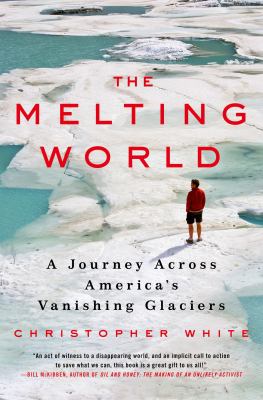
The Melting World: A Journey Across America's Vanishing Glaciers by Christopher White

I had two primary reasons for reading in The Melting World: A Journey Across America's Vanishing Glaciers by Christopher White. The first was my general interest in environmental issues and the conservation of wild places. The second more specific reason was that Bonnie and I are going to Glacier National Park later this year.

Having now read The Melting World, I see another way that it satisfies my interests. I enjoy stories told by naturalists working in the field. Much of White's book accounts for his days spent outside with the shrinking glaciers in the remote national park. On each of these days, he treks many miles with dedicated researchers to measure and observe ice and snow. The team utilizes many tools; GPS, portable and stationary weather stations, and a variety of cameras are primary sources of data. They also count wildlife species and record the levels of the streams and lakes feed by glacial melting. In five years, they discover many reasons to be concerned about the future of Glacier National Park and the planet.

While not a travel guide, I did learn much about the mountains, glaciers, and bodies of water as well as flora and fauna. Unlike White, I will not be able to go far into the back country, but I want to see as much as I can. I know I will better able to make sense of the place having read this book.

The Melting World is a worthy item to add to current natural history collections.

White, Christopher. The Melting World: A Journey Across America's Vanishing Glaciers. St. Martin's Press, 2014. 272p. ISBN 9780312546281.

Wednesday, July 01, 2015

Jacksonland: President Andrew Jackson, Cherokee Chief John Ross, and a Great American Land Grab by Steve Inskeep

What forces shaped the culture, politics, and economy of the American South? The factors were many - it was not one man's doing - but NPR correspondent and author Steve Inskeep suggests that one particular man in the early 19th century played a key role in a struggle that allowed the South to develop as it did. That man was Andrew Jackson, and the issue was the forced removal of native tribes from the South. Inskeep tells the story in Jacksonland: President Andrew Jackson, Cherokee Chief John Ross, and a Great American Land Grab.

In Jacksonland, Inskeep focuses on two men. The first is, of course, Andrew Jackson, an icon of American history. The second is Cherokee chief John Ross, whose name is mostly forgotten today. Jackson and Ross were not always opponents, as the latter served in a Cherokee regiment under Jackson in the War of 1812. Ross was elected to the Cherokee Council in 1817, became its president in 1819, and spent the next twenty years negotiating with government officials in Washington to protect tribal land. Jackson and his wealthy friends, however, had designs on that land. When Jackson became president, the removal of the Cherokee tribe from the South became inevitable.

As the subtitle suggests, Jacksonland is a book in which the author's sympathies are apparent. What will interest many modern reader are the stories showing that Jackson seemed like a cad to many in his own time. Critics, mostly in the North, decried the forced removal of native tribes who had previously been assured by treaties of their territory in the South. For a while, the issue was hotter than slavery.

I listened to Inskeep read his book on compact disc. I especially liked the final section that brings the story to date, telling how many Cherokees never left and others returned to the South. The audiobook was good listening for commuting and gardening for a week.

Inskeep, Steve. Jacksonland: President Andrew Jackson, Cherokee Chief John Ross, and a Great American Land Grab. Penguin Press, 2015. 421p. ISBN 9781594205569.

Audiobook: Books on Tape, 2015. 10 compact discs. ISBN 9781101914953.


Friday, June 26, 2015

How About Never - Is Never Good for You?; My Life in Cartoons by Bob Mankoff

I seldom pick up The New Yorker now, but there was a time when once a week I would take the latest copy from the library's magazine room to our lunch room to read the cartoons during lunch. I would also glance at the "Talk of the Town" and the book reviews and scan the table of contents, occasionally coming back to the issue if I wanted to read the short stories, but the cartoons were the draw. I recollected this past with pleasure as I read How About Never - Is Never Good for You?; My Life in Cartoons by Bob Mankoff.

"How about never - is never good for you?" is the memorable part of the caption of Bob Mankoff's most famous cartoon. It has been enshrined in The Yale Book of Quotations and, according to Mankoff, been ripped off by comedians and the makers of T-shirts. He is collecting royalties on sales of the cartoon from the Cartoon Bank, which he founded, so he has profited. He tells stories about several of his cartoons in his multifaceted book.

How About Never - Is Never Good for You? may be called a memoir, but large sections of it deal with topics other than Mankoff. He recounts the history of cartooning and the story of The New Yorker magazine, and he profiles many of his fellow cartoonists. He also gives readers hints on how to win the weekly caption contest at The New Yorker.

Anyone contemplating cartooning as a career will find Mankoff's behind-the-scenes stories very instructive. The rest of us can appreciate the artistry and laugh at the many cartoons included. It is worth several hours of pleasure reading and may lead some readers back to The New Yorker.

Mankoff, Bob. How About Never - Is Never Good for You?; My Life in Cartoons. Henry Holt and Company, 2014. 285p. ISBN 9780805095906.

Wednesday, June 24, 2015

Mister Owita's Guide to Gardening: How I Learned the Unexpected Joy of a Green Thumb and an Open Heart by Carol Wall

Carol Wall and her husband Dick never enhanced their yard. There were not any flowers, the grass was patchy, and the shrubs and trees looked weary, in need of pruning and rejuvenation. The couple was too busy to deal with yard issues beyond mowing, and Carol was opposed to flowers. Carol was sure their yard was an eye-sore to their neighbors, who had beautiful yards. Neighbor Sarah Driscoll was even a Master Gardener. Why did Sarah have a new man working in her yard?

This new man became an object of interest to Carol, a teacher who had taught English as a foreign language. She saw also him bagging groceries at the local supermarket and helping people load their plants at the parking lot of the local garden center. Unlike most hourly low-skill workers, he seemed to attract the attention and high regard from the customers. He spoke in an oddly charming way. Was he an immigrant?

In Mister Owita's Guide to Gardening: How I Learned the Unexpected Joy of a Green Thumb and an Open Heart, the author tells about her friendship with Giles Owita and his wife Bienta who immigrated from Kenya with their two sons to attend colleges in the United States. While gardening is a continuing theme in their recounted conversations, it is not really the focus of this book. Instead, self-discovery, overcoming self-imposed limits, and leading a full life prevail. There is also a mystery for the author to solve.

Ironically, most libraries have Mister Owita's Guide to Gardening in their gardening sections. Bonnie, who is also a librarian, told me that she thinks there is not really any better place in Dewey for this hard-to-categorize book. Being about non-famous people, it would be lost in biography. It could be placed with friendship books, but who ever goes to the library for a friendship book? Maybe we need shelves just labelled "Good Reading." It should be there. Check it out.

Wall, Carol. Mister Owita's Guide to Gardening: How I Learned the Unexpected Joy of a Green Thumb and an Open Heart. Amy Einhorn Books, 2014.  294p. ISBN 9780399157981.


Monday, June 22, 2015

Deep Down Dark: The Untold Stories of 33 Men Buried in a Chilean Mine and the Miracle That Set Them Free by Hector Tobar

I enjoyed its reviews in newspapers and podcasts, and Bonnie and other readers whose opinions I trust recommended this book. I remember the story from 2010 as amazing and compelling. The probability that I would enjoy Deep Down Dark: The Untold Stories of 33 Men Buried in a Chilean Mine and the Miracle That Set Them Free by Hector Tobar was high. The only reason that I have taken so long in starting is my to-read list is long. (I started to say over-populated, but you can not have too many books in your reading queue.)

Luckily for me, Bonnie borrowed the 11 disc audiobook of Deep Down Dark so I could listen while driving, cooking, and gardening. Henry Leyva is a great reader. I like how he moved easily from English to Spanish and back in this book, pacing well, and distinguishing different voices effectively. Of course, with 33 men in the collapsed Chilean mine and numerous important figures on the surface above, the task for the writer and the narrator to make each of them singularly memorable is impossible. Still I felt the voices were right as I heard them.

What I did not expect was the amount of the story that takes place after the miners were discovered to still be alive and after they were rescued. The one part of the story I would have like to be more detailed is the actual day of rescue. I am glad Tobar recounts about his interviews and tells how the miners have fared since the ordeal.

I would happily read Deep Down Dark again if it is chosen for our book group. If you wonder about conditions in mines and want a dramatic tale with suspense, even when you know the outcome, You may also like this disaster rescue story.

Tobar, Hector. Deep Down Dark: The Untold Stories of 33 Men Buried in a Chilean Mine and the Miracle That Set Them Free. Farrar, Straus and Giroux, 2014. 309p. ISBN 9780374280604. 

Audiobook: Macmillan Audio, 2014. 11 compact discs. ISBN 9781427244505.


Friday, June 19, 2015

A Practical Illustrated Guide to Attracting and Feeding Backyard Birds: the Complete Book of Bird Feeders, Bird Tables, Bird Baths, Nest Boxes, and Garden Bird-Watching

With the title A Practical Illustrated Guide to Attracting and Feeding Backyard Birds: the Complete Book of Bird Feeders, Bird Tables, Bird Baths, Nest Boxes, and Garden Bird-Watching, there is hardly any need to write a review. The title explains how the book is practical, and the cover hints at how beautifully colorful. Judging books by their covers can lead to disappointment, but not with this book. I renewed it to keep looking at its thematic two-page illustrated articles and its projects. I might use several ideas to enhance our yard's bird-appeal.

The topics in A Practical Illustrated Guide to Attracting and Feeding Backyard Birds are wide ranging. Readers may learn about bird anatomy, physics, and behaviors, as well as how to attract them by offering feeders, fountains, and nesting boxes. Gardeners find recommendations for landscaping, while hobbyists find templates for wood-working projects. There is also an essential guide to birds who frequent yards.

Though the publisher is British, this edition seems to be aimed at the American market. The range maps show North America. A Practical Illustrated Guide to Attracting and Feeding Backyard Birds is a great selection for public or personal libraries. I am now returning it to let others enjoy it.

A Practical Illustrated Guide to Attracting and Feeding Backyard Birds: the Complete Book of Bird Feeders, Bird Tables, Bird Baths, Nest Boxes, and Garden Bird-Watching. Southwater, 2014. 256p. ISBN 9781780192802.


Wednesday, June 17, 2015

This Strange Wilderness: The Life and Art of John James Audubon by Nancy Plain

I think the first biography that I ever read was John Audubon, Boy Naturalist by Miriam Evangeline Mason, a 1962 publication in the Childhood of Famous Americans series. I think I read it in a single evening. So I was thrilled when Bonnie brought home This Strange Wilderness: The Life and Art of John James Audubon by Nancy Plain, a 112 page illustrated biography for tween and teen readers. Ironically, I could not read it in a single evening because I can not stay awake long enough now.

If I could have started in the morning and ignored all my obligations, I would have had a wonderful time reading without stop about the Frenchman born in Haiti who became the most famous of American ornithologists and wildlife artists. His life is a quintessential American hero story. He came to Pennsylvania as a teen, fell in love with the country, and left a lasting legacy. That he struggled financially and at times was discouraged makes the story even better. I enjoyed This Strange Wilderness a little at a time over a couple of days.

Plain's book is more modern and honest than Mason's, which was written when our culture supported faultless accounts of our ancestors. Plain acknowledges what now seems unthinkable - Audubon shot many birds for the sake of studying and drawing them. In the early 19th century, future extinction of abundant wildlife seemed impossible. Audubon saw skies filled with passenger pigeons and the plains covered with bison. He witnessed the beginnings of the slaughter of these species and even warned others that it was unsustainable, but he did not alter his own habits. Readers may wish they had time machines to see what Audubon saw.

Naturally, This Strange Wilderness is filled with Audubon's own paintings of birds and mammals of North America. It is a good choice for aspiring naturalist as well as mature readers reviewing the world they think they know.

Plain, Nancy. This Strange Wilderness: The Life and Art of John James Audubon. University of Nebraska Press, 2015. 112p. ISBN 9780803248847.


Monday, June 15, 2015

My Beloved World by Sonia Sotomayor

At a time when memoirs are fashionable, Sonia Sotomayor has published an autobiography. My Beloved World is not her full life story, ending the book with becoming a federal judge in 1992 after being recommended by Democratic New York Senator Daniel Patrick Moynihan and nominated by Republican President George H. W. Bush. Her wide-ranging book tells of her childhood, education, and early career as a lawyer. Besides being a how-I-got-to-this point-book, it is a testament to the years of her youth - which were the youthful years of the Baby Boom Generation.

The major outside force in Sotomayor's early life was the Civil Rights Movement. Her personal challenges were diabetes and the death of her Puerto Rican father when she was only nine. She took charge of her daily insulin shots, helped her mother run the home, and graduated as valedictorian at Blessed Sacrament Catholic School and at Cardinal Spellman High School. She received a scholarship to Princeton thanks to affirmative action, for which she is grateful. She is not ashamed of needing help and taking it. She points out that she was academically qualified and won many honors because she applied herself.

Sotomayor's book is a lesson about effort being rewarded. She tells several stories of starting new phases of her life without having role models to prepare her for the cultural challenges. The key she says is to be honest about your needs and ask questions and for help when necessary.

Being of Sotomayor's age, I enjoyed My Beloved World thoroughly and hope she will write another to recount her years as a judge.

Sotomayor, Sonia. My Beloved World. Vintage Books, 2014. 398p. ISBN 9780345804839.

Friday, June 12, 2015

The Atlas of Birds: Diversity, Behavior, and Conservation by Mike Unwin

This book review blog has gone to the birds! As any frequent reader must have noticed, I have written many reviews of bird-related books lately. In front of me now is The Atlas of Birds: Diversity, Behavior, and Conservation by Mike Unwin, an attractive paperback reference book on birds from Princeton University Press. It is not really meant to be read straight through, but I am finding very few pages to skip.

The author points out in his introduction how by being so omnipresent and visible, birds established themselves as an indicator of the health of specific habitats and the earth as a whole. Today numerous factors are contributing to declines in the populations of many birds, habitat destruction being the leading cause.

There are many observations throughout that fascinate me:

Bird diversity concentrates on tropical and subtropical regions, especially in forests.  Russia, which is over 60 times larger than Ecuador, hosts only 645 bird species while the small tropical South American country hosts a whopping 1,515 species.

About 6,900 species are found in the forests of the earth while about 200 are found in its deserts.

Birds migrate at various altitudes. Bar-headed geese fly at 29,000 feet.

William Shakespeare mentioned doves 60 times in his plays, more than any other bird. Geese were second at 44 and eagles third at 40.

Illegal hunting of songbirds in Southeastern Europe threatens the survival of numerous migrating species. Most of the illegally killed birds are smuggled into Italy for the restaurant trade.

The Royal Society for the Protection of Birds with over a million members is the world's largest bird conservation organization. With Audubon and other regional groups it forms BirdLife International, which is identifying and securing sanctuaries around the world.

A beginning birder wishing to understand the world of birds and veteran bird advocates can both learn much from The Atlas of Birds.

Unwin, Mike. The Atlas of Birds: Diversity, Behavior, and Conservation. Princeton University Press, 2011. 144p. ISBN 9780691149493.


Wednesday, June 10, 2015

I Was a Child by Bruce Erik Kaplan

Our job as children growing up is to accept and reject. Accept our parents for who they are. Reject some of their ways. Be close if possible in loyalty, but move away, perhaps physically great distances if necessary. Find our own ways better for us. These are my thoughts on reading I Was a Child by Bruce Erik Kaplan, a cartoonist for The New Yorker as well as a television writer and producer.

Kaplan and I are by no means twins, as his ways are not mine, but we definitely shared some experiences. In his cleverly illustrated memoir, he briefly recounts moments that send me back to my own childhood. And I think Kaplan might agree that we never wholly leave childhood, as we are still children as long as we have parents or even remember our parents.

I was particularly struck by all the useless things in his parents' house, all the broken things that remained in place. He tells about a box outside his parents' door for the milk delivery. Decades after milk was no longer delivered, it was still there. He also tells about a console holding a nonfunctioning record player and old never-played records. I am not the only child to have noticed such things! He also tells about closet doors that won't close, and I feel a sudden urgency to get a door fixed.

I can imagine some readers will believe that Kaplan is disloyal for shining a light on his parents' failings. They might also argue against almost any revealing childhood memoir. For this reason and because I Was a Child is very entertaining and quick to read, I think it would be a great choice for some book discussion groups.

Kaplan, Bruce Erik. I Was a Child. Blue Rider Press, 2015. 193p. ISBN 9780399169519.


Monday, June 08, 2015

How We Got to Now: Six Innovations That Made the Modern World by Steven Johnson

Groundbreaking Reads: Ideas That Shook the World is the theme of the adult summer reading program at the Thomas Ford Memorial Library. Our intent is to inspire readers by emphasizing innovations that led to literary, scientific, political, and cultural developments. In some cases, books themselves are groundbreaking. We feature many of these books on our suggested reading lists, but we also highlight books that tell the story of progress. Such a book is How We Got to Now: Six Innovations That Made the Modern World by Steven Johnson.

Johnson's book was bestseller in 2014 and the companion to his highly-entertaining six-part PBS series. In both the book and the televised series, Johnson tells the stories of these concepts:

  • Clean
  • Time
  • Glass
  • Light
  • Cold
  • Sound

My favorite chapter may be Cold. Johnson shows how someone's idea of cutting ice from frozen ponds to store until summer led to shipping it to the tropics. Once that started someone else perfected insulating the hold for the ice and another on making artificial cold by heat removal, both of which led to refrigerators. The idea of chilling food led to cooling spaces with air conditioning (or the other way around). Air conditioning led to people being able to live more comfortably in tropical and desert regions, starting a migration to states like Florida, Texas, Arizona, and California. All because someone cut ice from ponds.

Being about technology, it is appropriate that How We Got to Now is available in many formats. All facilitate optimism and love of innovation.

Johnson, Steven. How We Got to Now: Six Innovations That Made the Modern World. Riverhead Books, 2014. 293p. ISBN 9781594632969.

Audiobook: Penguin Audio, 2014. 5 discs. ISBN 9781611763386

DVD: PBS, 2014. 2 discs. ISBN 9781627890366