Showing posts with label poetry. Show all posts

Wednesday, December 24, 2014

Blue Horses: Poems by Mary Oliver

I woke
and crept
like a cat

on silent feet
about my own house ...

I have already read a book of poetry today. It is a small book, I admit, but it is tremendous. I checked it out from the library at the last moment last night to have another book for the two-day holiday. I woke just before 2:00 a.m., crept from bed and read a bit, then I woke again to read a little more at 4:30 a.m. I finished the collection at breakfast. The book is Blue Horses: Poems by Mary Oliver, from which the lines above came.

In Blue Horses, Oliver speaks her mind with humor and compassion. As I read the poems, I could imagine them all put together into a sort of one-woman show that would be appropriate for stage or perhaps on PBS's Great Performances. As she would read her poems, we would see stills and videos of the woods and wildlife about whom she frequently writes. We'd also see her at home, perhaps at her window looking out. It would be spellbinding to listen to her define our world and how to live in it.

The book title Blue Horses refer to her poem "Franz Marc's Blue Horses" in which she tells about the art and death of the young artist in World War I.

I do not know how to thank you, Franz Marc.
Maybe our world will grow kinder eventually. 
Maybe the desire to make something beautiful 
is the piece of God that is inside each of us.

As a bird lover, I appreciate Oliver's frequent avian references that include a heron, kingfisher, mockingbird, wren, vulture, song sparrow, bluebird, and a variety of hummingbirds. She observes frogs and wasps and expresses a wonder for rocks. Her poems resonate with people who would gladly spend much of their time in wild settings. I hope many of them find Blue Horses under their trees this Christmas.

Oliver, Mary. Blue Horses: Poems. Penguin Press, 2014. 79p. ISBN 9781594204791.

Wednesday, December 17, 2014

Splitting an Order by Ted Kooser

"I like to watch an old man cutting a sandwich in half
maybe an ordinary cold roast beef on whole wheat bread
no pickles or onions, keeping his shaky hands steady
by placing his forearms firm on the edge of the table ... "

This is what I enjoy about the poetry of Ted Kooser. In the opening lines of the poem "Splitting an Order" in his new collection Splitting an Order, he describes something ordinary in an extraordinary way. He sees the ways hands move and what is in the sandwich. He shows how the sharing of a meal is a ritual. If you or I were in a restaurant across from an older couple sharing a sandwich, we would pay no attention to them, not seeing the clues to their lives in plain sight. Kooser is different.

"I would love to have lived out my years
in a cottage a few blocks from the sea
and to have spent my mornings painting
out in the cold, wet rocks, ... "

Kooser is a painter, as he tells us here in the autobiographical poem "A Person of a Limited Palette" and later in the grief-filled essay "Small Rooms in Time." He notices details and reproduces them precisely in verse. Paging through his collection is like walking through an art gallery with a variety of portraits and landscapes. You may linger in front of some of them today and others next time you visit.

Kooser's poems in Splitting an Order are the work of an older man. He features his contemporaries in some of the poems, often with a middle aged child, but he also writes about young couples and children, as he does in "Swinging from Parents."

I think my favorite in the collection is a poem about his father called "Closing the Windows."

"It was all so ordinary then
to see him at the foot of the bed,
closing a squeaky window, 
but more than sixty years have passed
and now I understand that it was
not so ordinary at all."

When I return to the library books of poetry after only reading four or five poems, I wonder if I like the idea of reading poetry more than actually reading of poetry. Ted Kooser refutes this notion. I liked the poems of Splitting an Order so well that I read the collection twice. They are worth getting to know. I might return to them again, as I do to galleries of art.

Kooser, Ted. Splitting an Order. Copper Canyon Press, 2014. 84p. ISBN 9781556594694.

Wednesday, November 05, 2014

On the Wing by David Elliott with Illustrations by Becca Stadtlander

There are several ways that one may read On the Wing by David Elliott.

As an adult who reads everything at hand, one can zip right through this thin book of poetry for children in ten minutes or less.

As an adult who appreciates clever poetry and beautiful illustrations, one can pleasantly linger and absorb.

As a birdwatcher, one can study the shapes and colorful markings of the birds.

As an adult reading aloud to children, there can be the joy of sharing well-chosen words with eager listeners, committing poems to memory, and looking at the artful illustrations with younger eyes. I can imagine On the Wing becoming a favorite for naptime or bedtime.

Elliott, David. On the Wing. Candlewick Press, 2014. ISBN 9780763653248.


Wednesday, April 16, 2014

God Got a Dog by Cynthia Rylant and illustrated by Marla Fraze

BBWB. Bonnie brings wonderful books. I could label many of my reviews with this code.

After reading God Got a Dog written by Cynthia Rylant and illustrated by Marla Fraze, I could write a sermon, but this is a book review.

If I wrote a sermon, I would say how we would be more mindful and respectful toward other people if we realized who they really were. I would go on to say that we probably would restrain ourselves from hurting others, and if we did harm, we would be sorrowful and make amends.

But this is a book review, and God Got a Dog is a good book. I want to tell you about it without telling too much. You should discover its contents yourself.

God Got a Dog is a book filled with one-page story poems aimed at children that should also be made available to open-minded adults. With every poem is a delightful illustration clarifying its story's character and mood.

My favorite poems in the book:
"God woke up"
"God went to the doctor"
"God wrote a book"
"God got cable"
"God went to India"
Actually, I like them all. God Got a Dog is charming, sweet, and profound. Now I need to get God Went to Beauty School from which these poems were selected.

Rylant, Cynthia. God Got a Dog. Beach Lane Books, 2013. 9781442465183.

Monday, November 25, 2013

What W. H. Auden Can Do for You by Alexander McCall Smith

When I picked up What W. H. Auden Can Do for You, my interest was more in its author Alexander McCall Smith than in Auden. I have read many of McCall Smith's mysteries and other books, while my reading of the poetry of Auden has been limited to school assignments. I almost always enjoy whatever McCall Smith writes, and this book was no exception.

That said, I think I should give Auden some time. McCall Smith has told me why he is devoted to the poet, and at my advanced age I may now be mature enough to appreciate the poetry. McCall Smith points out that a reader has to take Auden's verse slowly and reread puzzling bits of it to make any sense of it, but he assures readers that it can be rewarding to those who are seeking meaning in life. McCall Smith portrays Auden as a thinker of great compassion and tolerance who can both challenge and reassure readers.

What W. H. Auden Can Do for You is not literary criticism. Its twelve chapter are essays about what McCall Smith likes about the poet. None are long and should appeal to readers who enjoy or think they should enjoy poetry.

McCall Smith, Alexander. What W. H. Auden Can Do for You. Princeton University Press, 2013. 137p. ISBN 9780691144733.

Wednesday, April 03, 2013

Here by Wislawa Szymborska

Reading books leads to reading more books. Along the path down which an author leads readers are signposts to paths blazed by other authors. In reading a collection of newspaper columns by Mary Schmich, I noted her quoting the Nobel Prize-winning poet Wislawa Szymborska. Liking the quote, I emailed Bonnie who borrowed for me Here, a collection of poems in Polish with English translations on facing pages. At only 84 pages of text with a lot of white space, of which I read only the English half, it was a attractive choice, a short path that may lead to wider roads.

Even 42 pages of poetry can be hard going if the reader can not discern the topic or the meaning. I had no worries with this collection by Szymborska. Most of the poems chronicle daily life or describe tangible ideas of art or science. I was particularly struck by "Hard Life with Memory." Of an age when there is more to look back on than to look forward to, it tells about a struggle to balance one's attention in the present. "She" refers to Memory in this verse:

She thrusts old letters, snapshots at me eagerly,
stirs up events both important and un-,
turns my eyes to overlooked views,
peoples them with my dead. 

With some poems I identify, see myself. In others I am introduced to others and their views. Here is a mixture of emotions and high ideals, familiar and the strange, new and old. Szymborska's poems are never dull.

Szymborska, Wislawa. Here. Houghton Mifflin, 2010. 85p. ISBN 9780547364612.

Wednesday, June 27, 2012

The Courtship of Miles Standish by Henry Wadsworth Longfellow

I remember reading a lot of poetry in 7th grade when Mrs. Coates required that each student put together a poetry scrapbook. I recall cutting out pictures from my parents magazines and gluing them to lined notebook paper on which I then hand-copied poems from library books. Most of the work was done the night before the project was due, and the photos were as random as the poems. For the slapdash effort, I did not get as high a grade as I usually earned. I am sure that with a word processing program and photos from the Internet I could do a much better job now. In minutes.

Around this time I was introduced to the long historical piece "The Courtship of Miles Standish" by Henry Wadsworth Longfellow, which at least has a story, unlike some of the poems that we read. It dramatises the early days of the Plymouth Colony in Massachusetts when Standish, the commander of the colony's small militia, asked his friend John Alden to communicate the commander's love to orphaned beauty Priscilla Mullins, whose family members had died just before or after the landing of the Mayflower. Standish was sure that the bookish Alden could find better words to win the heart of the young lady. Many readers will remember that Priscilla turns the tables and said to the messenger, "Why don't you speak for yourself, John?"

I found an illustrated edition of Longfellow's poem in our collection. The verso says copyright 1903 below dates of 1858, 1886, 1883, and 1888, in that order. The paintings and drawings by Howard Chandler Christy have very hard to read dates by the signatures. One looks like 1923. Maybe it is 1903. It is a handsome book. Even the text has a subtle background design.

I was surprised to find no rhyming, but I am not surprised to find 19th century attitudes toward women and American Indians. I'll bet this is not taught in many schools today. It probably should be (in context) so students can understand how attitudes have changed. It could be paired with an unedited The Adventures of Huckleberry Finn and Uncle Tom's Cabin.

Another funny thing is that is more about John and Priscilla than about Standish. Check it out yourself and see what you think.

Monday, May 28, 2012

The Swerve: How the World Became Modern by Stephen Greenblatt

Narrated by Edoardo Ballerini, The Swerve: How the World Became Modern by Stephen Greenblatt is pleasurable listening. I really enjoyed hearing Ballerini's pronounciations of the many Roman and Italian names that were a part of the story of the discovery and copying of On the Nature of Things, a poem by the Roman poet and philosopher Lucretius. The Epicurean poet would approve, as the seeking of pleasure is a central theme to his first century B. C. poem that posed that all matter was made of tiny atoms.

One of those great Italian names was Poggio Bracciolini, a personal secretary to an overthrown pope. Poggio (Greenblatt always calls him by the first name) used the freedom he had after losing his job to visit out of the way monasteries to see what forgotten classical texts he could find. As soon as he found a ninth century copy of On the Nature of Things, he recognized it as an important missing text. Because he could not borrow the book, he hired a scribe to make a copy, which he sent to a friend who contracted the making of copies in a better hand.

Greenblatt contends that Poggio's discovery was a key event of the Renaissance, for the ideas contained in the poem were spread to dissenters who eventually broke the power of the Roman Catholic Church to restrict scientific investigation and discussion. The idea of atomic particles was considered by church officials to be a direct attack on the miracle of the eucharist. Poggio escaped being punished because he worked during a brief period of liberal thought but many others were burned at the stake later when the church tried to suppress the poem.

The story told by Greenblatt is epic in size, including Greek, Roman, Medieval, and Renaissance history. The conclusions even include William Shakespeare, Thomas Jefferson, and Charles Darwin. The Swerve is a bestseller worth reading and keeping.

Greenblatt, Stephen. The Swerve: How the World Became Modern. Recorded Books, 2011. 8 compact discs. ISBN 9781461838227.

Wednesday, November 02, 2011

Every Thing On It by Shel Silverstein


Talked my head off
Worked my tail off
Cried my eyes out
Walked my feet off
Sang my heart out
So you see,
There's really not much left of me.
(from Losing Pieces by Shel Silverstein)

When Shel Silverstein died at age 68 in 1999, he left many unpublished poems and drawings. A committee of his family has spent years reading and discussing them with the idea of publishing another book for children. Every Thing On It, also the title of a poem with illustration about a surprising way to fix a hot dog, is now available and ready to join Where the Sidewalk Ends, A Light in the Attic, and Falling Up on home and library bookshelves.

In a story on National Public Radio, family members explained that Silverstein would not mind their effort. He took great care in the selection and sequencing of poems in his books, leaving out many polished worked just because they did not have a place in his themed collections. Many would have eventually been used. As a result, Every Thing On It is less focused, but the title itself seems to allow for that.

As with any collection of verse, there are poems I like and ones that I don't. "Man-Eating Plant" on page 53, "Unhappy Here" on page 56, "Jimmy-Jack-John" on page 88, "Rainbow Thrower" on page 135, and "Mer-Maid" on page 171 are among my favorites. They range from happy to sad, showing Silverstein in many moods. There is something for just about everyone in this collection, especially for kids who like snappy, irreverent verse. Of course, we are all still kids.

When I am gone what will you do?
Who will write and draw for you?
Someone smarter - someone new?
Someone better - maybe YOU!
(from When I Am Gone by Shel Silverstein)

Silverstein, Shel. Every Thing On It. Harper, 2011. ISBN 9780061998164.

Friday, August 26, 2011

Bright Wings: An Illustrated Anthology of Poems About Birds

On our trip to Iowa City several weeks ago, we visited Prairie Lights, one of our favorite bookstores. Browsing the long display of recent books on the main floor, I discovered Bright Wings: An Illustrated Anthology of Poems About Birds edited by Billy Collins with paintings by David Allen Sibley. Collins and Sibley are two of my heroes, and I was pleased to find their collaboration. Collins, a former poet laureate of the United States, chose the poems, and Collins contributed paintings of birds doing what birds do - wading, flying, and perching. Collins wrote an introduction, which includes a poem the reader will not want to miss. I am not certain who wrote the captions below the paintings; I suspect Sibley for the most part because they give the kinds of facts that he highlighted in his famous The Sibley Guide to Birds; Collins may have written some that refer to the poems that follow.

The poems come from the historical parade of poets, back to the Roman lyricist Catullus and up to contemporary poets, including Kevin Stein, Dorian Laux, and Collins himself. The book could serve well as a topical introduction to the world of poetry, which includes, John Keats, the Brownings, Emily Dickinson, Thomas Hardy, Sylvia Plath, Mary Oliver, and many other well-known poets. Collins said in his introduction that he purposely avoided overused titles, "The Swans" by Yeats and "The Raven" by Poe, but there is still an excellent representation of the masters.

Collins starts the collection fittingly with a tribute "John James Audubon" by Stephen Vincent Benet.

Of course, collections will always include some poems with which I don't connect, but Bright Wings has plenty of poems I did like and admire. My favorites include the philosophical "Wild Geese" by Mary Oliver, a humorous portion of "Woody's Restaurant, Middlebury" by Greg Delaney, and the nightmarish "A Barred Owl" by Richard Wilbur. I enjoyed the rhyming in Elizabeth Bishop's "Sandpiper" and the story told in Henry Wadsworth Longfellow's "The Emperor's Bird's-Nest." Slogging through a few titles I did not like was worth the effort, for I found much that I did enjoy.

Bright Wings is an attractive book that should be found in many public libraries. It would also make a nice gift to a literate bird-loving friend.

Bright Wings: An Illustrated Anthology of Poems About Birds edited by Billy Collins, paintings by David Allen Sibley. Columbia University Press, 2010. ISBN 9780231150842.

Wednesday, June 15, 2011

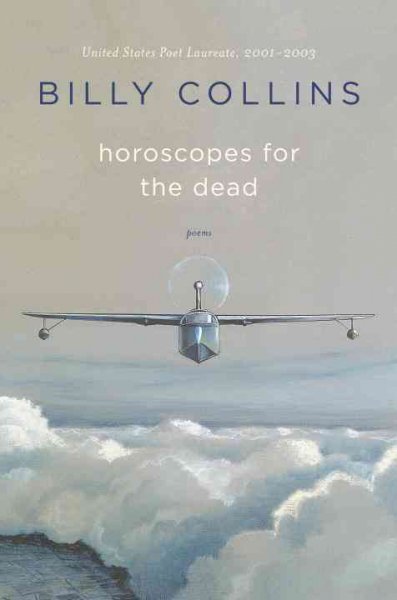
Horoscopes for the Dead: Poems by Billy Collins

As I read through the poems in Horoscopes for the Dead: Poems by Billy Collins, I began to imagine the daily life of the former poet laureate. His to-do list must look something like this:
  • Sit on dock and watch water
  • Ride bike across town
  • Listen to the neighborhood
  • Read Dante
  • Think
  • Write
  • Cook from recipes but vary at will
  • Drink wine with wife
  • Dream all night
Collins admits to a routine "regimen of aimless wandering." I suppose this allows him to observe everything around him without too much involvement. He stays detached, until his wife or a friend require attention. It is good, however, that the poet can not stay clear of complications. Discomfort and annoyance give him more to think about. Again alone and free, he muses and records his mental acrobatics. As readers, we get to play along, enjoying the fun of hanging out with a poet.

As I read, I noted poems to revisit, starting with "The Straightener" on page 5. I can identify with a man wanting to having everything in line in the right place. While he wants his shirts arranged by color, I am more concerned that the short and long sleeves don't mix, but the obsession is similar. I had to smile at "Genesis" on page 23, in which he suggests man began as woman's rib. As a former math major, I also liked "Simple Arithmetic" on page 32, in which Collins subtracts objects from time and space. Eventually, my list of favorites was too long to be meaningful. Perhaps I should ask for the book for Christmas.

Collins, Billy. Horoscopes for the Dead: Poems. Random House, 2011. ISBN 9781400064922.

Monday, April 18, 2011

Endpoint and Other Poems by John Updike

I pulled the book that was obviously on the wrong shelf, Endpoint and Other Poems by John Updike. The call number on the spine label was in error. Updike was an American, not British author. He may have spoken the same English language as Keats and Shelley, but we believe in geographically-correct nationalism in our Dewey-committed library. I would take the book down to the technical process department (two people in our small library) and get the catalog corrected and a new label made.

But I decided to look at the book first. It was National Poetry Month, and I had not read any poems yet this year. I had not really cared for Updike's novels, but I really am not a contemporary novel reader, so it may have been more my taste instead of his writing that made me stop after five pages last time I tried. I think that I enjoyed his short stories long ago.

I started the title poem "Endpoint" and was immediately hooked. The poem is Updike realizing that he is nearly out of time and saying a long goodbye. He describes how his body is failing even as we sees the beauty around him in the New England woods, Atlantic shores, and Tucson mountains. Written in short bursts, some on his birthdays, starting in March 2002, he reflects on his life and work.
A thousand dollars then meant we could eat
for months. A poem might buy a pair of shoes.
My life my life with children, was a sluice
that channeled running water to my pan;
by tilting it, and swirling lightly, I
at end of day might find a fleck of gold.

He remembers events and people, while seeing change. He goes to Best Buy to get a new laptop and struggles to get oleanders to grow in the thin desert soil. Eventually he is admitted to Massachusetts General Hospital.
I lived in Boston once, a year or two,
in furtive semi-bachelorhood. I parked
a Karmann Ghia in Back Bay's shady spots
but I was lighter then, and lived as if
within forever. Now I've turned so heavy
I sink through twenty floors to hit the street.

The last verses are from December 22, 2008. Updike died January 27, 2009.

The other poems take on a variety of topics, some of which interest me, too - the paintings stolen from the Isabella Stewart Gardner Museum still not found, the renewed appreciation of Doo-Wop, the difficulty of playing the seemingly lazy game of baseball, and travel to numerous cities. Often witty and nostalgic, the poems are clear and need no decoding. I read a handful at a time.

Funny how being out of place made this a book worth considering, like birds storm blown to distant continents.

Updike, John. Endpoint and Other Poems. Alfred A. Knopf, 2009. ISBN 9780307272867.

Monday, February 21, 2011

Borrowed Names: Poems about Laura Ingalls Wilder, Madam C. J. Walker, Marie Curie, and Their Daughters by Jeannine Atkins

When I discovered Borrowed Names: Poems about Laura Ingalls Wilder, Madam C. J. Walker, Marie Curie, and Their Daughters by Jeannine Atkins on the "Books for Youth" list in the Editors' Choice, 2010 section of the January 2011 issue of Booklist, I never suspected how much I would enjoy the book. I confess that I expected something light and rhyming. What I found were three powerfully emotional accounts about women overcoming difficult circumstances and profound insight about mother-daughter relationships.

Why is Borrowed Names poetry? It doesn't rhyme. It is, however, laid out in verse in pieces that never last more than three pages. The words are precise and economic and certainly meant to be read aloud. Any one of the three sections could be performed as a library program. The Laura Ingalls Wilder/Rose Wilder Lane section would be popular in many areas. I am surprised there is no audiobook available in CD or downloadable.

What also strikes me about this wonderful book is that it is really more about the daughters than the very famous mothers. Living up to expectations, wanting to please, and wanting to truly help one's mother as an equal are themes in all three stories. Atkins's writing demands mature readers, but I suspect that are many daughters who will identify with these stories. Mothers should read them, too. (It may have little appeal to guys - I enjoyed it but I am a bit older than the target audience.)

Atkins, Jeannine. Borrowed Names: Poems about Laura Ingalls Wilder, Madam C. J. Walker, Marie Curie, and Their Daughters. Henry Holt, 2010. ISBN 9780805089349.

Monday, September 27, 2010

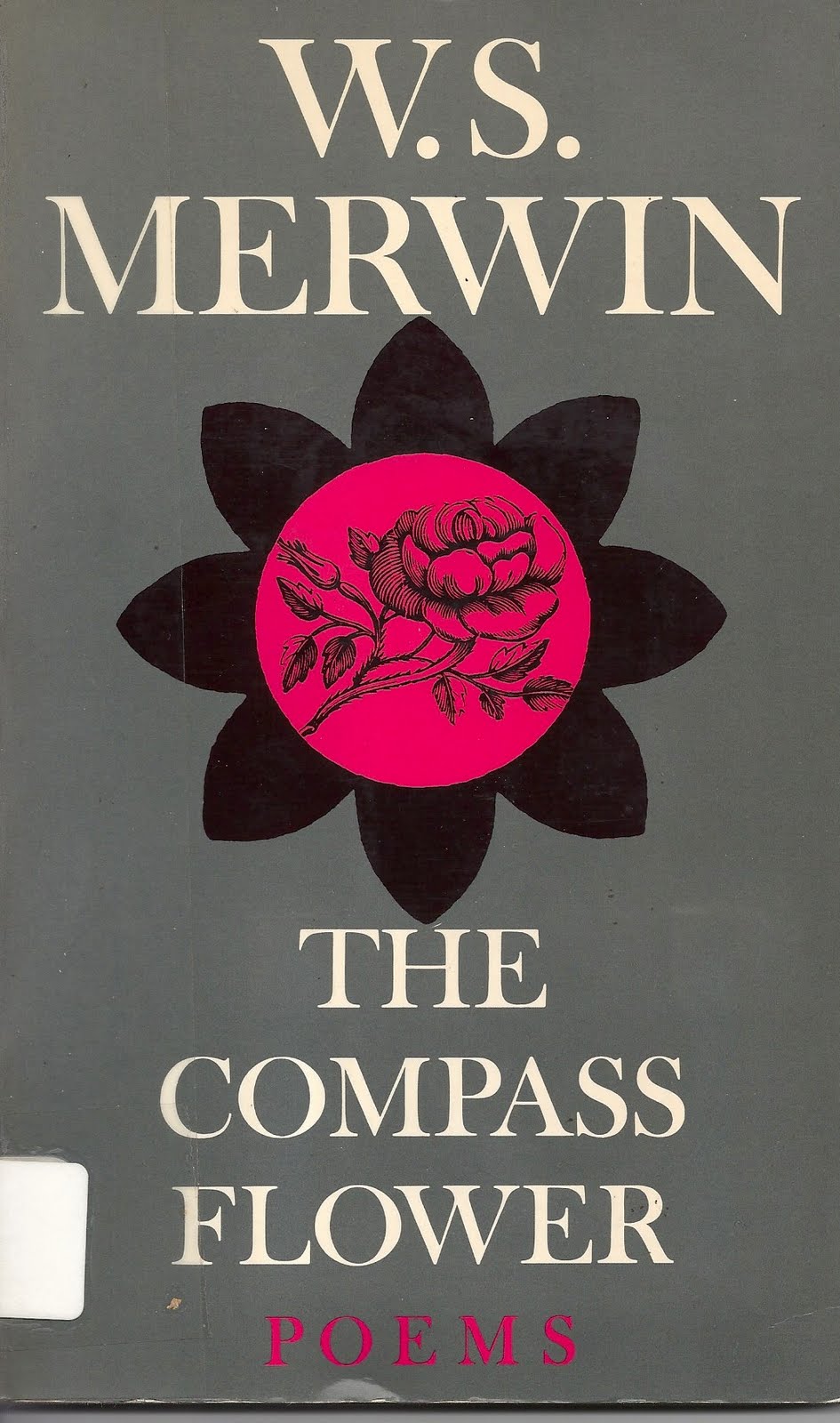
The Compass Flower by W. S. Merwin

I have been pleasantly surprised by our readers interest in poetry. Since July when W. S. Merwin was been named Poet Laureate, I have been waiting to check out one of my library's copies of his books. We have only a few of the many that he has written, and they have been on loan constantly. Finally, I got an older title The Compass Flower from 1977 to see if his poems are truly as accessible as the poems of Billy Collins and Ted Kooser.

The Compass Flower has four numbered but not titled sections. I am not sure why they are grouped as they are, though it seems that the poems near the front of the book refer to city living and those in the back half seem to be set in the countryside or wilderness. Whether urban or rural, they all seem to be concerned with nature, including the weather, plants, and birds. They also frequently mention lovers, as the poet describes the sharing of experiences, specifically the moments captured in the poems. As I read, I imagined that Merwin lives a life of leisure, as he often seems to be pursuing pleasure and not working. Being in woods or mountains appeals to me, so I liked the latter part of the collection better than the first.

Is Merwin as accessible as Collins and Kooser? Judging by only reading one book written twenty something years into his over fifty year poetry career, I would say not. I often felt a little lost in his poems which seemed so personal. These poems also are not as witty as those of Collins and Kooser. Still, I enjoyed many of the vivid images and his thinking about nature. I especially liked "The Windows" on page 88 with its child's perspective. I remember as a boy looking at everything while hanging upside down.

I'll try another Merwin book soon. This one did not take long to read, and maybe we will click if I try again.

Merwin, W. S. The Compass Flower. Atheneum, 1977. ISBN 0689107684.

Tuesday, February 16, 2010

For the Pitchers and Catchers in Camp: A Poem

For the pitchers and catchers in camp,
The mornings are chilly and damp.

For players brought up from the farm,
Noon is both sunny and warm.

For the weary and crippled old vet,
We are sad the sun will soon set.

For all it's the season to dream
Of hot summer days with the team.

May the snows soon all melt away
For the fans waiting for opening day.

Monday, August 03, 2009

The Legend of Sigurd and Gudrún by J.R.R. Tolkien

J.R.R. Tolkien has another new book, The Legend of Sigurd and Gudrún. His son Christopher continues to find writings that interest his father's devoted fans. This new volume includes some early Tolkien translations and commentaries of Norse legends concerning the Völsungs, descendants of Sigmund. Tolkien in verse retells the Elder Edda, the oldest of the collections of the myths, which are also retold in the Icelandic Völsung Saga, the Middle High German Nibelungenleid, and Richard Wagner's series of operas, Ring of the Nibelungs.

I skipped the introduction to see if I could understand the legends without first being told what I was reading. I did fairly well. Tolkien describes a world of forests and highlands where kings travel by swift horses. These kings and queens produce offspring who become future kings and queens, if they live. A serpent is slain with a well-forged sword to capture the creature's treasure of gold. A king lusts to possess a powerful ring. Sins of fathers pass on to their sons. Many people die to satisfy the greed of a few. It's just what you expect from mythology.

My favorite line: "Wives oft are wooed by worthless men."

There are lots of names to keep straight: Gudrún, Gunnar, Grimhild, Gjúki, Sigmund, Sigrlinn, Siggeir, Signý, and Sigurd are just a few of the characters. Readers may want to create scorecards to keep the players straight. Names that disappear for dozens of pages appear again when old crimes are remembered. Keeping alliances straight is difficult, partly because of the betrayal of allies. It does not end well for anyone.

Thus glory endeth,
And gold fadeth,
On noise and clamours
The night falleth.
Lift up your hearts,
Lords and maidens
For the song of sorrow
That was sung of old.


Read The Legend of Sigurd and Gudrún if you want to know Tolkien's sources and enjoy ancient mythology.

Tolkien, J.R.R. The Legend of Sigurd and Gudrún. Houghton Mifflin Harcourt, 2009. ISBN 9780547273426

Friday, April 17, 2009

I Read You, You Read Me: A Poem

I have noticed many jabs at social networking lately in cartoons, columns, and editorials. Some of the jokes are funny, many are exaggerated, some are unfair. It is an irresistible target. Here's my shot in verse for National Poetry Month.


I read you,
You read me,
We both read endlessly.
Our Facebook pages suit us most.
Please wait a moment,
I have something to post.

*****

Nosy people want to know
Just where it was you planned to go.
Why did we see you on THAT street?
Just who was it you planned to meet?
We noticed you were so neatly dressed,
You tie was tied and your pants were pressed.
Your hat was tipped on your head so low.
Just where was it that you planned to go.
Nosy people want to know.

*****

So now where were we?
Is it time to read?
I'm going to log off now
And check my Twitter feed.

*****
___________________________________________________41
If I turn into chocolate and melt in your hand, will you remember my sweetness and say I was grand?

*****

I read you,
You read me,
We both read electronically.
Our digital footprints are spread so wide.
Listen folks, we have nothing to hide.

Friday, February 20, 2009

White Heat: The Friendship of Emily Dickinson and Thomas Wentworth Higginson by Brenda Wineapple

I have become interested in dual biographies lately. I find that they have a similar appeal to novels that weave two story lines. Authors often alternate chapters, bringing one subject up to a milestone or turning point and then switching gears to tell about the other subject. I find that I read a bit more intently, wanting to bring the story lines together. These books naturally give the reader benchmarks with which to measure the qualities of the characters. Readers have to compare Person A and Person B. Such is the case in Giants: The Parallel Lives of Frederick Douglass and Abraham Lincoln by John Stauffer. It is now also true in White Heat: The Friendship of Emily Dickinson and Thomas Wentworth Higginson by Brenda Wineapple.

The alternating of chapters is a bit subtle in White Heat. It almost feels at times that the book is really a biography of Higginson with a bit of Dickinson thrown in, but the poetess from Amherst is always in the background when not on the stage. Between the chapters about the very public Higginson are the chapters about his long correspondence and infrequent visits to see Dickinson. If you are like me, you are less familiar with Higginson, who did very many things in his long life. As a young man he idolized the Transcendentalists, especially Emerson and Thoreau, with whom he wrote letters. He graduated from Harvard and tried being a minister, but he was too radically liberal for his congregations, who did not really want someone urging them to completely remake the world every Sunday. His main causes were abolition and women's rights. In his early career as a writer, he often turned to these topics in the articles that he wrote for Atlantic Monthly and other magazines and newspapers.

Dickinson wrote to Higginson out of the blue because she sensed that he was a compassionate man with a willing ear. According to Wineapple, Higginson truly was that, but he never completely understood Dickinson nor what she wanted. In the book, he does not actually visit her until page 179, about a decade after they started writing. He had at this point already led black Union troops in the Civil War and turned to writing more about literature and nature. He even tried his hand at poetry. Their meeting exhausted him, as Dickinson had so much to say. He did not return for years.

When Dickinson died, he was enlisted in the effort to publish her poetry in a manner that the public would accept. With limitless tact, he mostly stayed above the fight among Dickinson's sister, sister-in-law, and brother's mistress over which poems to include and who to credit with editing. He was regrettably responsible for putting titles on some of the poems and replacing original words and punctuation. Later editions of Dickinson's poetry have restored the works to their manuscript versions.

In White Heat, Wineapple takes readers to a time of Victorian sensibilities when Dickinson's poetry was quite shocking. She depicts Higginson as a man who is very forward thinking but still weighed down by the conventions of his time. This dual biography should be enjoyed by many public library readers.

Wineapple, Brenda. White Heat: The Friendship of Emily Dickinson and Thomas Wentworth Higginson. Alfred A. Knopf, 2008. ISBN 9781400044016

Wednesday, November 19, 2008

Complete Poems of Carl Sandburg

When I read The Complete Poems of Robert Frost, I read about ten pages a day over the course of two months. In a similar manner, I spent two months reading Leaves of Grass by Walt Whitman. It worked well. In both cases I enjoyed taking the books slowly, having time to digest what the poets said. Sometimes, I had to do a little research to discover the events to which they referred. In the end, I felt I learned much about their lives and times. I should be treating The Complete Poems of Carl Sandburg the same, but I am not. With less than two weeks before a book discussion, I began the book and quickly found it overwhelming. With two days left, I am far from finishing the book and have turned to sampling. It is not nearly so satisfying as the slow treatment that I used before. Still, I have learned much.

Sandburg's poetry from the end of his life seems far different from his Chicago Poems that were published in 1916. The early works seem quickly written while the later works seem more refined. His concern for the lower classes and the worker is consistent, but the early work is more drama, while the later is philosophy. The world changed greatly from 1916 to 1967. Still, according to the essays I have read, it is the early work that is most often anthologized.

While reading Sandburg can be a bit of an historical exercise, especially when much of our factory work has been sent overseas, it still has moments of contemporary relevance. With the current economic crisis growing, "Buyers and Sellers" from his book Honey and Salt (1963) asks what white or blue collar workers could ask.

What is a man worth?
What can he do?
What is his value?
On the one hand those who buy labor,
On the other hand those who have nothing to sell but their labor.
And when the buyers of labor tell the sellers, "Nothing doing today, not a chance!" - then what?


For a new look at Sandburg, turn to YouTube. There is a slideshow about a meeting between Marilyn Monroe with Sandburg and an animation of a Sandburg still photo reading from "The People, Yes."

I'd like to start all over now and take the book slowly.

Sandburg, Carl. The Complete Poems of Carl Sandburg. Harcourt, 1969. ISBN 0151009961

Saturday, July 19, 2008

When the Book Is All Finished

When the book is all finished
When the writing is done
I will close up the laptop
And just have some fun
I will go to a garden
And smell the roses all day
Then I'll go to the city
And there I will stray
I'll see all of the paintings
In a gallery display
Then I'll go to a snack shop
Where I'll fill up a tray
With ice cream and cake
And a cookie or two
When the book is all finished
That's just what I'll do.

When the book is all finished
When the writing's complete
I'll back up all the files
And then put up my feet
I'll sleep late in the morning
Read the paper in bed
Wear pajamas to breakfast
And when I'm properly fed
I will listen to music
And I'll not multi-task
When the book is all finished
Is that too much to ask?