Showing posts with label science books. Show all posts

Monday, June 08, 2015

How We Got to Now: Six Innovations That Made the Modern World by Steven Johnson

Groundbreaking Reads: Ideas That Shook the World is the theme of the adult summer reading program at the Thomas Ford Memorial Library. Our intent is to inspire readers by emphasizing innovations that led to literary, scientific, political, and cultural developments. In some cases, books themselves are groundbreaking. We feature many of these books on our suggested reading lists, but we also highlight books that tell the story of progress. Such a book is How We Got to Now: Six Innovations That Made the Modern World by Steven Johnson.

Johnson's book was bestseller in 2014 and the companion to his highly-entertaining six-part PBS series. In both the book and the televised series, Johnson tells the stories of these concepts:

  • Clean
  • Time
  • Glass
  • Light
  • Cold
  • Sound

My favorite chapter may be Cold. Johnson shows how someone's idea of cutting ice from frozen ponds to store until summer led to shipping it to the tropics. Once that started someone else perfected insulating the hold for the ice and another on making artificial cold by heat removal, both of which led to refrigerators. The idea of chilling food led to cooling spaces with air conditioning (or the other way around). Air conditioning led to people being able to live more comfortably in tropical and desert regions, starting a migration to states like Florida, Texas, Arizona, and California. All because someone cut ice from ponds.

Being about technology, it is appropriate that How We Got to Now is available in many formats. All facilitate optimism and love of innovation.

Johnson, Steven. How We Got to Now: Six Innovations That Made the Modern World. Riverhead Books, 2014. 293p. ISBN 9781594632969.

Audiobook: Penguin Audio, 2014. 5 discs. ISBN 9781611763386

DVD: PBS, 2014. 2 discs. ISBN 9781627890366


Friday, May 29, 2015

A Window on Eternity: A Biologist's Walk Through Gorongosa National Park by Edward O. Wilson

There are few pristine places left on this earth. When noted biologist Edward O. Wilson visited in 2011, Gorongosa National Park in Mozambique was not by any means untouched, but philanthropist Gregory C. Carr had led a determined effort at restoration. There had been much to fix. During a civil war that lasted from 1975 to 1992 and in the impoverished years after the war, poaching of wildlife and the clearing of woods in the park had left it almost empty of large mammals and other signature species. It is the effort to restore the habitat that is examined in A Window on Eternity: A Biologist's Walk Through Gorongosa National Park by Edward O. Wilson.

Luckily for Wilson, there was some unspoiled habitat on the mountains when he arrived. He and his team were able to identify unknown ants and other insects. He tells about them and fossils of human ancestors found in the region.

In the hands of Wilson, who is the author of numerous thick and influential books, such as Consilience: The Unity of Knowledge, Sociobiology, and On Human Nature, the story of this remote park has universal implications. His small book on Gorongosa serves as an illustration of what he has written before and is written for a broader readership. Well-illustrated with photographs by Piotr Naskrecki, A Window on Eternity serves as a good lesson on the conservation of species and sustainability of habitats in poor nations.

Wilson, Edward O. A Window on Eternity: A Biologist's Walk Through Gorongosa National Park. Simon and Schuster, 2014. 149p. ISBN 9781476747415.

Wednesday, May 06, 2015

Cuckoos: Cheating by Nature by Nick Davies

If I wasn't a librarian, I might enjoy being a naturalist. Reading Cuckoos: Cheating by Nature by Nick Davies, I am impressed by the dedication of scientists who spend countless hours outdoors observing the behaviors of birds and other wildlife. Davies has spent over three decades doing such work in the fens outside Cambridge where he is a professor of behavioral ecology. He also takes trips to other sites in England and around the world to observe cuckoos and the birds that they victimize with their egg laying. What an interesting life!

What a strange and hard-to-understand bird! The cuckoo lays its eggs in the nests of other birds, so the foster parents raise the chicks. Is this good parenting? How many of the hosts fall for the deception and raise the cuckoo chicks instead of their own? Davies tries to answer these questions through conducting many experiments in the field. Many involve egg swapping.

Through his own observations and studies of cuckoos conducted over hundreds of years, Davies has come to some conclusions. One is that the host birds are not totally defenseless; they do sometimes reject the cuckoo eggs. Another is that there are numerous subspecies of common cuckoos in Europe that can only be identified by their eggs. One subspecies has eggs that resemble reed warbler eggss, another makes meadow pipit-like eggs, and so on. Their breeding success relies on getting their eggs into the right nests at the right times.

If the cuckoos were invariably successful, they would probably wipe out their host species. Studies show, however, that the common cuckoo is declining in number, as global warming is allowing their target species to nest earlier and earlier, but the cuckoos are returning from their winters in Africa at their tradition times, sometimes too late to lay their eggs unnoticed.

Davies has a fascinating subject and his reporting is lively and personal. Cuckoo should prove popular with natural history readers.

Davies, Nick. Cuckoos: Cheating by Nature. Bloomsbury, 2015. 288p. ISBN 9781620409527.

Monday, March 16, 2015

Ten Million Aliens: A Journey Through the Entire Animal Kingdom by Simon Barnes

Did I ever tell you how I read and outlined each chapter of my biology textbook twice and then reviewed the outlines before 50-question multiple choice tests in high school? In acing those tests, I memorized much about zoological taxonomies of everything from bacteria to mammals. That was many years ago before DNA mapping revealed species relationships that zoologists never guessed. Many animals have been moved into different genera, families, and orders since that time, so this was for me a good time to read and learn from Ten Million Aliens: A Journey Through the Entire Animal Kingdom by Simon Barnes.

Barnes is a writer of many interests, publishing books in fiction, sports, and natural history. I read and was entertained by How to Be a Bad Bird Watcher several years ago. In the fall, Booklist sent me his latest book, which published in Britain in 2013. The advanced proof jacket has an endorsement from actor Stephen Fry, a clue that it is not a dry scientific text. I was eager to read it. I enjoyed it and wrote a positive review for Booklist, which published in February 2015.

Though full of humorous bits, Ten Million Aliens is a serious book about the diversity of the animal kingdom, and the author has points to make. Among them, Darwin was right to spend years in study of the minuscule to gain understanding of universal principles. Animals evolve over time to survive and propagate, not to improve. There was no inevitable movement to create humans as the pinnacle of evolution. "Lower" forms of life are just as vital and capable as more complex organisms. In a mass extinction, insects are more likely to survive than mammals.

By injecting the funny bits and by alternating invertebrate chapters with chapters about more familiar vertebrate species, Barnes keeps the text lively. Many historical and literary references also keep the story entertaining for non-scientific minds. Ten Million Aliens is a good refresher course on the diversity of life with which we share the earth.

Barnes, Simon. Ten Million Aliens: A Journey Through the Entire Animal Kingdom. Atria Books/Marble Arch Press, 2015. 480p. ISBN 9781476730356.

Monday, February 09, 2015

Welcome to Subirdia: Sharing Our Neighborhoods with Wrens, Robins, Woodpeckers, and Other Wildlife by John M. Marzluff

As soon as I saw a review of Welcome to Subirdia: Sharing Our Neighborhoods with Wrens, Robins, Woodpeckers, and Other Wildlife by John M. Marzluff in the Chicago Tribune in November, I knew I wanted to read it. I had noticed in the past couple of years, as I became more dedicated to bird watching, that we have a great number of bird species in our neighborhoods and parks. I saw goldfinches and cedar waxwings in our yard for the first time in 2014. It probably helps that Bonnie and I are adding bird-friendly plants to our yard annually. Still, I assumed that birds are more populous in the woods, prairies, and other environments that are more natural than the suburbs.

According to the author, many birds actually do quite well in Subirdia, as there is a wealth of food and shelter to be found. While plants that provide seeds, berries, and nectar draw some birds, others come to feast at bird feeders and water features. The diversity of plants also attract insects on which birds feed. If species can find safe nesting locations, the breeding is great for some, but not all birds in Subirdia.

There are concerns. As cities and their suburbs become more alike, they support the same species and some diversity is lost. Marzluff points out five birds that are found in abundance in many metropolitan area worldwide: rock pigeons, house sparrows, European starlings, mallards, and Canada geese. They may displace some native species, but the consequences are not always that simple.

The latter part of Welcome to Subirdia is about what individuals and communities can do to promote bird and other wildlife diversity. I am thinking of replacing even more of the lawn with tall grasses, thistles, and shrubs. I am also eager for the spring migration to see what other birds might come through our suburb.

Marzluff, John M. Welcome to Subirdia: Sharing Our Neighborhoods with Wrens, Robins, Woodpeckers, and Other Wildlife. Yale University Press, 2014. 303p. ISBN 9780300197075.

Friday, December 19, 2014

Moonwalking with Einstein: The Art and Science of Remembering Everything by Joshua Foer

Is memory just a game?

The ability to remember has been prized by our civilization for ages. Ancient poets recited epic tales from memory. Priests and priestesses performed religious rites unaided. Guides led travelers without maps. Hunters and gatherers remembered when and where to find the food. In more recent times, stage actors remembered all the lines of plays, and classical musicians remembered all the notes to fixed compositions without sheet music. Today, champions on the game show Jeopardy are those who can recall facts faster than their competitors. 

According to journalist Joshua Foer in Moonwalking with Einstein: The Art and Science of Remembering Everything, our heavy reliance on written text and video recordings has cut into our ability to remember people, facts, events, and other information unaided. Not cluttering our brains with unessential memories has contributed to our technical and cultural advances and having static records gives us assurances of truth, but we may still be losing something.

Foer became fascinated by the subject of memory having reported on national memory games, competitions that bring together men and women who can quickly memorize the order of a pack of playing cards, strings of random numbers, grocery lists, poems to recite, and names with faces. Upon getting to know several of the champions, some of whom have written books on their techniques, Foer joined their racks and trained for the U. S. Memory Championship.

In Moonwalking with Einstein, Foer recounts his year of training, describes the experts with whom he studies, and reports on brain science. The book is an entertaining mixture of intellectual musings, sports reporting, and memoir with some memory tips thrown in. You, too, could become a memory champ.

Foer, Joshua. Moonwalking with Einstein: The Art and Science of Remembering Everything. Penguin Press, 2011. 307p. ISBN 9781594202292.

Wednesday, December 03, 2014

The Sixth Extinction: An Unnatural History by Elizabeth Kolbert

Throughout most of Earth's history, the rate of species extinction has been very slow. For mammals, it has been calculated as one species disappears once every 700 years. This is such a slow process that no human could notice. In extraordinary times, many species die off rapidly. Our planet's fossil records suggest that this has happened five times in the distant past, most recently when an asteroid slammed into the Yucatan Peninsula sixty-six million years ago, killing off the dinosaurs. According to science journalist Elizabeth Kolbert, we are again in an extraordinary time, as many species are disappearing. She explains in The Sixth Extinction: An Unnatural History.

The idea of extinction is historically new, first proposed by French naturalist Georges Cuvier two hundred years ago to explain fossils that resembled no living animals. Up to that point, scientists and people in general had assumed that all life was current, abundant, and inexhaustible. (Some people still believe this despite the many cases of specific extinctions that have been proven.) Once the extinction idea was accepted, scientist identified five mass extinctions, but the explanations for these were not clear. Some appeared to have resulted from quick and catastrophic environmental events, such as monstrous volcanoes or asteroids. Our current extinction seems to be caused by environmental changes brought on by the actions of humans.

In each chapter of The Sixth Extinction, Kolbert recounts the disappearance of a species or genus or even a family of animals or plants. She describes her visits all over the planet with scientists in the field who are documenting the disappearance of frogs, mastodons, ammonites, giant auks and other flightless birds, Neanderthals, and coral reefs. Some of the missing were hunted to extinction. Non-native species or diseases introduced by humans did in others. Fossil-fuel-created global warming is the newest threat.

Comments about The Sixth Extinction from our church book club were mostly positive. Many agreed that the subject is ultimately depressing but the book is fair and very readable. It will surely be on many of the best books lists that should proliferate soon.

Kolbert, Elizabeth. The Sixth Extinction: An Unnatural History. Henry Holt and Company, 2014. 319p. ISBN 9780805092998.

Wednesday, August 06, 2014

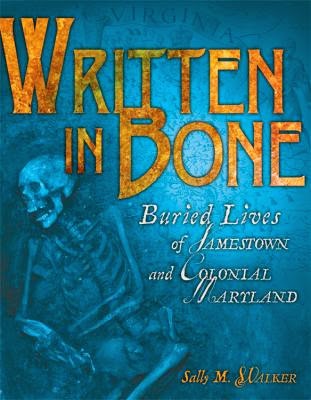
Written in Bone: Buried Lives of Jamestown and Colonial Maryland by Sally M. Walker

Laura in the Youth Services Department at Thomas Ford Memorial Library grew up in Maryland. When I mentioned that I took a trip to St. Mary's County in Maryland to do some family history research, she suggested that I read Written in Bone: Buried Lives of Jamestown and Colonial Maryland by Sally M. Walker. A day or two later in the lunch room, Uma, head of the Youth Services Department, saw that I was reading a Sally M. Walker book. She said that Walker is a well-known author of nonfiction for youth and that our library usually buys her books. A lot of hands touched the book before it landed in my hands, for which I am grateful.

Reading Written in Bone is much like watching an episode of Nova on our local PBS station. Walker shows in pictures and explains through text the work and findings of forensic archaeologists uncovering burial sites in two of our country's original English colonies. Her reporting is on the spot down in the dirt. You can almost feel the Chesapeake heat and humidity as the archaeologists brush the soil from the bones of individuals who died in the 17th and early 18th centuries. Better yet, you get to witness how they examine evidence to learn how the early settlers lived and died.

Looking at our library's catalog of books, I see that Walker has written books at various grade levels. I am attracted to two titles similar to Written Bone. Frozen Secrets recounts Antarctic exploration, and Secrets of a Civil War Submarine uncovers another a bit of American history. I am glad to be a big kid set loose in the children's book collection.

Walker, Sally M. Written in Bone: Buried Lives of Jamestown and Colonial Maryland. Carolrhoda Books, 2009. 144p. ISBN 9780822571353.

Monday, August 04, 2014

The Tale of the Dueling Neurosurgeons: The History of the Human Brain as Revealed by True Stories of Trauma, Madness, and Recovery

I picked up an advanced reading copy of The Tale of the Dueling Neurosurgeons: The History of the Human Brain as Revealed by True Stories of Trauma, Madness, and Recovery by Sam Kean at the Public Library Association Conference in March. The fact that there was a pile of them for the taking in the exhibit hall indicates to me that the publisher was hoping librarians would help lift the book to a profitable plateau in public book awareness. I do not know how well the book has done at bookstores, but Amazon readers have rated it at about 4 1/2 stars. I see it now in 19 of 77 libraries in my local consortium (over half are loaned out) and over 400 libraries according to Worldcat. That is modest success.

I intended to read it before publication in May. Where was my brain? Rather, where was my mind? Better still, where in my brain is my mind? That's part of what The Tale of the Dueling Neurosurgeons is about. Many of the chapters in the book recount how cases of brain trauma to various regions of the brain helped physicians (some just country doctors of their time) deduce the locations of specific brain functions and misfunctions. Some of the stories might make readers wince, as the author tells about doctors viewing and poking around exposed brains. Readers inclined to good science stories will, however, enjoy the frank descriptions.

The Tale of the Dueling Neurosurgeons lends to a bit of reader self-diagnosis, too. Several times I found myself stopping to think about why I turned my head ever so slightly to favor a dominant eye, why I laugh when I do, or whether the left or right side of my brain controls most of what I do. In an entertaining way, Kean gives us much to contemplate. As I finished, I felt enlightened, as well as thankful for not having had brain trauma.

Kean, Sam. The Tale of the Dueling Neurosurgeons: The History of the Human Brain as Revealed by True Stories of Trauma, Madness, and Recovery. Little, Brown, and Company, 2014. 400p. ISBN 9780316182348.

Monday, July 21, 2014

Ten Billion by Stephen Emmott

We have an emergency and are doing little about it, according to computational scientist Stephen Emmott in his book Ten Billion. Everyone talks about global warming, but our troubles are much greater than climate change. As the world population grows, demand for food and water grows, but our resources are limited. Serious planning for the future needs to be done now, but Emmott believes little has been accomplished so far and there are few signs of any action in the near future. By the time enough people notice our situation, it may be too late to avoid catastrophe.

Take the subject of food production. The reason there are so many of us is that humans have succeeded in greatly increasing agricultural production three times in the history. We seem to assume that we can do it again, but Emmott says that it will not be so easy. Most of the land good for agriculture is already being used, and some of it is in bad shape because of soil depletion and erosion. The Green Revolution of the 1960s and 1970s is not a good model for the future as it required great amounts of water (a declining resource) and steady use of artificial fertilizers, herbicides, and pesticides, which have polluted water.

Next take water. Many aquifers are being rapidly depleted. People who believe we can invent our way out of every problem say there is plenty of ocean water to desalinate. The problem is that it takes a lot of energy to remove salt out of water to produce quantities needed by large communities or for agriculture. Desalination produces waste and pollution, and ways to delivery great quantities of water inland has not been planned.

With more people, there will be more demand for many consumer items, increasing the demand for water, energy, and metals for manufacturing. Every aspect of life on earth will be stressed. What can we do? Emmott thinks we either have to 1) technologize our way out of the situation (possible but unlikely) or 2) radically change our behaviors of consumption and procreation (again possible but unlikely). Seeing that there will soon be ten billion of us, he thinks that there are bad days ahead.

Ten Billion is a very scary book. As a rule, people do not like to read very scary books without zombies. In Emmott's book, we are the zombies. Passionate and eloquent throughout, the author tries to wake us from our sleep. Ten Billion is a slim volume with much to report and would be a great book discussion choice.

Emmott, Stephen. Ten Billion. Vintage Books, 2013. 216p. ISBN 9780345806475.

Monday, July 07, 2014

The Light in High Places: A Naturalist Looks at Wyoming Wildness, Rocky Mountain Bighorn Sheep, Cowboys, and Other Rare Species by Joe Hutto

Add Joe Hutto to my list of favorite authors. After finishing Touching the Wild: Living with the Mule Deer of Deadman's Gulch, I had to read his previous book The Light in High Places: A Naturalist Looks at Wyoming Wildness, Rocky Mountain Bighorn Sheep, Cowboys, and Other Rare Species. The subtitle well describes the wide-ranging subject matter, except it does not indicate how autobiographical a book it is. Anyone who has been charmed by Hutto in Touching the Wild or his early book Illumination in the Flatwoods: A Season with the Wild Turkey will want to read what Hutto tells about himself. He is a most interesting character.

Reading The Light in High Places reminds me how great it was that Bonnie and I went to Wyoming last year and makes me want to go again. Hutto probably does not want the place overrun with tourists, but he sees that well-run, eco-friendly tourism can help with the protection of the places and wildlife that he loves. A reader will see that as a hunter Hutto also sees a place for hunting, but he is greatly troubled by the idea of hunting as sport and big business. The aims of traditional rural life and wildlife conservation are not served by such sport, which caters to people who pay to kill threatened species.

Hutto does not consider himself a cowboy, coming from Florida and trained as a naturalist, but he is very respectful of men and women who grew up with traditional cowboy skills. He has learned many of those skills and managed ranches, but he still seeks advice and assistance from the experts. He sees himself as a dedicated scientist and enjoys spending months alone in species studies on the tops of mountains. He tells us how hard such studies are, but I bet many of us would like to join him for a day or two. Imagine the vistas!

If Worldcat is to be trusted, there are just about 150 copies of The Light in High Places in U.S. libraries, only about three per state. Illinois has eight. I think there should be more copies available. I am afraid Hutto and his eloquent books are among the rare species in need of attention. They should not be allowed to disappear unnoticed.

Hutto, Joe. The Light in High Places: A Naturalist Looks at Wyoming Wildness, Rocky Mountain Bighorn Sheep, Cowboys, and Other Rare Species. Skyhorse Publishing, 2009. 281p. ISBN 9781602397033.

Monday, June 30, 2014

Sally Ride: America's First Woman in Space by Lynn Sherr

Astronaut Sally Ride was a very private person, a tough position to keep for someone so famous, an icon for the women's movement and hero of many children. Being the first American woman in space in 1983 put her in the national spotlight and subjected her to media attention for several years. Offered publishing contracts, she resisted writing anything more than a few magazine articles and a children's book about herself, and those writings can be described as more inspirational than personally revealing. She kept her affairs private. So, it was a surprise to the public when her obituary revealed that she enjoyed a long same-sex relationship.

Two years after her death, Ride is the subject of a biography by one of the journalists who closely followed her career from her early days at NASA. Lynn Sherr also counted herself as one of Ride's friends, having often had dinner with her over the course of nearly 30 years. In Sally Ride: America's First Woman in Space, Sherr admits that even she knew nothing about her friend's secret relationship.

While Ride's sexual orientation may now be the topic that may bring many readers to Sherr's book, it is not the overriding focus of the biography. Even Ride's initial trip into space is just an episode (though a very important episode) right at the halfway point in the book. Sherr takes a look at all of Ride's life, showing how her subject identified herself more as an athlete, physicist, and educator than astronaut, not exactly the person the media portrayed.

Because Sherr says so much about America from the 1950s to the present, the biography Sally Ride serves as a portrait of all of us, showing the way we reacted to Ride's fame and now to her death. Sympathetic to Ride, never sensational, this new biography may help us understand the way we treat science, celebrity, and controversy.

Sherr, Lynn. Sally Ride: America's First Woman in Space. Simon and Schuster, 2014. 320p. ISBN 9781476725765.

Wednesday, June 25, 2014

My Brief History by Stephen Hawking

Only this book is brief. Stephen Hawking's life, as he describes in My Brief History, has been relatively long compared to his prospects after being diagnosed with amyotrophic lateral sclerosis in his senior year at Oxford in 1963. He has been under the cloud of short expectations ever since, just carrying on as best he can. That's 51 years in which he has had a family and three children, written numerous hefty books, travelled the world, and become nearly as famous as Albert Einstein as a theoretical physicist. The threat of death encouraged him to make the best of his time.

His mobility and dexterity declined steadily after diagnosis, and in 1985 he required an emergency tracheotomy which stole his ability to speak. He now communicates through a wheel-chair-mounted computer linked to movements of his cheek bones. His ability to stay positive and involved in life is remarkable.

What I like about My Brief History is that Hawking is a natural story teller, concise and humorous. I almost wanted to both laugh and cry when the first doctor he consulted about his growing awkwardness told him to lay off the beer. I also enjoyed reading about the childhood bet of a bag of sweets that he would never amount to anything. That wager foreshadowed bets with other physicists made throughout his career.

I also like that Hawking included some serious science with challenging questions in this short memoir. My favorite question may be (paraphrased): if all time is current and everlasting, why don't we remember the future like we remember the past? Hawking says time travel is theoretically possible but impractical, as massive numbers of infinitesimally small particles would have to be controlled and sent at the speed of light. At least, that the way I understand what he said.

My Brief History is a slim book and only a little over two hours as an audiobook. I enjoyed listening to the audiobook twice.

Hawking, Stephen. My Brief History. Bantam Books, 2013. 127p. ISBN 9780345535283.

also, 2 compact discs. Books on Tape/Random House, 2013. ISBN 9780804164306.

Monday, April 21, 2014

A Feathered River Across the Sky: The Passenger Pigeon's Flight to Extinction by Joel Greenberg

The 100th anniversary of the extinction of the passenger pigeon, once North America's most populous species, is this year. The last pigeon, a female named Martha, died in the Cincinnati Zoo on September 1, 1914 after being the only one of her kind for about three years. There may have been billions of passenger pigeons only 40 years earlier. Just how could this have happened? The Field Museum of Chicago's Joel Greenberg tells us the very sad story in A Feathered River Across the Sky: The Passenger Pigeon's Flight to Extinction.

Passenger pigeon science is a bit iffy as the birds disappeared before academically-trained research scientists were available to study them. Greenberg has had to plow through all sorts of newspaper accounts, letters, journals, and other papers that were obviously filled with as much myth and misinformation as firm data. One of the most misleading statements often repeated by professional hunters was that the passenger pigeon nested up to four times in a breeding season and that a clutch usually included two eggs. They stated that there would never be a shortage of passenger pigeons. What Greenberg concludes from more reliable sources was that most pigeons bred once and raised one chick. Usually the flocks moved too often to new feeding grounds to have bred more than once.

According to Greenberg in A Feathered River Across the Sky, there never seems to have been much sympathy for passenger pigeons while they lived in great quantities. They could arrive in the millions and destroy farmers' crops and woodlots. Ironically, many hungry people celebrated when passenger pigeons arrived in their areas as they supplemented their family meals with pigeons. Once railroads crossed the country, professional hunting companies harvested and shipped millions of birds as cheap food for cities. In the 1870s and 1880s, every mass pigeon gathering was a slaughter with people netting birds for the live bird trade trying to keep from being shot by local and corporate hunters with guns. The population plummeted quickly.

21st century readers may be shocked by the behavior of their ancestors. Yet every thing they did was thought justified at their time. That should make us question current times, when we say that we need to exploit our resources for economic reasons and deny that they are limited.

I fear that A Feathered River Across the Sky will be passed over by many in our entertainment-crazy society, but Greenberg tells many good stories with lessons that should be headed. Look for it at your public, school, or college library.

Greenberg, Joel. A Feathered River Across the Sky: The Passenger Pigeon's Flight to Extinction. Bloomsbury, 2014. 289p. ISBN 9781620405345.

Wednesday, April 02, 2014

The Age of Radiance: The Epic Rise and Dramatic Fall of the Atomic Era by Craig Nelson

Would you call The Age of Radiance: The Epic Rise and Dramatic Fall of the Atomic Era by Craig Nelson a microhistory? In this book, Nelson recounts a bit more than a century of discovery and application of atomic science, in a sense a narrow topic, but one that has had so much impact on politics, the economy, the environment, and all of our lives. Applying this science has come close to killing us.

Like an epic novel, Nelson's history has many characters, and like great novelists, the author has made many of them memorable. These are famous atomic physicists, names that most of us already know, but I will wager many of us really could not identify them in a pop quiz. Nelson knows them well.

About Pierre and Marie Curie, he wrote, "When the couple pressed glowing radium against their eyelids, they saw fireworks and meteors flashing across the retinas." (p. 31)

About Enrico Fermi,  he quotes Nobel prize winner Hans Bethe, "Fermi seemed to me at the time like bright Italian sunshine. Clarity appeared wherever his mind took hold ..." (p. 61)

"Niels Bohr was both a famed soccer player in his youth and Ping-Pong champion as an adult, while Werner Heisenberg spent his life downhill racing, at one time clocked at an alarming fifty miles an hour." (p. 66)

Albert Einstein, Leo Szilard, Lise Meitner, Otto Hahn, Robert Oppenheimer, Edward Teller, and on and on. It helps to keep a scorecard. It also helps to take the book slowly and let the story steep. It took me 9 or 10 days to pass from the early days of atomic discovery, past the World War II race to build a weapon, through the Cold War, to the present, when keeping weapons out of the hands of terrorists and rogue states is a top concern.

Passing through the decades, I felt many moods while reading. I enjoyed the scientific discovery period, futilely rued weapons development (hopelessly hoping the bomb would never work), and cursed the decades of senseless proliferation of bigger and deadlier weapons. The author makes clear the cost of atomic power and weapons to individuals and society. I am not certain the author state his opinion this way (the age of atomic science is a complicated story), but my take is that money, lives, and the integrity of our governments have often been wasted on systems that have failed to benefit humankind. The Age of Radiance is a sad but important story. I hope it generates will for positive changes.

Nelson, Craig. The Age of Radiance: The Epic Rise and Dramatic Fall of the Atomic Era. Scribner, 2014. 448p. ISBN 9781451660432.

Friday, January 31, 2014

Look Up! Bird-Watching in Your Own Back Yard by Annette LeBlanc Cate

The American Library Association announced its children's book awards this week, including the highly-entertaining Look Up! Bird-Watching in Your Own Back Yard by Annette LeBlanc Cate. This illustrated introduction to bird watching was named an honor book in the Robert F. Sibert Informational Book Awards. Knowing I enjoy bird watching, Heather Booth handed me a copy of the book. It was instant love. After work I brought the book home and started reading right away.

Of course, I am a bit older than the target audience, but I must propose that Look Up! would be a great beginning bird book for any age reader. Anyone over nine years old can benefit from a look at this book. The author/illustrator introduces almost every important topic of interest to birders, including how to distinguish field marks, how to read range maps, how to observe behaviors, ethical bird watching, and scientific classification. She even advocates for scavengers, birds that some people dislike. She accomplishes this in 52 illustrated pages.

Like naturalist/journalist Pete Dunne, Cate urges birdwatchers to learn to sketch birds in the wild. The discipline makes the bird watcher note the field marks. Maybe I should take this advice.

Now that Look Up! has been honored by the ALA, look for it in more libraries.

Cate, Annette LeBlanc. Look Up! Bird-Watching in Your Own Back Yard. Candlewick Press, 2013. ISBN 9780763645618.

Monday, November 11, 2013

Falling Upwards: How We Took to the Air by Richard Holmes

When I began reviewing for Booklist, Brad Hooper enlisted me to read new science titles. At some point I let him know that I would also review biography or history. So, Falling Upwards: How We Took to the Air by Richard Holmes was a perfect assignment - a book about the history of ballooning with generous technical details and biographical profiles. I chose it first from a shipment of books that Brad sent at the end of summer and was not disappointed.

I have never gone up in a balloon, but I have always thought it would be spectacular to float over the earth, getting a grand sweeping view of town and country. It never looked particularly dangerous to me, but a reader of Falling Upwards will learn that it can easily become deadly. Several of the pioneers of ballooning lost their lives in accidents, some in particularly dramatic fashion. Most notably, thousands of people witnessed the death of French heroine Sophie Blanchard as she fell from the sky over Paris in 1819. Also, Thomas Harris may have jumped from a plummeting balloon to reduce the weight and save the life of the mysterious and beautiful young woman that he taken for a ride in 1824. Other balloonists barely survived unforeseen circumstances only to repeatedly test the skies again and again.

In the late 18th and throughout the 19th centuries there were always unforeseen circumstances. Weather forecasting was just a dream, and balloonists had no actual means to steer their balloons. They might lose air or catch fire at almost any point. Some balloonists fainted from oxygen deprivation when they flew too high. The perils were numerous, but experimenters persisted in believing balloons were the key to modern rapid transportation of goods, communications, and people. Only the success of the Wright Brothers in introducing powered flight brought the balloon dream to an end.

In Falling Upwards, Holmes tells many great stories, including how scientists first learned about the upper atmosphere firsthand and how the French used balloons to get letters and witnesses out of besieged Paris during the Franco-Prussian War. This entertaining history will appeal to many readers.

Holmes, Richard. Falling Upwards: How We Took to the Air. Pantheon Books, 2013. 416p. ISBN 9780307379665.

Wednesday, September 18, 2013

The Botany of Desire: A Plant's-Eye View of the World by Michael Pollan

Michael Pollan has been on my to-read-again list since earlier this year when I heard entertaining New York Times Book Review and NPR Books interviews of the author. He had just published Cooked: A Natural History of Transformation, which sounded as though it would interest anyone who cooks or eats. I have not borrowed the new title yet, but when I found a library audiobook of The Botany of Desire: A Plant's-Eye View of the World available, I downloaded it instead.

The Botany of Desire was published in 2001 and predates Pollan's biggest bestseller The Omnivore's Dilemma. In The Botany of Desire, Pollan tells stories about four prominent plant families in the context of agricultural cultivation, attributing to each different qualities that people crave.
  • sweetness - the apple
  • beauty - the tulip
  • intoxication - marijuana
  • control - the potato
Each plant gets a lengthy chapter full of botanical information, cultural history, and personal accounts of Pollan's gardening efforts. His story about growing marijuana is both suspenseful and somewhat comic.

Pollan first, however, considers the apple, which in America is closely associated with the folk tales of Johnny Appleseed. The author profiles 19th century pioneer John Chapman, the real person on whom the Johnny Appleseed legend is based. Pollan spends much of the chapter myth-busting. The apple trees that grew from the seeds Chapman planted or sold produced apples that were usually not good for eating. Instead, they were bitter and small, only good for making hard cider - what most 19th century Americans actually wanted from apples. Apples were rarely eaten before Prohibition. Ironically, because apple seeds are genetically very unpredictable, Chapman's mass distribution of seeds established the U.S. as the country with greatest genetic diversity, which has led to all of today's great eating apples. The irony is that these varieties have to be maintained by grafting, not by seed planting.

Throughout the chapters, Pollan works the idea that the plants are really in control, using humans to assist their survival and development. By giving humans what they desire, the plant families prosper and adapt to new regions. Without humans, apple, tulip, marijuana, and potato populations would decline drastically.

Like the plants, The Botany of Desire satisfies human cravings - those for wickedly good stories and those for learning. It is still good a dozen years after its publication.

Pollan, Michael. The Botany of Desire: A Plant's-Eye View of the World. Random House, 2001. 271p. ISBN 0375501290.

Wednesday, July 31, 2013

The Universe Within: Discovering the Common History of Rocks, Planets, and People by Neil Shubin

Joni Mitchell was right when she sang "We are stardust ..." in her song "Woodstock." According to University of Chicago professor Neil Shubin in his recent book The Universe Within: Discovering the Common History of Rocks, Planets, and People, the human body is composed of elements that were forged by the stars. There had been a point when there was only hydrogen, helium, and lithium. The process took billions of years, and it may have been only five to ten million years ago that the right elements in the right quantities under the right conditions allowed our species, or at least its predecessors, to evolve on earth. No knowing about elsewhere. 

So what contributed to our appearance on earth? Our solar system had to absorb stellar matter, form spheres, and establish orbits, and the earth had to stabilize with a temperature in a receptive range for life. We need to thank Jupiter and its gravitational pull for keeping us viable. Warm water had to foster the growth of single cell organisms, some of which had to develop photosynthesis to build up available oxygen reserves for a great variety of spiny and spineless creatures to evolve and spread over the planet. There were many other contributing factors. Even the break up of the super continent was necessary to get the balance of elements right. 

Shubin has written popular science before. His Your Inner Fish was awarded best book of the year by the National Academy of the Sciences in 2009. The Universe Within expands on the themes he introduced in that book, starting with the Big Bang and ending with the age of DNA research. He tells a great story with many interesting characters, some of them human. Look for it in libraries with the earth sciences books. 

Shubin, Neil. The Universe Within: Discovering the Common History of Rocks, Planets, and People. Pantheon Books, 2013. 225p. ISBN 9780307378439.

Friday, July 12, 2013

The King of Infinite Space: Euclid and His Elements by David Berlinski

In high school, I never knew how ancient the proofs of geometry were. I worked with points, lines, and planes without feeling I was part of a continuum, enjoying how new the ideas of logic applied to shapes and spaces felt. Only years later did I read about Euclid and how for over 2000 years his axioms had been applied in mathematics, engineering, and philosophy.

According to David Berlinski in his book The King of Infinite Space: Euclid and His Elements, the writings of Euclid have held up very well, withstanding many who have tried to disprove his propositions. Only the parallel postulate from his book The Elements continues to trouble as no one has been able to definitively prove or disprove it. Euclidean geometry was the only geometry until the middle of the nineteenth century when non-Euclidean geometry rose to explain some phenomena not previously explained.

In picking up this small volume, I hoped to learn more about Euclid himself, but there is little to know. Like Shakespeare, it is his writing that has survived to inspire new generations of scholars, many of whom still swear by him. Though it has been many years since I studied geometry, I found I could follow most of the text of The King of Infinite Space and enjoyed puzzling about negative numbers, infinity, and our ability to test theories about real things on geometrical models. I had to use a dictionary to read several pages, but my vocabulary may expand from the effort.

Berlinski, David. The King of Infinite Space: Euclid and His Elements. Basic Books, 2013. 172p. ISBN 9780465014811.