Showing posts with label plays. Show all posts

Monday, October 21, 2013

Henry IV Part 1 by William Shakespeare


Bonnie and I recently watched the Great Performances broadcast of William Shakespeare's Henry IV Part 1. Including both Jeremy Irons (above) and Tom Hiddleston, the film shot in historical locations in Great Britain promised to be entertaining. It proved fascinating, but I was a little confused throughout.

Shakespeare did not provide an explanatory prologue in Henry IV Part 1. Instead, readers of the play or viewers of the broadcast are from Act One thrown right into the plot with Henry IV (Irons) telling his court why he is unhappy with the news from battlefronts. Long passages introduce numerous characters, whose allegiances are questionable. I knew from previous Shakespeare experiences to wait and much will become clear. In the meantime, I tried to remember bits of British history and draw on my memory of reading the play in college.

I found that I remembered comic parts about the Prince and his friend Falstaff better than any of the political and military history. Of course, on the screen the pub scenes seemed edgier than I ever imagined when reading. The prince was more wayward than just a school boy involved in pranks. Hiddleston brought the role to life splendidly.

Near the end of the video during the battle scene, Bonnie pulled down The Riverside Shakespeare (one of the few books that I have kept from college) and tried to follow along. She discovered that some very helpful lines were cut and the sequence of the action altered somewhat. After the play ended - its summation as brief as its introduction - I kept The Riverside Shakespeare out and read the play again over the next three nights.

I see now that while viewing I confused facts about the character Mortimer with that of the character Worcester. I also learned the Henry Percival the younger, called Hotspur, was a brother-in-law of Mortimer. Mortimer had been designated as heir by Richard II, who was dethroned and probably executed by Henry IV. Mortimer was a more important character than I realized. No wonder Hotspur had issues with the king.

Reading the play before viewing the broadcast would help, but conversely, viewing the broadcast helped me in reading the play. Make your choice.

The play is part of the Hollow Crown: Shakespeare's History Plays Series, produced by Thirteen New York Public Media's with NBC Universal International, and Neal Street Productions (who made Call the Midwife). I do want to see more. We were supposed to start with Richard II. We'll have to get the DVD from the library or watch online.

Friday, September 07, 2012

Troilus and Cressida by William Shakespeare

Recently, I heard voices telling me "Read Troilus and Cressida by William Shakespeare." First, it was Lorenzo speaking with Jessica in Act V Scene I of The Merchant of Venice, which we saw under the stars in July.

   "Troilus methinks mounted the Troyan walls
   And sigh'd his soul toward the Grecian tents,
   Where Cressid lay that night."

Then it was a group of actors in Oxford in an episode of PBS Masterpiece Mystery's Inspector Lewis. They were recording Troilus and Cressida for a professor. The young woman playing Cressida became a murder victim, and her boyfriend who read Troilus was a suspect.

Finally, we replaced a bunch of old Shakespeare volumes in our library's play collection with fresh copies. Among the additions was an edition of Troilus and Cressida from the Folger Shakespeare Library. It was definitely time to read this play of which I was unfamiliar.

Despite the clues in the brief encounters above, I was totally surprised to learn that Troilus and Cressida tells a story from the siege of Troy by the Greeks wanting the return of Helen, Queen of Sparta, who had been kidnapped by the besotted Paris. Having once read The Iliad, I was able to figure out some of what was going on. The story, however, seems a bit different from what I remember of the battle between Achilles and Hector. It is certainly different than the battle in the movie Troy.

According to the introduction in the Folger Shakespeare Library edition, the playwright drew from Homer and from Troilus and Criseyde, a play by Chaucer. Shakespeare's play was published in 1609, but there is no evidence of its being performed during his lifetime. The Riverside Shakespeare says the first known performance was in 1898. To help modern readers, the Folger edition has text on the right hand page with extensive footnotes on the left hand page.

Troilus and Cressida is a hard play to categorize. There is comic banter that reminds me of Much Ado About Nothing and a forbidden steamy romance much like Romeo and Juliet. In the fourth act, most of the Greeks and Trojans enjoy a friendly banquet together to prepare for the next day's battle. The main characters (if you use the title as a clue) hardly appear in the final act and then not doing much of final importance. The Riverside Shakespeare groups it with the comedies but calls it historical.

Troilus and Cressida is not among Shakespeare's masterpieces, but it is interesting for those wanting more after having repeatedly seen or read the major plays.

Shakespeare, William. Troilus and Cressida. Simon and Schuster, 2007. 343p. ISBN 9780743273312.

Friday, June 22, 2012

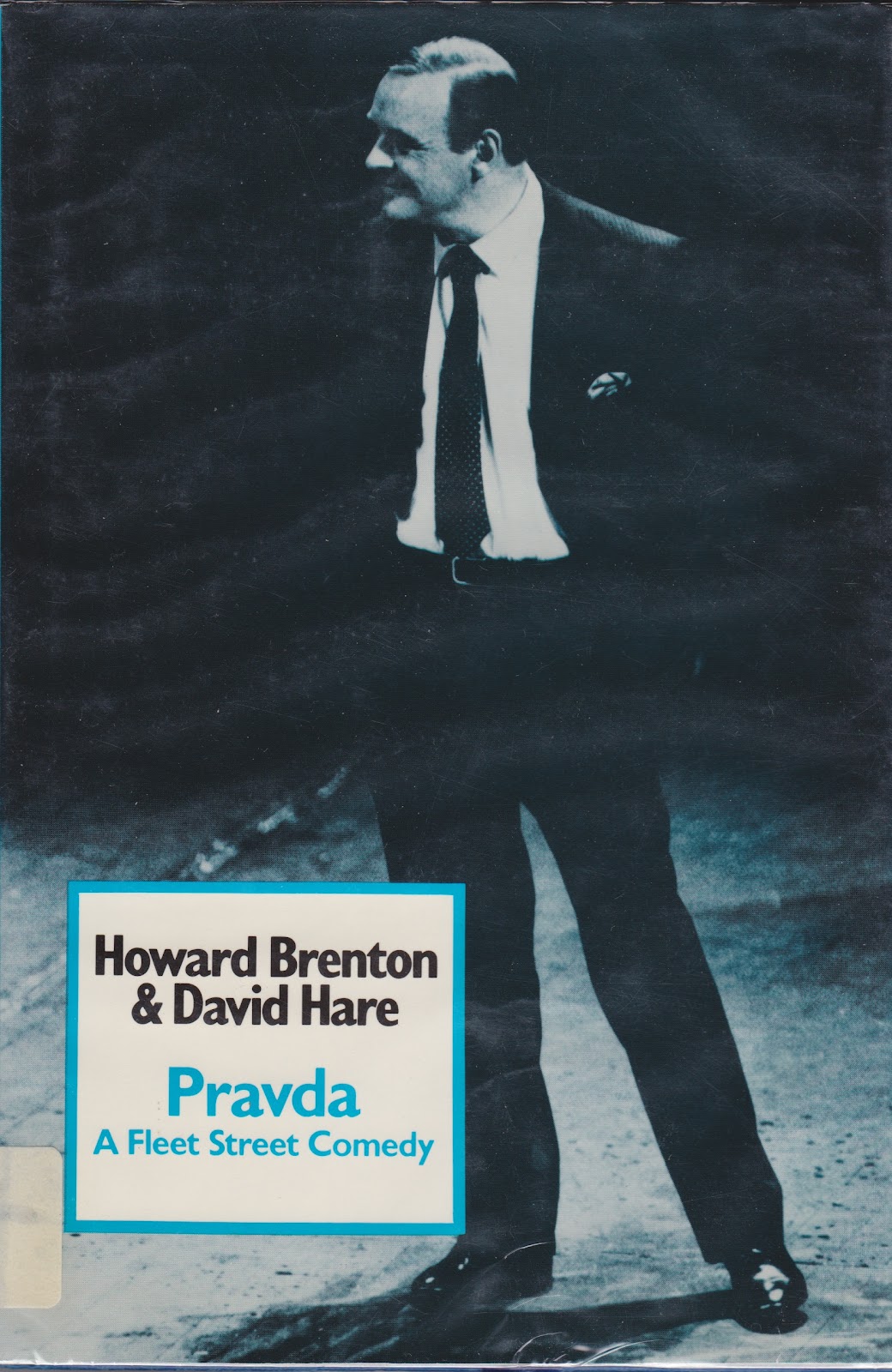
Pravda: A Fleet Street Comedy by Howard Brenton and David Hare

Bonnie and I attended a slew of plays when we spent two weeks in and around London in late spring 1985. I was reminded of this when I found Pravda: A Fleet Street Comedy by Howard Brenton and David Hare at my library. At the National Theatre we saw Anthony Hopkins in the role of Lambert Le Roux, a very Rupert Murdoch-like newspaper tycoon. We knew of Hopkins from several programs that we had seen on Masterpiece Theater. He was big then but not as big as he would become soon after. We were very lucky to get tickets, as the play had just debuted. We were at the right place at the right time to get returned tickets and had great seats.

After 27 years, my memory of the actual play is fuzzy, so I borrowed and read the book. I was surprised to learn that we also saw a young Bill Nighy as La Roux's evil aide Eaton Sylvester. I verified this with the playbill, which we still have. In Pravda, La Roux and Sylvester dissect the very lax-standards British newspaper publishing industry for their own profit. The comedy is very dark in this play that foresaw much that seems to have become true in Britain and the U.S.

If you have not tried reading plays since high school, let me recommend them to you. They are usually dramatic (of course) and take just an hour or two to read (depending on your reading speed).

Brenton, Howard and David Hare. Pravda: A Fleet Street Comedy. Metheun Inc., 1985. 148p. No ISBN.

Wednesday, May 18, 2011

The Oscar Wilde Collection

Depending on which biographies you read, Oscar Wilde died a broken man or simply publicly disgraced but certain himself of his legacy. I like to think the later, particularly after listening to his four plays on four consecutive days. Each was an hour or more delightfully spent, laughing at the embarrassing situations in which British aristocrats lowered themselves. Best of all, Wilde was the master of satirical statements, which flowed from many of the characters. Many are quotable, such as these from An Ideal Husband:

To love oneself is the beginning of a lifelong romance.


Lord Caversham: What are you doing here, sir? Wasting your time, as usual?
Lord Arthur Goring: My dear father, when one pays a visit, it is for the purpose of wasting other people's time and not one's own.


Gertrude, it is not the perfect, but rather the imperfect who have need of love.


Life is never fair, Robert. And perhaps it is a good thing for most of us that it is not.


Laura: The higher education of men is what I should like to see. Men need it so sadly.
Lady Markby: They do, dear. But I'm afraid such a scheme would be quite unpractical. I don't think man has much capacity for development. He has got as far as he can, and that is not far, is it?


I listened to the plays on compact discs from The Oscar Wilde Collection from L. A. Theatre Works, which include the voices of many great actors, such as Miriam Margolis, Martin Jarvis, Jacqueline Bissett, and Alfred Molina. The production quality is very high, and I always knew what was going on without any narration or visuals. I could in my mind create the action. I imagined drawing rooms with players in period costumes. The plays are great audio theater.

Some critical conversations with directors are also included on the discs. Michael Hackett calls The Importance of Being Earnest the pinnacle of Wilde's career. He says that it drew from Shakespeare and led to the writing of P. G. Wodehouse and eventually to Monty Python. I'll grant that it was excellent, but I favor A Woman of No Importance and An Ideal Husband, which seemed to be a bit more serious about exposing hypocrisy and the fragility of relationships. I can not decide which is better. Why should I? I recommend both to anyone who likes witty conversation and situation comedy.

The Oscar Wilde Collection. L. A. Theatre Works, 2010. 10 discs.* ISBN 158081753X

*A dramatization of The Picture of Dorian Gray is also included, but I chose not to listen and review it, as I was having so much fun otherwise.

Monday, February 14, 2011

Courtship: Valentine's Day: 1918: Three Plays from the Orphans' Home Cycle by Horton Foote

Having just read and discussed Mockingbird: A Portrait of Harper Lee by Charles J. Shields, I was reminded that Horton Foote wrote the screenplay for To Kill a Mockingbird. Remembering that I enjoyed reading his plays, I reread Courtship: Valentine's Day: 1918: Three Plays from the Orphans' Home Cycle, short plays which are really appropriate reading for today, our day to celebrate romance.

Foote's three plays are set between 1915 and 1918 in the small town of Harrison, Texas. They begin with Elizabeth Vaughn complaining with her younger sister Laura about how much they are missing because their father will not let them go to the local dance. Sitting on the porch listening to the music, Elizabeth wishes she could be there with her new beau Horace Robedaux, who drops by to describe the event. Her father, identified formally through the trilogy as Mr. Vaughn, frequently visits the porch to urge the college age girls inside and to dissuade Horace from staying. By the end of the one act "Courtship," we learn much about the community and just how serious Elizabeth is about Horace.

The first surprise of the one-act, three-scene "Valentine's Day" is that it is set at Christmas 1917. We learn what happened the previous Valentine's Day, while the characters resolve ten-month-old disagreements. "1918" is set a few months later when the community is beset with a flu epidemic and the return of soldiers from the war in Europe. Elizabeth and Horace remain the focus in these plays through which the troubles of the times are eloquently expressed. The couple endures, and we are left feeling that their love is what will hold their world together in the challenging decades to come. The plays are good reading for today or any day.

Foote, Horton. Courtship: Valentine's Day: 1918: Three Plays from the Orphans' Home Cycle. Grove Press, (1987). ISBN 0394560744

Wednesday, November 03, 2010

The Madness of Edgar Allan Poe by David Rice

For nearly ten years, Bonnie and I have been attending outdoor productions of Shakespeare plays by First Folio at Mayslake Peabody Estate Forest Preserve in Oakbrook, Illinois. We have taken picnics and stayed for both the tragedies (Hamlet, MacBeth, Richard III) and the comedies (Twelfth Night, Much Ado About Nothing, Midsummer Night's Dream) under the stars. Despite sticky heat or evening cold, we have always enjoyed lively and imaginative performances. We go almost every summer.

Starting in 2004, First Folio moved into Mayslake Hall, the mansion/monastery that we had always viewed with curiosity. It took us several years to move with them, but in 2008 we saw the hilarious adaptation Jeeves Intervenes by P. G. Wodehouse, staged in the mansion's old library. We were a bit disappointed by Noel Coward's Design of Living in 2009 but loved Jeeves in Bloom in winter 2010. The latter play was staged in the mansion's chapel, a soaring space well suited for intimate theater.

So we were gung-ho to see First Folio's third staging of The Madness of Edgar Allan Poe by David Rice, one of the theater company's founders. We even managed to get tickets for Halloween Night. I was also excited to learn that each scene of the play was staged in a different room of the mansion. We were getting to join our love of theater with our hobby of touring old buildings.

The play lived up to its billing and my imagination. With morbid flare, the players acted out scenes both from Poe's life and from his poems and short stories. We were thrown into nearly total darkness in "The Pit and the Pendulum" and had the murderer right in our faces in "The Tell-Tale Heart." Diane Mair was as I would imagine the petite Virginia Poe, the tortured author's child bride. Understudy Michael Aguirre was a sympathetic yet disturbing Poe.

I'd like to go again.

Monday, March 02, 2009

The Lion in Winter Book Discussion at La Petite Sweet

On last Thursday evening, while the rain lashed at the windows of La Petite Sweet, members of the St. Luke Presbyterian Church book group discussed The Lion in Winter, a play by James Goldman. It was the first time that we had met at the bakery/dessert shop in Westmont, Illinois. The owners set us up with a couch, comfy chairs, and handy tables, and we selected coffees, teas, and cocoa. With a platter of assorted cookies, we sat for nearly two-and-a-half hours discussing the lives of twelfth-century monarchs and a contemporary comic drama about them.

We spent more time discussing history than the play itself. Several people in our group have read British history extensively and visited sites related to Henry II, Eleanor of Aquitaine, and their sons Richard, Geoffrey, and John. I used my library's Gale Virtual Reference to find articles from a variety of encyclopedias about all but Geoffrey, about whom less is written - probably because he did not become king like his two brothers. I also used the library's color copier to print an 11 x 17 map showing how much of France was under Henry II's control, thanks to his marriage to the beautiful and powerful Eleanor. One group member brought a book about Eleanor, and another a pocket-sized guide to British monarchs. Armed with these reference sources, we recounted stories about these ruthless monarchs who are still remembered after 800 years.

James Goldman wrote a variety of plays, screenplays, and novels, but The Lion in Winter was his major success. It was reviewed poorly on Broadway in 1966, but the 1968 movie with Peter O'Toole and Kathryn Hepburn was highly acclaimed. It has been revived frequently on professional and amateur stages. With simple settings and a limited number of characters, it is easy to stage, and it has numerous memorable lines. Still, several of us thought it was unsatisfying as reading. Goldman weaves 1960s pop psychology into dialogue. I doubt that the characters were so self-aware and full of historical perspective in 1183.

As light entertainment The Lion in Winter serves well, and it can introduce many topics. It made a great discussion choice.

By the way, La Petite Sweet cookies are excellent. I also recommend the cakes and cheesecakes.

Goldman, James. The Lion in Winter. Random House, 1966. No ISBN.

Friday, May 23, 2008

Doubt: A Parable by John Patrick Shanley

One of the factors that keeps people out of book discussion groups is choosing big books that require many hours to read. Some people will read portions and skim, but many will not, so attendance is low when the books are gigantic. There is no need to worry with the choice of Doubt: A Parable by John Patrick Shanley. The 2005 Pulitzer Prize for Drama is only 58 pages. It reads very quickly, yet my book group found plenty to discuss for an hour and a half.

Doubt has only four characters: two nuns, a priest, and the mother of a student at a Catholic school. The year is 1964, and Sister Aloysius is unhappy with the times. A shortage of nuns has required the school to hire some lay teachers. The students are unruly and unmotivated. Ballpoint pens are replacing fountain pens. She thinks the song "Frosty the Snowman" is offensive to the church. Most importantly, Sister does not like the charismatic priest whom she suspects of abusing students.

Shanley has written a play that works on many levels, making it very discussable. It is of current interest because of the recent revelations of abuse by clergy in many denominations. It can also be scene as a political parable. Short as it is, it made members of the discussion remember many other works that they had read and plays that they had seen. With one character believing something for which there is no evidence, reading Doubt confirms a theme in True Enough by Farhad Manjoo, which I recently read. The intrigue within a community of nuns reminds me of The Abbess of Crewe by Murial Spark.

Book groups looking for a worthy and marketable book should consider this gripping play.

Shanley, John Patrick. Doubt: A Parable. Theatre Communications Group, 2005. ISBN 1559362766

Monday, March 03, 2008

Jeeves Intervenes: A Play from First Folio

When the eager-to-wed Gertrude Winklesworth-Bode thinks that you have potential (i.e. you are spineless, defenseless, and malleable to her designs), you need someone with a bit of gray matter to save your sweaty neck. When Sir Rupert Watlington-Pipps is threatening to cut off your allowance and send you to the jute farms of India, you need someone with a talent for strategy. If you are Bertie Wooster and his pathetic friend Eustice Bassington-Bassington (pronounced baa-sington bay-sington), you turn to the greatest of British superheroes - (pause for dramatic effect) - Jeeves.

Based loosely on the P. G. Wodehouse short story "Jeeves and the Hard-Boiled Egg," Jeeves Intervenes is classic comic theater. Bonnie and I attended a very intimate performance of the First Folio Shakespeare Festival performance on Friday night at the Mayslake Peabody Estate in Oak Brook, Illinois. The stage was set for the six-character play in the old estate's wood-paneled library. With the stage at one end of the room and risers wall-to-wall, about eighty were seated for the play. Always smart, Bonnie had gotten our tickets in advance online. There were no empty seats.

The entire cast was top drawer. I think we had seen all of them in other First Folio productions. We were laughing nearly the moment the lights went up. Jim McCance as Jeeves calmly stepped forward with solutions to impossible problems just in the nick of time. Christian Gray was just the wastrel that Bertie should be, and Kevin McKillip was hilarious as his dim-witted friend Eustace.

I would recommend that you go, but the last performance was yesterday. What I can recommend is that you try other First Folio productions, especially the summer Shakespeare performances. We've been going for years.

You can find the original "Jeeves and the Hard-Boiled Egg" online at Classic Reader.