Showing posts with label biography. Show all posts

Wednesday, July 01, 2015

Jacksonland: President Andrew Jackson, Cherokee Chief John Ross, and a Great American Land Grab by Steve Inskeep

What forces shaped the culture, politics, and economy of the American South? The factors were many - it was not one man's doing - but NPR correspondent and author Steve Inskeep suggests that one particular man in the early 19th century played a key role in a struggle that allowed the South to develop as it did. That man was Andrew Jackson, and the issue was the forced removal of native tribes from the South. Inskeep tells the story in Jacksonland: President Andrew Jackson, Cherokee Chief John Ross, and a Great American Land Grab.

In Jacksonland, Inskeep focuses on two men. The first is, of course, Andrew Jackson, an icon of American history. The second is Cherokee chief John Ross, whose name is mostly forgotten today. Jackson and Ross were not always opponents, as the latter served in a Cherokee regiment under Jackson in the War of 1812. Ross was elected to the Cherokee Council in 1817, became its president in 1819, and spent the next twenty years negotiating with government officials in Washington to protect tribal land. Jackson and his wealthy friends, however, had designs on that land. When Jackson became president, the removal of the Cherokee tribe from the South became inevitable.

As the subtitle suggests, Jacksonland is a book in which the author's sympathies are apparent. What will interest many modern reader are the stories showing that Jackson seemed like a cad to many in his own time. Critics, mostly in the North, decried the forced removal of native tribes who had previously been assured by treaties of their territory in the South. For a while, the issue was hotter than slavery.

I listened to Inskeep read his book on compact disc. I especially liked the final section that brings the story to date, telling how many Cherokees never left and others returned to the South. The audiobook was good listening for commuting and gardening for a week.

Inskeep, Steve. Jacksonland: President Andrew Jackson, Cherokee Chief John Ross, and a Great American Land Grab. Penguin Press, 2015. 421p. ISBN 9781594205569.

Audiobook: Books on Tape, 2015. 10 compact discs. ISBN 9781101914953.


Monday, June 15, 2015

My Beloved World by Sonia Sotomayor

At a time when memoirs are fashionable, Sonia Sotomayor has published an autobiography. My Beloved World is not her full life story, ending the book with becoming a federal judge in 1992 after being recommended by Democratic New York Senator Daniel Patrick Moynihan and nominated by Republican President George H. W. Bush. Her wide-ranging book tells of her childhood, education, and early career as a lawyer. Besides being a how-I-got-to-this point-book, it is a testament to the years of her youth - which were the youthful years of the Baby Boom Generation.

The major outside force in Sotomayor's early life was the Civil Rights Movement. Her personal challenges were diabetes and the death of her Puerto Rican father when she was only nine. She took charge of her daily insulin shots, helped her mother run the home, and graduated as valedictorian at Blessed Sacrament Catholic School and at Cardinal Spellman High School. She received a scholarship to Princeton thanks to affirmative action, for which she is grateful. She is not ashamed of needing help and taking it. She points out that she was academically qualified and won many honors because she applied herself.

Sotomayor's book is a lesson about effort being rewarded. She tells several stories of starting new phases of her life without having role models to prepare her for the cultural challenges. The key she says is to be honest about your needs and ask questions and for help when necessary.

Being of Sotomayor's age, I enjoyed My Beloved World thoroughly and hope she will write another to recount her years as a judge.

Sotomayor, Sonia. My Beloved World. Vintage Books, 2014. 398p. ISBN 9780345804839.

Friday, May 15, 2015

A Love Affair with Birds: The Life of Thomas Sadler Roberts by Sue Leaf

When our daughter Laura led us through the Thomas Sadler Roberts Bird Sanctuary just north of Lake Harriet in Minneapolis in the summer of 2013, I had never heard of the nine-year-old boy who moved with his family to Minnesota in 1867 and grew up to be a leading doctor in the city. As a boy, he and his friends wandered the woods and canoed the lakes of the area, noticing the birds, about whom Roberts had learned much from his bird-fancying father. In A Love Affair with Birds: The Life of Thomas Sadler Roberts, Sue Leaf tells how Roberts balanced his dedication to medicine and his patients with his love of birds.

Roberts accomplished much in his life. Before medical school, he worked as a land examiner and civil engineer. Working as a doctor for over half a century, he treated many patients, delivered many babies, helped found the local medical society, and helped build hospitals. As a  ornithologist, he started birding clubs with his friends, led many bird walks, taught ornithology at the University of Minnesota, collected species for the natural history museum on the University campus, served as museum director, and eventually led the effort to build what is now the Bell Museum of Natural History. He may be most remembered for his two-volume The Birds of Minnesota which was published in 1930.

On one level, A Love Affair with Birds can be read as a tribute to an exemplary life. The author, however, offers the reader more than that. Her section on Roberts' medical career serves as a compelling history of health care in Minnesota, spanning the era in which Roberts road a horse to reach his rural patients or sometimes caught a trolley in town to his mature years when he rode with his chauffeur. The growth and development of Minneapolis runs through the story. Readers learn about the planning and building of hospitals and museums. Most of all, Leaf tells the story birds and the birding community of Minnesota.

Having been to Minneapolis over a dozen times now with prospects for many more visits, wanting to see all the Minnesota birds, I enjoyed A Love Affair with Birds immensely.

Leaf, Sue. A Love Affair with Birds: The Life of Thomas Sadler Roberts. University of Minnesota Press, 2013. 271p. ISBN 9780816675647.

Monday, May 11, 2015

H is for Hawk by Helen Macdonald

Falconry tests the endurance and sanity of anyone keen to attempt the sport. Author T. H. White was ill-prepared for his first attempt. Over 70 years later, Helen Macdonald was more experienced and realistic when she acquired a goshawk. Still, her experienced included self-doubt and despair, as well as self-discovery, as she recounts in H is for Hawk.

Just as it helps to read Middlemarch by George Eliot before reading My Life in Middlemarch by Rebecca Mead, having read The Goshawk by White will enrich anyone's reading of Macdonald's book. Thankfully for me, reading H is for Hawk also explained much of what puzzled me about The Goshawk.

Of course, you are more likely to have read Middlemarch than The Goshawk, as Eliot is still fashionable and White is mostly forgotten. He was most popular in the mid-twentieth century when children were reading The Sword in the Stone and their parents were reading The Once and Future King. In the 1960s, his Arthurian tales were source materials for a Disney animated film and the broadway musical Camelot.

Luckily for all, you do not have to have read White's book before reading Macdonald's, as she liberally recounts and quotes sections of it as she describes her experiences with Mabel, a young goshawk that she acquired from a breeder in Ireland and brought to her home near Cambridge to train to hunt. Like White, she take's her bird on walks through field and forest and frets over how much it weighs. For the benefit of good reading, Macdonald did not stick to White's narrative as a template for hers, and her prose flows more pleasingly.

Mead's book My Life in Middlemarch is an easier book to compare with Macdonald's title. Both mix these elements:

  • Memoir of the author
  • Biography of famous author
  • Story of a famous book
  • Observations about English history and culture

To this formula, Macdonald adds a dose of natural history, letting readers know much about hawks and falconry. The result is a great book that keeps the reader engaged.

Now I should try So We Read On by Maureen Corrigan, another book in which a reader recounts her relationship with a book.

Macdonald, Helen. H is for Hawk. Grove Press, 2014. 300p. ISBN 9780802123411.


Wednesday, March 18, 2015

Gloomy Terrors and Hidden Fires: The Mystery of John Colter and Yellowstone by Ronald M. Anglin and Larry E. Morris

Who was John Colter? He was a companion of Lewis and Clark on their trek across the continent from 1803 to 1806 and is often credited with discovering what later became Yellowstone National Park (as if no native Americans had ever set foot in the volcanic region). He ventured alone into the valleys of the Bighorn, Yellowstone, and Snake Rivers to trap beaver, always failing to make a profit to cover expenses. He led a large group of trappers into the same area, and they also failed to bring many pelts back; some even lost their lives. He was the subject of many popular frontier legends of the early 19th century, especially the story of his run to escape being killed by Blackfoot warriors. He was a key witness to the exploration of the American West, but he left no accounts of his own. Only a sort of figure eight drawn on a map by William Clark remains, and even what that means is disputed. In short, according to Ronald M. Anglin and Larry E. Morris in Gloomy Terrors and Hidden Fires: The Mystery of John Colter and Yellowstone, Colter is a mystery.

I was drawn to this book because I have been to Yellowstone, where Colter's name is mentioned on history boards at many of the visitor's centers and in the books found in their bookshops. I could not help wonder what it would be like to explore such a wild and unforgiving place alone. The authors of this book did not tell me because Colter did not tell anybody. The authors did, however, lure me into contemplating the mystery of a man for whom there are no records prior to the Lewis and Clark journals and payroll.

If you chose to read this book about first encounters between native tribes and frontiersmen, get a good map of Wyoming, Montana, and Idaho for reference. Then get lost in a story of a time now so hard to imagine. Then read either Mrs. Dred Scott: A Life on Slavery's Frontier by Lea VanderVelde for another life of a person more imagined than known or Before Lewis and Clark: The Story of the Chouteaus, the French Dynasty That Ruled the American Frontier by Shirley Christian to learn more about the frontier into which Lewis, Clark, and Colter ventured.


Anglin, Ronald M. and Larry E. Morris. Gloomy Terrors and Hidden Fires: The Mystery of John Colter and Yellowstone. Rowman and Littlefield, 2014. 243 p. ISBN 9781442226005.

Monday, January 05, 2015

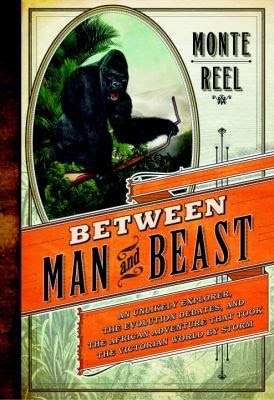
Between Man and Beast: An Unlikely Explorer, the Evolution Debates, and the African Adventure That Took the Victorian World by Storm by Monte Reel

I had never heard of the African explorer Paul Du Chaillu. According to author Monte Reel, few people have, which was part of the appeal for him to write a book. Writing about Du Chaillu also gave Reel a vehicle for exploring the Victorian Age and its controversies and prejudices. The result of his research is Between Man and Beast: An Unlikely Explorer, the Evolution Debates, and the African Adventure That Took the Victorian World by Storm.

That Du Chaillu is called an African explorer can be interpreted a couple of ways. The obvious is that he explored Africa. He took two extended journeys into the interior from coastal Gabon in the 1856 and 1863 and is thought to be the first European to see a live gorilla. Before that only gorilla skeletons and skins had been collected and sent to the scientific societies in the capitals of Europe, where there was much skepticism of such an animal truly existing. After his first expedition, Du Chaillu took preserved gorillas to New York and London to both great acclaim and charges of fraud.

Du Chaillu's origins were obscure. His father was French and his mother was rarely mentioned. He said at different times that he was born in France, in New Orleans, and in French colonies. Many of his supporters believed him to be dark skinned from his years in the Africa sun. In fact, he was part African, born on the island of Reunion east of Madagascar. The author poses that perceptions of Du Chaillu's race factored in his failure to impress men of science with his observations, stories, and specimens. Though his books sold well initially, his fame was short-lived.

Reel's sympathetic account of Du Chaillu's brief career is filled with big names in science, including Sir Richard Burton, Richard Owen, Roderick Murchison, Charles Darwin, and Thomas Henry Huxley. They and others used Du Chaillu's accounts in their arguments over evolution. The explorer tried to stay neutral but others implied his allegiance or opposition. After two African trips, he gave up gorilla studies and devoted himself to less volatile Scandinavian topics.

Readers who enjoy history of exploration and science will appreciate Between Man and Beast. If you library does not have it, request an interlibrary loan.

Reel, Monte. Between Man and Beast: An Unlikely Explorer, the Evolution Debates, and the African Adventure That Took the Victorian World by Storm. Doubleday, 2013. 331p. ISBN 9780385534222.

Monday, November 17, 2014

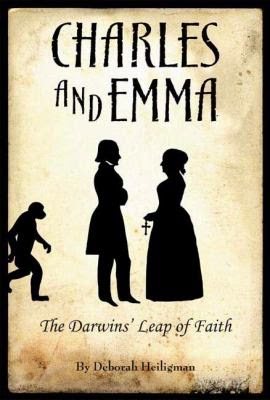
Charles and Emma: The Darwin's Leap of Faith by Deborah Heiligman

Emma Wedgewood knew the situation when she married Charles Darwin. She was a Christian who believed in God, Jesus, and the afterlife. He was a skeptic who preferred being called an agnostic to an atheist. Charles said that he had an open mind. Emma counted on it. In fact, she insisted on it. They married and maintained respect for each others views. He sometimes attended church with her, while she read and commented on all his scientific papers, even those that explained evolution of species though natural selection. How they remained happily married until Charles' death (43 years) is the story told by Deborah Heiligman in Charles and Emma: The Darwin's Leap of Faith.

I listened to Charles and Emma on an audio download read by Rosalyn Landor never guessing that the book is considered juvenile literature and shelved in the youth or teen sections in libraries. The content is for mature readers, as the author includes detailed scientific and theological content. I never found it simplified. I was instead charmed by the story that was both serious and sometimes sweet.

Throughout the story I admired the patience and care shown by two people with profound differences. I wish the rest of us could learn this lesson.

Heiligman, Deborah. Charles and Emma: The Darwin's Leap of Faith. Henry Holt, 2009. 268p. ISBN 9780805087215.

Audiobook: Random House/Listening Library, 2009. 6 compact discs. ISBN 9780739380499.

Friday, October 10, 2014

JFK's Last Hundred Days: The Transformation of a Man and the Emergence of a Great President by Thurston Clarke

Over time, stories of decades often are reduced to key events. The assassination of President John F. Kennedy is certainly one of those events. It tops the list of pivotal moments in the 1960s, a decade of great promise and disappointment. In JFK's Last Hundred Days: The Transformation of a Man and the Emergence of a Great President, author Thurston Clarke expands the story of the early 1960s, reminding older readers of the complex national and international politics of the Kennedy White House.

Like many history books focusing on specific time frames, JFK's Last Hundred Days includes many stories from outside its focus. Clarke includes accounts of John F. Kennedy's childhood, youth, service in World War II, early political career, marriage, and first two years as president. These accounts are inserted as flashbacks as Clarke counts down the days to Kennedy's visit to Dallas in November 1963. In doing thus, Clarke makes almost every day rich and lively. Deep in details, though I certainly knew the outcome of the story and noticed foreshadowing, the assassination still seemed to spring on me as a reader.

Clarke's attitude toward his subject is apparent from the title. What might not be expected by readers is how thoroughly the author describes Kennedy's faults, such as vanity, recklessness toward personal safety, and adultery. Whether the reader leaves the book with a positive, negative, or mixed attitude may depend more on the reader than the author's story. Clarke seems to tell us everything.

Like all good history, JFK's Last Hundred Days is still relevant. Readers may rethink whether today's politics is really meaner than ever before. They may also question whether promises to keep American soldiers out of combat zones will be kept. The audiobook is a good option for busy readers.

Clarke, Thurston. JFK's Last Hundred Days: The Transformation of a Man and the Emergence of a Great President. Penguin Press, 2013. 432p. ISBN 9781594204258.

Audiobook. Penguin Audio, 2013. 12 compact discs. ISBN 9781611761719.


Monday, October 06, 2014

The Writer's Garden: How Gardens Inspired Our Best-Loved Authors by Jackie Bennett, Photography by Richard Hanson

My where-I-want-to-go travel list is already very long, but I am adding to it. I have just finished reading The Writer's Garden: How Gardens Inspired Our Best-Loved Authors by Jackie Bennett with photographs by Richard Hanson. Bennett recounts how nineteen British authors tended to, wandered around, and settled in gardens to write some of their best-known books. Many had little huts among the flowers and trees. All had windows overlooking the gardens. Through his colorful photos, Hanson shows those gardens today. Most are open for the public to visit.

Among the authors included are Jane Austen, Virginia Woolf, and Rudyard Kipling. I recognized all of the names except John Clare, who was a gardener first and then became a poet. Some readers might be surprised by the inclusion of Winston Churchill, known mostly for being British prime minister; he also wrote a series of large history books about his country. Some might argue that Henry James is an American author, but he spent most of his writing life in Great Britain.

I think I'd most want to see the gardens of Beatrice Potter, Thomas Hardy, and Walter Scott. I'd get a good dose of rural England and Scotland from them. Not wanting to limit myself, I would also see all of the estates, many with grand houses as well. Seeing beautiful gardens and learning more about great authors. What could be better? A summer trip to Great Britain goes on my list.

The Writer's Garden is a British publication that will be released in the U.S. in November. I am happy I got one early. The perks of being a book reviewer.

Bennett, Jackie. The Writer's Garden: How Gardens Inspired Our Best-Loved Authors. Frances Lincoln Limited, 2014. 176p. ISBN 9780711234949.

Monday, September 22, 2014

The Fight of Their Lives: How Juan Marichal and John Roseboro Turned Baseball's Ugliest Brawl into a Story of Forgiveness and Redemption by John Rosengren

I remember a newspaper picture of the fight. San Francisco Giants pitcher Juan Marichal hit Los Angeles Dodgers catcher John Roseboro with his bat when they tussled near home plate in an August 1965. Sandy Koufax ran into the scene. I read that Roseboro required stitches for his head wound. I was shocked that a player would hit another player with a bat, but being an eleven-year-old boy in rural Texas, I then thought nothing more of it. I continued thinking of Marichal and Roseboro as stars in my baseball card collection.

I have seen photos and an occasional reference to the incident since, but I never realized that the memory of the fight dominated Marichal and Roseboro's lives for decades. In his new book The Fight of Their Lives: How Juan Marichal and John Roseboro Turned Baseball's Ugliest Brawl into a Story of Forgiveness and Redemption, sports writer John Rosengren tells how the players tried to put the incident behind them, but friends, fans, and journalists continued to ask about it. Only public acts of contrition and reconciliation years later finally eased the stress. Marichal and Roseboro even became friends.

The Fight of Their Lives illustrates a point made at an Adult Reading Round Table meeting focusing on sports books. Sports books are usually about something other than games. This dual biography recounts how two men rose from poverty thanks to their athletic ability but how little of their wealth came from their paychecks. Baseball salaries except for star players were pretty blue collar in the 1960s. Rosengren also examines race and ethnic relations in 1960s baseball. You do not have to be a baseball fan to enjoy his book.

Rosengren, John. The Fight of Their Lives: How Juan Marichal and John Roseboro Turned Baseball's Ugliest Brawl into a Story of Forgiveness and Redemption. Lyons Press, 2014. 277p. ISBN 9780762787128.

Friday, September 19, 2014

This Land That I Love: Irving Berlin, Woody Guthrie, and the Story of Two American Anthems by John Shaw

2014 is the 200th anniversary of "The Star Spangled Banner," the official national anthem of the United States. It is not, however, the only song used to evoke love of country. "America the Beautiful," "My Country 'Tis of Thee," and "Stars and Stripes Forever" are also often played or sung at public ceremonies. Most anthems are really old, but there are two songs from the 20th century in their class, "God Bless America" written by Irving Berlin and "This Land is Your Land" by Woody Guthrie. Author John Shaw explains the evolution of the two songs in This Land That I Love: Irving Berlin, Woody Guthrie, and the Story of Two American Anthems.

While these two newer songs differ much in tone, and their authors held very different political positions, Shaw shows that they have over time converged in many ways. "God Bless America" began as a strident war march, and "This Land is Your Land" began as a labor rights anthem. There was little love in either. Verses were added and dropped, and performers also reinterpreted the songs in ways unplanned by the composers. As their composers softened and added more spiritual lyrics for their songs, they became more like we know them today.

Setting is very important in this story. The author spends much time on the lives of the composers and political and economic history of the country during the periods in which the composers lived. Shaw also tells abbreviated stories of other American anthems that have risen and fallen in popularity. Readers who enjoy dual biographies or micro-histories may enjoy This Land That I Love.

Shaw, John. This Land That I Love: Irving Berlin, Woody Guthrie, and the Story of Two American Anthems. Public Affairs, 2013. 274p. ISBN 9781610392235.

Audiobook. Audio Go, 2013. 6 compact discs. ISBN 8671482931853.

Monday, September 08, 2014

A Curious Man: The Strange and Brilliant Life of Robert "Believe It or Not" Ripley by Neal Thompson

I have never subscribed to a newspaper running Ripley's Believe It or Not strips on its comic page. I thought the strip had probably ceased and was surprised to learn that it is still being published. According to the Ripley Entertainment Inc., the strip begun in the 1920s is still in hundreds of newspapers in over forty countries. You may also see daily strips on the website. There are also Ripley books, videos, podcasts, museums, and aquariums. All of this is the legacy of a strange, mostly forgotten man who died in 1949.

In his book A Curious Man: The Strange and Brilliant Life of Robert "Believe It or Not" Ripley, Neal Thompson tells about Robert Leroy Ripley, who was born in 1890 in Santa Rosa, California, home city of the church built from one tree (which was featured in an early Believe It or Not strip). He was know as Leroy or Roy as a child and was very impressed by sports heroes. Never very studious at school, he spent much of his time drawing; one teacher took pity on him, letting him substitute drawings for essays as long as they were on the assigned topics. This illustration work prepared him to be a sports cartoonist. Thompson tells how Ripley landed cartooning jobs at newspapers in San Francisco and New York. While overseas covering Olympic games and other international sports events, he collected odd facts and occasionally drew them into his cartoons. A strong response to these special strips led to his changing the focus of his work, eventually emphasizing bizarre stories and facts. As his popularity rose, he was asked to lecture, which led to vaudeville, which led to radio, which led to films, which led to television. Like Bob Hope or Will Rogers, he became a celebrity in many mediums.

Though the rags-to-riches story is admirable, Thompson's description of Ripley is not very attractive. The cartoonist stuttered, had buck teeth, dressed in flashy clothes, and was always very compulsive. Most importantly, he seemed to have had many habits and prejudices that look especially bad in hindsight. Even in his day, he was criticized for the sensational quality of his cartoons and radio broadcast, but he was very popular with the general public. I can see why modern defenders of broadcast media and entertainment might want us to forget the real Mr. Ripley, but newspapers and broadcast networks prospered featuring his low entertainment for decades.

I listened to A Curious Man read by veteran audiobook narrator Marc Cashman. The celebrity story never bogs down in the telling, as the text keeps introducing new phases of Ripley's varied life. It is a bit sad at the end, but many biographies are.

Thompson, Neal. A Curious Man: The Strange and Brilliant Life of Robert "Believe It or Not" Ripley. Crown Publishers, 2013.

Audiobook. Books on Tape, 2013. 10 compact discs. ISBN 9780385366373.

Friday, August 15, 2014

My Life in Middlemarch by Rebecca Mead

These were my questions before I listened to My Life in Middlemarch by Rebecca Mead, read by Kate Reading:

Would I find a book about a woman's relationship to a single book interesting?

How much of Middlemarch by George Eliot would I remember?

Despite reading several strong reviews and hearing another on National Public Radio, I wondered if My Life in Middlemarch could retain my interest through eight audio discs. The topic seemed rather narrow. I need not have worried. The subject matter as presented is broader than it first appears. I would estimate Mead's book is 45 percent about George Eliot, 35 percent about the characters and events in Middlemarch, and 20 percent about Mead herself. Of course, it is all tied together in such a way that any one paragraph or even sentence could be about all three. The story keeps turning and evolving so that specific topics are fresh. I never wavered in my desire to keep listening.

It has been a long time since I read Middlemarch - obviously before I started a spreadsheet of my reading in 1990 (unless I somehow neglected to enter the book). I also saw the 1994 BBC miniseries twenty years ago. I only remember Patrick Malahide in the role of the cold Reverend Edward Casaubon. Until I looked up the credits, I could not name any others from the cast, though I now see numerous actors that I recognize. Thinking that I remembered little, I wondered whether discussion about the characters would make any sense to me. Again, I need not have worried. Mead introduces the characters through descriptions that stimulate memory. (I don't know how it would be for someone who has no knowledge of Middlemarch.) I remembered much more than I would have thought.

The surprise for me was that the book is about George Eliot more than anything else. At least, that is what I take from My Life in Middlemarch. I think it serves as an entertaining introduction to the 19th century author's life, coming from a scholarly admirer, tempered but still passionate in admiration. I now want to read or listen again to the novels of Eliot. I only see Silas Marner on my spreadsheet. That does not seem right. Surely I have read more. It has been too long.

Mead, Rebecca. My Life in Middlemarch. Crown Publishers, 2014. 293p. ISBN 9780307984760.

Audiobook: Blackstone Audio, 2014. 8 compact discs. ISBN 9781482973532.

Wednesday, July 23, 2014

The Elephant Whisperer: My Life with the Herd in the African Wild by Lawrence Anthony

South African conservationist Lawrence Anthony is a model for the modern version of the rugged man. He is unconcerned about comfort, brave in the face of danger, smart when he needs to be, and dedicated to a better planet. He is one part pragmatist and another part dreamer. He is all of this as the owner and principal manager of the Thula Thula game reserve in Zululand. He is also a splendid writer, as he demonstrates in his memoir The Elephant Whisperer: My Life with the Herd in the African Wild. 

While the threads of story are many in The Elephant Whisperer, the central action revolves around Anthony's agreeing to accept a "rogue herd" of elephants into his preserve. These elephants had continually escaped from their previous preserve, causing much damage in surrounding villages and farms. Anthony knew that they would prove difficult to manage, but he also knew that they would be killed if he did not adopt them. He had always dreamed of reintroducing elephants to his part of Zululand, an area that had been without them for 100 years. On the first night in Anthony's care, they tipped over an ancient tree to break out of a high voltage enclosure, verifying that his task would be challenging.

Read by Simon Vance, The Elephant Whisperer is a very entertaining audiobook. Told at a lively pace, the book includes comedy, tragedy, romance, suspense and action, as well as many memorable characters, many of them pachyderms. It joins other splendid recent books about conservation work in Africa, including Life, Love, and Elephants by Dame Daphne Sheldrick and Cathedral of the Wild by Boyd Varty.

Anthony, Lawrence. The Elephant Whisperer: My Life with the Herd in the African Wild. Thomas Dunne Books, 2009. 368p. ISBN 9780312565787.

audiobook. Tantor Audio, 2012. 9 compact discs. ISBN 9781452610894.

Wednesday, July 09, 2014

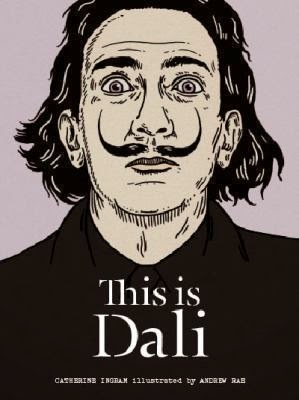
This is Dali by Catherine Ingram

A graphic novel treatment is a most appropriate approach to the life of the surrealist artist Salvador Dali. He is remembered for wildly strange art, much of which had elements of humor. Most was oil on canvas, but he also strove to express his own brand of art with his clothing and the design and furnishing of his home. Using a mixture of the most famous Dali images and comic drawings from illustrator Andrew Rae, author Catherine Ingram recounts Dali's strange life in her concise biography This is Dali.

"Outrageous" might be the most appropriate one word to describe Dali. He seems to have enjoyed shocking the public and have no true purpose in life other than self-promotion. About the kindest thing Ingram has to say about Dali, other than he was an artistic genius, was that he was lonely. She points to poor parenting as one reason for his seeming lack of care for others.

Whosoever understands Dali, the author suggests can also understand his art. In This is Dali, she explains the joke behind the melting clocks and suggests that Dali influenced many artists to come, including Alfred Hitchcock and Andy Warhol. I would add that John Pasche probably knew Dali's lips logo when he made a tongue and lips logo for the Rolling Stones. Maybe you'll recognize other ways Dali shaped our world if you give this odd little book a try.

Ingram, Catherine and illustrations by Andrew Rae. This is Dali. Laurence King Publishing, 2014. 80p. ISBN 9781780671093.

Monday, June 30, 2014

Sally Ride: America's First Woman in Space by Lynn Sherr

Astronaut Sally Ride was a very private person, a tough position to keep for someone so famous, an icon for the women's movement and hero of many children. Being the first American woman in space in 1983 put her in the national spotlight and subjected her to media attention for several years. Offered publishing contracts, she resisted writing anything more than a few magazine articles and a children's book about herself, and those writings can be described as more inspirational than personally revealing. She kept her affairs private. So, it was a surprise to the public when her obituary revealed that she enjoyed a long same-sex relationship.

Two years after her death, Ride is the subject of a biography by one of the journalists who closely followed her career from her early days at NASA. Lynn Sherr also counted herself as one of Ride's friends, having often had dinner with her over the course of nearly 30 years. In Sally Ride: America's First Woman in Space, Sherr admits that even she knew nothing about her friend's secret relationship.

While Ride's sexual orientation may now be the topic that may bring many readers to Sherr's book, it is not the overriding focus of the biography. Even Ride's initial trip into space is just an episode (though a very important episode) right at the halfway point in the book. Sherr takes a look at all of Ride's life, showing how her subject identified herself more as an athlete, physicist, and educator than astronaut, not exactly the person the media portrayed.

Because Sherr says so much about America from the 1950s to the present, the biography Sally Ride serves as a portrait of all of us, showing the way we reacted to Ride's fame and now to her death. Sympathetic to Ride, never sensational, this new biography may help us understand the way we treat science, celebrity, and controversy.

Sherr, Lynn. Sally Ride: America's First Woman in Space. Simon and Schuster, 2014. 320p. ISBN 9781476725765.

Friday, June 06, 2014

Women Heroes of World War I: 16 Remarkable Resisters, Soldiers, Spies, and Medics by Kathryn J. Atwood

The first global war of the twentieth century was a sad yet in some ways exciting time for women. Their brothers, husbands, and sons rushed off to battle for personal glory or the honor of their "king and country," leaving them to take up men's work. Those in Belgium, Serbia, and other invaded countries were in harm's way. In the shadow of a war that proved to be long and bloody, some strong women felt compelled to take up causes or even join the men in battle. Kathryn J. Atwood has written about them in Women Heroes of World War I: 16 Remarkable Resisters, Soldiers, Spies, and Medics. 

Atwood's new book is a logical and useful prequel to her book Women Heroes of World War II. In both books she sets the historical stage and profiles women who acted bravely for causes in which they believed. A few of the women, such as mystery writer Mary Roberts Rinehart, were famous in their time, and others, such as Emilienne Moreau, became national heroines, but most are names current readers will not recognize. Atwood thinks they should.

With interesting sidebars explaining important details in the stories, such as the use of poison gases in warfare or the popularity of the song "Over There," and with a generous use of photographs, Women Heroes of World War I is a good introduction to the war that started 100 years ago for readers of any age. It is also a helpful addition to the literature of women's studies. Look for it to be popular in school and public libraries.

Atwood, Kathryn J. Women Heroes of World War I: 16 Remarkable Resisters, Soldiers, Spies, and Medics. Chicago Review Press, June 2014. 246p. ISBN 9781613746868.

Friday, April 18, 2014

An Autobiography of Black Chicago by Dempsey Travis

If bookshelves were streets, you would find An Autobiography of Black Chicago by Dempsey Travis at the busy intersection of Chicago Way and Memory Lane. Stopped at this corner, the book's pages would open for you to see billboards for black-owned real estate, banking, and insurance companies and in the shop windows posters asking you to march for civil rights. And you would hear a calm, steady voice explaining to you why you have to get up early and do your part to change the world. By all accounts, black businessman and civil rights leader Dempsey Travis (1920-2009) did his part.

An Autobiography of Black Chicago was first published in 1981. That this memoir was ever written is remarkable, because in 1946 when he enrolled in college, Travis's poor reading ability forced him into remedial classes. When challenged by the probable failure of many in his situation, he applied himself and succeeded in college and business thereafter. Near the end of his book, he wrote of the importance of daily study for business people, stating that he read from ten newspapers each day.

In his book, Travis recounted what he saw in Chicago from the early 1920s to 1981 when Ronald Reagan became president. The account may surprise readers who mistakenly think that Jim Crow attitudes were confined to the South. 20th century Chicago was a very racist city, where most of the discrimination radiated from industry, unions, banks, real estate, and professional organizations, most controlled by white people. Blacks could only take the lowest paid jobs in factories, could not secure business loans, could not rent or buy properties in many neighborhoods, and were denied opportunities to join professional organizations, even when they had gotten college degrees. Fighting discrimination and making opportunities for himself and his race was Travis's mission.

Chicago was not the only stage in Travis's book. He was active in national business, professional, and civil rights organizations and eventually became an advisor to several presidents. He also was greatly shaped by a childhood trip to a funeral in Kentucky and his experiences in a racially-segregated military during World War II.

Agate Publishing put out a new paperback edition of An Autobiography of Black Chicago in 2013, preserving the essential Travis book but eliminating a collection of short autobiographical pieces by other black leaders. Serious students of Black Chicago may want to seek the older edition, which also includes many illustrations, but many contemporary readers will be more attracted to the new slimmer edition with greatly improved font and the most compelling part of the older book. An Autobiography of Black Chicago belongs in many Chicago area libraries and is a worthy addition to any collection on the national civil rights movement.

Travis, Dempsey. An Autobiography of Black Chicago. Agate Publishing, 2013. 216p. ISBN 9781932841671.

Wednesday, April 09, 2014

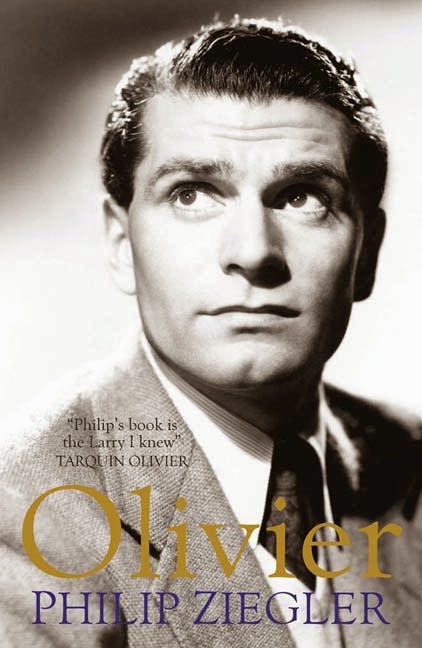
Olivier by Philip Ziegler

Lack of clear identity is a theme in Olivier by Philip Ziegler, a biography published in Great Britain in 2013 which comes to American bookstores and libraries this June. The author quotes Laurence Olivier saying late in his life that he did not really know who he was. The actor had spent his whole life being other people, an almost denial of self. Perhaps his lack of self was an asset which allowed him to portray Henry V, Richard III, Othello, Uncle Vanya, and King Lear so convincingly.

If Ziegler is to be believed, and he presents plenty of evidence, Laurence Olivier did not, however, lack ambition. He wanted to be known as the world's greatest actor. To achieve this honor, he wanted to be the lead character in every play and film in which he appeared. To be second to Ralph Richardson or John Gielgud was sheer agony. When he was not cast as a lead, he did everything he could to make his character the one most remembered by audiences, and the author says that by grabbing attention Olivier often succeeded in changing the focus of a play. As you can imagine, he made enemies of directors and other actors. How he actually remained fairly good friends with Richardson and Gielgud, his most serious rivals, is one of the interesting aspects of Ziegler's story.

Theater was Olivier's focus most of his life, working as an actor, director, producer, and founder of the National Theatre in London. He was very suspicious of film and television, and in his early movie appearances, he was criticized for gross overacting, applying skills for theater to the more intimate screen. Ironically, for most Americans outside New York and anyone born after the 1970s, Olivier will be thought of as a movie star. Henry V, Sleuth, and Marathon Man will keep his image living as long as people are still watching classic films. (While shooting Marathon Man, Olivier always called Dustin Hoffman "Justin," which may have been a ploy to unsettle the young actor with whom he was competing for dominance of the movie.)

At over 400 pages of actual text in the British edition, Olivier looks like an appropriately big book for a major figure in 20th century entertainment. There was much for me to learn on every page, but it read fairly quickly, and I was left wanting to learn more. I now want to see some old movies.

Ziegler, Philip. Olivier. MacLehose Press, June 2014. 352p. ISBN 9781623650421.


Friday, March 28, 2014

Living with Cannibals and Other Women's Adventures by Michele Slung

Inventorying the travel collection at our library, I identified another little-read book worthy of promoting. It is Living with Cannibals and Other Women's Adventures by Michele Slung, a collection of biographical pieces about adventurous women from the 19th and 20th centuries. In it are short profiles featuring women with strong international travel urges. I recognized some of the names, such as Dian Fossey and Amelia Earhart, but most I did not know. Almost all wrote bestselling books. Many also submitted articles and photos to the National Geographic magazine.

This book sprang from the work of a librarian. In the Afterword, librarian Susan Fifer Canby says that she discovered writings by these women in the National Geographic Society Library where she worked. She added a bibliography of articles and books by these and other adventurous women to the back of Living with Cannibals. She also provides a chronology "Women Who Pushed the Limits," which starts with "A.D. 381 - ETHERIA, a nun, travels to Jerusalem and Egypt, and writes a guide to the Holy Land for pilgrims."

Most of Slung's profiles are about twelve pages long. With the bibliography, the profiles make a great resource for students looking for out-of-the-ordinary biographical subjects. Living with Cannibals is also a pleasant and inspiring read for adults.

Slung, Michele. Living with Cannibals and Other Women's Adventures. National Geographic Society, 2000. 243p. ISBN 0792276868.