Showing posts with label nature. Show all posts

Saturday, August 22, 2015

The Call of the Osprey by Dorothy Hinshaw Patent

I am finding more and more that my favorite books about birds are pitched at kids. Add to the list The Call of the Osprey by Dorothy Hinshaw Patent, a title in the Scientists in the Field series from Houghton Mifflin Harcourt. The series label proclaims "Where Science Meets Adventure." That's a series of books for me.

Go into the children's section of a public library and you will likely find a good collection of let's-follow-working-scientists books. Many of these feature zoologists, botanists, and other nature scientists because they do such cool things, like study ospreys in Montana, as in The Call of the Osprey. Better than most university press birding books (which I do read and appreciate), these nature books aimed at kids have such great colorful pictures. Like the university press books, the youth-aimed books deal with serious topics, such as predation, pollution and habitat loss. I suspect the youth who read these books are better informed than their parents.

Why read The Call of the Osprey specifically? You get to follow the lives of Ozzie and Harriet, a breeding pair of ospreys. You also get to join the author learning to band osprey fledglings. There is more drama than you might imagine. Check it out.

Patent, Dorothy Hinshaw. The Call of the Osprey. Houghton Mifflin Harcourt, 2015. 80p. ISBN 9780544232686.

Tuesday, August 18, 2015

Wandering Home: A Long Walk Across America's Most Hopeful Landscape by Bill McKibben

Bill McKibben is a well-known environmental activist and author. While inventorying our library's travel collection, I came across his 2005 title Wandering Home: A Long Walk Across America's Most Hopeful Landscape: Vermont's Champlain Valley and New York's Adirondacks, an account of recent hike through the forests and mountains that transformed him several decades earlier from a suburbanite to a nature enthusiast.

The hike started in Vermont near Robert Frost's cabin near Mount Abraham, headed generally west (with lots of long curves), and ended in New York at his house near Garnet Lake. Some portions of the trail was harder than he remembered and he took one good fall, but mostly it was a delight, as he was joined for stretches by friends, most of whom are also environmentalists. In their conversations, they told McKibben their career stories. The narrative also reveals how the Northeastern United States has become a symbol of conservation and restoration. It is one of the few areas on earth in better shape now than 100 years ago.

At this point, McKibben has written many books. This is one of the shortest and most leisurely. It is a good introduction to his important body of work. Readers who enjoy travel accounts will especially appreciate Wandering Home.

McKibben, Bill. Wandering Home: A Long Walk Across America's Most Hopeful Landscape: Vermont's Champlain Valley and New York's Adirondacks. Crown Publishers, 2005. 157p. ISBN 0609610732.


Friday, July 24, 2015

Tooth and Claw: Animal Adventures in the Wild by Ted Lewin

"Close Encounters with Dangerous Animals" is the subtitle I would have given Ted Lewin's book Tooth and Claw: Animal Adventures in the Wild. Perhaps that would have been too sensational, but Lewin sometimes gets closer to wildlife than he intended. Round a path's curve, find bears. Climb onto a sunny rock on a chilly day and find rattlesnakes. Go for a swim and meet a bull face to face.

The most dangerous of animals just looked at Lewin, who stayed still and backed away slowly, shaken but not breaking eye contact. The boldest animals were the raccoons of the Okefenokee National Wildlife Refuge. They jumped onto a backpack he was still holding.

After each short wildlife encounter that Lewin describes in his book, he adds factual information about species and habitat in which he found them. I was particularly struck by his telling that dung-beetles were hard at work during the time of the dinosaurs. They had a lot to work with then and are still providing valuable service to the environment worldwide.

Tooth and Claw is an older title (2003) that Bonnie discovered and brought home. Lewin wrote the text, took the photos, and drew the illustrations. It is still timely. Considered a children's book, it is vastly entertaining to adults as well.

Lewin, Ted. Tooth and Claw: Animal Adventures in the Wild. HarperCollins, 2003. 97p. ISBN 9780688141059.


Friday, July 17, 2015

Welcome to the Neighborwood by Shawn Sheehy

As a parent and librarian, I have seen many children's pop-up books in my years, but I can not recall one I like better than Welcome to the Neighborwood by Shawn Sheehy. Its eight pop-up scenes of forest fauna and flora are works of art. I am amazed that Sheehy was able to hide and reveal a hummingbird on a nest and a bee approaching its golden honeycomb inside a thick paper book.

I love this book as a person who enjoys walking in the woods any time I can. Sheehy has seen things I seen and shown me new ways to look at them. I can imagine the delight of reading this book to a child.

As a book person, I wonder how this clever work was manufactured. I hope the people in Thailand who put it together were fairly paid for their work. At $29.95, it is bargain for art. It probably will not withstand use by young children, who might view it with an adult. Welcome to the Neighborwood would make a great present for a mature child involved in either art or nature study.

Sheehy, Shawn. Welcome to the Neighborwood. Candlewick Press, 2015. 18p. ISBN 9780763665944.

Wednesday, July 15, 2015

Fastest Things on Wings: Rescuing Hummingbirds in Hollywood by Terry Maseur

I have read bird rescue stories before, but I never imagined that emergency relief could specialize in just hummingbird rescue. I realize that hummers differ from other birds in some ways and emergency helpers might need special knowledge and skills, but I never realized that there would be enough rescues to keep anyone busy. Obviously I have not lived in the Los Angeles area where there are far more hummingbirds and species of hummingbirds than most parts of the United States.

From reading Terry Masear's book Fastest Things on Wings: Rescuing Hummingbirds in Hollywood, I have learned there are many hummingbird-human interactions in L.A., and many end badly for the hummingbirds. Often after trees or shrubs are pruned, nests with tiny hummers are discovered. Unless a homeowner can rehang the nest in its exact previous location (not even a foot away), the parent hummingbirds will never find it. Usually baby hummers will need rescue services after pruning. Other people find their cats have killed parent birds, leaving needy nestlings. Also many adult hummers are stunned or injured from running into picture windows or even moving vehicles.

Masear handles several hundred cases annually. Her Hollywood home is filled with cages and aviaries. An English professor during the rest of the year, she devotes her springs and summers to hummingbird rescue and is often up through the night feeding nestlings or nursing injured birds.

Fastest Things on Wings may sound like just another cute animal book, but it is not. Partly this is due to the hummingbirds not really being cuddly birds. Some are downright mean and attack Masear and other hummingbirds in her care. Another factor is the strange variety of people who contact Masear when birds need rescue. The author fills her book with their desperate stories, giving much insight into living conditions in Southern California.

I found Fastest Things on Wings compelling, entertaining reading.

Masear, Terry. Fastest Things on Wings: Rescuing Hummingbirds in Hollywood. Houghton Mifflin Harcourt, 2015. 306p. ISBN 9780544416031.

Wednesday, July 08, 2015

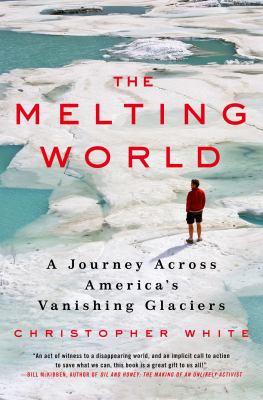
The Melting World: A Journey Across America's Vanishing Glaciers by Christopher White

I had two primary reasons for reading in The Melting World: A Journey Across America's Vanishing Glaciers by Christopher White. The first was my general interest in environmental issues and the conservation of wild places. The second more specific reason was that Bonnie and I are going to Glacier National Park later this year.

Having now read The Melting World, I see another way that it satisfies my interests. I enjoy stories told by naturalists working in the field. Much of White's book accounts for his days spent outside with the shrinking glaciers in the remote national park. On each of these days, he treks many miles with dedicated researchers to measure and observe ice and snow. The team utilizes many tools; GPS, portable and stationary weather stations, and a variety of cameras are primary sources of data. They also count wildlife species and record the levels of the streams and lakes feed by glacial melting. In five years, they discover many reasons to be concerned about the future of Glacier National Park and the planet.

While not a travel guide, I did learn much about the mountains, glaciers, and bodies of water as well as flora and fauna. Unlike White, I will not be able to go far into the back country, but I want to see as much as I can. I know I will better able to make sense of the place having read this book.

The Melting World is a worthy item to add to current natural history collections.

White, Christopher. The Melting World: A Journey Across America's Vanishing Glaciers. St. Martin's Press, 2014. 272p. ISBN 9780312546281.

Friday, June 19, 2015

A Practical Illustrated Guide to Attracting and Feeding Backyard Birds: the Complete Book of Bird Feeders, Bird Tables, Bird Baths, Nest Boxes, and Garden Bird-Watching

With the title A Practical Illustrated Guide to Attracting and Feeding Backyard Birds: the Complete Book of Bird Feeders, Bird Tables, Bird Baths, Nest Boxes, and Garden Bird-Watching, there is hardly any need to write a review. The title explains how the book is practical, and the cover hints at how beautifully colorful. Judging books by their covers can lead to disappointment, but not with this book. I renewed it to keep looking at its thematic two-page illustrated articles and its projects. I might use several ideas to enhance our yard's bird-appeal.

The topics in A Practical Illustrated Guide to Attracting and Feeding Backyard Birds are wide ranging. Readers may learn about bird anatomy, physics, and behaviors, as well as how to attract them by offering feeders, fountains, and nesting boxes. Gardeners find recommendations for landscaping, while hobbyists find templates for wood-working projects. There is also an essential guide to birds who frequent yards.

Though the publisher is British, this edition seems to be aimed at the American market. The range maps show North America. A Practical Illustrated Guide to Attracting and Feeding Backyard Birds is a great selection for public or personal libraries. I am now returning it to let others enjoy it.

A Practical Illustrated Guide to Attracting and Feeding Backyard Birds: the Complete Book of Bird Feeders, Bird Tables, Bird Baths, Nest Boxes, and Garden Bird-Watching. Southwater, 2014. 256p. ISBN 9781780192802.


Friday, June 12, 2015

The Atlas of Birds: Diversity, Behavior, and Conservation by Mike Unwin

This book review blog has gone to the birds! As any frequent reader must have noticed, I have written many reviews of bird-related books lately. In front of me now is The Atlas of Birds: Diversity, Behavior, and Conservation by Mike Unwin, an attractive paperback reference book on birds from Princeton University Press. It is not really meant to be read straight through, but I am finding very few pages to skip.

The author points out in his introduction how by being so omnipresent and visible, birds established themselves as an indicator of the health of specific habitats and the earth as a whole. Today numerous factors are contributing to declines in the populations of many birds, habitat destruction being the leading cause.

There are many observations throughout that fascinate me:

Bird diversity concentrates on tropical and subtropical regions, especially in forests.  Russia, which is over 60 times larger than Ecuador, hosts only 645 bird species while the small tropical South American country hosts a whopping 1,515 species.

About 6,900 species are found in the forests of the earth while about 200 are found in its deserts.

Birds migrate at various altitudes. Bar-headed geese fly at 29,000 feet.

William Shakespeare mentioned doves 60 times in his plays, more than any other bird. Geese were second at 44 and eagles third at 40.

Illegal hunting of songbirds in Southeastern Europe threatens the survival of numerous migrating species. Most of the illegally killed birds are smuggled into Italy for the restaurant trade.

The Royal Society for the Protection of Birds with over a million members is the world's largest bird conservation organization. With Audubon and other regional groups it forms BirdLife International, which is identifying and securing sanctuaries around the world.

A beginning birder wishing to understand the world of birds and veteran bird advocates can both learn much from The Atlas of Birds.

Unwin, Mike. The Atlas of Birds: Diversity, Behavior, and Conservation. Princeton University Press, 2011. 144p. ISBN 9780691149493.


Friday, June 05, 2015

Fire Birds: Valuing Natural Wildfires and Burned Forests by Sneed B. Collard III

On topics of nature and conservation, adults should sometimes turn their attention to children's books, some of which get to the point quickly and effectively. Bonnie brought home such a book, Fire Birds: Valuing Natural Wildfires and Burned Forests by Sneed B. Collard III. The author takes readers to Montana to follow University of Montana biology professor Dick Hutto through forests burned by wildfire to show that our society's ideas about forest fires have often been mistaken.

How can this be? Smokey the Bear told us to prevent forest fires. It turns out, and many of us discovered this in a big way in the 1980s when fire swept through Yellowstone National Park, suppressing small natural fires for decades contributes to hugely destructive fires in the future. Suppression of wildfire also inhibits growth of some plant and wildlife species that need periodic fires. Hutto shows how beneficial fire has been to Montana's birds.

Fire Birds is an attractive and informative book with many photos that let you feel as if you have been to Montana. I especially liked all the photos of woodpeckers, bluebirds, and other species that I want to see when I go to Glacier National Park later this year. (The black-backed woodpecker, western tanager, and mountain bluebird are on the book jacket.) I hope many children and their parents and grandparents find this book at the library.

Collard, Sneed B., III. Fire Birds: Valuing Natural Wildfires and Burned Forests. Bucking Horse Books, 2015. 48p. ISBN 9780984446070.

Monday, June 01, 2015

The House of Owls by Tony Angell

The owls of North America have not only been important to the career of artist and naturalist Tony Angell, they have been a great pleasure. In The House of Owls, he recounts his encounters with almost all of the species. The exception that I see upon looking back through his very personal reference guide to owls is the ferruginous pygmy owl. In his introduction to this owl that lives in Central America, Mexico and just the smallest sliver of Arizona, he tells how early twentieth century ornithologist George Sutton's saw his first ferruginous pygmy owl.

For all of the owl profiles, Angell describes range and habitat, food preferences, vocalizations, courtship and nesting, threats and conservation, and vital statistics (length, wing span, and weight). Some details seem to repeat. Owls that use cavities in trees depend on either pileated woodpeckers or northern flickers to excavate them. Most eggs hatch between 21 and 24 days after being laid. Owlets fledge at around three to four weeks and remain with their parents for a couple of months or more. Cooper's hawks prey on many of the owlets and some of the small adult owls.

Angell starts his guide to owls with a chapter recounting his raising a western screech owl. In this chapter and throughout the book he includes his own topical drawing that support the text.

The House of Owls is a delightful book that will interest birders and other amateur naturalists. More libraries should add this new book.

Angell, Tony. The House of Owls. Yale University Press, 2015. 203p. ISBN 9780300203448.

Friday, May 29, 2015

A Window on Eternity: A Biologist's Walk Through Gorongosa National Park by Edward O. Wilson

There are few pristine places left on this earth. When noted biologist Edward O. Wilson visited in 2011, Gorongosa National Park in Mozambique was not by any means untouched, but philanthropist Gregory C. Carr had led a determined effort at restoration. There had been much to fix. During a civil war that lasted from 1975 to 1992 and in the impoverished years after the war, poaching of wildlife and the clearing of woods in the park had left it almost empty of large mammals and other signature species. It is the effort to restore the habitat that is examined in A Window on Eternity: A Biologist's Walk Through Gorongosa National Park by Edward O. Wilson.

Luckily for Wilson, there was some unspoiled habitat on the mountains when he arrived. He and his team were able to identify unknown ants and other insects. He tells about them and fossils of human ancestors found in the region.

In the hands of Wilson, who is the author of numerous thick and influential books, such as Consilience: The Unity of Knowledge, Sociobiology, and On Human Nature, the story of this remote park has universal implications. His small book on Gorongosa serves as an illustration of what he has written before and is written for a broader readership. Well-illustrated with photographs by Piotr Naskrecki, A Window on Eternity serves as a good lesson on the conservation of species and sustainability of habitats in poor nations.

Wilson, Edward O. A Window on Eternity: A Biologist's Walk Through Gorongosa National Park. Simon and Schuster, 2014. 149p. ISBN 9781476747415.

Monday, May 25, 2015

Birding by Impression: A Different Approach to Knowing and Identifying Birds by Kevin T. Karlson and Dale Rosselet

When I attended David Sibley's book signing last year, he said that he looks at shape and listens to songs more than spotting marks and plumage in identifying birds. Sibley and many skilled birders do not have to get long close looks at birds to know what they are. With years of experience, they just know because of bird songs, behaviors, habitats, size, and shape. They often do not even have to see the birds.

New birders may have trouble naming species unless the birds sit still in full view, which they rarely do so. Luckily, novices may learn about expert ID methods by reading the new book Birding by Impression: A Different Approach to Knowing and Identifying Birds by Kevin T. Karlson and Dale Rosselet. In this Peterson Reference Guide, the authors group similar birds and then explain size and shape differences, as well as where to find the birds and important plumage. The new birder then needs much book and field study beyond the book, but a foundation can be laid.

The authors include many illustration, some in quizzes that are fun to take. I scored well on heron-like birds, woodpeckers, jays, and even sparrows. I was weak on shorebirds, flycatchers, and warblers.

Birding by Impression is an excellent choice for public library collections. Birders might like having personal copies, too.

Karlson, Kevin T. and Dale Rosselet. Birding by Impression: A Different Approach to Knowing and Identifying Birds. Houghton Mifflin Harcourt, 2015. 286p. ISBN 9780547195780.

Friday, May 15, 2015

A Love Affair with Birds: The Life of Thomas Sadler Roberts by Sue Leaf

When our daughter Laura led us through the Thomas Sadler Roberts Bird Sanctuary just north of Lake Harriet in Minneapolis in the summer of 2013, I had never heard of the nine-year-old boy who moved with his family to Minnesota in 1867 and grew up to be a leading doctor in the city. As a boy, he and his friends wandered the woods and canoed the lakes of the area, noticing the birds, about whom Roberts had learned much from his bird-fancying father. In A Love Affair with Birds: The Life of Thomas Sadler Roberts, Sue Leaf tells how Roberts balanced his dedication to medicine and his patients with his love of birds.

Roberts accomplished much in his life. Before medical school, he worked as a land examiner and civil engineer. Working as a doctor for over half a century, he treated many patients, delivered many babies, helped found the local medical society, and helped build hospitals. As a  ornithologist, he started birding clubs with his friends, led many bird walks, taught ornithology at the University of Minnesota, collected species for the natural history museum on the University campus, served as museum director, and eventually led the effort to build what is now the Bell Museum of Natural History. He may be most remembered for his two-volume The Birds of Minnesota which was published in 1930.

On one level, A Love Affair with Birds can be read as a tribute to an exemplary life. The author, however, offers the reader more than that. Her section on Roberts' medical career serves as a compelling history of health care in Minnesota, spanning the era in which Roberts road a horse to reach his rural patients or sometimes caught a trolley in town to his mature years when he rode with his chauffeur. The growth and development of Minneapolis runs through the story. Readers learn about the planning and building of hospitals and museums. Most of all, Leaf tells the story birds and the birding community of Minnesota.

Having been to Minneapolis over a dozen times now with prospects for many more visits, wanting to see all the Minnesota birds, I enjoyed A Love Affair with Birds immensely.

Leaf, Sue. A Love Affair with Birds: The Life of Thomas Sadler Roberts. University of Minnesota Press, 2013. 271p. ISBN 9780816675647.

Monday, May 11, 2015

H is for Hawk by Helen Macdonald

Falconry tests the endurance and sanity of anyone keen to attempt the sport. Author T. H. White was ill-prepared for his first attempt. Over 70 years later, Helen Macdonald was more experienced and realistic when she acquired a goshawk. Still, her experienced included self-doubt and despair, as well as self-discovery, as she recounts in H is for Hawk.

Just as it helps to read Middlemarch by George Eliot before reading My Life in Middlemarch by Rebecca Mead, having read The Goshawk by White will enrich anyone's reading of Macdonald's book. Thankfully for me, reading H is for Hawk also explained much of what puzzled me about The Goshawk.

Of course, you are more likely to have read Middlemarch than The Goshawk, as Eliot is still fashionable and White is mostly forgotten. He was most popular in the mid-twentieth century when children were reading The Sword in the Stone and their parents were reading The Once and Future King. In the 1960s, his Arthurian tales were source materials for a Disney animated film and the broadway musical Camelot.

Luckily for all, you do not have to have read White's book before reading Macdonald's, as she liberally recounts and quotes sections of it as she describes her experiences with Mabel, a young goshawk that she acquired from a breeder in Ireland and brought to her home near Cambridge to train to hunt. Like White, she take's her bird on walks through field and forest and frets over how much it weighs. For the benefit of good reading, Macdonald did not stick to White's narrative as a template for hers, and her prose flows more pleasingly.

Mead's book My Life in Middlemarch is an easier book to compare with Macdonald's title. Both mix these elements:

  • Memoir of the author
  • Biography of famous author
  • Story of a famous book
  • Observations about English history and culture

To this formula, Macdonald adds a dose of natural history, letting readers know much about hawks and falconry. The result is a great book that keeps the reader engaged.

Now I should try So We Read On by Maureen Corrigan, another book in which a reader recounts her relationship with a book.

Macdonald, Helen. H is for Hawk. Grove Press, 2014. 300p. ISBN 9780802123411.


Wednesday, May 06, 2015

Cuckoos: Cheating by Nature by Nick Davies

If I wasn't a librarian, I might enjoy being a naturalist. Reading Cuckoos: Cheating by Nature by Nick Davies, I am impressed by the dedication of scientists who spend countless hours outdoors observing the behaviors of birds and other wildlife. Davies has spent over three decades doing such work in the fens outside Cambridge where he is a professor of behavioral ecology. He also takes trips to other sites in England and around the world to observe cuckoos and the birds that they victimize with their egg laying. What an interesting life!

What a strange and hard-to-understand bird! The cuckoo lays its eggs in the nests of other birds, so the foster parents raise the chicks. Is this good parenting? How many of the hosts fall for the deception and raise the cuckoo chicks instead of their own? Davies tries to answer these questions through conducting many experiments in the field. Many involve egg swapping.

Through his own observations and studies of cuckoos conducted over hundreds of years, Davies has come to some conclusions. One is that the host birds are not totally defenseless; they do sometimes reject the cuckoo eggs. Another is that there are numerous subspecies of common cuckoos in Europe that can only be identified by their eggs. One subspecies has eggs that resemble reed warbler eggss, another makes meadow pipit-like eggs, and so on. Their breeding success relies on getting their eggs into the right nests at the right times.

If the cuckoos were invariably successful, they would probably wipe out their host species. Studies show, however, that the common cuckoo is declining in number, as global warming is allowing their target species to nest earlier and earlier, but the cuckoos are returning from their winters in Africa at their tradition times, sometimes too late to lay their eggs unnoticed.

Davies has a fascinating subject and his reporting is lively and personal. Cuckoo should prove popular with natural history readers.

Davies, Nick. Cuckoos: Cheating by Nature. Bloomsbury, 2015. 288p. ISBN 9781620409527.

Wednesday, April 22, 2015

Birdology: 30 Activities and Observations for Exploring the World of Birds by Monica Russo

In both of the first two libraries in which I worked as a librarian with my MLS, the adult and juvenile nonfiction was shelved together. The reasoning was that adults and children could benefit from many of the same books and they could be found all in one place. Birdology: 30 Activities and Observations for Exploring the World of Birds by Monica Russo is just the kind of book that supports that philosophy. It is aimed at young readers but offers much to readers of any age.

Inside the brightly illustrated cover of Birdology are lessons on birding, basic ornithology, do-it-yourself experiments, and many beautiful photographs of birds. Though I am about 50 years beyond the target audience, I read with interest, gaining understanding of some aspects of bird life that I had not realized reading more scholarly works. That birds who eat only insects in flight must migrate in winter is probably in the books I've previously read but it never registered with me. Woodpeckers who pick insect eggs and larvae from bark can winter over in many climates. I saw woodpeckers all winter long because of this.

I read with the interest the section on attracting birds to your yard with plants. We are expanding our flowerbed and replacing shrubs in the next few weeks. I will keep the birds in mind.

Birdology is a good addition to any public library.

Russo, Monica. Birdology: 30 Activities and Observations for Exploring the World of Birds. Chicago Review Press, 2015. 108p. ISBN 9781613749494.

Monday, April 20, 2015

Beneath the Surface: Killer Whales, SeaWorld, and the Truth Beyond Blackfish by John Hargrove

On a family trip to Orlando in 1980, John Hargrove saw a killer whale show at SeaWorld and immediately knew his vocation. He wanted to be a trainer and ride the orcas into the air. To get his wish, he focused on learning everything about the whales and convinced his family to take vacations that included the Florida theme park. He asked trainers questions at the park and wrote letters to them from home. Finally in 1993, his dream came true when he was hired as apprentice trainer at SeaWorld in San Antonio.

In Beneath the Surface: Killer Whales, SeaWorld, and the Truth Beyond Blackfish, he recounts how after many years as a dedicated SeaWorld employee he slowly realized how his love for being with the killer whales had blinded him to the ethics of using them in popular entertainment. He saw they were stressed by the demands of performing unnatural behaviors up to seven times a day and then bored in the confinement in small pools when not in training or performing. He was also appalled by the discomfort and danger to whales required for artificial insemination and by SeaWorld's policy of separating mothers and offspring, who would be together for life in the ocean. He began to sense the truth in the animal rights movement criticism of trained animal entertainment.

Changing sides was still difficult because it meant leaving his employment, closest friends, and the whales he loved. Agreeing to speak out in the documentary Blackfish was his declaration of his new conscience.

While at first glance Beneath the Surface might seem a book that would appeal to a narrow audience, for Hargrove is hardly a national celebrity or killer whales a frequent front page news story (except when a trainer is accidentally killed), but his situation is universal. Many of us have matters of conscience that trouble us upon which we do not act because we would sacrifice so much. Combine that with subjects of animal rights, wildlife conservation, government regulation, and corporate responsibility and the title deserves a wider audience. Nonfiction book discussion groups should consider Beneath the Surface.

Hargrove, John. Beneath the Surface: Killer Whales, SeaWorld, and the Truth Beyond Blackfish. Palgrave Macmillan, 2015. 272p. ISBN 9781137280107.

Friday, April 17, 2015

The Art of Migration: Birds, Insects, and the Changing Seasons in Chicagoland by Peggy Macnamara

The spring migration of birds has just begun. While there are many books, articles, and websites that tell birders what species to expect when and where, a particularly interesting title to me is painter Peggy Macnamara's The Art of Migration: Birds, Insects, and the Changing Seasons in Chicagoland. With text by John Bates and James H. Boone, she alerts readers to the birds and insects that will come up the Mississippi flyway through the counties surrounding Chicago.

Macnamara's watercolor illustrations are not by any means photographic, but they reproduce the effects of sunlight and shade on birds and insects as observed outdoors. Their intentional impressionism prepares spotters to natural conditions that are not ideal for seeing everything that the best photographers have been able to present in their bird and insect guides.

Working often with the scientists at the Field Museum of Chicago, Macnamara has access to the museum's specimens of birds and insects collected for over a century. Of particular interest to her are the birds who died during migration when they crashed into buildings in downtown Chicago or along the lakefront. These birds were gathered and brought to the museum every day for about 30 years. A census of them shows trends in the migrations passing through the area. Current numbers are way down thankfully because building managers have reduced lights and architects have designed friendlier buildings, but there are still plenty of bird corpses to gather.

Macnamara's book will interest artists as well as birders, as she often describes how she uses her brush to apply colors and shading. As a professor at the School of the Art Institute of Chicago and illustrator-in-residence at the Field Museum, she has much experience. The Art of Migration could as easily be shelved in the art section as the zoology area.

Since Macnamara and her co-authors tell so much about the birds and where to see them in the Chicago area, we shelve it with other helpful birding guides.

Macnamara, Peggy. The Art of Migration: Birds, Insects, and the Changing Seasons in Chicagoland. University of Chicago Press, 2013. 202p. ISBN 9780226046297.

Monday, April 06, 2015

Bird Books Old and New

I have been devoting much of my free time to birding this spring, lessening the time I have spent writing this blog. I haven't stopped reading, though I may be reading a little less, and my focus lately has been books about birds or Italy.

I live in the Chicago suburbs and visit various DuPage County Forest Preserves to see what I might see. My reading, however, is geographically unbound. Through the pages of The World of the Shorebirds by Harry Thurston, I have been able to travel by armchair all over North and South America, learning about the behaviors and migrations of plovers, sandpipers, oystercatchers, jacanas, stilts, avocets, and thick-knees. This Sierra Club Book is nearly twenty years old, so readers need to look up more recent statistics about bird populations and what is happening in critical flyways. The photos are still beautiful, and the author inspires love of birds.

I am traveling around the planet in Woodpeckers of the World by Gerard Gorman. Woodpeckers can be found on every continent except Australia and Antarctica. South America has the most, some of which have very small ranges. Many do not migrate, so they won't be coming up my way this spring or ever. Gorman explains that little is known about some of the more remote species and that there is disagreement about which ones should be certified as species. He profiles 239 woodpeckers, identifying ranges, habitats, behaviors, and population status; the photos he includes are gorgeous. This recent guide is hefty. The author put many years into its making.

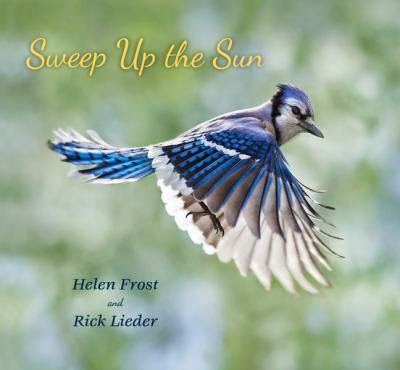
Sweep Up the Sun by Helen Frost and Rick Lieder is a children's book that brings me home. I have seen every bird in this book already this year, either in our yard or at one of the nearby preserves. The text is a poem about flying by Frost set into amazing photos by Lieder, each showing a familiar bird in flight. Sweep Up the Sun is a great addition to any young ornithologist's collection.

I also just read a book about hummingbird rescue for Booklist. Watch there for a review.

Thurston, Harry. The World of Shorebirds. Sierra Club Books, 1996. 117p. ISBN 0871569019.

Gorman, Gerard. Woodpeckers of the World: A Photographic Guide. Firefly Books, 2014. 528p. ISBN 9781770853096.

Frost, Helen and Rick Lieder. Sweep Up the Sun. Candlewick Press, 2015. ISBN 9780763669041.


Monday, March 16, 2015

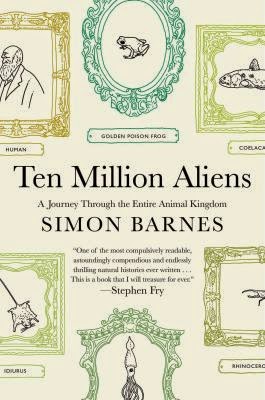
Ten Million Aliens: A Journey Through the Entire Animal Kingdom by Simon Barnes

Did I ever tell you how I read and outlined each chapter of my biology textbook twice and then reviewed the outlines before 50-question multiple choice tests in high school? In acing those tests, I memorized much about zoological taxonomies of everything from bacteria to mammals. That was many years ago before DNA mapping revealed species relationships that zoologists never guessed. Many animals have been moved into different genera, families, and orders since that time, so this was for me a good time to read and learn from Ten Million Aliens: A Journey Through the Entire Animal Kingdom by Simon Barnes.

Barnes is a writer of many interests, publishing books in fiction, sports, and natural history. I read and was entertained by How to Be a Bad Bird Watcher several years ago. In the fall, Booklist sent me his latest book, which published in Britain in 2013. The advanced proof jacket has an endorsement from actor Stephen Fry, a clue that it is not a dry scientific text. I was eager to read it. I enjoyed it and wrote a positive review for Booklist, which published in February 2015.

Though full of humorous bits, Ten Million Aliens is a serious book about the diversity of the animal kingdom, and the author has points to make. Among them, Darwin was right to spend years in study of the minuscule to gain understanding of universal principles. Animals evolve over time to survive and propagate, not to improve. There was no inevitable movement to create humans as the pinnacle of evolution. "Lower" forms of life are just as vital and capable as more complex organisms. In a mass extinction, insects are more likely to survive than mammals.

By injecting the funny bits and by alternating invertebrate chapters with chapters about more familiar vertebrate species, Barnes keeps the text lively. Many historical and literary references also keep the story entertaining for non-scientific minds. Ten Million Aliens is a good refresher course on the diversity of life with which we share the earth.

Barnes, Simon. Ten Million Aliens: A Journey Through the Entire Animal Kingdom. Atria Books/Marble Arch Press, 2015. 480p. ISBN 9781476730356.