Showing posts with label Africa. Show all posts

Friday, October 24, 2014

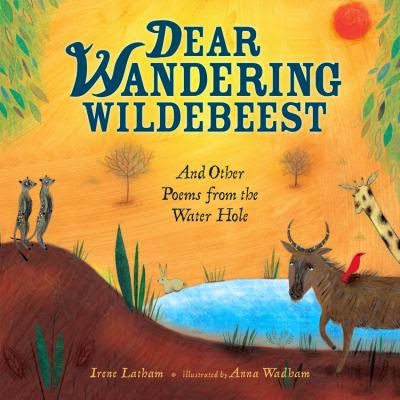
Dear Wandering Wildebeest and Other Poems from the Water Hole by Irene Latham

When you go to Africa for camera safari, (which you should - don't let the fear of malaria, yellow fever, or ebola stop you) visit water holes. Almost all animals have to drink water at some point in the day or night, and water holes are where they find water in the drier seasons. These low pools are gathering spots for many species. Watching the wildlife traffic is entertaining and exciting, as Irene Latham attests in Dear Wandering Wildebeest and Other Poems from the Water Hole. This bright children's book is illustrated by Anna Wadham.

If you have been to savannah lands in Africa, you can vouch for Latham's descriptions of the animals and their behaviors. Impala do literally spring high into the air when frightened, as Latham says in "Impala Explosion"; it is quite a sight to see. Vultures, storks, jackals, and hyenas do squawk and snarl around the remains of dead animals, as she describes in "Calling Carcass Control." Drinking from a water hole is a risky necessity for giraffe, as she explains in "Triptych for a Thirsty Giraffe."

I thought "Oxpecker Cleaning Service" was the funniest poem. I'd enjoy reading it to a child.

An explanatory paragraph accompanies each poem. Latham includes a glossary of words that may be new to young readers in the back of her book. There was even a word that I didn't know (volplane), proving that this is a book that will benefit young and old.

Latham, Irene. Dear Wandering Wildebeest and Other Poems from the Water Hole. Millbrook Press, 2014. 33p. ISBN 9781467712323.

Wednesday, September 24, 2014

The Elephant Scientist by Caitlin O'Connell and Donna M. Jackson

Elephants continue to surprise us. In her field studies in Namibia, zoologist Caitlin O'Connell noticed that when elephants warily stop to assess the safety of a situation, the matriarch holds a front foot bent so that the front toes firmly contact the earth. She had seen similar behavior in insects and recognized it as hearing vibrations through feet (signals sent from toes to ear). In her book for young readers The Elephant Scientist, she recounts research and field experiments that she and a team of naturalists conducted to verify her observation.

I particularly liked the section of the book showing O'Connell and others building and inhabiting a scaffold-like four-story observation station. The station overlooks a water hole that attracts elephants, giraffe, and zebras. And an occasional lion, of course. Wrapped in boma cloth, the electrified perimeter fencing keeps the team safe from the wildlife and let them observe elephant behaviors without disturbing the elephants. The boy in me that always longed for a tree house thinks it would be really cool to live and work in an observation tower in Namibia.

As a title in the Scientists in the Field Series from Houghton Mifflin Books for Children, The Elephant Scientist, which was a Robert F. Siebert Honor Book, is filled with photos of the wildlife and the scientists at work. The chapters are concise and fairly quick reading, and the authors include a glossary and reading list in the back of the book. The Elephant Scientist is an attractive book for elephant lovers of any age. Thanks to Bonnie for bring it home.

Connell, Caitlin and Donna M. Jackson. The Elephant Scientist. Houghton Mifflin Books for Children, 2011. 72p. ISBN 9780547053448.

Wednesday, July 23, 2014

The Elephant Whisperer: My Life with the Herd in the African Wild by Lawrence Anthony

South African conservationist Lawrence Anthony is a model for the modern version of the rugged man. He is unconcerned about comfort, brave in the face of danger, smart when he needs to be, and dedicated to a better planet. He is one part pragmatist and another part dreamer. He is all of this as the owner and principal manager of the Thula Thula game reserve in Zululand. He is also a splendid writer, as he demonstrates in his memoir The Elephant Whisperer: My Life with the Herd in the African Wild. 

While the threads of story are many in The Elephant Whisperer, the central action revolves around Anthony's agreeing to accept a "rogue herd" of elephants into his preserve. These elephants had continually escaped from their previous preserve, causing much damage in surrounding villages and farms. Anthony knew that they would prove difficult to manage, but he also knew that they would be killed if he did not adopt them. He had always dreamed of reintroducing elephants to his part of Zululand, an area that had been without them for 100 years. On the first night in Anthony's care, they tipped over an ancient tree to break out of a high voltage enclosure, verifying that his task would be challenging.

Read by Simon Vance, The Elephant Whisperer is a very entertaining audiobook. Told at a lively pace, the book includes comedy, tragedy, romance, suspense and action, as well as many memorable characters, many of them pachyderms. It joins other splendid recent books about conservation work in Africa, including Life, Love, and Elephants by Dame Daphne Sheldrick and Cathedral of the Wild by Boyd Varty.

Anthony, Lawrence. The Elephant Whisperer: My Life with the Herd in the African Wild. Thomas Dunne Books, 2009. 368p. ISBN 9780312565787.

audiobook. Tantor Audio, 2012. 9 compact discs. ISBN 9781452610894.

Monday, April 01, 2013

Chike and the River by Chinua Achebe

The late Nobel Prize-winning Nigerian author Chinua Achebe is most known for his novel Things Fall Apart, set in the 1890s when British colonization disturbed the balance of tribal societies across Africa. Not only did Achebe write several sequels to the story, he also wrote poetry, essays, and children's books. The first of the children's stories, Chike and the River, first published in 1966, has recently been reissued with bright new  illustrations by Edel Rodriguez.

Chike is a young Nigerian boy of eleven living in rural Umuofia with his widowed mother as the story begins, but he is soon sent to stay with his uncle in Onitsha, where he attends school and learns about city life. He is an innocent who sometimes falls prey to the deceptions of city boys.While he misses village life, he is ready for adventures that the city offers, particularly riding a ferry across the Niger River. His mother has warned him never to go close to the River, so you can easily imagine what he wants to do.

Written for children, Chike and the River is somewhat light and optimistic and has been criticized as not up to Achebe's standards for realistic fiction. Being just a big kid, I enjoyed it for the story and sense of place.

I read a digital library copy of Chike and the River (88 pages in print but unspecified as an ebook) using Overdrive Read, a new ebook reader that works on Internet browsers, saving the borrower from downloading any files. I started in Firefox on a PC running Window XP, switched to Safari on my iPhone, and finish in Chrome on an iMac. Overdrive claims that my place will be kept each time I switch devices, but that did not happen. Each time I logged in, I started at the beginning. Luckily, the table of contents made it easy to navigate, and it was helpful not having to download the files.

Achebe, Chinua. Chike and the River. Anchor Books, 1966. Illustrations, 2011. 88p. ISBN 9780307473868. eISBN 9780307742070.

Monday, March 11, 2013

The Boy Who Harnessed the Wind: Creating Currents of Electricity and Hope by William Kamkwamba and Bryan Mealer

If you have been reading depressing books and need a pick-me-up to lift your mood, you should consider The Boy Who Harnessed the Wind: Creating Currents of Electricity and Hope by William Kamkwamba and Bryan Mealer. You may have passed before it thinking that it was just a technical achievement story. Your library may have contributed to this misconception by shelving it at Dewey 621.31 with how-to books about electricity. If there is ever a contest for books most-handicapped by Dewey, The Boy Who Harnessed the Wind can contend. It is a great story unlikely to be borrowed by someone just wanting to rewire their house.

Running electrical wires is part of the story, but no one should do it as Kamkwamba did. After he built a power-generating windmill from scraps mostly found at a local dump, he strung second-hand wires for lights and a radio in his family's house in rural Malawi, but he almost burned the place down. Constantly reading textbooks borrowed from the library of the school he could not afford to attend, he had no one with whom to consult. Safety was not one of his strong subjects and there was no one to warn him of dangers, which adds suspense and a bit of humor to this entertaining story.

Readers will be drawn into The Boy Who Harnessed the Wind by the quality of Kamkwamba's storytelling, a talent the author inherited from his father. He was born into poverty in an undeveloped country where superstition still played a large role in daily life. His parents worked hard to provide for their children, but corrupt government and severe droughts threatened their survival. Kamkwamba shows how having a dream of a better life can lift a person, his family, and his village out of a seemingly hopeless situation. Likewise, his story is a great antidote for depressing books. Ask your librarian if you have trouble finding it.

Kamkwamba, William and Bryan Mealer. The Boy Who Harnessed the Wind: Creating Currents of Electricity and Hope. Willaim Morrow, 2009. 272p. ISBN 9780061730320.

Monday, November 12, 2012

The Queen of Katwe: A Story of Life, Chess, and One Extraordinary Girl's Dream of Becoming a Grandmaster by Tim Crothers

I am so impressionable. I have just read a book about the world of chess and am now thinking that I should start playing again. Maybe there is an ap I could get for my computer or smartphone. I know there are instructional books in our library. Of course, the hero of the book that I have just read had none of these advantages. In fact, she barely had clothes and food. The promise of a daily meal was one of the reasons that she took up chess.

The book is The Queen of Katwe: A Story of Life, Chess, and One Extraordinary Girl's Dream of Becoming a Grandmaster by sports writer Tim Crothers. The hero is Phiona Mutesi, a street girl from Kampala, Uganda, who at age 14 represented her country at the 2010 Chess Olympiad in Siberia. It is such an unlikely story as there were several times when her mother and siblings literally had no home other than under a tree. With her mother working at the local street market, the kids often had to fend for themselves. One day Phiona followed her brother to a center for poor children where Robert Katende started a chess program with the idea that the discipline of the game would teach boys skills to rise above the slum. Phiona asked to play, too.

What sets The Queen of Katwe aside from feel-good third world achievement books is that the author tells the story but does not suggest for a moment that Phiona has escaped her origins. Several times she has returned from winning chess tournaments in other countries and had to beg for food the next day. Uganda has no safety net.

What can we do about a world that puts girls and women in such peril? This book will break your heart. It might also strengthen your resolve.

Crothers, Tim. The Queen of Katwe: A Story of Life, Chess, and One Extraordinary Girl's Dream of Becoming a Grandmaster. Scribner, 2012. 232p. ISBN 9781451657814.

Monday, June 11, 2012

Love, Life, and Elephants: An African Love Story by Dame Daphne Sheldrick

This is very much a biography and should not be assigned Dewey 639 where it will be lost.

For a number of years, Bonnie has been a fan and avid supporter of the David Sheldrick Wildlife Trust and the Orphan's Nursery in Nairobi National Park. Every month she receives email reports from Dame Daphne Sheldrick about the rescue and rehabilitation of orphaned elephants. Until recently, there were notes and pictures of Zarura, the elephant that Bonnie sponsors, but he has chosen to leave the sanctuary and live wild. Bonnie passes the reports to me, so I also learn about dramatic rescues, wonderful keepers, mud baths, soccer games, and special friendships among dozens of orphan elephants. We are not the only fans.

Thanks to Elephant Diaries on Animal Planet, a couple of stories on CBS's 60 Minutes, and the 3-D IMAX film Born to Be Wild, many people now follow and contribute to the trust. Some of them even travel to Kenya to visit the nursery and witness the daily feedings and baths of the orphans. So we are the target audience for Dame Daphne Sheldrick's new autobiography Love, Life, and Elephants: An African Love Story, in which she recounts a lifetime of caring for orphaned animals. Even as a girl on a farm in the Kenyan highlands, she befriended numerous small mammals and birds that had been orphaned or injured. Her stories about the creatures are always entertaining and sometimes sad, as many do fail to thrive or become the prey of other creatures.

Much of Love, Life, and Elephants is a romance, as the author tells about her life with her second husband David Sheldrick, the warden of Tsavo National Wildlife Park for over twenty years. It was David who introduced her to fostering large mammals, including elephants and rhinoceros. Together the Sheldricks worked to expand Kenya's parks, protect the animals from poaching and habitat loss, and develop ecological tourism at a time when Kenya was given its independence and was struggling with political corruption. Sheldrick is a congenial writer with a wealth of stories and passionate about her cause. Her book should be popular with many readers.

Sheldrick, Dame Daphne. Love, Life, and Elephants: An African Love Story. Farrar, Straus and Giroux, 2012. 352p. ISBN 9780374104573.

Monday, April 02, 2012

Wife of the Gods by Kwei Quartey

On the back cover of the audiobook case for Wife of the Gods by Kwei Quartey, Kirkus Reviews is quoted “Move over Alexander McCall-Smith. Ghana has joined Botswana on the map of mystery.” This seems to me an unintentionally misleading statement because the only common factor between mysteries of McCall Smith and Quartey is the African setting. They are otherwise very different. McCall Smith’s No. 1 Ladies’ Detective Agency books are gentle and filled with humor, while Quartey’s Inspector Darko Dawson Series mysteries are violent and serious. Inspector Dawson, who loves his marijuana, violates police protocol frequently, and beats a couple of suspects after charging other cops with brutality. Mma Ramotswe would never act like Dawson.

Now that you are forewarned about the differences, I suggest that you try listening to Wife of the Gods if you enjoy flawed cops like Kurt Wallander or like learning about foreign cultures while trying to solve a mystery. The author Quartey evokes a tropical Ghana filled with superstition and bad cops. The plot also has a good supply of twists that will be a challenge to foresee. It will be interesting to see how Inspector Dawson develops in subsequent titles.

Quartey, Kwei. Wife of the Gods. Tantor Audio, 2010. 8 compact discs. ISBN 9781400113415.

Friday, February 24, 2012

Skin, a Film Directed by Anthony Fabian

Genetic science was not well understood by common people in the 1950s when a dark-skinned girl was born to Abraham and Sannie Laing, white Afrikaners living in the East Transvaal of South Africa. History was also misunderstood, as white Afrikaners had been taught that their ancestors had settled an empty land long before the arrival of dark tribes that they forced to work their crops and mines. The idea that many of them were of mixed race seemed ridiculous to them. With their own prejudices against blacks, her parents raised Sandra as white, not preparing her for the protest that arose when they sent her to boarding school. Nor did they imagine the three decades of trouble dramatized by director Anthony Fabian in his 2008 film Skin.

With a talented cast from Great Britain, South Africa, and other Commonwealth countries, Skin portrays the pervasive prejudice of 1950s to 1990s. Shopkeeper Abraham Laing (played by Sam Neill) will not allow the blacks to hand him money; glaring at them, he taps on the counter when they try to do so. Other people stare at Sandra (played by Sophie Okonedo) when she goes into a restaurant with date who talks constantly of chicken farming. When Sandra's racial classification is contested in court, crowds fill the courtroom and the streets. Her ever-changing legal status makes her life difficult, but is almost irrelevant in the end. She is seen as an outsider by everyone.

Skin is an excellent choice for film groups, for it is artfully made and has troubled characters with perplexing situations worthy of discussion. Viewers at the Thomas Ford Memorial Library were sympathetic and wanted to learn more about the Apartheid Era and current South African affairs. Because its distribution in the U.S. was very limited, many libraries can debut it to their communities. We had our best turn out of the season.

Trailer on You-Tube

Skin. E1 Entertainment, 2011. 107 minutes. ISBN 9781417233816

Wednesday, February 22, 2012

Twenty Chickens for a Saddle: The Story of an African Childhood by Robyn Scott

I enjoy two kinds of memoirs. The first is the kind that resonates with my own experiences. When I recognize the similarities in my life and that of the author, I feel the importance of my own story and often find new perspectives to contemplate. I may understand my family, friends, and myself better. The second kind describes a life very unlike my own. From reading such a book, I learn of other places, cultures, and aspirations, challenging me to envision other ways, making me sympathetic to the world as a whole. Twenty Chickens for a Saddle: The Story of an African Childhood by Robyn Scott is mostly the second kind of memoir.

I say mostly, because there is always some commonality. We all breathe, eat, sleep, and desire a good life. We all have families. But the particulars of Scott's childhood memoir are far different from my own. She was born in New Zealand and spent most of childhood in Botswana, where her father was a flying doctor skilled in alternative medicine. She was home schooled because her mother disliked the routine and repetition of regular schools. With her brother and sister, the African landscape was their primary school room; they swan in sight of crocodiles, learned to watch for snakes, and rescued injured animals. When she wanted a new saddle for riding their free-spirited horses, her father suggested that she raise free range chickens to sell their eggs to earn the funds. Living in what was a converted cow barn, her unorthodox family was unlike other white families who lived in cookie cutter houses.

To her credit, Scott is not self-centered in her memoir, as she devotes much of Twenty Chickens for a Saddle to stories about her parents, siblings, grandparents, and three nations of Botswana, Zimbabwe, and South Africa. In fifteen years, he witnessed black/white relationships, deteriorating economies, and the spread of AIDS, as well as her parents' struggles with broken dreams. She recounts the time with much wit (despite her father's claim that she had none), almost always tempering a sad story with a funny one. Readers who enjoy the Botswana of The No. 1 Ladies' Detective Agency books may also enjoy Twenty Chickens for a Saddle.

Scott, Robyn. Twenty Chickens for a Saddle: The Story of an African Childhood. Penguin Press, 2008. 453p. ISBN 9781594201592.

Monday, February 06, 2012

Left to Tell: Discovering God Amidst the Rwandan Holocaust by Immaculee Ilibagiza

Eighteen years have passed since the genocide in Rwanda, a tragedy that should be remembered for eighteen hundred years and never repeated. The historical record, however, shows that lethal clashes between Tutsis and Hutus have occurred every other decade since the country's campaign for independence began in the 1950s. A million people may have died in 1994. How can the cycle be broken?

In Left to Tell: Discovering God Amidst the Rwandan Holocaust, genocide survivor Immaculee Ilibagiza offer forgiveness as the key. Ilibagiza has so much to forgive. Her parents and two of her three brothers were brutally murdered in the Interhamwe uprising following the downing of Rwandan President Juvenal Habyarimana's plane. Ilibagiza fled to the home of a Hutu minister who hid her and seven other women in a very small bathroom for 91 days while the massacre of Tutsis literally took place outside the tiny window through which she would sometimes peek. She survived by frequently reciting the prayers of the rosary, pausing and sometimes skipping the "as we forgive those who sin against us" statement in The Lord's Prayer. Her conscience would not rest, however, and she decided that the call to forgive is the challenge of her life.

Left to Tell is a natural for discussion groups. The book group from my church found it a very moving account but had several unanswered questions. The most puzzling was how Ilibagiza could spend 91 days with a group of women and say so little about them in her book. How could they all have maintained such quiet and discipline for three months? Also, is Ilibagiza's support of current president Paul Kagame consistent with her principles?

Group Left to Tell with the book An Ordinary Man by Paul Rusesabagina and films Hotel Rwanda and Munyurangabo, and you can get idea of what happened in Africa eighteen years ago.

Ilibagiza, Immaculee. Left to Tell: Discovering God Amidst the Rwandan Holocaust. Hay House, 2006. 215p. ISBN 1401908969

Monday, July 11, 2011

When a Crocodile Eats the Sun: A Memoir of Africa by Peter Godwin

Near the end of When a Crocodile Eats the Sun: A Memoir of Africa, the author Peter Godwin in New York ends a phone conversation with his sick father in Harare, Zimbabwe.

I chat on about tobogganing with the kids in Central Park and the Hudson being thick with ice floes. And when I run out of news, he says, "OK, well, good-bye, then." The phone clicks off, and all I can hear is the buzzing of distance. And instead of hanging up, I leave it at my ear, listening to the audio signature of the long lines to Africa, something I have listened to much of my life. I imagine the lines looping from pole to pole across Harare, with paradise flycatchers and blackeyed bulbuls and masked weavers perched on it as it strings through jacaranda and musasa trees until it swoops down past the Hindhead hawkers and over our garden, over the aloes and papyrus reeds, the monkey puzzle and Jain's kapok tree and onto the Dutch gables of the house, where my mother is up to her elbows in crappy sheets, and Dad is toppling off his bed, and Gomo is padding quietly about the kitchen.


In a moment, Godwin has seen and shown his world to us. He has physically escaped the dangers of living in Zimbabwe, but his heart is still there with his parents. His mother, a nurse, is devoting her time to caring for his dying father. Neither will even consider moving out of the country they consider home. Amid the daily threats of robbery and murder, there are still the beautiful birds and gardens. Their friends are all dead or exiled, but to flee would be admitting defeat. Where would they go and what would they do at their age?

When we discussed When a Crocodile Eats the Sun, several people in our book group were very upset with Godwin. They thought he should have taken charge and made his parents leave Zimbabwe. I can not imagine that he could ever have succeeded. Being able to write beautiful prose is not enough to sway the hearts of parents. Few of us can ever dictate to our parents. Few of us even want to. Instead, we go our way, living far away, feeling regret and loss and helplessness.

I think When a Crocodile Eats the Sun will strike a cord with many readers.

Godwin, Peter. When a Crocodile Eats the Sun: A Memoir of Africa. Little Brown and Company, 2006. ISBN 9780316158947

Wednesday, June 29, 2011

Wild Africa by Alex Bernasconi

Wild Africa by photographer Alex Bernasconi is a stunningly beautiful book. The jacket describes Bernasconi as a seasoned landscape and wildlife photographer with a shelf full of nature photography prizes. I can believe this is true just looking at the 270 pages of his new book. There is little text. Pictures tell the stories very dramatically. On page 174-175 for example, we see the moment of death for a wildebeest in the jaws of a lioness. The victims eyes are wide open and his teeth bared. Bernasconi reminds us that Africa is as cruel as it is beautiful.

My favorite photos are many. I especially like the leopard lounging on a burnt sienna rock across pages 60 and 61. Behind the leopard is a sky full of dark clouds fringed with orange. He may have been relaxed moments before, but he is now gazing intently to something to the left. On pages 142-143, a lone elephant wades through a marsh. The water is deep blue and the grass vivid green. He casts a shadow three times longer than his bulk. Where is he going? On page 160-161, a lone oryx stands among yellow tufts of grass set in the reddist dirt I've ever seen. In each case, the great image is a combination of animal in a dramatic landscape.

In the acknowledgements, Bernasconi states that these pictures taken in Kenya, Uganda, Botswana, and Namibia represent many years of work. As an occasional traveller, I envy the oportunity the photographer had to see all that he captured on film. Perhaps, I would not have wanted to spend the years he spent getting them. But then again, maybe I would.

Bernasconi, Alex. Wild Africa. Firefly Books, 2010. ISBN 9781554077724.

Monday, May 10, 2010

Hemingway in Africa: The Last Safari by Christopher Ondaatje

Are the British fascinated by American author Ernest Hemingway? In one of his popular travel adventures, Michael Palin followed the Hemingway trail through Chicago, Paris, East Africa, Key West, Cuba, and finally to Idaho. With similar intent, Sir Christopher Ondaatje studied Hemingway's two African safaris, reading the books, and visiting Hemingway sites in Kenya, Tanzania, and Uganda. The result is Hemingway in Africa: The Last Safari, his stylishly illustrated travel adventure/literary biography.

Am I fascinated by Hemingway? No, but I do like to look at almost any book about East Africa. I intended to just look at the pictures and check whether the book worked as a biography. Seeing that two trips that my family took to Kenya and Tanzania crossed the Hemingway trail (of which I was never aware), I ended up reading the book. I realized that we followed almost exactly the same road between Nairobi and Arusha. Like Hemingway, we stood on the rim of the Ngorongoro Crater, crossed the Serengeti plains, and saw elephants in Tsavo. We slept in tents and visited a Masai village. Common experience drew me in. We did not, however, shoot anything. Neither did Ondaatje.

In one trip, Ondaatje tried to recreate Hemingway's two extended stays in East Africa. Hemingway's first was in 1933 and resulted in his critically disappointing Green Hills of Africa. It also gave him the background he needed for the acclaimed short stories "The Snows of Kilimanjaro" and "The Short Happy Life of Francis Macomber." He shot a lot of animals, drank a lot of beer and whisky, and, not very successfully, tried to find his better self. Twenty years later, he returned with less interest in killing and more with escaping from his increasing unsatisfactory life. His account of this safari was published long after his death as True at First Light. In both books Hemingway pontificates about writing and being a man. Neither is particularly honest. Ondaatje judges the first to be better than most critics at the time thought, but he argues that Hemingway would never have let True at First Light publish in such unfinished form.

Ondaatje mixed many of his own contemporary photos with historical shots of Hemingway and late colonial East Africa. These tell more about the land than his travel comments, as the text seems to be about eighty percent about Hemingway's life and writings. In the end, Ondaatje seems to learn more about and to sympathize with Hemingway, but he does not ever claim to understand or condone the troubled man. His book will satisfy those with biographical interest more than travel readers.

Ondaatje, Christopher. Hemingway in Africa: The Last Safari. Overlook Press, 2003. ISBN 1585675393.

Wednesday, March 31, 2010

Kilimanjaro: A Photographic Journey to the Roof of Africa by Michael Moushabeck

Twice we have been to Tanzania. Both times we drove for hours around Mount Kilimanjaro without seeing more than the lower slopes because clouds hid the summit. I still desire seeing it rising up from the African plain. Kilimanjaro: A Photographic Journey to the Roof of Africa by Michael Moushabeck with photographs by Hiltrud Schulz increases my longing.

Actually climbing to the summit would make sure I saw it. Moushabeck tells how they made their way to the top, a feat that is not beyond imagining. No special gear is needed on several of the trails up. You just walk and walk and walk. The difficulty is the cold and altitude sickness. It took Moushabeck and his wife Schulz six days of hiking with a guide, companions, and porters to position themselves for the final ascent. Then starting just before midnight they made their dash to the top (actually going slowly to adjust to altitude), arriving at sunrise. Then they descended by a route that got them off the mountain in two days.

The views from the top of Africa are not the only reason to go. Schulz's vivid pictures show many unusual plants that I would like see. She also photographed black colobus monkeys, the main animal that we missed on our two trips. Just looking at this photo-filled book makes me want to book a flight to Kilimanjaro International Airport outside Arusha. Adventure beckons.

Moushabeck, Michael. Kilimanjaro: A Photographic Journey to the Roof of Africa. Interlink Books, 2009. ISBN 9781566567817.

Friday, November 20, 2009

As We Forgive, a Film by Laura Walters Hinson

Various experts estimate that at least 800,000 and maybe over a million people lost their lives in the chaotic weeks of the 1994 genocide in Rwanda. No one in the country was untouched by tragedy, and the longing for justice is high. At one point the prison population of the small country grew to greater than 100,000, many suspected of genocide crimes. Keeping so many prisoners was a burden for Rwanda, which needed workers to rebuild the country. With the help of evangelical ministers and local village officials, the Rwandan government began releasing confessed murderers back into their villages and neighborhoods, where they are taking part in reconciliation councils. Some websites say 22,000 were released in 2003, 36,000 in 2005, and 68,000 in early 2008. No matter what the numbers, many survivors are unhappy and afraid to have the guilty among them.

As We Forgive focuses on two women who lost their families in the genocide and the two men who admitted committing the murders. One of the women embraces the process of reconciliation, saying that it is the only hope that her community and nation has. The other women is reticent, though she does agree to meet the former neighbor in a group conversation with a pastoral minister and community leaders.

In the process of discussions, the needs of both survivors and the guilty men are revealed. Mostly, the survivors need help harvesting crops, winnowing grains, and rebuilding houses, while the confessed need tasks to help them regain respect and self-respect. Agreements are reached to the pleasure of the local leaders who hope to eliminate longstanding prejudice between Tutsi and Hutu.

As We Forgive is an optimistic documentary that admits that it is rather daring to be so hopeful. Some brief scenes of the genocide are included, but the bulk of the film is set in the present. At 53 minutes, this thoughtful film is a convenient length for discussion groups who should find plenty of topics.

As We Believe. MPower Pictures, 2009.

Friday, November 06, 2009

Munyurangabo, film by Lee Isaac Chung

At this point, much has been written about the genocide in Rwanda, yet it is hard for outsiders to imagine and understand. With the bloodbath past, we hope that progress toward peace and reconciliation is being made, and we turn our attention elsewhere. Perhaps there is progress. How else could a film like Munyurangabo be made.?

The story of the film is almost as good as the story in the film. Lee Isaac Chung, a Korean American filmmaker, taught cinema and photography in Rwanda to street kids with the result that they became cast and crew of his film, the first ever in the Kinyarwanda language, a language the director does not speak. The principle actors were boys from the ghetto who worked as porters in the Kigali market. One was a genocide orphan; the other thought he was until after the film was made and his father was located in Uganda. Just think, over ten years after the genocide people are still finding each other. The film was shown in festivals around the world.

Munyurangabo itself is pretty stark. Though it shows Rwanda to be a beautiful country with rolling hills and bright green banana plants, it reveals how impoverish the people are. They are also still leery of strangers and question whether they are Hutus or Tutsis. Many still feel bound to seek revenge in the name of their slain relatives. Others long for peace, even if for "just one more night at home." The dramatic tension lasts to the very end.

Chung artfully brought Rwandan dance, music, and poetry into his beautifully composed film. It is hard to believe Munyurangabo was his first feature length film. I hope for more to come.

Munyurangabo. The Film Movement, 2009. 97 minutes. ISBN 9781440746451

Wednesday, August 19, 2009

Wildflower: An Extraordinary Life and Untimely Death in Africa by Mark Seal

Recognition of known places is an appeal factor that Mark Seal probably discounted in writing Wildflower: An Extraordinary Life and Untimely Death in Africa. Most American readers have not been to Africa, except via wildlife documentaries, such as the ones produced by Alan and Joan Root in the 1950s, 1960s and 1970s. In this heart-wrenching biography, Seal recounts the life of Joan Root, her marriage to Alan, a brilliant but reckless cinematographer, and her tragic murder against the background of Africa's Great Rift Valley, a place of stunning scenery and desperate people. The exotic setting will be a plus for many readers.

However, I have been to Tanzania and Kenya and was taken back there by the story. I know the dining room in the lodge above the Ngorongoro Crater where Alan first met Joan. I was sick the long hour that I sat there sipping tonic water, which may have burned the room into my memory. I also know the switchbacks that they descended to get into the crater for a game drive on their "first date." Throughout the book are great places I have visited - the Serengeti, Samburu, Mt. Kenya, Lake Nakuru, Tsavo, and Arusha - as well many others that I would someday like to visit. So for me, the appeal is familiarity.

In Wildflower, Seal offers readers a sympathetic look at a woman who was very loyal to an unworthy husband. Joan did everything for Alan and never really gave up her hope that he would some day return. I found her very admirable, but it would be interesting to know how other readers react.

Most importantly, Wildflower is a riveting story with elements of adventure, romance, and crime narratives. Because he tells about his visits with her friends and includes many quotes from Joan's letters to her mother, the account also has an intimate feel. I think readers will enjoy this quick reading book.

Seal, Mark. Wildflower: An Extraordinary Life and Untimely Death in Africa. Random House, 2009. ISBN 9781400067367

Friday, August 07, 2009

The Thing Around Your Neck by Chimamanda Ngozi Adichie

The plight of women in contemporary Nigeria is the central concern in twelve stories in The Thing Around Your Neck, a new book from Chimamanda Ngozi Adichie. The situation for many is bleak, as they are restricted by tribal and religious strictures that say whether they can marry for love, choose their friends, have careers, or control their own fertility. One woman's birth name means "father's wealth," referring to the payment he will receive when he "sells" her to a husband. As Adichie shows, it is dangerous to challenge the rules of husbands, boyfriends, fathers, and even grandmothers. Yet, they do and some succeed at great cost.

In The Thing Around Your Neck, Nigeria is a corrupt and violent place, a once-promising country spoiled by military strongmen and bad bankers. In a nod to modernity, many women are allowed educations, but then they are expected to accept subservient roles. In "Jumping Monkey Hill," a promising Nigerian author attending a writers' workshop reads her story about after getting her degree being given a bank job that expected her to sleep with bank clients. In "Tomorrow is Too Far," a grandmother always favors the grandson over a grandaughter, ignoring the latter's talent. In "The Arrangers of Marriage," an orphan is forced to marry a hapless Nigerian medical student doing his residency in the United States. In this and some other stories, Nigerians immigrate to America, but they always take a good bit of the fatherland with them.

These stories could simply be depressing, but Adichie's narration compels readers to continue past every injustice to see which women succeed and which fail. And not every father and husband in these quick reading stories is an enemy. The Thing Around Your Neck will appeal to readers of literary fiction who appreciate psychological insight and advocacy for social reform.

Adichie, Chimamanda Ngozi. The Thing Around Your Neck. Knopf, 2009. ISBN 9780307271075

Tuesday, March 17, 2009

African Air by George Steinmetz

When a photographer has a perceptive eye, there is really not a need for many words. In African Air, a beautiful new volume of aerial photographs from across Africa, National Geographic and GEO photographer George Steinmetz quietly shows us much about the grand and struggling continent. Images of natural wonders butt up against scenes of human poverty and environmental degradation. After viewing these 119 photographs, readers maywant both to go to Africa as a tourist and to send aid.

How stunning are the photographs? They compare well with many of the images from the popular television series Planet Earth. As in the nature documentary, Steinmetz took many of his pictures from a motorized paraglider, the motor strapped to his back. In the paraglider he could hover quietly one hundred feet above a herd or rise thousands of feet over a valley or lake to get unusual views. The resulting photographs are both eye-popping and informative.

Steinmetz has been photographing Africa since 1979 when he took some time off from college. In the introduction, he recounts his many adventures, some of which seem ill-advised. Parents will not want their children following his lead. Still, it makes awfully good reading, so don't just look at the pictures. Steinmetz also includes several short personal essays among photos.

Many of the photographs date from his National Geographic assignment to supplement the journal's report about the African transect by Mike Fey in 1999. The most magical images often seem to comes from the Sahara. I particularly liked his photos of camels in caravans.

Not many libraries have this attractive book yet. I recommend it.

Steinmetz, George. African Air. Abrams, 2008. ISBN 9780810984035