In the Sunday, Chicago Tribune (February 8, 2009, Section 4, Page 7), Jon Yates wrote about a case in which America Online kept charging a woman for her monthly AOL service for two years after her debilitating stroke. The problem as described was that the woman's daughter could not get a person at AOL to help her. She was continually told that she had to login with her mother's user name and password, but this was information she did not know and her mother could not tell her.
The daughter took the issue to the Chicago Tribune Consumer Watch. With the newspaper's help, she got AOL to send her their power of attorney proof forms that had to be completed to get the account stopped by a third party. Apparently no customer service representative knew or was willing to offer these forms before.
So, if someone comes to you to ask for help getting a parent's AOL account stopped, tell them to call the AOL customer service center (1-800-827-6364), ask for power of attorney proof forms to cancel an account, insist that such forms exist, get the forms, complete them, and send them back. If this does not work immediately, ask for AOL spokesperson Molly McMahon.
The other suggestion from the article was that the daughter could have gotten help from her mother's credit card company.
AOL did grant the family a six month credit for the account that had not been used in two years.
Showing posts with label action item. Show all posts
Showing posts with label action item. Show all posts
Monday, February 09, 2009


Friday, August 31, 2007
Defend Fair Use from Big Content's Unfair Copyright Claims
Today's Library Link of the Day is to an article in Ars Technica, which tells about the new Defend Fair Use website. Defend Fair Use tells how major media companies and publishers are abusing their rights and making restrictive claims that they may not legally make. The website also has a petition to the FCC demanding that citizen's rights be maintained for you to sign. It takes only a few minutes to visit this site and act in a way that may help libraries in the future.
Friday, March 16, 2007
Filtering Threats from Illinois Legislature
A bill in the Illinois Legislature threatens to make filtering in libraries and schools manditory across the state with no thought of local control or civil liberties. Robert Doyle of the Illinois Library Association sums up the danger well in his letter of March 15.
If you live in Illinois, you should get your friends to join you in lobbying against House Bill 1727.
If you live in Illinois, you should get your friends to join you in lobbying against House Bill 1727.
Tuesday, March 13, 2007
Hungry Planet by Peter Menzel and Faith D'Aluisio
 What does your family eat in a week? Peter Menzel and Faith D'Aluisio asked that question around the world and with the answers created Hungry Planet: What the World Eats, a worthy sequel to their books Material World and Women in the Material World.
For Hungry Planet, Menzel and D'Aluisio visited thirty families in twenty-four countries. Each family profile starts with a photograph of the family with all the food that they would eat in a week spread across the dining room table, in a common room, or in front of whatever dwelling they inhabit. The displays vary greatly. In
Following the family photos are grocery lists, essays about the families, statistics about their countries, family recipes, and more colorful photos. The photos often show members of the family shopping, cooking, or harvesting crops, but Menzel also includes them at local celebrations, engagement parties, and restaurants. In the profile of the Aymes family of Equador there are photos of them hiking in the mountains with their mule, fruit sellers in the market of Zumbagua, and sheep awaiting their turn for slaughter.
Hungry Planet also includes essays on economic, health, environmental, and moral issues. "McSlow" is about the slow food movement. "Launching a Sea Ethic" discusses the depletion of fish populations and implications for food supplies. "Diabesity" reveals increasing health problems associated with increasing use of sweet processed foods. My favorite essay is "Cart a la Carte" which points out that street food is a result of industrialization; there must be people working away from home for a street food movement to begin; with prosperity, street food moves indoors.
Hungry Planet was named the James Beard Foundation Cookbook of the Year. It would be a great discussion book. Every library should have a copy or two.
Menzel, Peter and Faith DAluisio. Hungry Planet: What the World Eats.
Monday, January 08, 2007
ALA Conference Bag with Groceries
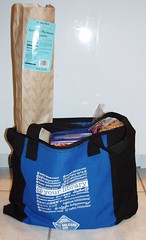
When I was in Trader Joe's last week, I noticed a bunch of canvas grocery bags for sale next to the checkout. Beside them was a "save the earth" message. For a moment I considered buying a couple of these bags, but then I remembered that I had a collection of bags from library conferences sitting in a closet. I decided to bring one to see if a clerk would load it with my groceries.
Today I returned to the store to get a few items. When I asked the clerk if we could use my bag, she answered "Certainly!" She said the company encourages reuseable bag use, and as an incentive it enters canvas bag users in a free raffle to win groceries. I now have a chance to win $25 worth of Trader Joe's goods.
My blue ALA New Orleans 2006 bag was just big enough for today's purchases. Next time, I will also bring a white PLA Seattle 2004 bag.
How are you using your conference bags?
Today I returned to the store to get a few items. When I asked the clerk if we could use my bag, she answered "Certainly!" She said the company encourages reuseable bag use, and as an incentive it enters canvas bag users in a free raffle to win groceries. I now have a chance to win $25 worth of Trader Joe's goods.
My blue ALA New Orleans 2006 bag was just big enough for today's purchases. Next time, I will also bring a white PLA Seattle 2004 bag.
How are you using your conference bags?
Thursday, January 04, 2007
Update about Library Supply Catalogs
Yesterday I received a very nice telephone call from Bill Stroner, the President/CEO of DEMCO concerning my observations last week. He agreed that the over-abundance of library supply catalogs is a concern for his company (which wishes to make a profit) and libraries (who want less mail), and he described some efforts DEMCO is making to reduce unwanted mailings. He said that with bundles of catalogs that his company recently sent, there were letters telling clients that they may contact the company to reduce their mail. He also said that his staff has a schedule of calling clients, and one of the questions is whether they want to add or reduce catalogs.
I told Mr. Stroner that my main objective is to persuade libraries to take the initiative to reduce their mail through contacting the supply companies and removing names of former employees from lists. It sounds as though DEMCO is helping this effort. Mr. Stroner said that some libraries respond positively and scratch some names from their lists. Some libraries do want everyone in the building to have a catalog. Some others do not bother to respond. DEMCO will honor the libraries' wishes. The company will happily take names off its lists.
Kelli at 'brary Web Diva left a good idea in the comments to last week's post. She said that her library gives the extra catalogs away to library clients who request them.
I told Mr. Stroner that my main objective is to persuade libraries to take the initiative to reduce their mail through contacting the supply companies and removing names of former employees from lists. It sounds as though DEMCO is helping this effort. Mr. Stroner said that some libraries respond positively and scratch some names from their lists. Some libraries do want everyone in the building to have a catalog. Some others do not bother to respond. DEMCO will honor the libraries' wishes. The company will happily take names off its lists.
Kelli at 'brary Web Diva left a good idea in the comments to last week's post. She said that her library gives the extra catalogs away to library clients who request them.
Thursday, December 28, 2006
Are You Buried in Library Supply Catalogs?
Over the holiday season, everyone in the library seems to take on some duties that they do not regularly perform. I have been sorting the incoming mail. Several days ago we got more than a dozen heavy Gaylord catalogs and over the past two days we have received a dozen just-as-heavy Demco catalogs. Poor postal carrier! Some of the names on the mailing labels were individuals who no longer work for us. One has been gone over ten years. Another died about that long ago. Some staff were getting duplicate copies, while others did not want theirs.
After some staff discussions to make sure who in the building really needs catalogs, I called both of the companies and cancelled nine or ten catalogs. In both cases, the customer service staff seemed happy that I had called and promised to remove the names. One said that labels are printed in advance, so we might still see mailings for the removed individuals for six weeks, but our mail should decrease after that time.
As a realist I know that this situation will reoccur. Every time someone places an order, another name goes onto the mailing list. Also, the companies are actually buying names to add to their lists as well.
I could just give up and say "It's their dollar," but it's our dollar, too. The companies are passing the marketing costs on to us in the prices for their products, and we are having to sort and recycle a lot of catalogs and fliers. The waste makes a physical impact on our work.
What would I like to see these companies do?
1. Purge their own lists of any names without recent activity.
2. Review large catalog shipments. The catalogs came bundled, so the companies must see that they are sending many copies to our small library.
3. With every bundle, send a how-to-cancel notice so libraries will learn how easy it is to reduce the number of copies received.
4. Review the sources from which they are buying names. One of the names was a library client who was a board member about fifteen years ago.
As a realist, I suspect that these reforms will not be adapted, but I can try. Marketing seems to be an industry based on waste creation. I think that is lazy and probably ineffective marketing.
After some staff discussions to make sure who in the building really needs catalogs, I called both of the companies and cancelled nine or ten catalogs. In both cases, the customer service staff seemed happy that I had called and promised to remove the names. One said that labels are printed in advance, so we might still see mailings for the removed individuals for six weeks, but our mail should decrease after that time.
As a realist I know that this situation will reoccur. Every time someone places an order, another name goes onto the mailing list. Also, the companies are actually buying names to add to their lists as well.
I could just give up and say "It's their dollar," but it's our dollar, too. The companies are passing the marketing costs on to us in the prices for their products, and we are having to sort and recycle a lot of catalogs and fliers. The waste makes a physical impact on our work.
What would I like to see these companies do?
1. Purge their own lists of any names without recent activity.
2. Review large catalog shipments. The catalogs came bundled, so the companies must see that they are sending many copies to our small library.
3. With every bundle, send a how-to-cancel notice so libraries will learn how easy it is to reduce the number of copies received.
4. Review the sources from which they are buying names. One of the names was a library client who was a board member about fifteen years ago.
As a realist, I suspect that these reforms will not be adapted, but I can try. Marketing seems to be an industry based on waste creation. I think that is lazy and probably ineffective marketing.
Subscribe to:
Posts (Atom)


