Thanks to Stephanie Miller for inviting me to the December meeting of the Reference Association of South Suburban Librarians (RASSL) held at the Calumet City Public Library last week. I enjoyed our discussion of readers' advisory. I you can see my slides for True Stories into the Hands of Readers online. I enjoyed being paired with Lynnanne Pearson from Skokie Public Library, who spoke about fiction readers' advisory.
Visiting RASSL was a homecoming for me, as I was present at its founding in 1981. I have fond memories of the leadership of Renata Ochsner of the Harvey Public Library and Jim Steenbergen of the Riverdale Public Library. Both were true believers in library sharing. In those pre-Internet days and even pre-shared library catalog days, we put together a guide to the staff and collections of neighboring suburban libraries, so we could more effective referrals to library users. It was a lot of work then and so easily done now.
Thanks also to Pat Coffey at the Calumet City Library who gave me a tour of the busy library. It is a library with a strong sense of mission.
Showing posts with label library visits. Show all posts
Showing posts with label library visits. Show all posts
Monday, December 15, 2014


Monday, October 24, 2011
The Howson Branch of the Austin Public Library
I'm just back from a trip to Texas. While in Austin, I had a few free hours and the use of a car, so I visited the branch library where I had my first library job. The Howson Branch of the Austin Public Library has changed a bit since I worked there as a desk assistant from 1976 to 1978 while I attended library school. The change was obvious as I approached.

When I worked at the Howson branch, the lawn was just grass. There may have been a few close-trimmed shrubs around the building and trees close to the street, but it was not the garden it is today. There are numerous perennials rated for the Austin climate dressing up the place. It would be nice to sit outside the library and read now.

Of course, the inside of the library has changed. We used a camera-based checkout system when I worked at the Howson branch. We would photo the patron's card with the book pockets and the numbered date cards. If the card did not return, the microfilm would be checked months later, and a notice to return the book would be mailed to the patron.
We had no online catalog. I'm not sure that we even had a card catalog for the branch. Every six months, the main library sent us a newly printed paperbound book catalog. If my memory is clear - a big if - we had one big floppy volume for authors, one for titles, and another volume for subjects. Covers were gray or pale blue or pastel pink.
There was a small collection of vinyl record albums. CDs and DVDs did not exist. Now there are plenty of both, as well as downloads from the website. There were no public use computers like there are now. We had the red version of The Reader's Guide to Periodical Literature - the edition with fewer titles. We had lots of large print books and mysteries. I remember reading Sports Illustrated and The New Yorker on my breaks. There was a big meeting room which sometimes hosted the library trustee meetings.
My favorite memory is helping Sally Ann, the children's librarian, with the puppet show production of Strega Nona. Children laughed as the yarn flew everywhere. Poor Big Anthony!

The least-expected coolest thing I found on my visit was the electric auto recharging station in the library parking lot. Recharge your mind and your electric car at the same time at the library.

When I worked at the Howson branch, the lawn was just grass. There may have been a few close-trimmed shrubs around the building and trees close to the street, but it was not the garden it is today. There are numerous perennials rated for the Austin climate dressing up the place. It would be nice to sit outside the library and read now.

Of course, the inside of the library has changed. We used a camera-based checkout system when I worked at the Howson branch. We would photo the patron's card with the book pockets and the numbered date cards. If the card did not return, the microfilm would be checked months later, and a notice to return the book would be mailed to the patron.
We had no online catalog. I'm not sure that we even had a card catalog for the branch. Every six months, the main library sent us a newly printed paperbound book catalog. If my memory is clear - a big if - we had one big floppy volume for authors, one for titles, and another volume for subjects. Covers were gray or pale blue or pastel pink.
There was a small collection of vinyl record albums. CDs and DVDs did not exist. Now there are plenty of both, as well as downloads from the website. There were no public use computers like there are now. We had the red version of The Reader's Guide to Periodical Literature - the edition with fewer titles. We had lots of large print books and mysteries. I remember reading Sports Illustrated and The New Yorker on my breaks. There was a big meeting room which sometimes hosted the library trustee meetings.
My favorite memory is helping Sally Ann, the children's librarian, with the puppet show production of Strega Nona. Children laughed as the yarn flew everywhere. Poor Big Anthony!

The least-expected coolest thing I found on my visit was the electric auto recharging station in the library parking lot. Recharge your mind and your electric car at the same time at the library.
No one knew the branch librarian Marian Laws, who I remember fondly. I have since discovered that she died September 28, 2010. I hope she saw the refurbished library.
Tuesday, December 15, 2009
A Visit to the Brookfield Zoo Library
Hidden behind one of the gift shops at the Brookfield Zoo, in what was once exhibit space, is a library devoted to zoology. As in many older institutions, the zoo library was never formally founded but evolved from small scattered collections in staff offices around the park. The collection has been centralized for about thirty years, though there is still a satellite site for the veterinarians and another containing the zoo's archives of maps, brochures, and other documents. The main collection was only recently cataloged by the current librarian Carla Owens.
Last Friday the staff of the Thomas Ford Memorial Library toured the Brookfield Zoo Library as a part of our in-service training day. Each year during the month of December, we visit another library either to get new ideas to help us run our own library or to learn about the work of different types of libraries. In the past we have visited the Morton Arboretum Library, the conservation lab at the Newberry Library, the John Crerar Library at the University of Chicago, and the Marion E. Wade Center, which is devoted to studies of J.R.R. Tolkien, C.S. Lewis, and their contemporaries, as well as visiting other public libraries.
The Brookfield Zoo is a special library run to support animal keepers, researchers, and volunteers at the zoo. On any given day, zookeepers and researchers enter the out-of-the-way library to find information about their species, often asking the librarian for help. These clients have numerous grant-funded conservation projects that require finding detailed studies from serials and monographs. Many also work from their offices using a collection of electronic resources acquired and maintained by the Library. This is what you'd expect in a zoo library. What surprised me was service to volunteers. The zoo has hundreds of docents and other volunteers, many of whom get rigorous training and have continuing education requirements. Because the docents have to write papers, they too need library services, which Owens and her half time assistant provide. To facilitate the volunteer training, Owens has created a wiki from which the volunteers can obtain and contribute information.
Being a special library, service to the public is limited. People wanting to use the collection have to make appointments. Owens and her assistant also answer telephone questions from the public, some of which ask how to donate exotic animals to zoos. Because Zoo policy does not allow for the accepting of unregistered animals, the librarians have information on contacts with animal sanctuaries that can accept or place the animals.
When asked questions about the library, Owens often broadened the query and gave an answer about the zoo. Library policies and operations are integrated into daily zoo work, and she seems to identify closely with the zoo mission. Based on what I heard her say, she is a zoo employee first, running the library for the good of the zoo and international wildlife conservation. She is also co-author of the new zoo history.
Last Friday the staff of the Thomas Ford Memorial Library toured the Brookfield Zoo Library as a part of our in-service training day. Each year during the month of December, we visit another library either to get new ideas to help us run our own library or to learn about the work of different types of libraries. In the past we have visited the Morton Arboretum Library, the conservation lab at the Newberry Library, the John Crerar Library at the University of Chicago, and the Marion E. Wade Center, which is devoted to studies of J.R.R. Tolkien, C.S. Lewis, and their contemporaries, as well as visiting other public libraries.
The Brookfield Zoo is a special library run to support animal keepers, researchers, and volunteers at the zoo. On any given day, zookeepers and researchers enter the out-of-the-way library to find information about their species, often asking the librarian for help. These clients have numerous grant-funded conservation projects that require finding detailed studies from serials and monographs. Many also work from their offices using a collection of electronic resources acquired and maintained by the Library. This is what you'd expect in a zoo library. What surprised me was service to volunteers. The zoo has hundreds of docents and other volunteers, many of whom get rigorous training and have continuing education requirements. Because the docents have to write papers, they too need library services, which Owens and her half time assistant provide. To facilitate the volunteer training, Owens has created a wiki from which the volunteers can obtain and contribute information.
Being a special library, service to the public is limited. People wanting to use the collection have to make appointments. Owens and her assistant also answer telephone questions from the public, some of which ask how to donate exotic animals to zoos. Because Zoo policy does not allow for the accepting of unregistered animals, the librarians have information on contacts with animal sanctuaries that can accept or place the animals.
When asked questions about the library, Owens often broadened the query and gave an answer about the zoo. Library policies and operations are integrated into daily zoo work, and she seems to identify closely with the zoo mission. Based on what I heard her say, she is a zoo employee first, running the library for the good of the zoo and international wildlife conservation. She is also co-author of the new zoo history.
Monday, December 11, 2006
A Visit to the Marion E. Wade Center: C. S. Lewis, J. R. Tolkien, and Friends.
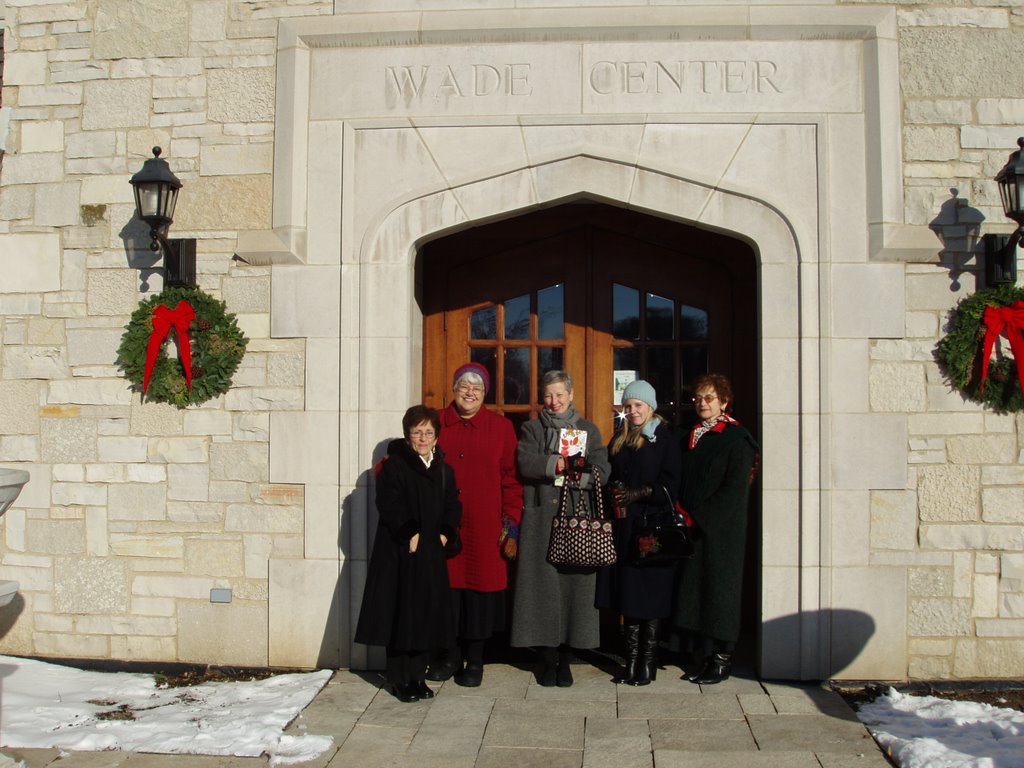
One of the great Thomas Ford Memorial Library traditions is the December staff outing to see another library. Every year Director Anne Kozak picks a library that she thinks that we will enjoy visiting and from which we will learn about different library missions, collections, and methods. This year we closed our library for a day and visited the Marion E. Wade Center on the edge of the Wheaton College campus in Wheaton, Illinois. The Wade Center has a museum and research library devoted to the study of seven English authors - C.S. Lewis, Owen Barfield, G. K. Chesterton, George MacDonald, Dorothy L. Sayers, J. R. Tolkien, and Charles Williams.
Upon entering the building, visitors find a small museum devoted to the authors in which there are several very impressive items, including the little desk at which Tolkien wrote The Hobbit and parts of The Lord of the Rings trilogy and the wardrobe that belonged to the grandparents of C. S.
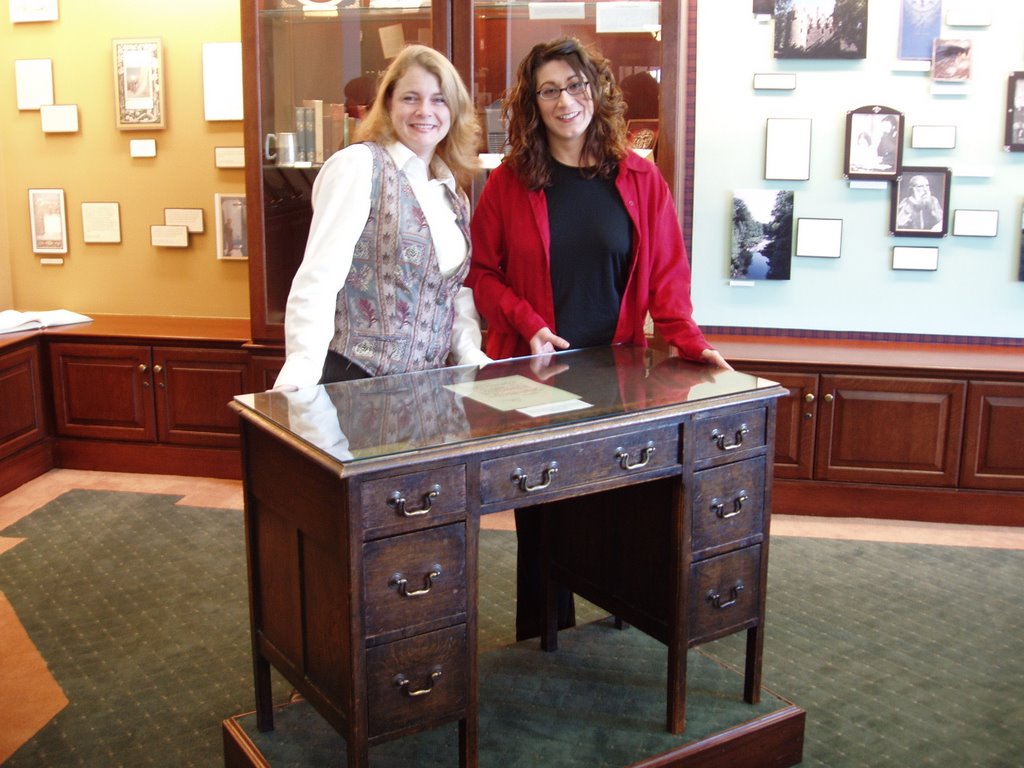 Lewis, said to have inspired his stories about Narnia. Also in the room are C. S. Lewis' desk from Oxford and his dining room table. Around the room are changing exhibits about the authors, their works, and how their works have been translated into films and other adaptations. I liked one of the cases that showed a photo of Sayers with a pair of her reading glasses and her telephone contact book. The exhibits are attractive. The staff of the Wade Center have developed great skill in making reproductions from originals; the tour guide assured us that they had not really glued original works onto their display boards.
A display in a hallway leading to the library told the story of the center's development. Key points were the friendship of Wheaton College professor Clyde S. Kilby with C. S. Lewis and the critical funding from Marion E. Wade, who founded Servicemaster Corporation. The center moved into its current building in 2001.
 The Kilby Reading Room houses a collection of books by and about the seven authors that may be read in the room. Included in the collection are translations of the works in many languages. An adjoining room includes serials, reproductions of letters, and dissertations. The rare original letters and manuscripts are stored in climate control rooms downstairs.
We were surprised to find that the collection has no catalogue as yet. When the physical arrangement is insufficient, researchers have to rely on staff to find materials for them. I hope the staff uses new technology and ideas to create a catalogue that will work for the Center and serve as a model for libraries needing to replace their stodgy old tools.

Besides the collection, what sets the Marion Center apart from most libraries is its beauty and comfort. I know I would enjoy spending many hours reading at the desks or in the comfy chairs in the reading room. The center is open to the public for casual or serious research of the seven authors.
Subscribe to:
Posts (Atom)


