Showing posts with label architecture. Show all posts

Wednesday, March 11, 2015

Michelangelo: A Life in Six Masterpieces by Miles J. Unger

When taking a big trip abroad, I read some in preparation and read more after the journey. Portions vary. To know what to see and its significance requires some prior study. I never do as much of this as I could, so I am fortunate that Bonnie is thoroughly prepared. She gets us to the right places at the right times and answers my immediate questions. I often read after the trip seeking more understanding of what I saw. Having already seen places, buildings and works of art, I connect with their descriptions and stories more readily. The big drawback is that I do not have the upcoming opportunity to look again on these places, buildings, and works of art in person.

Before our trip to Florence and Rome, I perused several guidebooks and magazine articles, as well as every photocopy Bonnie passed to me. About a week before our departure, I started Michelangelo: A Life in Six Masterpieces by Miles J. Unger with the intent of finishing before packing. It is a moderately heavy book that I did not want to carry. By trip time, however, I had read only the introduction and the chapters about The Pieta found in St. Peter's Basilica in Rome and David now at the Accademia in Florence. After the trip, I read chapters about Michelangelo's work on the Sistine Chapel, the Medici Chapel in the church of San Lorenzo, The Last Judgment, and the dome of St. Peter's Basilica.

The experience of reading is shaped by both the author and the reader. With Michelangelo: A Life in Six Masterpieces, the author contributes a well-written story balancing the details of the sculptor's life* with accounts of his masterpieces and his times. This is quite enough to insure a good reading experience for anyone with a general knowledge of history and art. Still, in the wake of the trip, my experiences helped the story jump higher from the page.

Don't be fooled by the subtitle into thinking Michelangelo: A Life in Six Masterpieces is a narrowly focused biography. Unger addresses many aspects of Michelangelo's personality and the events of his times, and because he is a central character in the story in the Italian Renaissance, having worked in both Florence and Rome, having served and survived many popes as well as his Medici sponsors, his sculptor's story is a good introduction to the period. It is easy to find in public libraries.

*Michelangelo always insisted that he was a sculptor not a painter or architect, though he is now famous for a wide range of work. He even wrote poetry.

Unger, Miles J. Michelangelo: A Life in Six Masterpieces. Simon and Schuster, 2014. 432p. ISBN 9781451678741.

Monday, December 08, 2014

On the High Line: Exploring America's Most Original Urban Park by Annik La Farge

When Bonnie and I visited Manhattan in May of 2013, the first place that my college roommate Robert took us was the High Line, an urban park created atop an abandoned elevated rail line on the west side of the island, running from Gansevoort Street north to 34th Street, over 20 blocks long. We climbed up the stairs at 20th Street to discover a wide walk surrounded by masses of flowers, shrubs, and trees. At some points along the popular walk, I noticed old steel rails and imagined they carried commuter trains, like the elevated lines of Chicago. But I misunderstood.

Annik La Farge tells the full story in On the High Line: Exploring America's Most Original Urban Park. The High Line opened in 1934 to get freight trains off the busy streets of the industrial west side. These trains delivered produce, raw materials, and manufactured goods from docks on the Hudson River to factories and warehouses, many with elevated rails running right into their buildings. The line was abandoned in 1980, and a debate about what to do with the property began. In the 1990s, naturalists noticed how abundantly wildflowers were growing all along the tracks and the effort to make a park began. Parts of it opened in 2003.

History is just a part of La Farge's book. Almost every page is filled with beautiful color photos of the park as it is today, and the author reports on ongoing projects on and around the High Line, which has proved to be a spark to urban renewal. Readers see that its great variety of spaces provide community gathering spots, places for quiet relaxation, great views of the Manhattan skyline, and a handy path for many New Yorkers going to work or out for the evening.

On the High Line is just what New York needs to combat the image of the city as gray and dreary place. It can go into either landscaping, travel, or history collections.

La Farge, Annik. On the High Line: Exploring America's Most Original Urban Park. Thames & Hudson, 2014. 226p. ISBN 9780500291412

Monday, April 28, 2014

The Public Library: A Photographic Essay by Robert Dawson

Photographer Robert Dawson has been aiming his cameras at public libraries for 18 years, capturing exterior and interior images to show the role of libraries in their communities and the nation. His project began slowly, as he photographed libraries while traveling on other assignments. Then in 2011 and 2012, he and his son Walker took cross-country trips specifically to visit libraries, often two or three a day. From thousands of photos, Dawson assembled a representative collection in The Public Library: A Photographic Essay.

The Public Library is not just a pretty book of pictures, though many photos celebrate the art and architecture of public buildings serving as libraries. The book serves as an introductory history of American public libraries and as a state of the institution report. In his captions and in essays collected from well-known writers, such as Bill Moyers, Ann Patchett, Barbara Kingsolver, Isaac Asimov, and Dr. Seuss, Dawson poses that our nation would not be so diverse and strong nor so rich if we had not had public libraries. Libraries have been essential in educating and inspiring individuals who have built the country, and they continue to be needed as the gap between haves and have-nots widens.

Dawson's book will not please everyone. Sometimes he aimed at the weather-beaten backs or windowless sides of beleaguered libraries; sometimes he shows abandoned buildings. I can imagine there are a few librarians and trustees who rue that he did not show their libraries more positively. I only hope that they see he is making the case that libraries (including theirs) need support to continue.

Every public library can benefit from having this book for their readers, staff, and trustees. I'd like every political leader to read it. Dawson's The Public Library is an important contribution to our effort to support the cause of libraries.

Dawson, Robert. The Public Library: A Photographic Essay. Princeton Architectural Press, 2014. 191p. ISBN 9781616892173.

Thursday, January 07, 2010

Daniel H. Burnham: Visionary Architect and Planner by Kristen Schaffer

2009 was the 100th anniversary of the Plan of Chicago, an influential document written by architect Daniel H. Burnham for the Commercial Club of Chicago. Groups around the region used the anniversary to launch projects and present programs throughout the year. I was aware all year and watched a documentary on Burnham on December 29. Inspired, I borrowed Daniel H. Burnham: Visionary Architect and Planner by Kristen Schaffer from the library on December 30. I quickly finished the big photo book on January 1 wanting to plan a tour of Pittsburgh, New York, and Washington, D.C. as well as revisit buildings in Chicago.

My desire is stoked by the gorgeous photos in Schaffer's book. The interiors of buildings, such as the Rookery in Chicago, the Society for Savings in Cleveland, and Union Station in Washington, are grand. I like all the marble and inlaid stonework, beautiful woods, and use of natural light. The exteriors are stately, orderly, somewhat reassuring. Beauty was a prime object in Burnham's work; he thought that it would well serve the commerce of his clients. Schaffer discusses in her text how Burnham has been often criticized for reflecting past architecture and not being more modern, but that's what I like about him even 100 years later. Many of the steel and glass buildings built since appear so cold and lack any master builder's touch. Any kid with Legos could do as well. Actually, colorful Lego structures look better.

Daniel H. Burnham: Visionary Architect and Planner is an architecture book and not much of a biography. A few facts about his life and stories about his professional challenges are included. Get Burnham of Chicago by Thomas S. Hines or Devil in the White City by Erik Larsen to learn about Burnham's life.

Schaffer, Kristen. Daniel H. Burnham: Visionary Architect and Planner. Rizzoli, 2003. ISBN 0847825337

Sunday, October 21, 2007

Graduate School of Art, University of Iowa

On Saturday, Bonnie and I toured the Graduate School of Art at the University of Iowa with our daughter Laura. Laura told us that there was a really cool exhibit, but it had closed when we got there. So we just wandered around the building. There was still plenty to see.

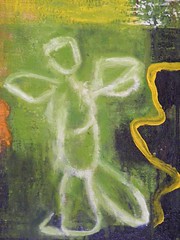
We went up the industrial metal ramps to the second level, where we found a collection of paintings around the landing walls. Most had no attributions. Were they by students? What I liked best was a little green figure, a detail in a larger piece. I'd tell you what it is, but I do not know. Maybe it is an angel.

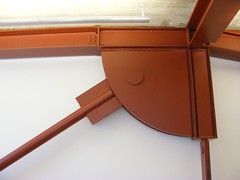
The art school library was fairly deserted while we walked around. It was mostly an unadorned, more functional than artful space, but I saw much to like from a service point of view. The reference collection and new titles were right up front. There were still many empty shelves for future acquisitions, and there were many interesting looking periodicals. Around the library were displays of red-colored uncovered structural steel.The large glass windows looked out on a goldfish pool under a limestone wall. If the windows were washed, it would be very nice. If I were a student, I'd like studying in the art library, away from the noise of dorms.

On the third level was a display of metal box sculpture. I liked the the burned-out oven. There were three other pieces, one of which I almost tripped over when I was looking at something else. There were more big windows, lots of faculty offices, and more naked structural steel.

It was a cool building. I have loaded 18 photos from around the graduate school in a set on Flickr.

Friday, May 18, 2007

Buildings of the District of Columbia by Pamela Scott and Antoinette J. Lee

By this time last year, I had reviewed four books about New Orleans. This is my first look at Washington, DC books in preparation for attending the American Library Association Annual Conference in late June. My own need for study is a little less this year, as I have been to DC in the past and have seen most of the major sites. Still I want to be an informed visitor, so I plan to read and skim a few books in the next month.

I am starting with Buildings of the District of Columbia by Pamela Scott and Antoinette J. Lee, published in 1993. Of course, there are new buildings in Washington since that date, such as the Holocaust Museum, but most of the architecture of the city is old and preserved for the citizens and visitors to see. This book, which includes both public and residential buildings, is still useful for tourists with architectural interests. It is arranged by neighborhoods, starting with the Mall, and describes hundreds of buildings, some in great detail.

For example, Scott and Lee devote about three pages to the Thomas Jefferson Building of the Library of Congress, 1871-1897. They tell readers that it was "the first building in Washington to express fully the tenets of the Beaux-Arts system of architecture." They explain that the architects modelled the building on the Paris Opera House of 1861-1875, replacing the theater with a reading room. They also describe the external and interior ornamentation, saying that like many Victorian era buildings, the art and sculpture is very symbolic. In the end, they state that the decoration is overdone and criticize the columns on some staircases as being poorly proportioned.

Black and white photos and maps are included. A glossary of architectural terms is included, just before the index.

Buildings of the District of Columbia was the first book in the Society of Architectural Historians Buildings of the United States series. The series is intended to be a comprehensive survey of all the architecture of the Unites States with a volume for every state and Washington, DC. Fourteen years later, there are ten volumes, adding Alaska, Colorado, Iowa, Louisiana, Michigan, Nevada, Rhode Island, Virginia, and West Virginia. The Virginia volume appears to be only a portion of the state, so there may ultimately be more than fifty-one volumes.

I purchased three volumes for our library back in 1996, thinking that we would build the set. Because our Iowa and Michigan books have never been borrowed, I have refrained from buying more. In our small library we do not have the readers to match with these books. The set, if ever completed, should be added to large city, college, and university libraries. Most public libraries should get their own state. This volume for Washington, DC may have more appeal than most other volumes.

Pamela Scott and Antoinette J. Lee. Buildings of the District of Columbia. New York: Oxford University Press, 1993. ISBN 0195061462