Showing posts with label marketing. Show all posts

Tuesday, March 18, 2014

Does This Display Make Me Look Fat? The Truth about Merchandising

"Merchandising" is such a funny looking word. It has the word "hand" in the middle and "sing" at the end. "Reach" and "search" can be formed with its letters. If only it had a "t" I could also rearrange the letters to form "retch." I am rather tired of hearing about marketing and merchandising. I just want to select and promote books, which is really merchandising and marketing, of course, but I am so tired of talking about it. So you would not think I would attend Does This Display Make Me Look Fat? The Truth About Merchandising. But I did and it was really good. I got several useful ideas.

Kathy Dempsey whose website is Libraries Are Essential and wrote the book The Accidental Library Marketer is a cheerful and understanding guide to the world of library promotion. And I liked how she started her tour of the library outside the building. Her point is that the outside suggests what's inside. The outside needs to be esthetically pleasing and also carry specific messages. Having attractive signs that post often changing messages can lure some curious nonusers inside to at least see what the library is about.

The entry way should be clear of clutter which might discourage the reluctant to continue. Most people pass through the entry way quickly. It is a better spot for branding than for the posting of content.

Once inside the building, people look for clear paths to departments and services. Space arrangement is more important than signs - though signs are also important.

Wherever bulletin boards are (hopefully not in the entryway), they should be orderly and well-tended.

Dempsey showed examples of many displays on tables and on wall shelving through libraries. She encouraged the use of cloths and rugs on tables, as well as well chosen props on any display. She also liked having books face out on end caps and library walls. For ideas she recommended looking at Trading Spaces: Reinventing the Library Environment on the South Jersey Regional Library Cooperative website.

Dempsey also addressed a question our library has where to get royalty free images for our publications, website, and social media. On the Resources page of her website is a lengthy section about stock photos.

Here are some assorted tips:

  • Laminating signs makes them harder to read for anyone with vision problems.
  • Place signs near display books letting people know that they may be taken.
  • Bundles of children's books on related topics are popular with time-stressed parents.
  • Cardboard cutouts of library staff heads are a nice touch on staff recommends shelves.
The last idea that I really liked was turning ugly pillars into attractive branding. My library has two pillars screaming for a make-over in our community meeting room.

Despite my reluctance, I spent an hour well.

Sunday, March 25, 2007

Jane Goodall at the Inside the Mind of Chimpanzee Conference

On Sunday Bonnie and I heard Jane Goodall speak at the final event of Inside the Mind of Chimpanzees, a conference sponsored by Chicago's Lincoln Park Zoo. The presentation was open to the public and held in Navy Pier's Grand Ballroom. 1700 people attended, most as in awe as I was. I do not remember ever seeing anyone as eminent as Jane Goodall.

Before Goodall took the stage, we heard Richard Wrangham, the author of Demonic Males: Apes and the Origins of Human Violence. He spoke about latest research into chimpanzee intelligence and showed a series of videos of chimps solving problems. I wish there were copies on YouTube so I could link to them. They showed chimps going far beyond making simple tools to fish for termites.

Goodall received a standing ovation for just appearing on the stage. She appeared to speak without notes and kept the audience enthralled with her stories and observations. She told of her early career and the life changing events that led her to pursue environmentalism. Her report on her recent activities updated her book Reason for Hope: A Spiritual Journey. I think she said that Roots and Shoots, her program to educate youth to care for the earth, now has groups in over 90 countries.

Goodall said that she travels about 300 days a year to give presentations worldwide, so you may have a chance to see her where ever you are. Do so if you can. If you hear she is coming to your area, put up a book display. She has written many books, including a series for children. Her latest book, Harvest for Hope: A Guide for Mindful Eating, calls for people to change eating and shopping habits to influence the food industry.

Tuesday, February 20, 2007

Libraries, the Retail Customer Service Model, and Feel Good Marketing: Updated

Sometimes a pattern only appears when it is broken.

When I shop at retail stores, clerks usually smile and sometimes comment about the weather, but they do not say very much. Until recently they have rarely said anything about what I buy. Occasionally a clerk at a clothing store might say "I like that color" or a grocery clerk might say "That's on sale. I should get a couple." These comments seemed mostly undirected.

I had not realized until this weekend that there is a new pattern. At both the big supermarket and the friendly speciality grocery, I have heard many comments recently about what I brought up to the register.

"I really like these apples. They are so crisp."

"Ghirardelli brownies! I bet they're good."

"You'll like those enchiladas."

"That's my favorite nut mix. That little bit of coconut makes it so good!"

"You found the Thai mixes. My favorite is the satay. Have you tried it?"

I have not heard so much from clerks since I had a toddler in the shopping cart. Could it be the few gray hairs at my temples that makes me more approachable?

I only thought about this about after shopping at an office supply store. A young clerk was being trained by a manager. As she checked me out, she said cautiously, "That's a really nice binder."

I walked back to my car wondering why she said that. It was just a plain blue plastic binder. Then it struck me. She is being taught to compliment the customer's selections. The idea is to make the customer feel good about buying something from her store. She hadn't gotten the hang of it yet.

Of course, this made me think about the library.

The idea of marketing a good feeling is not a bad idea. We may want to do it in libraries, too, but our comments have to be honest and natural. Any falsehood is quickly spotted.

Also, complimenting someone every time you see will rouse suspicions. People will wonder if we are trying to manipulate them or secretly make fun of them.

There has been much emulation of retail models of customer service in libraries in recent years. It does not always work. I hope I never see a library consultant pressing "feel good comments about what people borrow" onto our public service staff. We should stay honest and friendly and only say "I liked that book" if it is true.

As long as we stay friendly and helpful and real, we will cultivate good feeling.

Update: This is getting more comments than most of my blog posts, and a variety of viewpoints are being expressed. The discussion has brought up several ideas that I was not connecting.

For clarification about my viewpoint, let me say I see nothing wrong with honest, unforced comments by service staff at retail or in the library. I like talking with people and enjoy some of these little convesations, so long as they are tactful. Having clerks forced to comment or being kept from commenting both seem wrong to me. Also, I do not like the idea of being subliminally marketed.

Wednesday, February 14, 2007

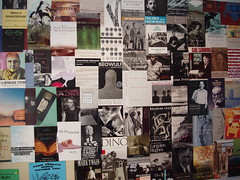
Wall of Book Covers at Augustana College


Wall of Book Covers
Originally uploaded by ricklibrarian.
Last week my daughter Laura and I were in the Treadway Library at Augustana College. I really liked the wall of book covers in one of the entry ways - fifth floor if my memory is good. The only one of the books on this wall that I have read is the Beowulf translated by Seamus Heaney, which you can see near the center.

Wednesday, February 07, 2007

Cleveland Public Library Places Content Outside Its Website

I have forgotten where I first heard the challenge to put library-generated content on
nonlibrary websites. Whatever, I have not actually seen a rush to meet this challenge, and I am personally guilty for not finding ways to partner with nonlibrary organization other than our local historical society, which was a good joint project, which needs follow up.

Yesterday, preparing for a trip to Nashville, I was looking for country music booklists. I did not find what I sought with the Librarian's Booklist Search and found only one guide list with other search engines. I will try again. Surely something more is out there. (By the way, I am still looking for libraries to add to the LBS.)

Whatever, I did find Hank Williams: Still Cookin': booklist from the Cleveland Public Library on a popular country music radio station website. It recommends books on Williams, histories of country music, songbooks, reference books, and music CDs, all at the Cleveland Public Library.

Well, partner, that's mighty good marketing!

Friday, December 22, 2006

AmericanTowns: A New Vehicle for Library Marketing

My library got an email several days ago from AmericanTowns asking us to join. I had not heard of the service and starting looking. I found that it lists local news stories, events, groups & organizations, and shopping. It seems to be a big operation, building online profiles for communities all over the country, so I registered and started adding upcoming library events.

When looking at Western Springs, Illinois, I found there were other organizations already profiled and numerous events on the calendar. I then saw our village is one of their "Feature Towns." I suspect that someone from AmericanTowns is seeding the information, hoping the local organizations will come on line. Some library events were already listed!

Moving around the website seems to be a little slow and I would like to be able to move forward on a calendar faster. Some of the communities that I viewed had little information. The service must be really new, but it seems promising.

If you are looking for another way to promote your library and its programs, you should consider AmericanTowns.

Tuesday, October 24, 2006

Reaching Patrons: Online Outreach for Public Libraries by Sarah Houghton-Jan

Sarah Houghton-Jan is one of several people at Internet Librarian with multiple presentations. She had a quick Jamba Juice for lunch on Monday and took the stage a second time with her presentation Reaching Patrons: Online Outreach for Public Libraries.

With many library users (and nonusers), especially teens, on the web gathering information, Sarah says that it is important for the public library to go where they go and be where they look. To this end she has created a 20-item checklist for library cyberoutreach.

I am glad to see that my library does some of the things that she suggests. Still there are some opportunities we have not taken. I plan to address items #5 (List your library events and services in local community websites and calendars) and #11 (Check reviews of your library on social review sites) when I get home.

One of the points Sarah makes is that once a library goes onto the web with its services it adopts everyone on the planet as possible library users. We have no choice. We have to get past geographically-limiting thinking. We serve everyone or no one at all. If we serve no one, then our purpose disappears.

il2006

Monday, October 23, 2006

Increasing the Use of Online Products

It was a challenge, but four speakers were able to tell their stories within 45 minutes at the program Increasing the Use of Online Products, an early program at Internet Librarian 2006.

The first speaker was Peter Simon from NewsBank Inc. In addition to introducing the other speakers, he directed our attention to a best practices page on the NewsBank web site. Most important in the points was having dedicated database introduction pages on a public library website. Having remote access also increases the use greatly.

Leslie Williams of Evanston Public Library in Illinois said increasing paid database use is a marketing problem. Many library users do not even know what a database is, much less think public libraries would have such research tools. Many consider libraries as repositories of books with service to children as their main mission. These people have to be enlightened. One method is to partner with other community organizations. Get the Chamber of commerce to provide a link on its website to your business databases. Likewise, get the local hospital to link to your medical databases on its pages for patients.

On the Evanston Public Library's website, databases are highlighted on its research resources page without ever using the word "databases," which Williams said is meaningless to most library users. Links are also present on the library's subject pages, such as the page for science research. Hennepin County Library also puts database links within subject guides. The nice thing about this library's subject guides is that the librarians responsible for pages are identified, as in this Literature subject guide.

Larry Mischo of Tacoma Public Library showed how his library has used the software Webfeet to categories and organize the databases. The web site has a rotating spotlight that features different databases in turn on the main page.

Jeff Wisniewski of the University of Pittsburgh showed how his library provides access to databases on a variety of web pages, including on an alphabetical list, in a federated search, and in subject guides. He agreed that words other than "database" should be found to use on public websites.

il2006