Showing posts with label ALA2009. Show all posts

Wednesday, July 15, 2009

Things That Go Bump in the Stacks: Whole Collection Advisory for Paranormal Fiction

Sunday at the American Library Association was my day to attend programs on subjects about which I knew little. I started with Things That Go Bump in the Stacks: Whole Collection Advisory for Paranormal Fiction, introduced and moderated by Neil Hollands of the Williamsburg Regional Library. Neil presented a brief history of these books with their vampires and other dark creatures. They differ from fantasy in that they bring magic into the everyday world. They spring from horror and often include appeal factors from romance and mystery. Some are even literary. Their rise has been spotlighted by the success of the Twilight novels by Stephanie Meyer.

With Neil were three authors. Marjorie Liu has spent much of her life in foreign countries and draws on her travel and diplomatic experience in crafting settings. She began her writing career in 2005 with Tiger Eye, a paranormal romance paperback. Liu says that she includes many forms of creatures in her novels, including her Dirk & Steele and Hunter Kiss series. she already has over a dozen books.

Charlie Huston is a classic rags to riches author, having been everything from a struggling actor to a bartender before becoming a successful author. His books are violent and often reflect life in the underside of society. Since his debut with Caught Stealing in 2004, he is known for the Hank Thompson trilogy and the Joe Pitt series. He jokes that he writes for maladjusted young men. "Splatter" is his favorite word.

Charlaine Harris is the most known of the panelists. She began her career writing Southern mysteries and segwayed into paranormal in 2001 with Dead Until Dark. Her latest book Dead and Gone, the ninth title featuring Sookie Stackhouse, debuted at the top of the New York Times Bestseller List.

Harris sympathized with librarians asked to recommend paranormal novels to readers. She said they range from cute and sweet books to titles filled with violence. She urged us to discover the differences before we put the books out. Huston agreed, admitting that his books are not for every reader, especially the young.

Neil listed appeals for paranormal fiction:

  • magic
  • blending of genres
  • paranormal characters
  • strong women
  • real world issues beneath the story

What I found most interesting during the session was the discussion about how one writes fiction. None of the panelists were like J.K. Rowling, having planned out the story for a whole series of books. Each book is a revelation to them. Harris also said she sometimes finds herself writing in parts that she does not particularly like. She said that she really like Sookie's grandmother, but she had to kill her off for the sake of the story.

Many titles were mentioned throughout the program. You can find many of them on the paranormal cheat sheet at the Readers Advisory website. With the cheat sheet are lists of TV, film, and music links for paranormal fans. Most importantly, there are paranormal titles suitable for younger readers.

Tuesday, July 14, 2009

Chicago as ALA Conference Site: Is It Really Working?


ALA Chicago 2009 013
Originally uploaded by ricklibrarian.
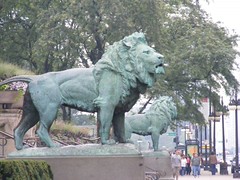
Nearly every librarian I know enjoys coming to Chicago. The city is especially beautiful this time of year, filled with flowers. There are more than ever since Mayor Daley has put planters everywhere and the parks have installed more gardens. The city is also full of museums, zoos, and great architecture. Having the American Library Association Annual Conference in the city is a popular idea.

As a librarian residing the western suburbs of Chicago, I benefit from having the conference here. I can send everyone in my department to the conference in shifts - we do still have to run the reference desk. My library's librarians benefit from all the opportunities the conference offers. The enthusiasm is high.

The organizers worked hard to present a good conference and people are leaving with many good memories and many ideas for their libraries. Still, I have to question whether Chicago is a good city for the conference.

I see one big, big problem - the distance between McCormick Place (the convention center) and the city center where all the visiting librarians stay during the conference. Complicating matters is the practice of holding many meeting away from the convention center. I heard numerous complaints on the buses about the distances and short times to get between meetings.

The real indication of a problem is the attendance at the remote meetings. I attended programs at the Intercontinental Hotel (where there is a bottleneck at the elevators to get to the seventh floor) and the Hyatt Regency. There were plenty of empty seats at the LITA Technology Trends forum and the RUSA President's Program on Readers' Advisory. I heard friends say that they did not attend because it was such a hassle to leave the convention center and get back for other meetings. I believe ALA needs to look at program attendance figures and see how the remote programs are not working well.

McCormick Place is clean and expandable, but not really warm and inviting. Food vending at this conference was definitely inadequate. Still, it might have been better to have all meetings at the center. There were more rooms. I know I could have attended two or three more programs if I hadn't been off on buses.

Still, there is a benefit from getting out of the sterile environment of the conference center. The city has many restaurants, shops, and parks that are just waiting for visitors between meetings.

If Chicago had a light rail to get people back and forth from McCormick Place, much of the problem would be solved, but that should have been put in place years ago. It would be more environmentally responsible to have the conference in a city that would not require so many bus and taxi rides. People like to walk. I suggest that we try Minneapolis, Indianapolis, or Milwaukee, cities with more accessible conference centers.

Sunday, July 12, 2009

Death at the Ballpark: A Comprehensive Study of Game-Related Fatalities by Robert M. Gorman and David Weeks


Death at the Ballpark
Originally uploaded by ricklibrarian.
I think that there may now truly be a book on every subject. At the McFarland Publishers booth at the American Library Association's annual conference, I found Death at the Ballpark: A Comprehensive Study of Game-Related Fatalities, 1862-2007 by Robert M. Gorman and David Weeks. Inside are listings for deaths of players, fans, umpires, or anyone else who happened to be a baseball game over a 145 year period. The authors have gathered their data from all levels of baseball, from youth to professional. The listings also tell cause of death, including suicide, violence, hit by pitch, foul balls, heart attacks, etc. McFarland has a number of interesting baseball books. I could spend the rest of my conference at the exhibit.

Libraries in Hard Times: The ALA Membership Meeting

For the last week, I have receiving emails and flyers urging me to attend Libraries in Hard Times at Saturday's ALA Membership Meeting. The marketing was well done, so my hopes were raised that it would be an interesting program. It was, but not really in the way that I expected. Patricia Wong summarized efforts of California Public Libraries to help the jobless and needy. Christopher A. McLean of the ALA Washington Office then reported on the federal government's stimulus package and what parts of it hold promise for library funding. The information was good (if a bit too general) but the setting and presentations and the timing did not do the subjects justice. The assembly hall was huge and the attendance slight. It was late in the day. We were very far from the speakers. I expected first hand stories from librarians telling what they are up against and what they are doing. I appreciate that the topic is being acknowledged before the assembly of membership, but it needs more coverage and debate in more intimate meetings where there will be more energy and passion.

On the up side, there were some useful web sites promoted, including Advocating in a Tough Economy Toolkit for the ALA President's Office. Another was the Library Use Value Calculator from Huntington beach Public Library.

Saturday, July 11, 2009

Pride and Passion: The African American Baseball Experience

I almost went to a management program at the American Library Association conference this morning, but my love of baseball (and my sweetheart) drew me to "Pride and Passion: The African American Baseball Experience" instead. I should listen to love more often. It was a wonderful program that I would not want to have missed. Not only did I hear Negro Leagues historian Lawrence Hogan recount his friendships with the old players, I heard Sharon Robinson tell about her new children's book about her father, Jackie Robinson, and I heard Kadir Nelson explain how he wrote and illustrated his award-winning We Are the Ship: The Story of Negro League Baseball. I will want to see Robinson's book (illustrated by Nelson) this fall. I have seen We Are the Ship and will post a review soon.

Anytime time there is a baseball reunion, there are good stories. They resonate because they are loaded with more meaning than just sport. To Hogan baseball is American history and to Robinson it is also family history. For Nelson it is beauty and inspiration.

This celebration of African American baseball launches the ALA traveling exhibit "Pride and Passion: The African American Baseball Experience." Two sets of illustrated panels are traveling to libraries around the country. One is in St.Louis currently while the other is on the ground floor of McCormick Place during the conference. It will then go to Milwaukee. The tour continues into 2013.

The Unconference at ALA

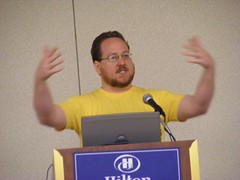
This is Jason Griffey of the University of Tennessee at Chattanooga, who opened yesterday's Unconference with a seven-minute presentation "The future of libraries in a ubiquitous computing world." It was a good beginning for a day full of conversation. You can find my full report on PlaBlog.

I will spend all day today in McCormick Place attending programs and wandering the exhibition hall. I hope to see my book.

Wednesday, March 04, 2009

The Art Insitute of Chicago for Librarians

Librarians heading to Chicago this summer for the American Library Association annual conference should plan to set aside some time to visit the Art Institute of Chicago. It is downtown where most of the visiting librarians will be staying. By that time, it will have opened its new modern wing, a huge addition which will increase the size of the museum about thirty percent. This benefits everyone who enjoys art. As the modern art heads into the new wing, the museum has more room in its existing galleries for art from earlier periods. Many of these galleries have already been re-installed. Bonnie and I were there Saturday to see how much better the arrangement is. Visitors can now find the beginnings of European art and follow its progression more easily. The French Impressionists now have larger rooms. More importantly, the Art Institute has brought many paintings out of storage now that there is more space. We saw dozens that we had never seen before.

We went to the museum last Saturday to see several exhibits - Becoming Edvard Munch and Yousef Karsh: Regarding Heroes. Neither will be there this summer, but if you can visit by mid-April, they are worthwhile. My favorite paintings in the Munch exhibit were by his friends, not by Munch himself. I enjoyed the Yousef Karsh more. There were many striking photographs of leaders in art and literature. The museum website, however, does not show them.

We always visit the museum shop. I noticed several children's books that I will be reviewing soon. The shop is currently being remodelled, but I suspect it will be completed before the summer.

The museum will not really have any big exhibits this summer, as it will be celebrating the new wing and showing more of what it has had stored away for decades. There will still be plenty to see. Librarians should stop by the museum library, which usually has an interesting exhibit of art books. Also, the restaurant in the courtyard will be open. Lunch at the Art Institute is an indulgence worth every calorie.