Showing posts with label baseball. Show all posts

Monday, December 22, 2014

1954: The Year Willie Mays and the First Generation of Black Superstars Changed Major League Baseball Forever

I have great interest in reading about 1954, my first year on the planet. It was an interesting time. President Dwight Eisenhower warned the nation about getting involved militarily in Vietnam after he authorized limited military aid to that country. Newsmen Edward R. Murrow and Fred Friendly produced a television exposé about Senator Joseph McCarthy. Jim Crow laws were still enforced in many states. Most importantly, the U.S. Supreme Court ruled in Brown v. the Board of Education that American public schools should integrate all races. Much was changing during the year of my birth.

It was also a time of change for major league baseball. The Boston Braves moved to Milwaukee in the previous year, the first franchise move since 1903, showing team owners how profitable moving a weary team to a new city could be. The St. Louis Browns moved to Baltimore to become the Orioles in 1954, a prelude to the Dodgers and Giants moving to the West Coast four years later. What may have been even more important to the way the game is played and who plays it is that 1954 was the first season that nearly every team in the pennant race had black players. The team that did not have any was the New York Yankees who failed to repeat as American League champs. Sports writer Bill Madden recounts this season in 1954: The Year Willie Mays and the First Generation of Black Superstars Changed Major League Baseball Forever.

In 1954, Madden tells a mostly chronological story featuring the teams that were seriously in the pennant race: Brooklyn Dodgers, Milwaukee Braves, and New York Giants in the National League and the Chicago White Sox, Cleveland Indians, and New York Yankees in the American League. Other teams are rare mentioned except when they played the contending teams. In the account, the author focuses on important black players Willie Mays, Larry Doby, Minnie Minoso, Monte Irvin, and rookies Henry Aaron and Ernie Banks. Other players who figure importantly in the story include Al Rosen, Pee Wee Reese, Dusthy Rhodes, and Johnny Antonelli.

Madden's 1954 reminds me of end of the season assessment articles written by Roger Angell for the New Yorker that I have read in the past. The book has less currency and more historical perspective, of course. It will interest readers who are baseball fans and/or those studying racial desegregation in America.

Madden: Bill. 1954: The Year Willie Mays and the First Generation of Black Superstars Changed Major League Baseball Forever. Da Capo Press, 2014. 290p. ISBN 9780306823329.

Monday, September 22, 2014

The Fight of Their Lives: How Juan Marichal and John Roseboro Turned Baseball's Ugliest Brawl into a Story of Forgiveness and Redemption by John Rosengren

I remember a newspaper picture of the fight. San Francisco Giants pitcher Juan Marichal hit Los Angeles Dodgers catcher John Roseboro with his bat when they tussled near home plate in an August 1965. Sandy Koufax ran into the scene. I read that Roseboro required stitches for his head wound. I was shocked that a player would hit another player with a bat, but being an eleven-year-old boy in rural Texas, I then thought nothing more of it. I continued thinking of Marichal and Roseboro as stars in my baseball card collection.

I have seen photos and an occasional reference to the incident since, but I never realized that the memory of the fight dominated Marichal and Roseboro's lives for decades. In his new book The Fight of Their Lives: How Juan Marichal and John Roseboro Turned Baseball's Ugliest Brawl into a Story of Forgiveness and Redemption, sports writer John Rosengren tells how the players tried to put the incident behind them, but friends, fans, and journalists continued to ask about it. Only public acts of contrition and reconciliation years later finally eased the stress. Marichal and Roseboro even became friends.

The Fight of Their Lives illustrates a point made at an Adult Reading Round Table meeting focusing on sports books. Sports books are usually about something other than games. This dual biography recounts how two men rose from poverty thanks to their athletic ability but how little of their wealth came from their paychecks. Baseball salaries except for star players were pretty blue collar in the 1960s. Rosengren also examines race and ethnic relations in 1960s baseball. You do not have to be a baseball fan to enjoy his book.

Rosengren, John. The Fight of Their Lives: How Juan Marichal and John Roseboro Turned Baseball's Ugliest Brawl into a Story of Forgiveness and Redemption. Lyons Press, 2014. 277p. ISBN 9780762787128.

Monday, June 16, 2014

For the Love of Baseball: A Celebration of the Game That Connects Us All edited by Lee Gutkind and Andrew Blauner

Baseball has a great literary tradition, and with the histories, biographies, memoirs, and novels that I have read, I have just barely sampled what is available. Every summer I try to read a couple of baseball books. (I also read a few in winter to rekindle memories of summer.) I started this June with a book sent to me by a book publicist, For the Love of Baseball: A Celebration of the Game That Connects Us All edited by Lee Gutkind and Andrew Blauner.

For the Love of Baseball is an updated collection of baseball-related stories and essays previously titled Anatomy of Baseball and Great Baseball Stories. Many are somewhat autobiographical and are as much about their authors as about actual games. In some, stars of the game play supporting roles for fans who are the real subjects. Contributors include a few familiar names, such as George Plimpton, Gay Talese, Frank Deford, and Roger Angell, but most names were new to me.

As you might expect with a diverse collection, not every piece fit my taste, but I found many entertaining and thought-provoking. I particularly liked "My Brilliant Career" in which Susan Perabo tells about her difficulty retiring from her pretend career as a major leaguer. She has mostly succeeded. I'm not sure I am there yet. I laughed while reading "My First Day with the Yankees" in which Matthew McGough describes his initiation as a batboy surrounded by well-known players and coaches. I was moved by the story of Art Williams, second black umpire in the major leagues, told in "Overhustle" by Lee Gutkind. The most surprising story was "Pesapallo: Playing at the Edge of the World" by teacher Caitlin Horrocks who describes baseball's evolution in school yard Finland.

For the Love of Baseball is a book you can read a little at a time if you like, savoring each story. You might even understand your own role in the culture of baseball by the time you finish.

For the Love of Baseball: A Celebration of the Game That Connects Us All. Skyhorse Publishing, 2014. 237p. ISBN 9781629142470.

Monday, May 19, 2014

Pitching in a Pinch: Baseball from the Inside by Christy Mathewson

Christy Mathewson was one of the most important figures in early 20th century baseball. Not only was he a great pitcher and later an able manager, he was college educated and an important symbol for the proponents of a more gentlemanly game of baseball than had been played in the late 19th century. He was one of five great players honored with election to the first class of the Baseball Hall of Fame in Cooperstown.

Knowing he could cash in on his fame, he "wrote" a column for the New York Herald with much assistance from sports writer John Wheeler, and from those pieces came his 1912 book Pitching in a Pinch: Baseball from the Inside. It was his moment, as he had been a star for slightly over a decade and his skills were just starting to decline. He had already witness and been part of many legendary games. His World War I disability and early death were yet to come.

The state of baseball in 1912 was far different in many ways from 2014. It was a dead-ball era when few hitters could clear the fences (hit a home run). Most players were paid poorly. Pitchers were frequently called "twirlers." The Chicago Cubs were a dominant team. But a 21st century reader of Pitching in a Pinch will find much familiar as well, especially in the descriptions of pitcher-batter encounters, which Mathewson describes with great clarity. Pitchers still need to get ahead in the count to be effective. Batter should still pick their pitch.

Penguin's 2013 republication of Mathewson's book is a must for baseball fans interested in the history of the game. Readers learn much about Giant's manager John McGraw, Mathewson's Giant teammates, and opponents, especially the Cubs Tinker, Evers, and Chance. Readers also get a foreward by novelist Chad Harbach and an afterward by famed sports writer Red Smith.

Mathewson, Christy. Pitching in a Pinch: Baseball from the Inside. Penguin Books, 2013. 178p. ISBN 9780143107248.

Friday, January 24, 2014

The 34-Ton Bat: The Story of Baseball as Told Through Bobble Heads, Cracker Jacks, Jock Straps, Eye Black & 375 Other Strange & Unforgettable Objects by Steve Rushin

The 34-Ton Bat: The Story of Baseball as Told Through Bobble Heads, Cracker Jacks, Jock Straps, Eye Black & 375 Other Strange & Unforgettable Objects is an awfully long title. Reading just the title, I wondered how good the book could be. It sounded both humorous and random. I suspected it might be a silly collection of tidbits, not something worth finishing unless you are crazy for baseball trivia. I was pleasantly surprised, however, that the author Steve Rushin has written an entertaining yet serious book with stories that connect to make a point.

The message of Rushin's book is that baseball has evolved over time in ways that can not be seen just in the stories of seasons, teams, and players. When you look at the equipment, stadium food, promotions, and other things associated with baseball, you learn how the sport has been shaped by social and technological trends, and at the same time, you see how the sport has contributed to the culture. Ruskin makes this point well by weaving stories about key innovations with accounts of his own experiences as a young employee of the Minnesota Twins.

Sports fans are the prime audience for The 34-Ton Bat, but it could serve as an interesting introduction to American culture as well. I liked it a lot.

Rushin, Steve. The 34-Ton Bat: The Story of Baseball as Told Through Bobble Heads, Cracker Jacks, Jock Straps, Eye Black & 375 Other Strange & Unforgettable Objects. Little, Brown and Company, 2013. 343p. ISBN 9780316200936.


Wednesday, October 23, 2013

Bushville Wins! The Wild Saga of the 1957 Milwaukee Braves and the Screwballs, Sluggers, and Beer Swiggers Who Canned the New York Yankees and Changed Baseball by John Klima


Here is a good World Series book.

During the major league baseball playoffs, with my teams dropping faster than the autumn leaves, I turned from the television to my reading wish list and choose Bushville Wins! The Wild Saga of the 1957 Milwaukee Braves and the Screwballs, Sluggers, and Beer Swiggers Who Canned the New York Yankees and Changed Baseball by John Klima, a baseball story that I knew would end well. The subtitle and the pictures on the cover give away the ending to anyone not already familiar with the story. I knew the basics, having read two books on the baseball career of Henry Aaron, a key player in the saga. I read this history of the 1957 Braves over four or five days, still peeking at the current playoffs each night.

Bushville Wins! is a classic team history divided into three parts. The first tells how in 1953 the hapless Boston Braves became the first major league team to relocate in 50 years. The move gave the team a larger fan base and more capital with which to build on an already promising core of young players. The second part recounts the ups and downs of the team during the 1957 season, which threatened at times to be as disappointing as 1956 when the Braves were eliminated from the pennant race on the final weekend. In the final part, the author tells how the Braves beat the favored Yankees, who had won so many times before.

Being anti-Yankee all my life, I found Bushville Wins! a story to savor. The author describes how in the 1950s New York dominance of baseball had dampened national interest in the game. He asserts that the Braves' move to Milwaukee led the way to the spread of teams across the country and that their win in the World Series signaled that most champions would come from outside New York City in the future.

I enjoyed many entertaining stories about old players whose baseball cards I had as a kid - Eddie Mathews, Warren Spahn, Lew Burdette, and Bob Buhl. They were a spirited brotherhood dedicated to fun on and off the field. I also liked what in the 21st century seem strange details, such as Braves officials running a thousand telegraph lines into County Stadium for reporters covering the 1957 World Series. The author makes 1957 Milwaukee a lively destination for sports book readers.

Klima, John. Bushville Wins! The Wild Saga of the 1957 Milwaukee Braves and the Screwballs, Sluggers, and Beer Swiggers Who Canned the New York Yankees and Changed Baseball. Thomas Dunne Books, 2012. 323p. ISBN 9781250006073.

Friday, August 09, 2013

The DiMaggios: Three Brothers, Their Passion for Baseball, Their Pursuit of the American Dream by Tom Clavin

While I was reading The Inventor and the Tycoon by Edward Ball, I was also reading The DiMaggios: Three Brothers, Their Passion for Baseball, Their Pursuit of the American Dream by Tom Clavin. I mention this because both are to some extent San Francisco stories, especially in their early chapters, and both authors describe the city and its inhabitants, many of whom came from the East Coast or abroad. Though set half a century apart (with a little overlap), both stories feature people restarting their lives, trying through hard work to prosper.

Sicilian fisherman Giuseppe DiMaggio arrived in California in 1898 and then in 1902 brought his wife Rosalie and one child born in Sicily to Martinez, a town northeast of San Francisco. From there they started a large family and eventually moved into San Francisco, where to Giuseppe's initial horror, three of his sons became baseball players. Little did the father know that his sons' success at sports would bring the family a fortune and fame.

As the book jacket states, The DiMaggios is about the three sons Vince, Joe, and Dominic, their baseball careers, and their complicated relationships. It also includes a surprisingly full portrait of Red Sox outfielder Ted Williams, who like the brothers began his baseball career in the highly competitive Pacific Coast League. Williams becomes Joe's greatest baseball rival while becoming Dominic's close almost-brotherly friend. The fifth focus in the book is on young actress Marilyn Monroe and her short marriage to Joe.

Aimed primarily at sports readers, the book includes descriptions of important games, accounts of seasons, and statistics. That all fades away in the latter chapters as the brothers deal with their lives after baseball and the continuing dynamics of the DiMaggio family. Here the author has unpleasant myths to dispel about Joe, and he does satisfactorily. Still, many readers will form strong opinions about the conduct of the brothers and judge who was more loyal. The DiMaggios should be considered for book discussions that enjoy discussing complicated characters.

Clavin, Tom. The DiMaggios: Three Brothers, Their Passion for Baseball, Their Pursuit of the American Dream. Ecco, 2013. 320p. ISBN 9780062183774.

Friday, May 17, 2013

42 and The Baseball Encyclopedia, 8th ed.

When Bonnie and I got home from seeing 42, the recent movie about Jackie Robinson's breaking the color line of major league baseball, I went straight to one of our bookcases for The Baseball Encyclopedia. We had questions to answer, and since our 8th edition of the BE has comprehensive statistics and facts through the 1989 season, we could verify details from the movie.

My first question came from the opening sequence of the movie. The 42 moviemakers included Stan Musial as one of the star players who missed playing time due to World War II. I thought that he had played for the Cardinals without interruption through the war, but I was wrong. He missed the 1945 season. BE verifies the gap in his career.

My second burning question was the identity of the pitcher that the Dodgers traded to the Pirates early in the 1947 season after he had led a petition effort to get Robinson off the team. (I had trouble keeping track of character names during 42.) I was able to triangulate the answer by checking three sections - "The Teams and Their Players," "Trades," and "Pitcher Register." I learned that K. Higbe was a starting pitcher for the Dodgers in 1946 and for the Pirates in 1947. "Trades" showed that Kirby Higbe was traded by the Dodgers on May 3, 1947 to the Pirates with four other players. I checked the "Pitcher Register" just to see how many games Higbe played before the 1947 trade. The answer was four. He had been the Dodgers' winningest pitcher in 1946, so the trade sent a strong message to the rest of the team.

Bonnie wanted to know about the Pirate pitcher who beaned Robinson in one of the games between the teams. His name was Fritz Ostermueller. Though he was called "a mad dutchman" or something to that effect, he was born in Quincy, Illinois. Not every objecting player was from the South.

I had read about Dodger manager Leo Durocher being suspended for a year but had not remembered that it was 1947. The "Manager Register" in BE showed that it was and that he was back at the helm in 1948. The 42 writers did not rearrange events for dramatic effect in this regard.

Of course, the manager that we most wanted to verify was Ben Chapman, the Phillies skipper, who heckled Robinson with racial slurs mercilessly each time the Dodger came to bat. During the credits at the end of the film, the filmmakers indicate that Chapman's managing career ended the next season. That was true, as Chapman managed 79 games into 1948 and was fired by his 7th place team. His lack of success, not his racism, probably sealed his fate. Bonnie and I discussed why the umpires did not stop what was obvious racist behavior. The umpires and the league that paid them may not have wanted Robinson in uniform either. Besides, umpires mostly eject players or manager for disputing or insulting umpires.

42 shows Robinson, the 1947 Rookie of the Year, stealing bases almost at will whenever he reached first base. He led the National League in the category that year, but I was surprised to see he did so with only 29 stolen bases. Perhaps, being intentionally spiked by a rival player mid-season took a toll on his speed. Two years later, when he was the National League Most Valuable Player, he would again lead the league with 37 steals. He played 10 years in the major leagues, all with the Dodgers in Brooklyn, and was elected to the Hall of Fame in 1962.

At first, I thought Harrison Ford's portrayal of Branch Rickey oddly comic, especially his low voice, but I got used to it. He has many of the best lines in the movie. However, I was always aware that it was Harrison Ford on the screen. The rest of the cast seemed real to me. The movie was a bit too pretty, as movies often are. Perhaps it should have been in black and white. Still, it achieved its goal of telling the story and I would like to see it again.

The Baseball Encyclopedia. 8th ed. MacMillan Publishing, 1990. 2781p. ISBN 0025790404.

Monday, May 06, 2013

The Bird: The Life and Legacy of Mark Fidrych by Doug Wilson

Detroit Tigers pitcher Mark Fidrych was not a flake. On the pitcher's mound, he talked to himself, not the ball, trying to stay focused as he prepared to pitch to the batter. The reason he seemed hyperactive on the field was that he actually was hyperactive. While he would have liked to have slowed down as often advised by coaches and teammates, but he just could not. That was the way he was, according to Doug Wilson in his new book The Bird: The Life and Legacy of Mark Fidrych.

The story of Fidrych's 1976 rookie season is wonderful. He caught other players and baseball fans off guard, and they were charmed. Usually rookies who could win scarce jobs were not warmly treated by established players, but Fidrych was so joyous that even old veterans embraced him. His flamboyant goofiness and blue collar origins really struck a cord with Detroit fans. They filled the stands every time he pitched. He always performed well, finishing 24 of 29 starts, including three 11-inning games and one 12-inning game. He was elected American League Rookie of the Year and fans looked forward to many great years from him.

Fidrych was injured the next spring, however, and after several years of trying to regain his form, he had to retire.

The rest of the story could have been sad, but it was not, as Fidrych returned to his hometown in Massachusetts and proved that all that he had told reporters in his rookie season was true. He really did not care much about money. He really did want to be a farmer and own a truck. He felt so fortunate to have been a major league player and wanted to spread his luck by helping others.

As I read the latter part of The Bird, I was reminded of the books by Michael Perry with compassionate descriptions of small town life in Wisconsin. Wilson's story about Fidrych only hints at everything Perry describes fully, but you know Fidrych lived in that kind of world. The Bird also serves as another entry in the parade of books about Detroit. This book deserves to be in more public libraries along side them.

Wilson, Doug. The Bird: The Life and Legacy of Mark Fidrych. Thomas Dunne Books, 2013. 306p. ISBN 9781250004925.

Monday, April 15, 2013

Hank Greenberg: The Hero of Heroes by John Rosengren

Hank Greenberg did not set out to be an icon for his faith. Not devout and very private, he said little about being Jewish, but being 6' 4" and named Greenberg, he could not help being noticed at a time when there were very few Jewish baseball players. The 1930s were also a time of heightened anti-Semitism. While only a few Americans openly supported Adolf Hitler's suppression of German Jews, dislike and distrust of American Jews was widespread. In Greenberg's early years with the Detroit Tigers, some of his teammates were cold, and many opposing players were vicious. When he debated sitting out games on Jewish holidays, some newspaper columnists denounced him.

Only with quiet, steady play and delivering winning hits did Greenberg earn fans. In Hank Greenberg: The Hero of Heroes, author John Rosengren recounts how the tall first baseman became the key player of the Tigers in 1934, when he hit 63 doubles and drove in 139 runs in only his second full season with the team. In 1938 he challenged Babe Ruth's season record by hitting 58 home runs. In 12 seasons with the Tigers, he led them to the World Series four times. He spent one final year with the Pittsburgh Pirates.

Greenberg's career was shortened by the U.S. involvement in World War II. He was one of the first players drafted into military service, inducted in spring 1941 long before the Japanese attack on Pearl Harbor. He rose in rank from private to captain and was the commanding officer for the 58th Bombardment Wing's base in China. He missed over four season's worth of games at peak of his career, having led the American League in doubles, home runs, and RBIs in the season before his military service began.

After retiring as a player, Greenberg became a baseball executive. According to Rosengren, he was just as tough in negotiations of players' salaries as management as he had been a player. He was in some ways, however, still sympathetic to players and was an early advocate for ridding baseball of the reserve clause that bound players to teams. He also helped the Cleveland Indians add their first black players.

Rosengren's biography of Greenberg is a traditional birth to death account, admiring but frank about some of the player's shortcomings. The bulk of the text covers Greenberg's years as a player, satisfying the interest of the sports fan, but it is not a game-by-game account. Rosengren highlights Greenberg's life and takes much effort to place him in the context of his community and culture. You do not have to be a sports fan to enjoy this biography.

Rosengren, John. Hank Greenberg: The Hero of Heroes. New American Library, 2013. 392p. ISBN 9780451235763.

In his final years, Greenberg recorded the contents of what became Hank Greenberg: The Story of My Life, were edited by veteran sports writer Ira Berkow. John Rosengren praises the book for its candor and feeling but warns that it includes numerous factual errors.

If you enjoyed Hank Greenberg: The Hero of Heroes, here are books that you might enjoy:

Sandy Koufax by Jane Leavy - Koufax was a high profile Jewish player in the 1950s and 1960s. Like Greenberg, he sat out some games on Jewish holidays, including an important World Series game. He retired in his prime, walking away from what was at the time a large contract, to protect the health of his arm.

The Last Hero: A Life of Henry Aaron by Howard Brandt - Aaron played and lived baseball much the way Greenberg did, never relaxing, carry his teams through success and failure. Like Greenberg, Aaron received death threats when he chased a Babe Ruth home run record.

Two Pioneers: How Hank Greenberg and Jackie Robinson Transformed Baseball - And America by Robert Cottrell - When Greenberg and Robinson collided at first base on a play in 1947, the former made sure the latter knew it was not intentional. Both withstood prejudicial abuse to become star players.

Monday, October 15, 2012

Imperfect: An Improbable Life by Jim Abbott and Tim Brown

Former major league pitcher Jim Abbott has inspired many fans just by being on the field. The odds against a player with only one hand making it through all of the levels of baseball to the top are incalculable. How could he both catch and throw? Through sheer willpower, he found a way to be able to rise from Little League to pro ball. He tells his story in Imperfect: An Improbable Life. 

Being a role model for physically challenged children and adults, however, was never Abbott's intent, but he decided it was his responcibility. The difficulty was that he grew weary of pity very early in his life. His plan was to refer to his missing hand as little as possible. Of course, his missing hand was what journalists noticed first and predictably asked about. He had to outlast the notariety and prove he was an effective pitcher to ever get a story that did not label him as the player with one hand. He also knew in his heart that he had to respond to every child who sent him a letter, sign as many autographs as possible, and meet families who made special trips hoping to meet him. He was a nice guy. Too nice according to his agent and sports psychologist.

Like Sandy Koufax: A Lefty's Legacy by Jane Leavy, Abbott's book alternates the story of a pitcher's best game with the story of his regrettably short career. Readers come to admire both men. Imperfect will be most liked by sports fans and people with physical challenges of their own.

Abbott, Jim and Tim Brown. Imperfect: An Improbable Life. Ballantine Books, 2012. 283p. ISBN 9780345523259.

Wednesday, September 26, 2012

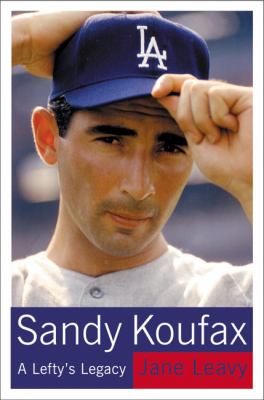
Sandy Koufax: A Lefty's Legacy

I remember 1964 baseball cards. The cards for National League's 1963 leaders in wins, strikeouts, and earned run average all showed Sandy Koufax at the top. He had had a great season and was in his prime. He would dominate opposing batters for three more years and then retire. He was baseball's highest paid player at $150,000 per year, but he said that his health was more important than money and walked away. He was only 31 years old and had nothing left to prove on the field.

Retiring early was only one of the unusual acts of Koufax's short career, according to Jane Leavy in her tribute Sandy Koufax: A Lefty's Legacy. By declining to start Game 1 of the 1965 World Series because it was Yom Kippur, he put his religious practice before his sports and solidified his reputation within the American Jewish community. He refused to make alcohol and tobacco ads, though he both drank and smoked. His dual strike for higher pay with Don Drysdale in spring training 1966 was the seed of the players' union movement, according to Leavy.

Perhaps the great game Koufax ever pitched was his September 9, 1965 perfect game against the Chicago Cubs. The fans at Dodger Stadium also witnessed a one-hitter pitched by the Cub Hendley. Leavy uses the game as a plot device, alternating innings of that game with chapters of Koufax's life. It is a common way to write a sports biography and in this case very effective. Sandy Koufax: A Lefty's Legacy is a biography that no baseball fan should miss. With the playoffs coming soon, this is a great time to pick it up.

Leavy, Jane. Sandy Koufax: A Lefty's Legacy. HarperCollins, 2002. 282p. ISBN 0060195339.

Monday, May 14, 2012

The Art of Fielding by Chad Harbach

Being a big baseball fan, I also enjoy a good baseball novel every now and then, such as The Art of Fielding by Chad Harbach. It tells the story of Henry Skrimshander, a college shortstop who loses his confidence right at the point that he ties a national record for the most games without an error, a record held by his idol, former St. Louis Cardinal Aparicio Rodriguez. The Art of Fielding is the title of Aparicio's collection of quotes about the philosophy of playing shortstop, a book that Henry reads constantly.

Henry's breakdown comes at terrible time for the surging Westish College Harpooners and four others on the campus by the shores of Lake Michigan in Wisconsin. Subplots involving the president of the college, his daughter, the Harpooners' catcher, and Henry's gay roommate divert readers from the shortstop's struggles for chapters at a time.

Baseball is only one of the elements of the unpredictable story. Literary readers will enjoy the discussions of architecture, philosophy, women's rights, campus promiscuity, drug use, and environmentalism. The writings of Emerson, Thoreau, and Melville are quoted alongside the words of Aparicio Rodriguez. Like many others who have reviewed The Art of Fielding, I was greatly entertained.

Harbach, Chad. The Art of Fielding. Little, Brown, and CO., 2011. 512p. ISBN 9780316126694.

Hachette Audio, 2011. 14 compact discs. ISBN 9781611132106.

Friday, May 11, 2012

21: The Story of Roberto Clemente: A Graphic Novel by Wilfred Santiago

I wanted to like 21: The Story of Roberto Clemente: A Graphic Novel by Wilfred Santiago, but I wanted a fuller biography of the Hall of Fame baseball player. The art work effectively evokes the poverty of Puerto Rico and the grit of industrial Pittsburgh, and I think Santiago succeeds in dramatizing the big games, but 21 is just highlights from the great Pirate outfielder's life with lots of gaps. Turn a page, and years have passed without explanation. Knowing baseball history, I am able to fill in the gaps, but I can't imagine a young reader can.

21 is still an attractive introduction to learning about baseball of the 1950s to 1970s. I hope it encourages young readers to probe further. A more complete profile of the Pirate can be found in Clemente: The Passion and Grace of Baseball's Last Hero by David Maraniss. Dismiss the "last hero" idea though as there have been many worthy players after Clemente.

Santiago, Wilfred. 21: The Story of Roberto Clemente: A Graphic Novel. Fantagraphic Books, 2011. ISBN 9781560978923.

Wednesday, July 27, 2011

Grand Slam Gazette: Fan Newspaper from the Kane County Cougars


When I attend a baseball game, either major or minor leagues, I do not expect much from any free team-related magazine or newspaper that I am given at the gate. These publications are often filled with advertising and not much else. I just hope for basic information about the facility and the players. With low expectations, I was genuinely surprised by the July 2011 issue of Grand Slam Gazette that we got at a Kane County Cougar game. Bonnie said I should look it over, and she was right.

I enjoyed "Behind the Plate Then ... In the Dugout Now," an interview with Cougar manager Vance Wilson that starts on page 8. Wilson is a former major league catcher who retired in 2009, but few fans will remember him, for he spent more time in the bullpen and dugout than on the field. He did not get into a game the first time he was called up to the Mets. First time he got to bat he had been in the bullpen and had to run through the tunnel in cleats to just get to the on deck circle in time. When with the Tigers, he got to meet and listen to Al Kaline talk about baseball in the 1950s and 1960s. Wilson seems to be a man with firm opinions and the ability to tell stories. I wonder if he might be capable of writing a book.

I also liked "Affiliation 101," a primer to the relationships between major league teams and the partnerships that run minor league teams. This Q&A spells out how a minor league team comes into being and who pays for what. While the article asserts that some great players have passed through Kane County, it is honest in mentioning that some players are released after their KCC season. I was surprised to learn that Adrian Gonzalez was a former Cougar. The Marlins traded him to the Rangers before he debuted in the majors. I checked the scorecard for the game that we attended in 2002; Gonzalez was out of the lineup that day.

Looking at the roster and at the "Top 10 Prospects" page, I see for the first time players that are younger than my daughter. Boy, do I feel old. Still, I think I ran the bases well after the game.

"Big League Dreams" states that 111 former Cougars have made it to the majors in the minor league teams in KCC's first twenty years. (Bonnie and I missed seeing at least one game only one year.) The article identifies players in the Oakland As organization who are close to promotion. The Cougars are now affiliated with the Kansas City Royals, so we should see a stream of players debuting in the next several years.

I am reminded that we saw Aaron Cames pitch a no-hitter at Elfstrom Stadium in 1997 by the story "Sugar Ray and Chas Throw Some Pizzazz." There have now been seven Cougar no-hitters.

Now that I have finished reading the Grand Slam Gazette, I will put it away in my baseball card closet. It will be even more more fun to read ten years from now.

Monday, June 20, 2011

The Last Hero: A Life of Henry Aaron by Howard Brandt

In 1991 I read Henry Aaron's excellent autobiography I Had a Hammer, in which he told about his childhood in Mobile, his month in the Negro League, and his career with the Milwaukee and Atlanta Braves. In this book, Aaron recounts many stories about the struggles of the second wave of African American baseball players in the major leagues and the countless death threats that he received as he neared Babe Ruth's all-time home run record. There is a mixture of pride, anger, and warmth within the pages of what I thought one of the best baseball books that I had read. I did not imagine I would read another big book about Aaron.

I hesitated to start The Last Hero: A Life of Henry Aaron because it is so long - nearly 22 hours as an audiobook. Did I really want to revisit the story that much? I am now glad I did, for the author Howard Bryant drew me into the story, which focuses on Aaron but also recounts a half century of baseball in civil rights history. As I listened, I recalled much of my own 1960s, including reading about baseball in newspapers, watching games on television, playing baseball in vacant lots, and collecting baseball cards of most of the players who played with and against Aaron. I especially enjoyed learning about the Milwaukee Braves, which won the World Series in 1957, lost the Series in 1958, and were in the pennant race in the surrounding years. These were great years for Aaron who was in the shadow of Willie Mays, who played in the New York media market. Being a quiet player, he never even got the attention focused on Eddie Matthews and Warren Spahn from his own team.

Readers learn much about the bad side of the business of baseball, too. Owners were stingy with salaries, traded or released injured players, and failed to challenge Jim Crow laws. They also had little loyalty to their fans. During their years in Milwaukee, the Braves were second only to the Dodgers in attendance, but the Braves owners imagining a gold mine moved the team to Atlanta to tap the large untapped market of the South. In retrospect, it was a great business move, but it was a tremendous blow to Milwaukee fans.

Bryant continues his story through the Barry Bond years, describing the dilemma that faced Aaron as his home run record was eclipsed. Should he have congratulated Bonds or denounced him for his suspected illegal steroid use? Doing a bit of both reluctantly, some critics thought Aaron misplayed the situation. With some sympathy, Bryant shows how Aaron really wanted to stay out of the debate, an unrealistic desire for a man of his stature.

Producers of the audiobook should have coached the reader Dominic Hoffman on the pronunciation of baseball names. Most glaring error was his calling Bill Veeck "Bill VEEK." Of course, that is the way it is spelled, but everyone in baseball knows the book title Veeck - As in Wreck. His pronunciations of Bill Virdon seemed wrong to me, too. Otherwise, I greatly enjoyed the epic story.

Bryant, Howard. The Last Hero: A Life of Henry Aaron. Books on Tape, 2010. ISBN 9780307736901.

Monday, May 16, 2011

Satchel Paige: Striking Out Jim Crow by James Sturm and Rich Tommaso

Legendary Negro League baseball player Satchel Paige was born about one hundred years ago. No one is exactly sure when because the state of Alabama was not really concerned with keeping accurate records of African Americans at the time. It was the era of Jim Crow laws, and Paige had few options in life other than picking cotton or playing baseball. Neither offered an easy life, but baseball payed the few players who could withstand the rigors of barnstorming better than working in the cotton fields. Among the tough players, Paige, with a smoking fastball and wicked curve, excelled.

In the graphic novel Satchel Paige: Striking Out Jim Crow, author-illustrators James Sturm and Rich Tommaso, who are affiliated with The Center for Cartoon Studies in Vermont, recreated pre-civil rights Alabama with its share-cropper shacks, dusty roads, smoky trains, and segregated baseball fields, where whites got the shaded grandstands and blacks stood in the sun beyond the outfield. Only on the field of play did the black players get any recognition. Even the whites knew and repeated stories about Satchel Paige's unbelievable talent. Some over-confident whites wanting to prove racial superiority even arranged to play baseball against him and his teams.

Satchel Paige: Striking Out Jim Crow is a fictional work, not a biography. The authors have taken some familiar stories about Paige and created a visit by him to fictional Tuckwilla, Alabama, the home of men whose dreams have failed. One is a young black man who made the Negro Leagues only to suffer an early career ending injury. He has to work in the fields belonging to the Jennings twins, brothers who played two years of minor league baseball before being released by the St. Louis Cardinals. Having formed a strong local team, the brothers challenge Paige's team to a game.

Aiming to sell their graphic novel to an educational market, Sturm and Tommaso included four pages of historical notes to explain their illustrations and story. While I am obviously beyond elementary and secondary school, I enjoyed the well-written, quick read. The proud, impudent Satchel Paige is a great character who will appeal to anyone who likes to see bullies brought to justice. For school and public libraries, it would also make a good gift to young readers.

James Sturm and Rich Tommaso. Satchel Paige: Striking Out Jim Crow. Hyperion, 2007. ISBN 9780786839001.

Wednesday, April 20, 2011

My Baseball Card Story

In the April 1, 2011 issue of Booklist, Bill Ott (whom I almost called Mel Ott) tells how reading the new memoir Cardboard Gods, in which Josh Wilker's tells how collecting baseball cards helped him through a difficult childhood, sparked Bill's memory of collecting sports cards. Bill and his friend Rob once traded some expendable comic books for several boxes of highly-prized baseball and football cards. The friends took the football cards and played games with them on his friend's dining room floor. Boys being boys, they got into a "brawl," many of the best of the best were damaged, and Bill and Rob learned they were not natural-born documents conservators. Glue and Scotch tape did not mend their cardboard heroes.

Though not as dramatically violent, my baseball card story also involves games played on a floor. I spent a year living on a ranch nine miles south of Big Lake, a small town in West Texas, often with no companions for play. On Saturdays, or evenings, or through the long summer between fourth and fifth grade, I reorganized my baseball cards. I might put them into order according to the card numbers, starting with my 1964 Topps cards, then the 1963s, and then then 1962s. Then I might sort them into team sets. Sometimes I alphabetized them, put all the players together by positions, left-handed and right-handed, and once even sorted them by birth dates. I like to think that I learned then the attention to details that I needed later to become a reference librarian.

At some point I devised a game that involved removing all the rubber bands and pouring all the cards onto my bedroom floor. I stirred and tossed the cards to mix them and then put them into big piles. Then, dealing from the top, I ran team races from one end of the room to the other. Each team advanced one spot with each player card added to its stack. First team to get twenty cards won. Often a team I disliked, such as the Yankees or the Reds crossed the finish line first, so I'd run the race again, hoping to get a better result. More stirring and tossing, dinging edges and bending corners of the thin cardboard rectangles.

While Bill seems slightly penitent, I do not regret the rough demands that I made on the cards. They were meant for play. Those were good days before adults made baseball cards into collectibles. Looking for mint-condition old cards and trying to get rich speculating on future Hall-of-Famers is not nearly so much fun as having your team beat the Yankees in a race across the floor.

Friday, January 14, 2011

We Are the Ship: The Story of Negro League Baseball by Kadir Nelson

When I saw my library had We Are the Ship: The Story of Negro League Baseball by Kadir Nelson as an audiobook, I was puzzled. Nelson is known for his wonderful illustrations in children's picture books. I had already read We Are the Ship, and the pictures of the baseball players are still fresh in my mind. I could hardly imagine separating the text and illustrations. Needing an audiobook, I borrowed it anyway.

To my surprise, it worked very well just as an audiobook. I had forgotten how Nelson had written his history of the Negro Leagues as if he was one of the players, giving the story a warmth and immediate appeal, and the text that seems so simple is really quite complex. What seems likes an off-hand telling weaves in so much detail, and the stories seem as though they are firsthand. It makes a great audiobook. I only hope that the author interview appended makes listeners go find the print edition as well.

Nelson, Kadir. We Are the Ship: The Story of Negro League Baseball. Brilliance Audio, 2008. ISBN 9781423375364

Friday, July 09, 2010

Cedar Rapids Baseball

In my dreams, I'd like to spend a summer with Bonnie attending minor league baseball games across the country. Maybe we'd write a book. Minor league games are much more fun than major league games these days. The players are more humble and better behaved, the stands are filled with families, and the between-inning entertainment often makes me laugh. Such was our experience attending the July 3 game between the Clinton LumberKings and the Cedar Rapids Kernels. Veterans Memorial Stadium in Cedar Rapids is relatively compact, and we were so close to the action that we saw all the plays well. And the game was a big 13-3 win for the home team.

Bonnie and I do go to games to watch every play. I even keep score. In the LumberKings-Kernels game, almost everything that could happen did. We saw a every kind of hit and almost every kind of out. We saw great catches, snappy double plays, and almost unbelievable errors. Two runners were thrown out trying to steal second. One runner was out because he was hit by the batted ball - something we rarely see. The final line score was very strange. The LumberKings scored three runs on nine hits. The Kernels scored thirteen runs on eight hits. That's more hits for the losing team. Many walks and errors made the unusual outcome possible.

Watching the game alertly is really important sitting just behind the third base dugout at just about any stadium. Bonnie and I were ready to duck the ever-dangerous screaming foul ball. We were so close. That also gave us a good view of the between inning entertainment. I had never seen a tooth fairy clean the bases nor a bloodshot-eyeball race.

Before the game, Bonnie found the Cedar Rapids Baseball Hall of Fame within the stadium shop and recommended it to me. Inside were a couple of cases with relics and old newspaper articles. On one wall were team pictures dating back to 1939 when the team was called the Raiders. The city's minor league history actually dates back to the 1891 Cedar Rapids Canaries. In 1897 they were called the Bunnies, and then a few years later the Rabbits. On the opposite wall were pictures of the hall of fame inductees. I liked how many of the honored were only famous in Cedar Rapids, not just players who went on to great major league careers. I noticed among them infielder Denis Menke, one of my favorite players as a boy. I saw him playing shortstop for Houston in 1969.

My brat and my bowl of mint chip ice cream were both good. The parking was free and convenient. The weather was almost perfect. The game was filled with action. I'd gladly go again.