Friday, January 19, 2007

A Stronger Kinship: One Town's Extraordinary Story of Hope and Faith by Anna-Lisa Cox


A Stronger Kinship by Anna-Lisa Cox is a true story of goodness in a world of evil.

The Midwest region of the United States during the latter half of the nineteenth century was not a safe place for African-Americans. Men from these states, including blacks, fought with the Union in the Civil War, but the outcome of the war did not lessen discrimination against blacks in the region. When black soldiers who were born in Indiana returned from the war, they found they had lost residency and were required to pay exorbitant Black Code bonds to return to the state. Most of the states would not allow blacks to run for public offices, and a blond blue-eyed man who was one-sixteenth black was thrown into prison was trying. Black children were denied schooling, and, as the decades passed, lynching became more common.

Quietly, the men and women of Covert in southwestern Michigan built an alternative community. In April 1868, the voters of the community defied state law and elected both an African-American and Native American (who was not even considered a citizen) as highway overseers. By 1875, Covert had a black justice of the peace to whom many whites had to go legal assistance. Blacks owned some of the best farms and small businesses, and their children were in the schools, sharing desks, attending dances, and signing autograph books with whites. Whites and blacks worshiped together, held picnics, served on local committees, and joined together in business ventures. Integration was common every day life.

New residents sometimes threatened the order of the community. Cox tells about several serious challenges that could have split Covert racially, but community leaders remained calm and patient, and bonds became stronger. Unhappy whites always left unable to exploit the blacks. Twentieth century civil rights activists could have learned from the common people of Covert.

A Stronger Kinship is a quick read and would be an excellent choice for a book discussion group.

Cox, Anna-Lisa. A Stronger Kinship: One Town's Extraordinary Story of Hope and Faith. New York: Little, Brown and Company, 2006. ISBN 0316110183

Wednesday, January 17, 2007

Notes from the Local History Special Interest Group Meeting at the Elmwood Park Public Library, January 16, 2007

Seventeen librarians attended the Metropolitan Library System Local History Special Interest Group on Tuesday, January 16 at the Elmwood Park Public Library. Most of the participants from the previous meeting returned, and several new members attended this meeting and tour of the local history room at the hosting library.

Russ Parker of the Elmwood Park Public Library passed out copies of his library’s local history policies and forms. The well-organized document describes the collection, explains the acquisition, access, and loan policies, and describes the library’s relationship to the Elmwood Park Historical Society. Attached were forms to apply to use the collection, to donate materials, to loan materials to the collection, to borrow materials, and to request duplication services (photocopies, scanned documents, or photographs). Russ said that he has used all the forms. Recently, staff from Channel 11 (PBS) in Chicago used the collection to research for an upcoming program.

Jack Simpson of the Newberry Library cautioned against making acquisition policies too detailed, which might scare off some donations. He said he would rather see what was being offered and then decide. Several members asked how to know when the documents of local organizations or companies were worth collecting. There was no easy answer, but many of the libraries limited by available space in their buildings. One suggestion is to collect newsletters from local organizations but not serve as the organizations’ archives.

Mark Johnson of the Franklin Park Public Library told us about the collection of photos and negatives given to his library. Some the photos can be seen at his library’s local history website. We discussed the rights to use scanned material on web pages. Copyright seemed to be less concern than being sensitive to privacy rights.

When discussing the management of digitization projects, Kathy Nicola of the Eisenhower Public Library District described Backstage Library Works, a company that will bring scanning equipment to a library and do a project on site. Knowledgeable staff will scan and create metadata. She has discussed a project with the company and thinks its rates are reasonable.

Christina Stoll of the Metropolitan Library System had another suggestion for a library trying to do a local history project but having trouble finding staff time. She said that library students at Dominican University need to do practical projects and might be able to help.

Kathy urged anyone who has not yet to join the group’s Yahoo Group.

Jack recommended the Mapping and Genealogy Workshop at the Newberry Library on April 13-14.

Christina took suggestions for Metropolitan Library System sponsored workshops. There included the following:

  • Basic archival techniques for small collections
  • Best practices for clipping files
  • Software and online tools for local history
  • Establishing good relationships between libraries and historical societies
  • Marketing historical collections
  • Using collections to create publications and programs
  • Meeting with Chicago area organizations, such as South Suburban Historical and Genealogical Society
The next meeting of the Local History Special Interest Group is pending for Thursday, March 15 from 10 a.m. to noon at the Metropolitan Library System.

My Life in France by Julia Child with Alex Prud'homme


My Life in France is Julia Child's story of learning to cook the French way, of writing her early cookbooks, and of starting of her life in television. I was surprised to hear that she knew very little about cooking when she arrived in France at age 36 in 1948. While her husband Paul worked for the United States Information Agency in Paris, she began taking cooking classes and experimenting in her kitchen. She had to be persistent to get serious instruction and meet most of the important culinary experts of the time. Eventually she joined Simone Beck and Louisette Bertholle in writing a cookbook for the American book market; after more than a decade that work became Mastering the Art of French Cooking.

Readers will enjoy learning about post-World War II France and American foreign service of the time. The witch hunt for communists in foreign service and the right wing politics of Child's father are subplots of the story of her discovery of French cuisine.

Alex Prud'homme helped Child write the book and completed it after her death in 2004.

I enjoyed listening to My Life in France read by Kimberly Farr on my iPod, which let me hear the pronounciations of the names of French dishes but not see how they are spelled. Since I will not be preparing any of them any time soon, I am not disadvantaged.

Readers should expect to gain five pounds.

Child, Julia with Alex Prud'homme. My Life in France. New York: Knopf, 2006. ISBN 1400043468

Tuesday, January 16, 2007

Two New Wikis

Yesterday I joined two new wikis.

While working on my funding request for this summer's American Library Association Conference in Washington, D.C., I discovered that the Official Conference Wiki is already up. It looks much like the wikis from 2005 and 2006, to which I contributed some museum information and book recommendations. There will be much useful conference and visitor information. I signed up and was the second person to join the blogging list.

Catching up on my reading of AL Direct, I learned about Nancy Pearl's Book Lust Wiki, which is trying to build a community of book lovers. As of a few minutes ago, there are already 787 members. I joined, added two links to blog lists, and started a profile. I also added a title to the Best Books of 2006 page.

Later yesterday I got welcome messages for joining both of the wikis. What a good day!

Monday, January 15, 2007

Live Aid and Live 8: DVDs That Save Lives


"This DVD saves lives" is printed on the booklet to Live Aid. "The long walk to justice" is on the Live 8 booklet. Both boxes display the distinctive guitar with a body in the shape of the African continent. Both sets contain 4 DVDs packed with performances by a mixture of legendary and relatively unknown musicians. Both continue to raise money for African relief and push for debt relief and fair trade.

Because of its time, Live Aid is the more dramatic of the two sets. Disc One starts with a BBC Television report from the summer of 1984 about the terrible famine in Ethiopia. Most of the 7 or 8 minutes of the report show emaciated children in a refugee camp. All have terribly skinny arms and legs, and many of the dying already seem mummified. Every morning the dead are wrapped in what looks like burlap and are lined up along the edge of camp for removal in open bed trucks. Many of these corpses are shockingly small.

After a slow fadeout, the DVD takes the viewer to late fall in London for the filming of the Band Aid Video "Do They Know It's Christmas" and then to spring in the United States for the shooting of the USA for Africa Video "We Are the World." In the wake of the BBC report, these performances are quite moving. After these pieces, the DVD moves to Wimbley Stadium London on July 13, 1985 where Prince Charles and Princess Diana enter the stadium with Bob Geldof for a day of mostly rock music. Later on Disc One the concert from JFK Stadium in Philadelphia begins.

According to the booklet in Live Aid, there was to have been no recording of the 1985 concerts. Geldof had said it was to be a one day event to be remembered, but the BBC and MTV ignored his directive. Both television companies recorded but then lost their tapes for years. When Live Aid staff went looking for the material in the 21st century, some of it had been destroyed. What is left is incomplete. Still four DVDs is a lot of music.

The 1985 concert was beset with technical difficulties, so the sound quality of some of the performances suffers, but many of the songs are still quite good. My favorites are "Rockin' All Over the World" by Status Quo, "I Don't Like Mondays" by the Boomtown Rats, "We Will Rock You" by Queen, "Footloose" by Kenny Loggins, "Don't Go Breaking My Heart" by Elton John and Kiki Dee, and "White Room" by Eric Clapton. By flying over the Atlantic in the Concorde, Phil Collins sings "Against All Odds" in London and "In the Air Tonight" in Philadelphia.

I believe I enjoy the Live 8 DVDs more than the 1985 set. The sound is better, the cameras are sharper, and direction is improved. More musical genres are included. Concerts in more cities are included. I like that the venues are parks instead of stadiums and that there are more pans of the audience. The 2005 set also introduced me to acts that I had never heard. I particularly like "Da-Na-Mi-Tee" by Ms. Dynamite, "Somewhere Only We Know" by Keane, and "I'm Gonna Be (500 Miles)" by the Proclaimers. The last half of Disc Three with Stevie Wonder, The Who, Pink Floyd, and Paul McCartney in succession is terrific.

Because of the events they document and the variety of artists performing, both Live Aid and Live 8 are excellent additions to any library collection.

Sunday, January 14, 2007

Unbowed: A Memoir by Wangari Maathai


Wangari Maathai is the 2004 winner of the Nobel Peace Prize. Born in central highlands in Kenya in 1940, her youth was poor but almost idyllic. Though near the equator, the region of her birth was cool, green, and fertile, and rarely was anyone in the still traditional Kikuyu villages ever hungry. Maathai loved the forests, the clear-running rivers, and the wildlife that was abundant.

In Unbowed, Maathai tells how she unexpectedly was sent to boarding school and did so well that she was eventually chosen for a Joseph P. Kennedy scholarship and landed at Mount St. Scholastica in Atchison, Kansas and then the University of Pittsburgh. After getting her graduate degree in biology, she returned to an independent Kenya, a nation full of promise and uncertain how to proceed in a modern world.

Most of Unbowed is the story of how Maathai became an activist for women's rights in an increasingly male-dominated society and an environmentalist in a country handing over public lands to commercial interests. As a founder of the National Council of Women in Kenya and the Green Belt Movement, she led many efforts to educate women and restore forests. She subsequently became an opponent to the corrupt one-party government of President Daniel arap Moi as a reaction to constant government harassment. She was frequently arrested and sometimes beaten, but she kept planting trees.

Readers interested in social justice, envirnmental concerns, and third world economics will enjoy this book, as will memoir readers.

Maathai, Wangari. Unbowed: A Memoir. New York: Knopf, 2006. ISBN 0307263487

Friday, January 12, 2007

The Complete Illustrated Sesame Street 1967-2006

It will be several days before I finish another book so here is a review of a book that does not exist but should.

The long awaited Complete Illustrated Sesame Street 1967-2006 is here. This boxed two-volume work tells the story of the founding of the Children's Television Workshop and how muppeteers, animators, and actors create a delightful program for children that is also enjoyed by many adults. It is the definitive work on Sesame Street.

The authors put much into these volumes. Of course, there are profiles of and photos for every recurring muppet and human on the show, as well as synopses of the every episode. One section in the second volume lists all the guest stars, identifying episodes and original broadcast dates. In sidebars, several of these celebrities tell about there Sesame Street experiences. Titles, credits, and images from every animated short are also included.

A quotation dictionary in volume one includes all the best lines from Big Bird, Oscar, Grover, Bert, Ernie, Telly, Elmo, and Aloysius Snuffleupagus. Volume two has a bibliography of all the Sesame Street books and pictures of all the licensed toys.

The Complete Illustrated Sesame Street is more than just a great reference work. It includes instructions on how to make your own muppets, illustrations of all the sets, and scripts for the most famous episodes. There are recipes for Cookie Monster's favorite cookies, Luis and Maria explain how to fix many small appliances, and photos of Savion Glover show basic tap steps.

If this is not enough, look in the back cover. There are several DVDs, including "The Complete Bert and Ernie," "The Best of Dr. Teeth and the Electric Mayhem," and the remastered director's-cut "Sesame Street Christmas."

Every library should have The Complete Illustrated Sesame Street.

If only it existed.

Wednesday, January 10, 2007

Right Attitude to Rain by Alexander McCall Smith


The Right Attitude to Rain is the third novel by Alexander McCall Smith set in Edinburgh, Scotland featuring Isabel Dalhousie, editor of The Review of Applied Ethics. The book is more a novel of manners than a mystery, but libraries will tend to shelve it with mysteries to place it with the author's other works. Central to its plot is the issue of when to tell the truth and when to restrain from telling anything. The issue of romantic love between people of different ages is also important.

I enjoyed listening to the audiobook read by Davina Porter. The descriptions of Scottish landscape, weather, and Edinburgh neighborhoods makes me want to visit the country. I would definitely want to visit little art galleries and try the small restaurants.

The real mystery for readers is how Isabel, a philosopher who seems to weigh every issue of conscience so thoroughly, can be so surprised by the obvious consequence of her actions. The story will certainly continue.

McCall Smith, Alexander. The Right Attitude to Rain. New York: Pantheon, 2006. ISBN 0375423001

8 compact discs. Prince Frederick, Maryland: Recorded Books, 2006. ISBN 1428115110

Monday, January 08, 2007

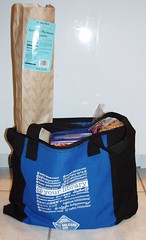
ALA Conference Bag with Groceries

When I was in Trader Joe's last week, I noticed a bunch of canvas grocery bags for sale next to the checkout. Beside them was a "save the earth" message. For a moment I considered buying a couple of these bags, but then I remembered that I had a collection of bags from library conferences sitting in a closet. I decided to bring one to see if a clerk would load it with my groceries.

Today I returned to the store to get a few items. When I asked the clerk if we could use my bag, she answered "Certainly!" She said the company encourages reuseable bag use, and as an incentive it enters canvas bag users in a free raffle to win groceries. I now have a chance to win $25 worth of Trader Joe's goods.

My blue ALA New Orleans 2006 bag was just big enough for today's purchases. Next time, I will also bring a white PLA Seattle 2004 bag.

How are you using your conference bags?

Kate Fleming: A Distinctive Voice Remembered

Listening to the December 24, 2006 podcast from NPR Books, I learned that Kate Fleming, an actress who recorded audiobooks under the name Anna Fields, died after rainwater flooded her basement studio in a storm that hit Seattle on December 14. The full story is in the Seattle Post-Intelligencer of December 18.

Fleming chose the name Anna Fields as a tribute to her great grandmother, whose picture is posted on the Cedar House Audio website. Her great grandmother was an actress known for her beautiful voice. Fleming was known for her great variety of voices and ability to portrait both young and old when reading.

I first heard Fleming reading Havava Dreams by Wendy Gimbel, but I most remember her readings of Bushwhacked and Who Let the Dogs In? by Molly Ivins. She was so good that I thought her voice was that of Ivins. She did not sound as though she were reading.

Fleming leaves a legacy of over 50 audiobooks. Search your library catalog for Anna Fields.

Saturday, January 06, 2007

The Singing by C. K. Williams

What I like in poetry are stories with words that paint pictures in my mind. In the first section of The Singing by C. K. Williams, there are plenty. A blind piano teach raps the fingers of a student with a baton. A coed falls from the window of a dormitory. A ghost comes to Christmas dinner. The poet looks closely into the eyes of Rembrandt's self portrait. As I read, I saw all of these events and shared the poet's experiences.

The second section, a longer poem called "Of Childhood the Dark," is divided into fourteen ten-verse parts. While it lacks narrative, it includes many ideas, such as human desire being the real Pandora's box.

In the third section, Williams witnesses the decline and death of a friend and describes his difficult acceptance of his loss. The fourth section is a strong collection of post-September 11 poems, which seem neither despairing nor optomistic.

Though Williams won the 2003 National Book Award for poetry with this collection, it is not in many libraries. It can still be purchased, but some libraries may want to buy Williams's new Collected Poems (containing these poems) instead.

Williams, C. K. The Singing. New York: Farrar, Straus, Giroux, 2003. ISBN 0374292868

Friday, January 05, 2007

Librarian's Booklist Search

As promised, I have used the Google Coop website to create another customized search. It called Librarian's Booklist Search. The intent of this tool is to find online booklists from libraries.


Librarian's Booklist Search


How can it be used? For reader's advisory, you may type in an author, book title, or keywords, and receive links to booklists on library websites. Many of these lists will recommend similar titles or authors.

I also think this list will help my library get ideas for creating our own booklists.

So far, the engine searches the following:

BookBytes
Christchurch City Libraries If You Like
Downers Grove Public Library Good Reads
Fiction_L Booklists
Hennepin County Library Find A Good Book
Pickering Public Library Book Picks for Book Lovers
Sachem Public Library The Readers Advisor
Waterboro Public Library Booklists

As you can guess, there is potential for growth. There must be many more library booklists to add. If you know some, let me know. I will gladly add more library websites.

So far the search resides right here in the sidebar. I tried to put it onto a Google Page today, but it is not sticking for some reason. I think that Google Pages is having a problem, because I created Librarian's Book Revoogle on a Google Page weeks ago with no problem. It is also now in the sidebar of this blog.

Want to put either of these customized searches on your own pages? Send an email to ricklibrarian at hotmail.com and I will send the code to you. Specify javascript or non-javascript versions. (I did try to post it right here but it kept creating search boxes instead of showing the code.)

Thursday, January 04, 2007

Update about Library Supply Catalogs

Yesterday I received a very nice telephone call from Bill Stroner, the President/CEO of DEMCO concerning my observations last week. He agreed that the over-abundance of library supply catalogs is a concern for his company (which wishes to make a profit) and libraries (who want less mail), and he described some efforts DEMCO is making to reduce unwanted mailings. He said that with bundles of catalogs that his company recently sent, there were letters telling clients that they may contact the company to reduce their mail. He also said that his staff has a schedule of calling clients, and one of the questions is whether they want to add or reduce catalogs.

I told Mr. Stroner that my main objective is to persuade libraries to take the initiative to reduce their mail through contacting the supply companies and removing names of former employees from lists. It sounds as though DEMCO is helping this effort. Mr. Stroner said that some libraries respond positively and scratch some names from their lists. Some libraries do want everyone in the building to have a catalog. Some others do not bother to respond. DEMCO will honor the libraries' wishes. The company will happily take names off its lists.

Kelli at 'brary Web Diva left a good idea in the comments to last week's post. She said that her library gives the extra catalogs away to library clients who request them.

Wednesday, January 03, 2007

Under the Banyan Tree & Other Stories by R. K. Narayan

R. K. Narayan, who died in 2001 at the age of 94, was a master of the short story. Under the Banyan Tree & Other Stories is a good sample of his work, including many stories of only five or six pages. Narayan could tell a memorable tale quickly, unlike the story teller in the title piece who took ten evenings each month to tell a long story to villagers outside a temple under a banyan tree. Some of these stories could easily be read on an afternoon break.

I enjoyed this collection of twenty-eight stories set in the cities and villages of India. Most of them take place in the twentieth century, but life in some villages still reflects old ways. All the stories deal with justice and injustice in some way, and many have ironic twists in the plot. Sanctimonious bachelors learn to forgive the people who irk them. Servants play tricks on masters. Superstitions guide people into disastrous decisions. Readers are never sure what will happen next.

Under the Banyan Tree is out of print in the United States, but numerous public and academic libraries still have copies. Otherwise, you can buy new or used copies through internet book sellers or pick up a copy next time you are in England.

Narayan, R. K. Under the Banyan Tree & Other Stories. New York: Viking, 1985. ISBN 0670804525

Tuesday, January 02, 2007

I Feel Bad About My Neck: and Other Thoughts About Being a Woman by Nora Ephron


"Why are you listening to that?" my daughter asked, hearing that I had I Feel Bad About My Neck by Nora Ephron on my iPod. "That's a girl's book." I remember what she asked better than my answer. I think I just said, "I thought I might enjoy it." I did.

Ephron is at times very funny, though I am sure I did not catch all the humor. I do not buy purses, cosmetics, or hair dyes, but I can understand the issues involved and laugh with the author about her choices. Good writing transcends common experience.

Not all of Ephron's essays are strictly about women's issues. I would worry about what to serve the author of a cookbook should one come to dinner. I have trouble finding my reading glasses. I have mourned to loss of favorite restaurants and their dishes that I can no longer find. I enjoy reading Wharton and Trollope. I have aging friends with health problems. We are all facing death.

The audio version of I Feel Bad About My Neck is especially good because Ephron reads. As I said before, she can be very funny.

Ephron, Nora. I Feel Bad About My Neck: and Other Thoughts About Being a Woman. New York: Knopf, 2006. ISBN 0307264556

Monday, January 01, 2007

New Year, New Look

As you probably have noticed if you are reading at this blog's site (and not reading a feed), the blog has a new look. I finally took the New Blogger bait and moved to the new version, which does have more features and easier modification of the template. I have thrown out the old paper look and reversed the layout. The sidebar is now on the right and has more information.

I have added a list of book review website from librarians and libraries to help you find good books to read, and I have placed the Librarian's Book Revoogle search box into the sidebar. I am working on another customized search tool that I can easily add when it is ready. (Now I have committed myself, so I have to make it.) I also added a picture and a current reading list, which I will be changing periodically.

There is no longer a recent posts list. The titles in the body of the blog serve as links to the individual blog posts should you want the URLs or to see the comments.

The links to the archives are now contained in a dropdown menu, saving lots of space.

The best thing is that the space for the text is now wider, so you do not have to scroll so much when I get long winded.

The search from Blogger in the top left of the screen is also improved. Now if you search a keyword you get every post from the blog with the word instead of a list of links.

In the next year, I want to review more books. Nonfiction will remain my emphasis, but I want to add more poetry and short story collections, which are included less frequently in other book reviews. I will review more audiobooks now that I have an iPod. I hope to attend at least two library conferences, so there will also be conference reports, as well reports of workshops and meetings I attend.

Happy New Year.

The View from Castle Rock Alice Munro


Alice Munro is mostly known for her short stories. As she explains in her introduction, The View from Castle Rock differs from her other ten collections in that it is more personal. For several decades, she has been researching her Laidlaw ancestors and writing stories about their lives, imagining their experiences of immigration from Scotland and settlement in Huron County, Ontario. These stories comprise the first part of this collection. In the second part of the book, she collects stories about her grandparents, parents, and her own life. These stories are mostly true, but she asks that they be considered fiction as they are not always factual.

Because the stories are closely related, The View from Castle Rock seems much like a novel, especially in audiobook form. I listened to the 10 disc set read by Kimberly Farr and was not as aware of changing stories as I would have been with visual clues. I also enjoyed the oral history feel of the audiobook.

The View from Castle Rock might encourage some readers to study their own families.

Munro, Alice. The View from Castle Rock. New York: Knopf, 2006. ISBN 1400042828.

10 cd set. Santa Ana, California: Books on Tape, 2006. ISBN 1415932689

Sunday, December 31, 2006

A Nation Among Nations: America's Place in World History by Thomas Bender


A Nation Among Nations by Thomas Bender has been on my I-want-to-read list since last spring when I found a short, enthusiastic review in Booklist. Many other books intervened, and I had forgotten about it until I found it misshelved in my library earlier this month. "Now or never," I thought.

I did not count on this book taking so long to read. "A slow read," my daughter might say. Though I questioned my sanity, I kept on reading because some of Bender's ideas are so different from those taught in textbooks.

Bender's premise is that American history is often taught as if the United States is mostly isolated from the rest of the world. From colonization until the twentieth century world wars, isolation allowed American commerce, industry, political thought, and culture to develop on its own, without outside influence, according to many American historians. There were a few encounters with the British and the French in the early days of the republic, a brief war with Mexico, and an even shorter war with Spain, but none of these incidents really meant much to the country of the Monroe Doctrine and Manifest Destiny. President Washington had warned against alliances.

A Nation Among Nations is 301 pages of evidence to the contrary. What makes it worth reading are the subplots.

According to Bender, Columbus discovered the Atlantic Ocean, not America. Before Columbus and the other explorers the oceans were thought of as barriers. What the Spanish and Portuguese explorers discovered was the oceans were viable highways to distant markets. The Silk Road was bypassed, and the global economy was strengthened. Interdependence soon followed. For instance, when 17th century China could not get a steady supply of South American silver, its economy collapsed. The English colonies in North America were soon trading with Africa and Asia, too. After the American Revolution, the United States was the major player in the whaling industry and oriental goods were flowing into Massachusetts.

Ideas moved across the globe as quickly as goods. The American Civil War was not an isolated story but a chapter in the world movement to end slavery - a late but important chapter. Reformers in many countries had trouble holding up the American democratic example while slavery continued in the South.

Most historians celebrate the fulfilling of Manifest Destiny as a result of the U. S. War with Mexico in the mid-19th century. Bender points out that an unnatural national border dividing an economic region and a large Hispanic population is a continuing legacy of the little questioned war.

Bender's last chapter focuses on international reform of labor laws. He claims that reforms, such as social insurance, safe working conditions, and laws against child labor, were common in other countries long before they were in the United States.

Bender's work suggests that our international problems today result from our historical attitudes. This type of provocation is not often well-received in the American mainstream. A Nation Among Nations is just the kind of book that should be in academic and public libraries.

Bender, Thomas. A Nation Among Nations: America's Place in World History. New York: Hill and Wang, 2006. ISBN 0809095270

Saturday, December 30, 2006

Ricklibrarian's Books That Matter 2006 and Other Awards

As the year ends, many newspapers, magazines, journals, and other media publish their best books lists (Seldovia Public Library links to lists). As I read them, I add books to my library's shopping carts and to my personal wish-to-read list. Some of these are books that I had not noticed when first published. Others are books that I had passed over but now reconsider. I enjoy and benefit much from the end-of-the-year lists.

As you might guess, I am now presenting my own best of 2006 list. I have tried to think of a clever award name (like the Ricky), but that seems a little too silly. So I am going to call them "Books That Matter." Some, but not all, do tend toward the serious side. I am also adding some music, film, library, and web awards, all chosen through personal deliberation.

Not every item chosen is actually from 2006. My encounter with each was in 2006.


Nonfiction

Dead Beat: Lost Souls, Lucky Stiffs, and the Perverse Pleasures of Obituaries by Marilyn Johnson

Enrique's Journey: The Story of a Boy's Dangerous Odyssey to Reunite with His Mother by Sonia Nazario

Girls Who Went Away: The Hidden History of Women Who Surrendered Children for Adoption in the Decades Before Roe v. Wade by Ann Fessler

Human Cargo: A Journey Among Refugees by Caroline Moorehead

Impresario: The Life and Times of Ed Sullivan by James Maguire

White Man's Burden: Why the West's Efforts to Aid the Rest Have Done So Much Ill and So Little Good by William Easterly

Worst Hard Time: The Untold Story of Those Who Survived the Great American Dust Bowl by Timothy Egan


Memoir

Truck: A Love Story by Michael Perry


Novels

Beasts of No Nation by Uzodinma Iweala

Timothy; or, Notes of an Abject Reptile by Verlyn Klinkenborg

Digging to America by Anne Tyler


Short Stories

Brief Encounters with Che Guevara by Ben Fountain

Man Who Could Fly and Other Stories by Rudolfo Anaya

Stick Out Your Tongue by Jian Ma


Graphic Novel

Mom's Cancer by Brian Fies


Poetry

Blue Front by Martha Collins

Here, Bullet by Brian Turner

Talking Horse and the Sad Girl and the Village Under the Sea by Mark Haddon


Audio Books

Guitar: An American Life by Tim Brookes

Ordinary Man: An Autobiography by Paul Rusesabagina

Revolutionary Characters: What Made the Founders Different by Gordon S. Wood


Music CDs

Just My Heart for You
by Curtis and Loretta

We Shall Overcome: The Seeger Session by Bruce Springsteen


Films

Wordplay

Yesterday

The Queen

A Prairie Home Companion

Little Miss Sunshine


Book for Professional Librarians

Whole Library Handbook 4


Individual Book Review

Nonfiction Readers Anonymous


Library Book Review

Reader's Club at the Public Library of Charlotte and Mecklenburg County


Google Tool of the Year

Google Custom Search Engine (which runs LISZEN and Librarian's Book Revoogle)


Library Science Search Engine

LibWorm


Library Conference of the Year

American Library Association in New Orleans (this links to a list of bloggers' reports)


Library Science Article

Collaboration as the Norm in Reference Work by Jeffrey Pomerantz


I look forward to 2007. There will more good reading, listening, and viewing. Have a Happy New Year!

Update. Thanks to librarian.net for the Seldovia link.

Friday, December 29, 2006

Five Things You May Not Know about Me

I was tagged by Jenny!

I am fairly mysterious, so there is much you do not know.

1. I have been a Houston Astros fan since the mid-1960s when I listened to games on radio. From the ranch in west Texas where we lived in 1965, I could get the games on either San Antonio or Shreveport radio stations. Jim Wynn and Bob Aspromonte were my favorite players. I wanted to grow up to be a third baseman.

2. I assisted the children's librarian with puppet shows at my first library job in Austin, Texas. My favorite show was Strega Nona. I got to be Big Anthony and throw spaghetti colored yarn all over the puppet stage.

3. I was a stay-at-home dad for six and a half years. During that time I became very fond of afternoon naps. I took Laura to lots of libraries, which I saw from the viewpoint of a user instead of a librarian. I think this has been as important as library school for me.

4. Rail Baron is my favorite board game. My friends and I have a trophy made from an old model engine that is passed around to the most recent winner. My stategy is to buy a Super Chief as soon as possible after securing a rail line into New York. I always aim to buy the Union Pacific but the Santa Fe is a good alternative.

5. My favorite color is blue, no yellow, no, aaaaaaaaaaaaaa...

I tag Tinfoil + Raccoon, Nonfiction Readers Anonymous, Maggie Reads, Feel-good Librarian, and The Actress and the Bishop. Three of you are somewhat anonymous, so we could learn much from your memes. Please write.