Could Daniel Boone have ever written poetry? According to the American National Biography, his education is much debated. He claimed to have never had any formal schooling, but there persist stories of his mischief at school. He must have had little schooling if any, the biographer guesses, because his letters are full of misspellings and bad grammar.
Maurice Manning has taken a very unconventional approach in writing A Companion for Owls: Being the Commonplace Book of D. Boone, Long Hunter, Back Woodsman, &c. He has taken on the persona of the frontiersman to write verse about his daily life and adventures. Most of the poems are less than a page in length and convey some part of Boone's story. "Without Vision," which begins "Don't ever name a son Israel," tells about the death of his son in the Battle of Blue Licks, the final battle of the American Revolution. "The Sum Result of Speculation" describes his work as a land speculator. In "Jemima's Idyll" the poet tells of Boone's rescuing his daughter from the Shawnee. "A Recipe for Chink" instructs the readers how to build a log cabin.
The poetry is full of attitude and opinions. I liked the opening of "Opposition to Bridges":
If a man cannot cross a river on its own terms,
Then he doesn't deserve the other side.
The strength of A Companion for Owls is the communication of Boone's experience. Soaked with the rain, his teeth hurting, angry at the educated men who have cheated him out of property, ready to try something new, ready to leave eveything but Rebecca and head for Missouri, Boone contemplates his life. Of course, being poetry, it is self-conscious and philosophical. It is a fantasy, but one I enjoyed.
Manning, Maurice. A Companion for Owls: Being the Commonplace Book of D. Boone, Long Hunter, Back Woodsman, &c. Orlando: Harcourt, Inc., 2004. ISBN 0151010498
Wednesday, November 23, 2005


Tuesday, November 22, 2005
13 Seconds: A Look Back at the Kent State Shootings by Philip Caputo
It has been thirty-five years since the Ohio National Guard fired their guns at the students of Kent State University, killing four, all of whom were well beyond rocking throwing distance of the Guard. Nine others were injured on May 4, 1970 in the volley of fire that the President’s Commission of Campus Unrest later ruled was “unnecessary, unwarranted, and inexcusable.” Philip Caputo reported the story for the Chicago Tribune. In 13 Seconds: A Look Back at the Kent State Shootings, he returns to the topic. He describes the days leading up to the tragedy, details the shootings, and debates whether the shootings changed our country.
Caputo tries very hard to be fair in his reporting. He presents the positions of all the parties involved in the conflict, noting that none tried to lessen the tensions leading up to the event. Still, he seems to agree with the President’s Commission that the guardsmen had no valid justification for the shootings. He also predicts that no one will ever solve the mystery of whether an officer ever gave the command to fire on the students. Those who really know will take their secret to the grave.
With the book is a DVD of the documentary Kent State: The Day the War Came Home, which includes interviews of both former students and former members of the National Guard. There are many regrets expressed but no apologies. The most sickening part of the film is the series of clips of interviews with "average Americans" wishing that more students had been killed.
With anti-war sentiments growing in our country today, it is a good time to refresh our memories of what happened at Kent State.
Caputo, Philip. 13 Seconds: A Look Back at the Kent State Shootings. New York: Chamberlain Bros., 2005. 1596090804
Monday, November 21, 2005
Amazon as a Model for Open WorldCat
Numerous library bloggers rightly hold up Flickr and del.icio.us as models of social webware. They have created large communities of users already and are growing steadily. It seems less noticed in recent blogging what the commercial giant Amazon has done. I only noticed because I am studying the user-contribution features being tested by Open WorldCat. The idea apparently comes from Amazon.
I have used Amazon for years, of course, to identify books and media. Its search function seems more forgiving of mispelled names and keywords than most library catalogs and book jobbers databases. When readers come to the reference desk with the skimpiest clues to finding the books they seek, I often use Amazon and identify the books. Long ago I noticed that Amazon let readers voice their opinions, but the reviews seemed rather off-the-cuff and insubstantial. Most submissions seemed little more than a few sentences saying "I love" or "I hate" the books. I would turn to them only when helping book club hosts who were finding few substantial reviews of their assigned books.
Amazon reviews have matured. Through the years the company has enticed its customers to write by improving the service and offering them recognition. Each reviewer gets a profile, a home for her reviews, and a ranking in the community of readers. I suspect many readers who find too few opportunities to discuss their reading in their physical worlds have turned to Amazon and found new friends. Reviewers get to add links to the other reviewers they admire in their profiles. They can also create lists of their favorite books and media. Some people have embraced the service and have freely given hundreds of reviews to the company, not because they love the corporation, but because they feel they are connecting with other readers. Harriet Klauser is the current number one reviewer with 10,207 reviews and over 64,000 positive votes from readers.
The quality of some Amazon reviews is far better than five years ago. There are still some quick reader opinions, but there are also lengthy, well composed reviews. To get a mix of both extremes and to see debates that take place among the reviews, look at the reviews for My Detachment by Tracy Kidder.
In the past two weeks I have put six of my reviews that I had written for this blog and had posted to Open WorldCat onto Amazon to see how the service works. (Eric Lease Morgan said on the LITA Blog to send content out to many venues.) Three of my reviews have already been read and rated. As of this morning I rank 514,861th as a reviewer. (By afternoon I had risen to 219,711th.) That means there are over half a million people who have submitted reviews. That's impressive. I doubt any library has ever gotten one tenth of that response to its efforts to inspire readers to share their thoughts about books with other readers.
Not everything works well at Amazon. I completed the profile form twice and lost portions of it both times. After two weeks you can not find my reviews through the People Search either. Finding the People Search is not easy; it does not appear on any page that I can see until I click to see someone's reviews or profile. When you do find it, you can search a name to find reviews, profiles, and wishlists.
Amazon's review service may in some cases be too successful. Divine Secrets of the Ya-Ya Sisterhood has over 1100 customer submitted reviews. What hope would you have that anyone would ever see what you wrote again? You would be much better writing about less popular items or submitting to Open World Cat.
Open WorldCat has a long way to go to match Amazon and will need the help of a lot of librarians. OCLC obviously does have hope. Look at the webpage about user-contributed content. The mock record has seventeen reviews. Dream no small dreams!
Sunday, November 20, 2005
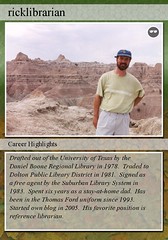
My trading card
Everyone needs their own trading card. You can make your own by going to http://flagrantdisregard.com/flickr/deck.php.
It was fairly easy. If you do decide to edit, you have to fill in the photo location again.
I'll trade you two of these for an Aaron Schmidt rookie card.
It was fairly easy. If you do decide to edit, you have to fill in the photo location again.
I'll trade you two of these for an Aaron Schmidt rookie card.
The Lady and the Panda by Vicki Constantine Croke
The West first learned of the existence of the panda when the French missionary Pere Armand David saw a panda skin while visiting remote western regions of China in 1869. For nearly fifty years after his report, European and American explorers sought the rare animal without success, only buying second-hand hides. As late as the 1920s the scientific community questioned whether pandas were extinct or mythical, according to Vicki Constantine Croke in her book The Lady and the Panda: The True Adventures of the First American Explorer to Bring Back China’s Most Exotic Animal.
By the time Ruth Harkness arrived in China to attend to the remains of her late husband’s expedition in 1936, several big game hunters had sent panda skins to museums, but no one had succeeded in bringing a live panda out of the country. Her husband had gone to China to try, but died of cancer in a Shanghai hospital without ever seeing one. No one thought a former dress maker and New York socialite could succeed where seasoned hunters had failed. They did not know Ruth’s idea. They never even thought of packing a baby bottle and formula.
In The Lady and the Panda, Croke tells the story of Harkness, her three expeditions, and the international acclaim that she received for bringing two pandas to the Brookfield Zoo. The journeys were difficult. When available, Harkness and her team traveled by boat, train, plane, auto, or rickshaw; often they hiked up steep paths to reach mountainous forest reserves. With supporters and rivals in the field, she dodged Chinese authorities and the invading Japanese army. In time she came to the conclusion that the expeditions were endangering the pandas and dishonored the land that she had come to love.
Readers who enjoy natural and political history and those who enjoy adventure stories will enjoy this book.
Croke, Vicki Constantine. The Lady and the Panda: The True Adventures of the First American Explorer to Bring Back China’s Most Exotic Animal. New York: Random House, 2005. ISBN 0375507833
Saturday, November 19, 2005
Every Step of the Way by Mark Dvorak
Mark Dvorak came to our library last week as our Friday at the Ford performer. He played his guitars and banjo and sang a mixture of his own compositions and well-known folk songs. He entertained everyone with his stories, and we all joined in without his asking when he started "Goodnight, Irene." I particularly liked his rendition of Lead Belly's "Bourgeois Blues." He sold a half dozen or more CDs after the concert. All this week I heard compliments about the concert. People want us to bring him back.
I bought his new CD Every Step of the Way and listened to it several times. Dvorak pays tribute to many musical influences in its dozen songs. In the liner notes he says that he imagines Johnny Cash singing his title song and claims that he had Billie Holiday in mind writing "Don't Make the Blues Make You Bad." My favorite "One Couldn't Run, One Couldn't See" tells about Blind Sonny Terry and Brownie McGhee. "Not War" would be a natural song for Pete Seeger or Peter, Paul & Mary to take up. He concludes with "Smile," which is based on a melody by Charlie Chaplin. The instrumental "Walking in the Air" is quite nice, too.
Mark has a website if you want to find his next concert or book him for your library, church, or coffeehouse.
Excuse me. I now have an urge to listen to my Steve Goodman albums.
The Good Earth by Pearl Buck
I just listened to The Good Earth by Pearl Buck, which won the 1932 Pulitzer Prize for Literature and has long been assigned for high school reading. I somehow missed having to read more than an excerpt in school, but I have had it on my to-read-someday list for a long time. Someday came last week when I found the audiobook on a display at the Downers Grove Public Library.
Based on second-hand knowledge, I had numerous assumptions about The Good Earth, many of which have been disproved. I did know that the story involved Chinese peasant farmers in the early part of the Twentieth Century and I knew that Buck was frank in her descriptions of daily life. I expected tragedy, but I also expected comic relief and characters standing up against adversity honorably. What I found was one long tale of characters compromising their morals to survive a relentlessly cruel environment. There is no one to admire in The Good Earth. (You can argue that last statement.)
The central character is Wang Lung, who is a poor farmer as the book begins. He is caring for his old father and owns nothing but his land, house, a few pieces of furniture, a few farm implements, and some seed. In rural China of the time, that was not bad. His father arranges for Wang Lung to take a slave woman from a great house in the village as his wife. They start having children, struggle to make ends meet, and flee to the south during a terrible drought. To save his children from starvation, Wang Lung does many things against his conscience and begins to justify the acts to himself. An opportunity for easy money badly gained leads to his stake at wealth. Hard work and cunning turn the stake into great wealth, but he never regains his moral courage.
The Good Earth can be read at several levels. It can be accepted as a story of one poor man. It may also be considered a story of China. Like Wang Lung, the country justified many terrible acts throughout the past century; women were treated very badly; children were sold into slavery; many died in the revolutions. The children of Wang Lung represent differing parties that struggled to control the land. Every type of villain you can imagine appears in the book: bandits, soldiers, prostitutes, opium sellers. I read in Women in History: A Biographical Encyclopedia that it had been translated into nine Chinese languages. I suspect many of the Chinese took offense to its portrayal of their society.
The book may also be read as a warning for any country that loses sight of its basic values. When tending to the land and the family are replaced by the pursuit of pleasure as the people's focus, the country will be torn apart by conflict.
Every source I read says that Pearl Buck was an advocate for China. Seventy-five years later her most famous book still raises many questions about the Chinese. Like Oprah, I bet The Good Earth would make a great discussion book.
Buck, Pearl. The Good Earth. Books on Tape, 2001. ISBN 0736685146. 10 discs
Wednesday, November 16, 2005
IM Shorthand for Monty Python Fans
Bonnie and I were talking about how it is sometimes hard to recognize what is meant by all the shorthand that is used in instant messaging. That's why there are websites like NetLingo. Of course, you can not really look up all of the abbreviations as they fly at you, but it sometimes helps when you are sorting it out later.
In the interest of making the world even more confusing, here are some Monty Python additions to IM shorthand:
MBH - My brain hurts!
NETSI - Nobody expects the Spanish Inquisition!
ANFSCD - And now for something completely different
IALAIOK - I'm a lumberjack and I'm okay.
UCT - Upper Class Twit
SW - Silly Walk
VSP - Very Silly Party
POTT - Penguin on the telly (We have one. Don't you?)
HIWTRAC - Hello, I wish to register a complaint.
IASBOLIRIP - It's a stiff, bereft of life. It rests in peace. (Some young IMers say this of email.)
ALOTBSOL - Always look on the bright side of life
STMIAN - She turned me into a newt! (A common complaint)
IGB - I Got Better.
KWSN - Knights who say "Ni!"
NNNNN - Ni! Ni! Ni! Ni! Ni!
STIGTS - Stop! This is getting too silly!
That last one could be particularly useful for some IM exchanges. Have any other suggestions?
Tuesday, November 15, 2005
Open WorldCat Review Samples
Judy at OCLC sent me some statistics from the User-Contribution Project for Open WorldCat. As of Monday, November 14, she had these numbers:
All content: 367 user submissions
Reviews added - 161
Table of Contents added - 135
Notes added - 71
That may seem like a small number, but there has been little publicity in the world outside techie library circles. This is giving OCLC some time to test and adjust the system. Judy said that there will be more publicity early next year.
Right now, it is hard to find reviews unless you know where to look. Judy sent these links, so you can see some examples other than mine:
http://www.worldcatlibraries.org/wcpa/oclc/60739594&tab=reviews
http://www.worldcatlibraries.org/wcpa/oclc/39551790&tab=reviews
http://www.worldcatlibraries.org/wcpa/oclc/57514882&tab=reviews
http://www.worldcatlibraries.org/wcpa/oclc/54022622&tab=reviews
http://www.worldcatlibraries.org/wcpa/oclc/49285663&tab=reviews
The first review is lengthy, while the other four are brief. All are very positive. No one seems to be slamming books as yet.
If you have submitted some reviews to Open WorldCat, send me the titles or the links. Either add them to the comments below or send them to my library email rick@fordlibrary.org, and I will pass them on through this blog or some other site - maybe on a wiki.
All content: 367 user submissions
Reviews added - 161
Table of Contents added - 135
Notes added - 71
That may seem like a small number, but there has been little publicity in the world outside techie library circles. This is giving OCLC some time to test and adjust the system. Judy said that there will be more publicity early next year.
Right now, it is hard to find reviews unless you know where to look. Judy sent these links, so you can see some examples other than mine:
http://www.worldcatlibraries.org/wcpa/oclc/60739594&tab=reviews
http://www.worldcatlibraries
http://www.worldcatlibraries
http://www.worldcatlibraries
http://www.worldcatlibraries
The first review is lengthy, while the other four are brief. All are very positive. No one seems to be slamming books as yet.
If you have submitted some reviews to Open WorldCat, send me the titles or the links. Either add them to the comments below or send them to my library email rick@fordlibrary.org, and I will pass them on through this blog or some other site - maybe on a wiki.
Mystery Solved, Apology Offered, and Information Shared About Open WorldCat Reviews
The mystery is solved, thanks to help from the friendly people at OCLC. If you read this blog last week, I expressed my frustration over not being able to submit my book reviews to Open WorldCat. The user-submission service had been working fine, but suddenly it seemed as though it was not working at all. I now know that it was never down. The problem stemmed from what and how I was submitting. Let me explain.
Through October I would occasionally submit a review to Open WorldCat, according to the instructions I wrote for the Library Success wiki. The length of my reviews varied, and I at times used Internet Explorer at home and either Internet Explorer or Firefox at my library. I never counted the number of words in my reviews. The Open WorldCat recommendation is that reviews be between 75 and 300 words. I could not imagine that I would ever hit 300 words. All my reviews submitted without error.
On Novemebr 2, I tried to submit my review of Peace is the Way from home using Internet Explorer as my browser. I pasted the review into the submission form, clicked the submit button, and watched while nothing happened. I assumed there was a temporary disruption of service. Still at home, I tried again several days later. Again it did not work. I thought that maybe something was wrong with the item record, so I tried another review. Same problem. I tried at work a couple of days late, probably using Internet Explorer. Same problem.
When I look at my review of Peace is the Way at Open WorldCat , it does not look long to me, but it is 377 words, well beyond the recommendation. When Judy from OCLC called me at the library on Friday, November 11, I happened to be using Firefox. She asked me to try submitting the review again so she could watch from her end. I pasted in the review and clicked submit. It worked right away. I loaded several more. They all worked.
On Saturday at home, I was using Internet Explorer and found I again was unable to submit a review. Remembering that Judy had asked what browser I was using, I loaded Firefox onto the computer and tried again. It worked.
On Monday, I sent a message to Judy and she replied that OCLC has found that Firefox will allow longer submissions than Internet Explorer. The OCLC staff is studying the situation. When I got home, I submitted some shorter reviews using Internet Explorer without problem, verifying what she said.
This seems a good time for an apology. I regret that I ever suggested that OCLC had let the service go down without even noticing. I learned from Judy that staff is actually reading every submitted review at this point. (Hey, I have captive readers!) They would notice if nothing was being submitted. I apologize.
I hope the episode does help OCLC in the design of the service and the writing of reviewing instructions. We are all learning as the project progresses.
Monday, November 14, 2005
Red Berries in the Children's Garden at the Morton Arboretum
With the opening of the Children's Garden and the fall leaves, there has been much to see at the Arboretum lately. Most of the brilliant leaves are gone now, which gives the berries their time to shine. It is worth bundling up and taking a hike.

Sunday, November 13, 2005
The Visit: A Drama in Three Acts by Friedrich Duerrenmatt
Last week I attended a performance of The Visit by Friedrich Duerrenmatt at Downers Grove North High School. Bonnie and I attend most of the plays and musicals, as we enjoy live theater and like to see students that we know on stage. This time our daughter Laura was on the crew doing makeup for four of the cast members. Her friend David was playing the son of Alfred Ill.
I had never heard of The Visit, which Critical Survey of Drama identifies as Duerrenmatt's masterpiece and most performed play. I do not recall having heard of Duerrenmatt either, who is identified by the reference set as the leading German-language playwright of post World War II Europe. My friend Dick Wyman, who has directed many community and high school plays, knows the work well. He said it was a very challenging drama for a high school production. He remembered that Joan Fontaine had played Claire Zachanassian in the American debut in the 1950s.
The play is set in the economically depressed town of Gullen in an unnamed country. Most of the cities of Europe are recovering and prospering, but Gullen has a wagon works, a foundry, and a pencil factory that all stay mysteriously closed. Everyone is wearing old clothes and old shoes, eating inferior food, smoking cheap cigarettes, and drinking cheap beer. They are all desperate for an economic savior, which comes in the form of Claire Zachanassian, a former citizen who has become one of the world's wealthiest women. She does offer the community a large sum of money, but she demands that the citizens commit a terrible crime to earn it.
After seeing the play, I read a copy from my library. I quickly discovered that there are different translations available. Characters names vary. Alfred Ill in the high school production is Anton Schill in the copy I read. Toby and Roby become Max and Mike. The Mayor is the Burgomaster. The actors as trees and the family driving scene are missing from the copy I read. Most of the story, however, and its impact are the same.
Critical Survey of Drama states that the play examines the difficulties of justice. Perhaps, but justice is definitely not served. Duerrenmatt combines both comic and tragic elements in this work with a 1950s or 1960s feel to it. It reminds me of the plays and short stories of Ray Bradbury and of television's The Twilight Zone; they often have an entire community act almost like a single character. The Visit is a creepy play that will make you shudder.
Duerrenmatt, Friedrich. The Visit: A Drama in Three Acts. New York: Samuel French, 1958, 1986. ISBN 0573617546
Saturday, November 12, 2005
Map That Locates Blogging Librarians
Click here to find a map showing where blogging librarians live. So far there is no one from Greenland.
If you wish to put yourself on the map, have your picture ready. I joined and later thought about adding my photo, but I can not find a way to do so. Have I asked for help? Of course not.
If you wish to put yourself on the map, have your picture ready. I joined and later thought about adding my photo, but I can not find a way to do so. Have I asked for help? Of course not.
Updating Adding Reviews to Open WorldCat
After adding some reviews to Open WorldCat yesterday from my library, I tried again today from home. It did not work. Like before, I got to the point of clicking the submit button and nothing happened.
When I talked to OCLC yesterday, I was asked what Internet browser I was using. That got me thinking about how I have been intending to add Firefox to the home computer. I use it at work all the time, but had never gotten around to loading it at home. So, I loaded it and I was able to submit reviews to Open WorldCat again.
I wonder if something went wrong with my Internet Explorer 6.0. I know I used it before to submit reviews. It has been slow lately. It is a mystery to me.
The point of this is, if you are unable to submit the reviews to Open WorldCat using IE, try Firefox.
Friday, November 11, 2005
Open WorldCat User-Contributed Content Pilot Problem
I have been frustrated by the Open WorldCat User-Contributed Content Pilot recently. It worked well for me in October, but I have not been able to add any reviews in November. I am able to find the Open WorldCat records, login with my user name and password, and compose the book reviews, but the process grinds to a stop when I click “Submit Review.” Nothing happens.
Update 2:30 p.m. Friday: Judy from OCLC called. We tried again. It worked. She is checking to see if the service was down.
Since I first noticed the problem, I have tried to submit from three different computers. I created a second account in case there was a problem with my first account. I am still unable to do what was so simple last month.
I assumed that there was a temporary problem when I first experienced the problem last week, and I was too busy with other things to inquire. When I tried again early this week and found I still could not contribute, I sent an email through the OCLC feedback system. Four days later, I have heard nothing from that inquiry. Yesterday, I left a voicemail and sent another email. This morning I got a reply to the email saying that my request for information was being assigned to a specialist. I am hoping that I will hear later today or tomorrow why I can not submit reviews.
Maybe I am being impatient, as it is a pilot, but the episode leaves me with some questions.
If the pilot was down, did anyone at OCLC notice? If they did, why didn’t OCLC post a notice on the webpage describing the pilot that the service was disabled? Why would OCLC continue to let contributors login and compose when there was no chance the submit button would work?
If anyone has trouble with submitting reviews, call OCLC right away. With few people submitting at this point, they might not know there is a problem.
My Detachment: A Memoir by Tracy Kidder
Detachment is a word with multiple meanings. In My Detachment: A Memoir, Tracy Kidder uses several of them. Lieutenant Kidder and the handful of enlisted men that he commanded in Vietnam were a detachment; they were stationed in a separate compound apart from the company, assigned to plot the coordinates of enemy movements using special radio intelligence equipment. Detachment also refers to the separation the author felt from the war and most of the officers to whom he reported; he had decided that the war was wrong before he left the States. He was doing only what he had to do, only following orders when necessary, eager for his tour to end. He was also detached from the men he commanded, but he was trying not to be. Detachment also means without bias. As a Harvard graduate with a liberal philosophy, he liked to think he saw all races as equal, including the enemy that he was sent to fight. In his compound, which he rarely left, he never saw any Vietnamese.
While reading My Detachment, I had to laugh at Kidder sometimes. When he arrived in Vietnam, he had no assignment. No one was expecting him, so he was told to settle into a non-air-conditioned hotel to wait for a position to be found for him. What did he do with his humid, sweaty time? Already having thoughts of writing a novel, he started reading the works of Joseph Conrad. This was years before the film Apocalypse Now.
In his book, Kidder states that he was never in much personal danger during his year in Vietnam. He and his men fled to their bunkers once when targeted by mortar fire. This danger was quickly forgotten and most of their sandbags were never filled. On most days, he plotted enemy radio locations and saw the jets heavy with bombs passing overhead. Every morning he attended a briefing at which a tactical officer reported the previous day’s tonnage of arsenal expended, results mostly unknown. This was as close as he got to learning whether his work mattered. Known now for his nonfiction writings, he spent his off-time in his hooch writing fiction – mostly letters full of lies about experiences he never had.
Scattered throughout My Detachment, Kidder has inserted portions of his never published novel Ivory Fields, which contrast greatly with his real experiences. His greatest challenges came during the visits by higher ranking officers, who had a tendency to notice non-regulation haircuts and unpolished boots. War was just a rumor. Instead, alcohol, prostitution, disease, self pity, boredom, and senseless protocol plagued the detachment. In its own way, this book is just as disturbing as battle line stories. It should be popular in most libraries.
Kidder, Tracy. My Detachment: A Memoir. New York: Random House, 2005. ISBN 0375506152
Tuesday, November 08, 2005
Changing Places: A Tale of Two Campuses by David Lodge
Last month in Berkeley, California, my friend Richard, who is a dedicated reader, recommended several books to me. During a conversation about books that satirize academic life, starting with Portuguese Irregular Verbs by Alexander McCall Smith and mentioning Moo by Jane Smiley, Richard remembered Changing Places: A Tale of Two Campuses by David Lodge, the first in a series of comic novels dealing with college life. I had never heard of it and made a mental note to myself to read it. The note had to be mental as I had no pencil and paper at the moment of the conversation. Like many of the readers I help in the library, I promptly forgot the author’s name, and I emailed Richard for the citation after I returned to Illinois. I had to interlibrary loan the book, of which there was only one copy in Metropolitan Library System’s SWAN catalog.
Once I started reading Changing Places, I realized why Richard, who has lived most of his life in Berkeley, would know the book. Part of the book is set at Euphoria State University in the city of Plotinus, high on the hills overlooking a bay. Across the bay is the city of Esseph (sound it out). The year is 1969 and the hippies are occupying a plot of university land and calling it the People’s Garden. Governor Ronald Duck calls out the National Guard. See the connection?
At the National Archives on Thursday, our guide spoke about how federal records that are preserved are often used for purposes other than their original intent. This novel written in 1975 can be read in a different way than when it was first published. It describes a period of history that is mostly past and almost forgotten. Here are some of the details that would not have been worth comment thirty years ago:
People smoking on airplanes
Renting a color television (with a big emphasis on “color”)
Everyone living in cheap apartments
Brick and plank bookshelves
Eight-track tapes
In the course of the novel, several characters hear of Women’s Liberation for the first time. Student unrest, the Vietnam War, and the Sexual Revolution are featured parts of the humorous story.
David Lodge took a creative approach to the writing of this novel. Every chapter is written in a different style. The story advances in one chapter through letters. Another chapter uses news clippings, and the final chapter is written as a play.
I ordered a copy of Changing Places for my library, so there will be two copies in SWAN. I recommend it to readers everywhere.
Lodge, David. Changing Places: A Tale of Two Campuses. New York: Penguin, 1995. ISBN 0140170987
Monday, November 07, 2005
Life: A Guide for the Perplexed by the Flying Karamazov Brothers
I became aware of the Flying Karamazov Brothers back in the 1980s when I saw their version of the A Comedy of Errors on PBS. All of Shakespeare's story was there, and the Karamazovs and their friends delivered all the lines. The really funny thing was that they did it all while juggling. Pins and balls in the air. Balls bouncing off walls and from the floor. All kinds of juggling. I could hardly take my eyes from the television. The Karamozovs are amazing jugglers.
Last week I got to strike through one of my life goals (second or third level, but still pretty important). I saw the Flying Karamozovs in Life: A Guide for the Perplexed at the McAninch Arts Cener at the College of DuPage. At 8:00 p.m. (maybe 8:02 p.m.) the house lights went down and the spot lights came on to show four buildings on wheels rolling onto the stage. Behind each was one member of the company. After a little dance of buildings, the members stepped forward and started juggling. The show had begun.
The Flying Karamozovs do more than juggle. They dance, tell jokes and stories, dress in silly costumes, sing, and play musical instruments in ways that you would not expect. In one scene of the show, the Karamazovs lined up with a flute, baritone horn, and guitar between them. One member blew the flute while another fingered the instrument. Likewise, one blew the baritone while another fingered. One fingered the frets while another strummed the guitar. The Karamozovs at the ends with one free hand each juggled balls back and forth across the ensemble while they played a merry tune. There seems to be almost nothing they will not try.
A tradition at Karamazov performances is The Gamble, a real test of juggling expertise. Members of the audience bring to the stage many strange items, which are then chosen for juggling according to the applause of the audience. Last Tuesday, being the night after Halloween, there were several pumpkins and other leftover decorating items, as well as many general household items and odd toys. The audience chose a big rubber ball, a Chicago telephone directory, and a bowl of salad for Dmitri to juggle. He had three tries to juggle the three items for ten seconds. He succeeded on the second try, after the modifications. He was rewarded with a standing ovation.
Throughout the show, the Karamazovs returned to four-juggler roving juggling that took up a lot of the stage. The stomp stomp stomp stomp told you it was coming. They actually dropped juggling pins several times in these exercises, but their humorous reactions to the errors made the viewing even more fun.
The Karamazovs have a website with history of the troop, a description of Life: A Guide for the Perplexed, and a schedule of upcoming performances. If you are lucky, you can see them, too.
Friday, November 04, 2005
National Archives Research Center in Chicago Needs Visitors
Yesterday a handful of reference librarians from the western suburbs of Chicago took an eye-opening tour of the National Archives and Records Administration’s Great Lakes Region Center in Chicago. The staff of the center, including Martin Tuohy, Peter Bunce, a couple of public service staff, and three of the archivists, rolled out the red carpet for us. They showed us through the massive facility, which includes a 900,000 square foot storeroom for federal records. The view down the aisles was amazing. After the tour we sat down with the archivists for a conversation.
Much has changed at the Chicago facility since we had last visited the facility. The N.A.R.A. has a new public research center, with a new microfilm reading room and a new room for public viewing of records. Workers were still painting door trim as we toured. There also seemed to be a new emphasis on public service, as the staff has produced many finding aids and the center is starting an experiment with Saturday hours. The center will be open to the public on the first Saturday of each month. Call ahead before sending anyone to the facility. Needing an appointment has not changed; the staff want to verify that the archives has the needed records and to suggest preparations before visitors come.
We discussed at length the differences between libraries and archives. Martin said that while libraries catalog and organize their holdings by subject, archives organize their items according to source and date. All the records from a government agency will be together regionally and chronologically. When a researcher goes to a catalog of the holdings of an archive, a keyword search will not work well. The searcher needs to understand the hierarchy of the records system and work from the general to the specific to find records. In the archive the records are kept by Record Group Numbers; the archivists know them by heart, just like librarians know our call numbers.
Martin listed the most common uses of the records at the archives:
Family history
Maritime history
Community and family history of native Americans
Legal research for litigation
Scholarly study of American history
The archives has much for the family history researcher, including census records, land records, selective service and military records, ship passenger lists, immigration and naturalization papers, and records from the Bureau of Indian Affairs. Bankruptcy recordsare a great source, too, as they tell much about ancestors possessions.
He urged all libraries to get the third edition of the Guide to Genealogical Research in the National Archives of the United States. He said most of our libraries had the first or second editions, which are quite dated now. The N.A.R.A. also has a number of other useful publications for sale.
Martin showed us a display of books whose authors did their research at the National Archives in Chicago. All of them used federal court records, a major part of the archives collection. Peter said that he hoped to sometimes have an authors group meet regularly at the archives.
After being shown through the archive permanent collection, in which records are constantly being moved into acid-free boxes, the archivists showed us a display of historical items spread across a large table. Among the papers, books, rubber dentures, photographs, and scary objects, was a legal brief written in the hand of Abraham Lincoln, which we all got to hold (inside a plastic sleeve, of course). The rubber dentures were items from a patent case involving a dentist named Goodyear. One big volume had the hand-written transcript of Aaron Burr’s trial (an Ohio case). The photographs were from an early twentieth century obscenity case. The scary objects were the remains of a Molotov cocktail and hand weapons submitted in the Chicago Seven trial. Also on the table were petitions for naturalization for Bob Hope and Enrico Fermi. These items suggest the many items of interest in the collection.
We finished the tour with a very interesting conversation. Peter, Martin, and the archivists told us how public use of the National Archives across the country has fallen drastically in the past ten years. Most of the microfilm readers sit empty much of the time now. The staff is seeking ways to draw the public back to the center and sought our ideas. Two groups they particularly want to recapture are family history researchers and students. Peter said that the archives staff would much like to work with high schoolhistory teachers to draw students for their history projects. He mentioned the hope that he would get an education liaison for his staff to work with high schools and colleges. We agreed that this would be a good idea.
Librarians can help. Let your genealogists know that there are readily available appointments now at the archives on almost any week day. Put up posters. Get the most recent Guide to Genealogical Research in the National Archives of the United States into your collections. Tell your high school teachers that the Archives is eager to with them. Call Peter Bunce, 773-948-9009, and plan a tour. It is an amazing place
http://www.archives.gov/great-lakes/chicago/
Thursday, November 03, 2005
Library Success: A Best Practices Wiki
Last summer Meredith Farkas set up Library Success: A Best Practices Wiki for everyone in the library community to share their knowledge and experiences to help others do their jobs better. While it has a stated emphasis on the applying of library technology, volunteers are adding pages about library services and management as well. The pages may have discussions or instructions, or they may have collections of links to websites with useful information.
Being a wiki, anyone can contribute. I did. Click here to find the page I created about adding book reviews to Open WorldCat. You may edit my page if you see typos or think of better words or want to add some more text. It is a tool for collaboration. That's what wikis are all about.
If you do decide to contribute, join the wiki user list so we will all know who you are. See you there.
Wednesday, November 02, 2005
Comments Let Us Know the Blogs Are Worthwhile
This blog is a little different than most. Most literature on blogs emphasizes the currency of information posted and the speed of reporting. People generally read blogs for hot news.
A majority of readers of ricklibrarian come to it through search engines when they seek reviews. As a result, some of the older postings are as popular now as they ever were. Some are only read occasionally.
I was glad to see that someone had visited my review of Imperial Reckoning this morning. It is one of those less visited reviews, and I had not seen it myself in a long time, as I wrote it in April. On a whim, I clicked the link and saw that the new visitor left a comment that dispelled any doubt I have about the value of blogging reviews.
It is humbling sometimes when we make connections with strangers.
Peace is the Way by Deepak Chopra
My feelings about the book Peace is the Way: Bringing War and Violence to an End by Deepak Chopra are mixed. I thought the first several chapter were well written and persuasive. They describe how war is a chosen path that never leads where leaders promise it will, how defining an opponent as enemy makes peace impossible, and how militarization leads to less security. The chapter “Beyond Toxic Nationalism” is particularly interesting; Chopra suggests we need to identify with our adversaries to find common ground and learn to consider them as equals.
I felt lost the middle part of the book. I know the author’s premise is that societal and political peace will not come until a majority of individuals embrace a personal spirit of peace, so the chapters on psychological health and preparing the individual for peace are important in his viewpoint. As a reader who avoids self-help books, I was impatient with this section. Some great quotes kept me reading, but I felt less involved. It was here that I realized Chopra’s concern is spirituality, while I was looking for philosophical and ethical arguements.
In the final chapter of Peace is the Way, Chopra states that we must maintain hope for peace. This echoes his assertion early in the book that most people support war only because they are told it will lead to peace eventually. He says that many young people have to be convinced by their leaders to overcome their aversion to violence when becoming soldiers. Some never fire their weapons until they are persuaded that other people are the enemy and less worthy of life and that the enemy is threatening them. To this end, much of our media, many of our schools and churches, and our government teach the lie that we are different from our enemies. Chopra’s hope is based on the underlying goodness in people who will embrace peace when they see the truth. He is an optimist.
With so many books on war in our libraries, it is good to add one about peace.
Chopra, Deepak. Peace is the Way: Bringing War and Violence to an End. New York: Harmony Books, 2005. ISBN 0307236072
Monday, October 31, 2005
Blind to the Link, Sighting the Blog for Reference
I knew it had to be there. A library client wanted a transcript of an interview from MSNBC's Meet the Press. I looked all over the MSNBC website for it. I scanned the menus on the left of the screen and found the web page for Meet the Press. There were many links among the boxes on the page, but I did not see one to the transcript of the interview. I tried the search tool for the web site and found information about the show's topic but not the transcript.
I took a different approach. I searched Google and Google Blogsearch with no luck. Then I went to Feedster but found it was down for maintenance. Then I searched Technorati and the first item on the results list was the wanted transcript posted to a blog. The library client said that it was the right thing and he left happy.
I noticed that the blog said that the transcript had been taken from the MSNBC web site. Being half crazed, I went back to look again. After gazing at the Meet the Press web page for a minute or two, I saw it. Near the top of the page in a dark rectangle in a spot often occupied by ads, in thin white letters I found the link “Transcripts & Resources.” I clicked the link and found the wanted transcript. It was right in front of me all the time.
My instincts for finding the link failed me this time, just when I thought I knew how web designers think. I am glad someone blogged the wanted transcript. I turn to blogs for current information and answer reference questions often these days when my other attempts fail. I am pleased how often someone has already posted something helpful.
Saturday, October 29, 2005
44 Scotland Street by Alexander McCall Smith and Expresso Tales by the Same Author
Alexander McCall Smith must be one of the busiest authors on the planet. Every time I look, there is a new book, and I’ve enjoyed every one of them. Like many of the readers at my library, my favorite series is the No. 1 Ladies’ Detective Agency novels. I am also keen on Portuguese Irregular Verbs and its sequels. According to Random House's McCall Smith web site, he has written over fifty books, including numerous serious academic titles. He is currently a professor of medical law at the University of Edinburgh in Scotland.
I just finished listening to 44 Scotland Street, read by Robert Ian MacKenzie. In its introduction, McCall Smith says that he was impressed by the Tales of the City novels by Armistead Maupin that were serialized in the San Francisco Chronicle. He took a challenge by editors at The Scotsman in Edinburgh to write a serialized novel and submitted 44 Scotland Street in 110 daily installments, which were run in the paper between January and June of 2004.
I do not want to say much about the story and spoil the surprises. The story is set in Edinburgh, and like in Tales of the City, it involves a group of people who inhabit or visit a particular apartment building. Pat rents a room in a flat occupied by Bruce, a young surveyor with many expensive hair gels and colognes, and two absent tenants. The ever sympathetic Domenica lives across the hall, and five year old Bertie practices his saxaphone and Italian downstairs. His mother Irene worries because his school does not follow the principles of Melaine Klein. Pat tries to help Mathew, her boss at the art gallery, establish whether a painting really is by the Scottish master Samuel Peploe. The real mystery writer Ian Rankin has a cameo role. It must have been fun to read in short daily installments.
Like all McCall Smith novels, there are sequels. A second series ran in The Scotsman last winter and is now available in the U.K. under the title Expresso Tales. If I had known I could have had Aaron buy a copy when he was in London. We could have been the first library in the area to have a copy. Amazon reports that the title will not be for sale in the U.S. until July 11, 2006. A third series began September 19, 2005 and can be read by subscription.
Warning: you might laugh out loud.
McCall Smith, Alexander. 44 Scotland Street. New York: Anchor Books, 2005. ISBN 1400079446
McCall Smith, Alexander. 44 Scotland Street. Prince Frederick, MD: Recorded Books, 2005. ISBN 1419340522, 10 compact discs
Friday, October 28, 2005
The Journey That Saved Curious George by Louise Borden
Voila! It was there! A book that I had been waiting to read. On my desk I found The Journey That Saved Curious George: The True Wartime Escape of Margret and H. A. Rey by Louise Borden, illustrated by Allan Drummond. Oooh, it was a nice looking book!
Everyone remembers Curious George, the mischievous monkey of picture book fame. If we did not read the books as children, we read them to our children. As a parent, I grew rather tired of them. Still, I wanted to read this book about an episode in the authors’ lives.
Margret and H. A. Rey were living in Paris at the start of World War II, and being Jewish, were very concerned for their safety. Both had been born in Hamburg and had become a citizen of Brazil, but they had been in France for four years working on children’s books. Two manuscripts were ready for publication, one about a penguin names Whiteblack and another about a monkey named Fifi, but the European publishers no longer had paper. The couple’s preparations to flee Paris became more serious when the Germans crossed through Belgium and the Netherlands. Getting all the paperwork completed was maddening.
Louise Borden heard the story of the Reys’ escape years ago and wanted to know more. She visited de Grummond Children’s Literature Collection at the University of Southern Mississippi to find the Reys’ papers, wrote to people who had known the Reys, and traveled to Paris and the towns through which the couple escaped. She enlisted Allan Drummond to illustrate the story.
The result is a fine book for youth and adults. I enjoyed looking at Drummond’s rich illustrations, showing the Reys on their bicycles in Paris, with people in their scarves and berets reading newspapers, crowded onto buses, carrying babies, all fleeing as Nazi planes dot the sky. Photos of the Reys, their passports, their day calendars, and other artifacts and illustrations of Curious George and Whiteblack also decorate the pages.
The penguin is really cute. I should read Whiteblack the Penguin Sees the World soon.
Borden, Louise. The Journey That Saved Curious George: The True Wartime Escape of Margret and H. A. Rey. Boston: Houghton Mifflin Company, 2005. ISBN 0618339248
Thursday, October 27, 2005
Henry David Thoreau's grave
Andrea Mercado posted photos from her visit to Author's Ridge in Concord, where graves of Thoreau, Emerson, and Alcott may be found. I really like the tributes left before Thoreau's marker. I must go there next time I visit Massachusetts. Thanks to Andrea. Click to see her other photos.

Wednesday, October 26, 2005
Strange Virtual Afternoon
Ever have one of those days? On Sunday several of my virtual reference exchanges were a bit strange.
One student had a screen name that was an entire paragraph long. Everytime he sent a message, I had to scroll down the chat box to find his message. He kept rephrasing his request and adding details. He also threw in jokes while I was searching. It was impossible to actually work on his question if I kept reading his chatter. I told him I was going away for a book.
Another seemed either to have no grasp of her topic or to be unwilling to read the pages that I sent to her. I had to point to the answer on each page that I sent and tell her why it answered her question. She had lots of followup questions. She would be silent sometimes for ten minutes or so and then come back. I fielded her questions for nearly two hours while juggling other clients.
A third student wanted mileage between two suburbs and then started telling me about seeing his teacher in a supermarket several suburbs away from his middle school. He wondered why his teacher would wander so far away from the school. "She might live near there." That he had also gone seven miles away from his school did not seem noteworthy. He wanted to know several other distances. I told him how to use Google Maps.
Then I had several "normal" virtual reference interviews.
Virtual reference has no monopoly on unusual transactions.
Constant talkers come to the reference desk every now and then, too. It is sometimes hard to think when bombarded by endless talk. It is interesting to see how the phenomenon manifests itself online.
I have students who want answers but who are unwilling to read what I hand them come to the desk, too. It should be no surprise to meet them virtually. I sometimes paste the answering statements into the chat box after pushing the web page.
At the desk I rarely get the students who mostly want to chat. Maybe I look too old. Online they have no clue to my age (other than my using complete sentences followed by periods.)
My library is now in its third year of offering virtual reference. The more I see the more I believe it is mostly like in-person reference. It is sometimes puzzling. It is more often very satisfying.
Tuesday, October 25, 2005
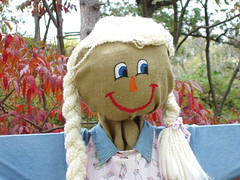
Scarecrows at the Morton Arboretum
The Morton Arboretum, which has recently opened its new children's garden and a maze, also has an exhibit of scarecrows this fall. Different community groups have created scarecrows unlike those of tradition. Click the photo to see more. Better, go see them at the Arboretum.
Monday, October 24, 2005
Living to Tell the Tale by Gabriel Garcia Marquez
Gabriel Garcia Marquez is one of the giants of Latin American literature, and my library has many of his novels and short story collections. I have enjoyed several, including Love in the Time of Cholera and Chronicle of a Death Foretold. Both include mesmerizing stories unlike anything written north of the Rio Grande. Reading Living to Tell the Tale, I find that many of those stories are somewhat true; the author listened to every family tale and retold them in his fiction. His work earned him the Nobel Prize for Literature in 1982.
As an experienced reader of Garcia Marquez would expect, he does not construct his memoir of youth in a chronological manner. He starts with adolescence, moves back to early memories, and follows with his school days. The latter part of the book recounts his newspaper work and early writing career; dates are particularly confusing in this section. Living to Tell the Tale ends with his leaving Colombia to cover a story in Switzerland. He did not return to his homeland for three years.
I like the beginning. While he is working for a newspaper in Barranquilla, living mostly in a outdoor cafe, with one year of law school behind him, his mother appears and demands that he return to Aracataca with her to sell his grandparents' house. They take a slow riverboat, a crowded train, and even walk to get there. When they arrive, nothing is as they expected. His mother does not sell the house, but they see old friends. In rich prose Garcia Marquez describes their every move and the many people they encounter. It is very like a story from his fiction.
I found the account of his early writing career very interesting. He really wanted to be a poet but wrote editorials for newspapers to make ends meet. While in school, his writing ability was noticed, and several publishers sought him for their papers. Out of school, he spent more than he earned and his friends often had to feed and shelter him. He wandered through the homes and bordellos of all classes, meeting every politician, policeman, criminal, and writer in Cartagena, Sucre, and Bogota.
I am leading a discussion on Living to Tell the Tale later this week. Garcia Marquez includes many names in the text, and I wish the book had an index to help me re-find what he wrote about these important people.
Devoted readers of his novels and short stories will want to read this first of three memoirs.
Garcia Marquez, Gabriel. Living to Tell the Tale. New York: Alfed A. Knopf, 2003. ISBN 1400041341
Friday, October 21, 2005
Open WorldCat for Rural America
I was playing around with Open WorldCat search and decided to see how many copies of This Ain't Brain Surgery by Larry Dierker there were in West Texas where I grew up. The book tells about Dierker's baseball career, including his years as the manager of the Houston Astros.
Living for twenty plus years in the Chicago suburbs, where all the libraries have been networked and connected, I forget that it just is not so across rural America. I had forgotten how good we have it here librarywise. I put in the zip code 76932 for Big Lake, Texas, thinking I would see copies in San Angelo, Midland, and Odessa for sure. I was hoping I would also see copies in Big Lake, Ozona, McCamey, and Stanton. I was surprised to see the first library in the results list is the Central Arkansas Library System. It is 670 miles from Big Lake to Little Rock! That's a long way to go for a book.
Open WorldCat does have an explanation of how it replies to the zip code searches. The results are displayed according to libraries within concentric radii of the given zip code. If there are not at least ten libraries with the item within a set radius, the next radius is added. If the search has to go beyond 62 miles, the results are presented alphabetically by state and name of library. When you live in a place like West Texas, there will not be more than two or three libraries within 62 miles if you are very lucky. Therefore, in this case, libraries in Arkansas, New Mexico, and Oklahoma get listed before libraries in Texas; these state all belong to Amigos, a regional OCLC service provider. Looking down the list, I find that the closest copy is in Abilene, 163 miles according to Google Maps.
To see what Open WorldCat is missing, because membership in OCLC is not universal, I went to individual library catalogs. The Reagan County Library in Big Lake does not have an online catalog. The libraries in San Angelo, Odessa, and Midland do, so I was able to search for Dierker's book. San Angelo and Odessa own it, but Midland does not. Do I assume the people in Midland, once the home of George W. Bush, are all Texas Ranger fans? It is football country. The librarians may be selecting only what will circulate.
Where does this leave the readers in West Texas who are hoping for more access for books? Two things need to be done. 1) All the libraries need to be added to OCLC so they show up in Open WorldCat. 2) A different formula for showing closest libraries needs to be created for rural America.
Does Open WorldCat even matter in places where towns are so far apart? Books can be requested through interlibrary loan. My aunt is always getting booksthrough ILL from Abilene and elsewhere. Would anyone really drive to another town for a book?
I think it can matter. People who live in the small towns in West Texas drive great distances to shop and conduct personal business. My friends and I used to drive 72 miles from Big Lake to San Angelo for a pizza or to see a movie. If you were going to Midland to get a piece of oilfield equipment or to San Angelo to visit a friend in the hospital anyway, you could pick up the book at the library.
Open WorldCat is still a trial. It has a long way to go before its dreams are realized. Let's not let rural America be left out.
Thursday, October 20, 2005
Domaine Carneros 1997 Brut Carneros Sparkling Wine
We do not drink champagne very often, but we opened a bottle of Domaine Carneros 1997 Brut Carneros last night after the Houston Astros won their game against the St. Louis Cardinals, earning them a place in the 2005 World Series. I have never opened a bottle of champagne after a game, but then again, the Astros have never been to the World Series.
(I hope I cited the wine correctly. I do not think there are rules in AACR2 - library lingo.)
Bonnie poured the champagne into our seldom used crystal wine glasses, and I took a sip. Wow, it was good! It didn't have the aftertaste of Sunday brunch champagne. The bottle had been a gift a few years ago. It seems to have been a nicer gift than I realized. Not outlandish, but still very nice.
It was pleasant to sip while watching interviews and highlights. On ESPN the coverage went on and on. My favorite play was Adam Everett bunting down the third base line to score Chris Burke. That's classic Astros baseball! Everett and Craig Biggio both made nice diving plays during the game, and I appreciated Jason Lane's home run. Most importantly, the pitching trio of Roy Oswalt, Chad Qualls, and Dan Wheeler limited the Cardinals to one run.
We still have some champagne. Maybe we can have some more next week.
Wednesday, October 19, 2005
This Ain't Brain Surgery by Larry Dierker
I hardly slept Monday. The Houston Astros were only one strike away from winning the game that would send them to the World Series for the first time ever when the St. Louis Cardinals rallied and won the game. It would be easier to take if the games were in the afternoon. When tragedy strikes around 11:00 p.m., it is hard to stop thinking "what if ... ."
Few people understand the position of Houston Astros fan. Most major league teams have been to the World Series at some point in history. For those who do not know Astros history, I recommend This Ain't Brain Surgery: How to Win the Pennant Without Losing Your Mind by Larry Dierker. Dierker is someone who really knows Astros history. He was a pitcher for the team in the 1960s and 1970s. From 1979 until 1996 he was the primary color analyst (the announcer with lots of interesting facts and stories) on Astros radio and television broadcasts. From 1997 through 2001 he was the manager. Under his leadership, the team won four division championships but never won a playoff series. In his book, you will read about forty years of Astros baseball. You will learn how close the team has come to the World Series without ever succeeding. You will learn about many of the team's great players. There are many sad stories, too, so keep a handkerchief handy.
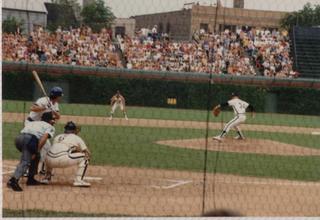 To the left is a photo of Nolan Ryan pitching to Ryne Sandburg in Wrigley Field in 1987. Ryan was a key Astros figure of the 1980s. He has been shown in the stands during the current games. (The picture does not really have anything to do with the book, but I wanted to use it anyway. It is the best I have from that day Bonnie and I had really great seats.)
By the way, the This Ain't Brain Surgery is also an autobiography. Dierker, who is an avid book reader and otherwise interesting character, tells about his experiences on and off the ball field, and there is brain surgery in the story.
It is Wednesday and Game Six of the playoffs is tonight. I wonder how I will sleep tonight.
Dierker, Larry. This Ain't Brain Surgery: How to Win the Pennant Without Losing Your Mind. New York: Simon & Schuster, 2003. ISBN 074320400x
Few people understand the position of Houston Astros fan. Most major league teams have been to the World Series at some point in history. For those who do not know Astros history, I recommend This Ain't Brain Surgery: How to Win the Pennant Without Losing Your Mind by Larry Dierker. Dierker is someone who really knows Astros history. He was a pitcher for the team in the 1960s and 1970s. From 1979 until 1996 he was the primary color analyst (the announcer with lots of interesting facts and stories) on Astros radio and television broadcasts. From 1997 through 2001 he was the manager. Under his leadership, the team won four division championships but never won a playoff series. In his book, you will read about forty years of Astros baseball. You will learn how close the team has come to the World Series without ever succeeding. You will learn about many of the team's great players. There are many sad stories, too, so keep a handkerchief handy.
 To the left is a photo of Nolan Ryan pitching to Ryne Sandburg in Wrigley Field in 1987. Ryan was a key Astros figure of the 1980s. He has been shown in the stands during the current games. (The picture does not really have anything to do with the book, but I wanted to use it anyway. It is the best I have from that day Bonnie and I had really great seats.)
By the way, the This Ain't Brain Surgery is also an autobiography. Dierker, who is an avid book reader and otherwise interesting character, tells about his experiences on and off the ball field, and there is brain surgery in the story.
It is Wednesday and Game Six of the playoffs is tonight. I wonder how I will sleep tonight.
Dierker, Larry. This Ain't Brain Surgery: How to Win the Pennant Without Losing Your Mind. New York: Simon & Schuster, 2003. ISBN 074320400x
Tuesday, October 18, 2005
Never Have Your Dog Stuffed by Alan Alda
I just finished listening to Never Have Your Dog Stuffed: and Other Things I've Learned by Alan Alda. I was surprised and slightly disappointed at the start that Alda did not read the book himself, but the compelling story soon let me forget his vocal absence. Having seen countless episodes of M*A*S*H and movies starring Alda and knowing his voice well, I almost heard his voice telling the story. His writing sends his voice well without the actual sound. Some of the story is so emotional, it might have been difficult for him to read.
I was surprised that Alda's earliest memories came from the period of traveling around the U.S. with his father on the Burlesque Circuit of the 1930s. I think of Alda as much too young to have ever seen something so ancient as Burlesque. I always equate him with the generation of college students protesting Vietnam in the late 1960s and early 1970s. That is when M*A*S*H debuted. That's where I had pegged him. On further reflection, I can seeing the Burlesque influence in his work.
The story about the stuffing of a pet dog comes from Alda's youth. His father was an actor under a Warner Brothers' contract during World War II, and the family was living in a house in rural California. The author had been given the dog as a companion during his polio quarantine. It died a very strange and shocking death after eating leftovers. Its stuffing, suggested by Alda's father, did not succeed in lessening the pain of the memory of its death. Even as a child, the author saw how misguided the gesture was, and the story became for him a standard by which to measure other episodes in his life.
Readers wanting M*A*S*H stories to dominate the book will be disappointed. There are some stories about the making of the show and his friendship with the other actors, but Alda's biography is mostly about his education, his career, his study of acting, and his relationship with his parents. He tells about his near death in the mountains of Chile in the later section of the book.
All Alan Alda's fans should read this book.
Alda, Alan. Never Have Your Dog Stuffed: and Other Things I've Learned. New York : Random House, 2005. ISBN 1400064090
Alda, Alan. Never Have Your Dog Stuffed: and Other Things I've Learned. Santa Ana, CA : Books on Tape, 2005. ISBN 1415924325
Monday, October 17, 2005
Adding Reviews to Open WorldCat
OCLC has announced that as of October 9, everyone is free to add content to the records in Open WorldCat. Click here for the announcement. Any book enthusiast can now put a review onto an Open WorldCat record as easily as putting one on Amazon. Karen Schneider did it on Thursday and urged others to try. I tried it Friday and found it was easy.
For those who do not remember or have not heard, Open WorldCat is OCLC (a very big library company) putting the bibliographic records from WorldCat (a very big database showing what libraries around the world own) onto the Web so that they can be found through popular search engines, like Google and Yahoo, and other non-OCLC web sites, such as Alibris and BookPage. These records tell anyone who finds them the closest libraries with the books they seek. While this might seem to a knowing librarian as a fairly easy thing to find otherwise, it should help nonlibrarians who do not know the URLs for their area libraries' catalogs. Librarians can also use Open WorldCat (as they do in FirstSearch WorldCat) to find library holdings in multiple systems in one search.
Joe Janes, Roy Tennant, and many others in the library community have called on librarians to use the Web to take library services to the public, reminding librarians that it is the libraries that are remote, not their public. Using Google and Yahoo to get the libraries to the public is one attempt.
Furthermore, online library catalogs are adding features, such as book covers and reviews, to make them more attractive to the public. Open WorldCat is going a step further adding an interactive component. Any reader can add reviews, the table of contents, or notes to Open WorldCat records.
Here is what you do to add a review to an Open WorldCat record.
1. Find Open WorldCat. There are several ways of doing this. The easiest way is simply go to http://www.oclc.org/worldcat/open/tryit/default.htm. Save this link. (An intended way is at the end of this piece.)
2. Enter your title in either the Google or Yahoo search box. Click "Search." I do not recommend the Google Scholar box, as it takes an extra step and it did not find many of the titles for me.
3. Click the correct title on the results list.
4. Click the tab that says "Reviews."
5. Click "Write an Online Review."
6. Open an Open WorldCat account if this is your first visit. It is free. If you have an account, sign in. (Karen had some difficulty signing up because she already had an account that she did not remember having.)
7. Select a rating for the book.
8. Give the review a title. I just used author and title of the book but you could give your review its own title.
9. Paste in your review. You can write the review at this point, but you are much better off having written it in advance. Open WorldCat will not time out as you write, and you will have a second chance to catch typos. Your readers will appreciate a better edited review.
10. Click "Submit Review." You will be returned to the record and your review will be on the screen. (Karen said her review took awhile to appear, but my reviews appeared instantly.)
I added five reviews to Open WorldCat on Friday:
Given: New Poems by Wendell Berry
Active Liberty by David Breyer
Before Lewis and Clark by Shirley Christian
Encyclopedia of an Ordinary Life by Amy Krouse Rosenthal
A Year Down Yonder by Richard Peck
I was the first to add reviews to these titles, which I chose to see how a variety of short and longer reviews would appear. As the trial is so new, there is little contributor content, but I did find the publisher had added the table of contents for Before Lewis and Clark. The reviews do look rather plain, as there is no way to use bold, italics or underline the text.
I found adding the reviews was easy for all the titles except A Year Down Yonder, which is available in hardcover, paperback, and compact discs, all of which were separate records; I had to paste the review into each of the records. This is not necessary on Amazon, where the submitted reviews post to all the editions of a title. Perhaps OCLC will find a way to connect the editions, too.
Back to step 1. You can get to Open WorldCat records directly from Google and Yahoo by using the phrase "find in a library" within quotation marks and the title and author. At this point I would recommend Google, which found three editions of A Year Down Yonder. Yahoo only found the hardbound edition. Remember to use the whole phrase "find in a library." I forgot the "a" once and it did not work. I wonder how many people will try "find in library" and be disappointed.
I will follow Open WorldCat developments and report when there is anything interesting. The review writing feature is promised for FirstSearch WorldCat in the near future.
Thursday, October 13, 2005
A Small Mystery to Solve Regarding Peter, Paul & Mary
In the past three days, I have noticed unusually high interest in my short review of old Peter, Paul & Mary recordings. It has been the most popular individual page other than my main page in this blog. Of course the numbers are small really: eight people have accessed the review, which usually has a visitor every week or so. After the fourth visitor I began to worry: had one of the members died?
I have been to the Peter, Paul & Mary website and to Back Porch News, and can find no bad news about the trio - though it does seem a lot of other folk singers have died in the last month, according to Back Porch News. I have also checked Yahoo News and Google News: no recent news. I guess there is a small resurgence in interest in Peter, Paul & Mary: that's good news!
I have been to the Peter, Paul & Mary website and to Back Porch News, and can find no bad news about the trio - though it does seem a lot of other folk singers have died in the last month, according to Back Porch News. I have also checked Yahoo News and Google News: no recent news. I guess there is a small resurgence in interest in Peter, Paul & Mary: that's good news!
Active Liberty by Stephen Breyer (with thoughts about libraries)
Stephen Breyer believes that the U.S. Constitution and the statutes passed by Congress must allow interpretation that maximizes the participation of the public. "Active Liberty" is his term for a method of judicial interpretation that considers the intent of the framers of the Constitution, the wishes of the legislators who wrote the laws, the administrators who enforce the laws, and the public in whom all authority rests. While it calls for judicial restraint, it is not a method of literal interpretation. Breyer shows in the text of his new book Active Liberty: Interpreting Our Democratic Constitution that word by word analysis sometimes leads to mistaking general Congressional intent and often serves the public badly. Breyer wants as a Supreme Court Justice the ability to look beyond the statutory text to form decisions; he will often use texts of hearings, commentaries, and testimonies that suggest the consequences of law.
In Active Liberty, Breyer discusses the application of his concept to free speech, federalism, privacy, affirmative action, statutory interpretation, and administrative law. He discusses cases brought before the Supreme Court, telling why he agreed or disagreed with the court's decisions. He points out that most Supreme Court decision are unanimous; most attention is given to the cases that divide the court. The colleague he quotes most in the book is retiring justice Sandra Day O'Connor.
I thought about libraries in his discussion of administrative law. Breyer points out that democratic control of government has to be tempered by expert knowledge in our technically modern life. The wishes of the public and the public good are not the same in areas of civil liberties, the environment, and other areas of controversy. The experts who work for governmental agencies and have to interpret their jobs daily should be listened to closely in judicial inquiries, according to Breyer. Librarians are such experts. Justices should listen to us in cases involving libraries and information.
The public library would never work as a totally democratic institution. We could never get our community of users and nonusers to agree to the hours of service, the services to provide, and the materials to stock. The public library has the mission to serve the informational, educational, and recreational needs of all its residents, and only professional librarians with the authority to sometimes do the unpopular can complete the mission. The role of the library, however, is to support active democracy, and librarians should listen to the library users; librarians should incorporate as many of their ideas and buy as many of the books they recommend as possible. We must make our users feel that the libraries are theirs.
Active Liberty is a more readable book than you might imagine would be written by a Supreme Court justice. Taken from a series of lectures, it is also fairly short. It includes a really good explanation of why we have many elected officals with differing lengths of service. More libraries should buy it.
Breyer, Stephen. Active Liberty: Interpreting Our Democratic Constitution. New York: Alfred A. Knopf, 2005. ISBN 0307263134
Tuesday, October 11, 2005
Where Are the Stories? Where Are the Bloggers? U.S. Cash Fuels Human Trade by Cam Simpson and Aamer Madhani
In Sunday's Chicago Tribune were two articles by Cam Simpson and Aamer Madhani about the exploitation of foreign workers in Iraq by subcontractors working for Halliburton. Halliburton, as many remember, is paid tons of money by the U.S. government to provide meals, housing, housecleaning, fuel, and other support services for U.S. military forces in Iraq. To get non-Iraqi labor to reduce the possibility of terrorist infiltration, Halliburton turns to local subcontractors who use Middle East brokers in contact with South Asia labor recruiters. The recruiters often take money from both the brokers and from the desperate laborers who want good paying jobs. The laborers are often told they are going to work in Jordanian hotels for good pay, when they in fact end up in compounds in Iraq for poor pay. The subcontractors confiscate their passports and may only pay them at the end of the contract, making it impossible for the laborers to flee. Halliburton and the U.S. military do not question the subcontractors, brokers, and recruiters about their practices. This seems to me an important story.
As of Tuesday morning, I do not see any reporting on this story by the New York Times or Washington Post; a search of Google News does not find the article either. One of the articles was an exclusive for the Chicago Tribune, but I would think that such an important story would some how be commented on by the other papers; when I search for Halliburton, I find many stories but not the story about expoited Asian workers. Using Google and Google News, I find plenty of news about Halliburton and Iraq, but again I can not find the article by Cam Simpson nor comments about it. I also do not see anything about the story on CNN, BBC News , National Public Radio, or Reuters.
Finally, using Yahoo News I find the story from the Chicago Tribune itself and a parallel release from the Baltimore Sun. Maybe I should have started with Yahoo News.
I thought I might find more by checking the search engines that search blogs. Using Technorati I found one posting, two using Feedster, and two using Google Blog Search. That is not the buzz I expected for this story. At the LITA Forum ten days ago, Danah Boyd said that bloggers keep the mainstream news organizations honest, reporting what the latter pass up. In this case, most of the bloggers must not even know the story, unless they are Chicago Tribune readers.
Michael Gorman said at the LITA Forum that access to content on the web is poor. Someone else, it may have been Danah Boyd, said Google and Yahoo and other search engines are often blocked from indexing and linking by the sources of exclusive content, such as the news sources. Whatever, everyone seems to agree that information is lost to the readers who are not persistent.
I wonder if this story will be found in next year's Project Censored (The News that Didn't Make the News) annual report. Censored 2006 is already on sale. 2007 seems a long time away.
Cam Simpson and Aamer Madhani. "U.S. Cash Fuels Human Trade." Chicago Tribune. October 9, 2005. Section 1, page 15.
Cam Simpson. "Desperate for Work, Lured into Danger: The Journey of a Dozen Impoverished Men from Nepal to Iraq Reveals the Exploitation Underpinning the American War Effort." Chicago Tribune. October 9, 2005. Section 1, page 1.
Cam Simpson. "Into a War Zone, on a Deadly Road: Worker's Chilling Call Home: 'I am Done for.' " . October 10, 2005. Section 1, page 1.
Update for Wednesday, October 12
As of this morning, the big national newspapers are still not mentioning this story. CNN, NPR, BBC News, and Reuters still have not chosen to report on it either.
My search in Yahoo News found a new article in the Seattle Times from a Los Angeles Times writer about the same subject. I then found the original article. Perhaps I should look west as much as east for news.
Twenty-four hours allowed a little more blog activity. I found two blogs on the topic through Technorati, five (including this posting) through Feedster, and still two through Google Blogsearch. Still, bloggers must be focusing their attention elsewhere.
Update for Saturday, October 15
Through Google News found a new article of the topic from AlterNet, an Internet reporting project from the Independent Media Institute. Two of the Chicago Tribune articles are now posted at CorpWatch (click here also).
Yahoo News shows that several other newspapers are republishing up the Chicago Tribune articles and the Los Angeles Times article.
Blogging activity seems to be increasing. I found more postings through both Techorati and Feedster. Google Blogsearch had fewer entries than the other two. I noticed that plurals did not matter in Feedster searches.
Saturday, October 08, 2005
Bookmarks Found in Library Books
When I am reading library books or when I am looking in a book for an answer to a reference question or when I am browsing through the books that I might weed, I find lost bookmarks. They may be bookmarks that my library has printed to promote our programs or recommend books; they may come from the government agencies and nonprofit organizations that supply the library with bookmarks to market their services or promote causes, such as daily dental care or recycling plastic; occasionally they are fine bookmarks of hand-made paper or embroidered silk that I am sure are sorely missed. People also leave items that become bookmarks only because they were used as such: grocery lists, church bulletins, train tickets, movie tickets, utility bills, wedding invitations, unused tissues, torn strips of paper towels, newspaper clippings, notes passed in class, post-it notes, postcards, baseball cards, cash register receipts. I recently found a hand-drawn doll dress pattern on very thin paper in a book about dolls. I can only imagine the story behind each lost item .
Friday, while I was reading A Field Guide to Getting Lost by Rebecca Solnit, I found a Dominican University GSLIS Alumni Council bookmark. On one side of the wine colored bookmark with white lettering is a list of the alumni council members, including the names of some librarians that I have met. The other side lists the council's 2005 events, including the McCusker Lecture to be held in October, no date, "call for further details." How did the lost bookmark get into a book about getting lost?
Someone I know may have read this book before me. Three of the librarians in my library attended the library school at Dominican University, one when it was still called Rosary College, and our neighboring libraries are full of GSLIS alumni. I know several residents of our community who are currently attending the library school, and several Dominican students come to our library every semester to interview us for their class assignments. Who could it be?
I am enjoying the book and this mystery seems very appropriate to the mood of the book.
Solnit, Rebecca. A Field Guide to Getting Lost. New York: Viking, 2005. ISBN 0670034215
Friday, October 07, 2005
How Libraries Deal with Donated Books
Marilyn Oorbeck of the Riverside (Illinois) Public Library recently polled the readers of RefList (a listserv for reference librarians, mostly in the Metropolitan Library System) about their procedures and policies regarding donated materials. She thoughtfully reported her summary on reflist and gave me permission to pass along to other readers. I particularly like her last paragraph.
Hello Everyone,
I received 11 responses concerning my posting [on reflist] about donations and library booksale procedures.
Here is a summary of the responses:
At 4 libraries Friends of the Library volunteers sort the donations, manage and run book sales and/or Friends stores.
One Library is in a state of transition because the Friends Book Sale coordinator will be stepping down after managing the book sale for 20 years.
Several libraries have one big book sale a year, with a smaller ongoing sale. The ongoing sales are usually managed by library staff.
At one library a large annual sale is not possible due to lack of storage space.
Of the libraries in which staff (not volunteers) manage donations, usually the Technical Services Manager, or T.S. staff, sort the donations. Sometimes the Reference Librarians manage donations. In one library the administrative secretary sorts through the donations.
The person(s) who triage the donations separate them into: discards, possible additions to the collection, and book sale items.
Often the Technical Services staff (or Friends volunteers) will alert selectors to the arrival of choice items. It is the responsibility of selectors or managers to look over the donations at least once a week to claim items for the collection.
Either a staff member or volunteer decides which items are saved for the annual book sale and which are immediately added to the ongoing sale.
One library keeps its ongoing book sale fresh by tagging items and removing them if they have not sold after a couple of months.
The consensus from the group about the possibility of adding items of marginal value that would only have to be weeded sooner rather than later was: don't worry about it. Selecting materials is an art. We all make miscalculations. If an added item needs to be weeded - it's ok.
Donated copies are often used to replace fiction or nonfiction classics in poor condition. If space is available items can be saved for future addition to the collection.
Several librarians commented that while most donations are not added to the collection, the time and effort necessary to manage donations is worth it. All of our collections have been enriched by our patrons' generosity.
Thank you for emailing me your responses. It was very helpful.
Marilyn Oorbeck, Adult Services Manager
Riverside Public Library, Illinois
Library Journal with Aaron on the Cover
Look for the October 1, 2005 issue of Library Journal with Aaron Schmidt among other bloggers on the cover. The article can be found at the Library Journal website.
Brazilian Turns His Home into a Public Library
Library Link of the Day sent another wonderful article to me through my email. (I know I could move this service over to Bloglines, but I like having something to look forward to in my inbox.) Yesterday's article is This Illiterate Brazilian's Home Speaks Volumes. It is humbling to read what some inspired individuals can accomplish.
Subscribe to:
Posts (Atom)


