I am in some ways a rejuvenile, still captivated by the art and music of my youth. I was listening to the Beatles today and now I am creating psychodelic art. I am not alone. Readers check out 60s music and art from our library.
Here is the photo that Aaron took of me warholized. Thanks to Librarian in Black for the lead to the image generator.
Thursday, November 30, 2006


The Ode Less Travelled: Unlocking the Poet Within by Stephen Fry
"For me the private act of writing poetry is songwriting, confessional, diary-keeping, speculation, problem-solving, storytelling, therapy, anger management, craftsmanship, relaxation, concentration and spiritual adventure all in one inexpensive package."
Stephen Fry expects a lot of poetry. In his book The Ode Less Travelled, he defines the form rather broadly, but then he begins to nail it down to rules of meter, rhyme, and form. Readers who expect a book by Fry to be comic will be surprised, as The Ode Less Travelled is a serious textbook for poetry writing. He does show his dry wit in the text and illustrative examples, but the reader will not fall on the floor laughing.
Fry's strength is in his examples of verse. He explains rules and then lists many clear examples. Teachers can benefit by drawing from his work for their lectures.
Librarians should expect this book to be renewed several times by each reader, as its lessons are lengthy and hard to skip over.
Fry, Stephen. The Ode Less Travelled: Unlocking the Poet Within. New York: Gotham Books, 2005. ISBN 1592402488
Stephen Fry expects a lot of poetry. In his book The Ode Less Travelled, he defines the form rather broadly, but then he begins to nail it down to rules of meter, rhyme, and form. Readers who expect a book by Fry to be comic will be surprised, as The Ode Less Travelled is a serious textbook for poetry writing. He does show his dry wit in the text and illustrative examples, but the reader will not fall on the floor laughing.
Fry's strength is in his examples of verse. He explains rules and then lists many clear examples. Teachers can benefit by drawing from his work for their lectures.
Librarians should expect this book to be renewed several times by each reader, as its lessons are lengthy and hard to skip over.
Fry, Stephen. The Ode Less Travelled: Unlocking the Poet Within. New York: Gotham Books, 2005. ISBN 1592402488
120-Year-Old Book Club at Home in Riverside by Joseph Ruzich
Catching up with my newspapers after the holiday, I found "120-Year-Old Book Club at Home in Riverside" by Joseph Ruzich in section 2, page 12 in the November 24, 2006 issue of the Chicago Tribune. The three-column article tells about the group that formed in 1886 and has been meeting in homes in and around Riverside, Illinois ever since. It started as the Ladies Literary Club of Riverside and changed to its current name in 1890. In its history the group has had as many as 32 and as few as 11 members. It now has 15, who meet on the first and third Thursday of the month.
The club does not follow standard book club procedures. Instead of having everyone read one book, everyone reads different books and reports on them. At a recent meeting most of the books discussed were nonfiction. The club also has a history of making charitable donations to causes, such as the San Francisco Earthquake of 1906.
The article reports that the club's minutes have been preserved in "lovely" handwriting at the Riverside Historical Museum. I wonder how many books have been read by members in 120 years. The number must be enormous.
The club does not follow standard book club procedures. Instead of having everyone read one book, everyone reads different books and reports on them. At a recent meeting most of the books discussed were nonfiction. The club also has a history of making charitable donations to causes, such as the San Francisco Earthquake of 1906.
The article reports that the club's minutes have been preserved in "lovely" handwriting at the Riverside Historical Museum. I wonder how many books have been read by members in 120 years. The number must be enormous.
Tuesday, November 28, 2006
Human Cargo: A Journey Among Refugees by Caroline Moorehead
For years, Caroline Moorehead has crossed the planet visiting people who have fled war, repression, discrimination, natural disaster, and poverty. In her lexicon, these people are all refugees. As she explains and describes in her recent book Human Cargo: A Journey Among Refugees, her view is not widely held. Some nations and the international relief organizations that they control define who is a refugee and worthy of aid more narrowly. For years, the United States and its western allies would only send aid to displaced people who could be considered anti-communist. Sometimes the displaced people have been denied help because it would embarrass our allies whose policies made them homeless. Racial, religious, and political prejudices have often affected international relief efforts. The situation is shameful.
Sometimes people are denied help because they have fled their homes but have not crossed an international border. These people are known as "internally displaced persons" or IDP, and, as you can guess, they frequently get temporary humanitarian assistance but are not offered resettlement assistance. Some spend decades in camps as prisoners, not allowed to have jobs or even grow their own crops.
Most of the chapters focus on either a group in need, such as Liberian or Palestinian refugees, or a country that hosts refugees or offers them new homes. In paired chapters Moorehead describes the generosity of the mostly poor people of Sicily to shipwrecked refugees and then the strenuous efforts of the United States to keep foreign nationals out of the country. She then also describes the racially biased policies in Australia and the bureaucratically handicapped system in Great Britain.
The final chapters focus on refugees returning to their homelands or accepting new permanent homes in lands very different from their origins. Resettlement is never easy.
Human Cargo will attract only very serious readers, but it is an important book and should be available at many libraries.
Moorehead, Caroline. Human Cargo: A Journey Among Refugees. New York: Henry Holt & Company, 2005. ISBN 0805074430
Sometimes people are denied help because they have fled their homes but have not crossed an international border. These people are known as "internally displaced persons" or IDP, and, as you can guess, they frequently get temporary humanitarian assistance but are not offered resettlement assistance. Some spend decades in camps as prisoners, not allowed to have jobs or even grow their own crops.
Most of the chapters focus on either a group in need, such as Liberian or Palestinian refugees, or a country that hosts refugees or offers them new homes. In paired chapters Moorehead describes the generosity of the mostly poor people of Sicily to shipwrecked refugees and then the strenuous efforts of the United States to keep foreign nationals out of the country. She then also describes the racially biased policies in Australia and the bureaucratically handicapped system in Great Britain.
The final chapters focus on refugees returning to their homelands or accepting new permanent homes in lands very different from their origins. Resettlement is never easy.
Human Cargo will attract only very serious readers, but it is an important book and should be available at many libraries.
Moorehead, Caroline. Human Cargo: A Journey Among Refugees. New York: Henry Holt & Company, 2005. ISBN 0805074430
Sunday, November 26, 2006
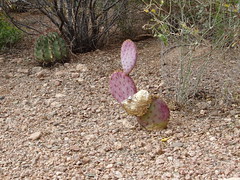
Rabbit-shaped Cactus
We're in Arizona for a few days and have been to the Desert Botanical Garden in Phoenix. It is one of my favorite places here, and I have been numerous times. We always see a variety of birds and small animals among the cacti and succulents and desert grasses. Sometimes, I only think I see a little animal.
November is a great time to visit this area, as the temperature is in the 70s. It is a little cool for swimming, but it is comfortable in shorts and a t-shirt. There also seem to be fewer tourists at this time, so it is easy to get dinner reservations and there are no crowds to fight.
November is a great time to visit this area, as the temperature is in the 70s. It is a little cool for swimming, but it is comfortable in shorts and a t-shirt. There also seem to be fewer tourists at this time, so it is easy to get dinner reservations and there are no crowds to fight.
Friday, November 24, 2006
The Neddiad by Daniel Pinkwater
You may know this already, but I just learned from NPR Books that Daniel Pinkwater will be publishing The Neddiad in April 2007. In the meantime, his original draft is being released a chapter at a time on Pinkwater's website. Chapter 18 published for Thanksgiving also has an audio version.
The Neddiad is the adventure of Ned Wentworthstein, who moves from Chicago to Los Angeles with his family so they can "eat in a hat." They ride cross country on the famous Super Chief train with a stop in Flagstaff. In Pinkwater tradition, it is a strange and humorous tale.
On the website, Pinkwater describes his writing process and uses terms that I had not read in a long time -"IBM clone computer." He also says that he has the book on two 3.5 inch floppies. He goes on to say that the hardcover will have slight changes and illustrations not seen on the web version. He hopes we will all buy copies. I am sure many libraries will.
The Neddiad is the adventure of Ned Wentworthstein, who moves from Chicago to Los Angeles with his family so they can "eat in a hat." They ride cross country on the famous Super Chief train with a stop in Flagstaff. In Pinkwater tradition, it is a strange and humorous tale.
On the website, Pinkwater describes his writing process and uses terms that I had not read in a long time -"IBM clone computer." He also says that he has the book on two 3.5 inch floppies. He goes on to say that the hardcover will have slight changes and illustrations not seen on the web version. He hopes we will all buy copies. I am sure many libraries will.
Thursday, November 23, 2006
Happy Thanksgiving
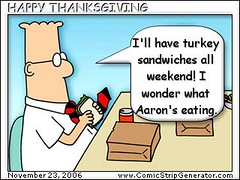
This Thanksgiving I am thankful for all the librarians I know in the Chicago area and throughout the blogosphere, whose help and friendship mean much to me.
I am thankful for now our being fully staffed in the adult services department at the Thomas Ford Memorial Library. There is a lot of excitement and potential.
I am also thankful for our new staff intranet wiki. Several of us have already said, "Why didn't we do this before?"
I have been looking for an opportunity to use the Comic Strip Generator.
Happy Thanksgiving to all!
I am thankful for now our being fully staffed in the adult services department at the Thomas Ford Memorial Library. There is a lot of excitement and potential.
I am also thankful for our new staff intranet wiki. Several of us have already said, "Why didn't we do this before?"
I have been looking for an opportunity to use the Comic Strip Generator.
Happy Thanksgiving to all!
Wednesday, November 22, 2006
I Didn't Know That I Huffed!
I am suddenly and briefly famous. A couple of weeks ago I had a phone interview with a reporter from the Associated Press, who had seen a Flickr photo of me cutting up my Macy's card. She said to watch around Thanksgiving to see if she used our conversation. Well, today it happened. If you search "rick roche" in Google News you will find the story repeated in many markets.
What the story does not tell is that Macy's sent me a card to replace my Marshall Field's card. At the bottom of the card, it said I had been a Macy's customer since 1981. I have never been in a Macy's store! I think the corporate bending of truth is what most bothers me about the affair.
A reporter tried to call me at the Downers Grove Public Library, which is not my workplace. DGPL staff told the reporter that I worked at Thomas Ford, but no call has come. The moment has passed. I am no longer famous.
What the story does not tell is that Macy's sent me a card to replace my Marshall Field's card. At the bottom of the card, it said I had been a Macy's customer since 1981. I have never been in a Macy's store! I think the corporate bending of truth is what most bothers me about the affair.
A reporter tried to call me at the Downers Grove Public Library, which is not my workplace. DGPL staff told the reporter that I worked at Thomas Ford, but no call has come. The moment has passed. I am no longer famous.
Thunderstruck by Erik Larson
Erik Larson has moved from the 1890s in The Devil in the White City to the 1900s and 1910s in his new book Thunderstruck, in which he mixes the stories of mild-mannered murder Hawley Harvey Crippen and young inventor Guglielmo Marconi. Both men immigrate to late Victorian/ early Edwardian London, where the newspapers of Fleet Street make them famous for very different reasons. Surprisingly, Crippen may be the man who is more likeable.
Erik Larson fans will not be disappointed by Thunderstruck. Structured much like The Devil in the White City, it moves back and forth in time and includes many historical details and many secondary characters. I particularly liked the descriptions of fantastic scientific demonstrations at the Royal Society and the building of large radio transmitters and receivers on isolated islands and rugged coasts. The story of the inspection of the Crippen house is also very detailed.
I listened to the book read by Bob Balaban, ten discs in four days. I did not want to stop.
Every librarian already knows to buy this book. I recommend reading it.
Larson, Erik. Thunderstruck. New York: Crown Publishers, 2006. ISBN 1400080665
10 compact discs. Westminster, MD: Books on Tape, 2006. ISBN 1415932794
Erik Larson fans will not be disappointed by Thunderstruck. Structured much like The Devil in the White City, it moves back and forth in time and includes many historical details and many secondary characters. I particularly liked the descriptions of fantastic scientific demonstrations at the Royal Society and the building of large radio transmitters and receivers on isolated islands and rugged coasts. The story of the inspection of the Crippen house is also very detailed.
I listened to the book read by Bob Balaban, ten discs in four days. I did not want to stop.
Every librarian already knows to buy this book. I recommend reading it.
Larson, Erik. Thunderstruck. New York: Crown Publishers, 2006. ISBN 1400080665
10 compact discs. Westminster, MD: Books on Tape, 2006. ISBN 1415932794
Tuesday, November 21, 2006
Library Goddesses: Garrulous Goddesses Generate Genuine Gems
The Librarian's Book Revoogle is growing. Every few days I get a lead or two or three for websites to add to the custom search engine. Today I added Library Goddesses. Thank you, Susan, for the lead.
I have no idea who the Library Goddesses are or even how many there are. They could be anywhere and everywhere. They are inviting other goddess (and even gentlemen) to join them. All the details are on their lead blog.
If you have not heard of the Library Goddesses before, do not be ashamed, for they are very new. Their archives only go back to October 2006. Despite their newness, however, they already have written many reviews for books in many categories. They review books for all ages and tastes in literature. Adding them to the search engine has certainly broadened the content of the Revoogle.
I am impressed by their organization and thrift. They have created a network of free Blogger blogs to distribute their reviews and have a companion wiki to post reading lists and serve as a message board. The Goddesses are very Library 2.0.
I have no idea who the Library Goddesses are or even how many there are. They could be anywhere and everywhere. They are inviting other goddess (and even gentlemen) to join them. All the details are on their lead blog.
If you have not heard of the Library Goddesses before, do not be ashamed, for they are very new. Their archives only go back to October 2006. Despite their newness, however, they already have written many reviews for books in many categories. They review books for all ages and tastes in literature. Adding them to the search engine has certainly broadened the content of the Revoogle.
I am impressed by their organization and thrift. They have created a network of free Blogger blogs to distribute their reviews and have a companion wiki to post reading lists and serve as a message board. The Goddesses are very Library 2.0.
Sunday, November 19, 2006
The Girls Who Went Away: The Hidden History of Women Who Surrendered Children for Adoption in the Decades Before Roe v. Wade by Ann Fessler

The Girls Who Went Away by Ann Fessler is an important book. Every public, college, and high school library should have a copy (or two) and consider it for book discussions. It should be added to core lists for collection development. It should be reviewed and displayed. It's that important.
Between the end of World War II and the Supreme Court decision of Roe v. Wade, there were approximately one and a half million adoptions in the
The unwed mothers have not forgotten their children. It is not normal for mothers to forget their children.
There is more to the story. Many of the young women had no sexual instruction and birth control advice before their pregnancies. Once they were hidden in maternity homes, they were given no birthing instruction. When labor began, some were sent in cabs to hospitals, where they admitted themselves and went through childbirth alone. Often they were sedated and woke to find their babies gone. Some never saw their children and were threatened with large medical bills if they did not sign the legal documents.
The women are not all in high school or college. The story of Linda I is particularly sad. She was a military nurse during the Vietnam war, who had many soldiers die in her arms. One of the survivors proposed marriage to her and she accepted. When she discovered she was pregnant, he confessed that he was already married. She was treated very badly, discharged, and gets no pension today.
The Girls Who Went Away is not just a book about a period of our history. Much of the book is about the present, as the mothers and children try to find each other. Fessler includes many reunion stories. In most of these families are reunited and extended joyfully, but in some misunderstanding and resentment remain. Fessler also tells about the large number of women who still have not found their children. Many suffer low self-esteem, alcoholism, drug abuse, and the inability to maintain relationships. Others have lived model lives trying to make up for their past failures. Many have still not come out of the "closet of shame."
The Girls Who Went Away is not a quick read. It includes the stories of eighteen birth mothers, each story being between five and fifteen pages. In nine chapters there are portions of interviews from forty-eight other women. Fessler also includes the story of her adoption and search for her mother. The book requires commitment to read, but it is hard to put down once you start.
Fessler, Ann. The Girls Who Went Away: The Hidden History of Women Who Surrendered Children for Adoption in the Decades Before Roe v. Wade.
Saturday, November 18, 2006
IM Shorthand for the Monty Python Fan Anniversary
ANFSCD.
It has been a year since I posted IM Shorthand for the Monty Python Fan. It is funny how a quick, spontaneous post has gotten more attention than most of my serious work. There is a lesson to be learned, as pointed out by In Praise of Slow Thinking by the Blue Skunk Blog. Humor helps us say what we want to say. In the case of IM Shorthand, I had nothing to say other than I am a member of the VSP and love Monty Python, but it helped break the ice so I could say other things on this blog.
BOYD. Of course, no piece in blogland is ever really dead. People continue to discover IM Shorthand. Every weekend someone discovers it and then alerts friends. Thank you, everyone.
The only piece I have written that has brought people together as much is Morton's Neuroma: A Librarian Looks at Consumer Health Resources. I did not expect this. (NETSI!) It now seems to get as many visitors as the IM Shorthand. Some of the visitors have been leaving their stories as comments. A couple of them may be marketing but it is hard to tell. A lot of people want to tell their stories to others who will understand. IGB, by the way.
It will be interesting seeing what the next year will bring.
ALOTBSOL!
It has been a year since I posted IM Shorthand for the Monty Python Fan. It is funny how a quick, spontaneous post has gotten more attention than most of my serious work. There is a lesson to be learned, as pointed out by In Praise of Slow Thinking by the Blue Skunk Blog. Humor helps us say what we want to say. In the case of IM Shorthand, I had nothing to say other than I am a member of the VSP and love Monty Python, but it helped break the ice so I could say other things on this blog.
BOYD. Of course, no piece in blogland is ever really dead. People continue to discover IM Shorthand. Every weekend someone discovers it and then alerts friends. Thank you, everyone.
The only piece I have written that has brought people together as much is Morton's Neuroma: A Librarian Looks at Consumer Health Resources. I did not expect this. (NETSI!) It now seems to get as many visitors as the IM Shorthand. Some of the visitors have been leaving their stories as comments. A couple of them may be marketing but it is hard to tell. A lot of people want to tell their stories to others who will understand. IGB, by the way.
It will be interesting seeing what the next year will bring.
ALOTBSOL!
Friday, November 17, 2006
Mountain Home: The Wilderness Poetry of Ancient China translated by David Hinton

Taking a little food, a light walking-stick,
I wander up to my home in quiet mystery,
the path along the streams wandering far away
onto ridgetops, no end to this wonder at
slow waters silent in their frozen beauty
and bamboo glistening at heart with frost,
cascades scattering a confusion of spray
and broad forests crowding distant cliffs.
from "Climbing Green-Cliff Mountain in Yung-Chia" by Hsieh Ling-yun (385-433)
I want to be there on the path looking down on the running streams and up at the green and rocky mountains.
Many of the poems in Mountain Home: The Wilderness Poetry of Ancient China translated by David Hinton make me feel this way. They paint beautiful pictures of what were remote places, far from the overcrowded cities, political corruption of government, and destruction of war. Reading a series of these poems is like examining a line of ancient paintings with little boats on lakes surrounded by peaks. Each tells a quiet story.
Nineteen poets ranging from 5th to 12th century China are profiled in this book. While some chose the wilderness life, others were political exiles. The poems themselves can be seen as a criticism of the prevailing way of Chinese life of the time, but the modern reader can only find hints of how spoiled the cities were. They instead get a poetic tour of the wilderness.
The modern reader may notice two things. First, the geography is not named for presidents or generals. Cold Mountain, Tremor Lake, Helmet Peak, and Three Gorges are typical names. Second, some titles are as descriptive as the poems themselves. I liked the title "Following the Trail Up from Deva-King Monastery to the Guesthouse Where My Friend Wang Chung-hsin and I Wrote Our Names on a Wall Fifty Years Ago, I Find the Names Still There" on page 244.
The modern reader wanting to forget Iraq, Enron, gang crime, and congressional scandal may find escape in these poems.
a thousand cliffs, ten thousand canyons,
I've wandered until I've explored them all,
from Climbing Mountains in Dream by Po Chu-i (772-826)
Don't you want to be there?
Mountain Home: The Wilderness Poetry of Ancient China, translated by David Hinton. New York: New Directions, 2005. ISBN 0811216241
Thursday, November 16, 2006
Man's Search for Meaning by Viktor E. Frankl
There is no one meaning to life. For each person it may be different and may change over time. The spiritually health, thoughtful person seeks meaning daily, according to Viktor Frankl in his book Man's Search for Meaning, a psychology classic in a new edition with a foreward by Harold S. Kushner.
The first half of the book describes Frankl's experiences in a series of concentration camps during World War II. He observes that secure, thoughtful people exhibited more ability to survive than the physically strong. He also describes how prisoners found ways to humanize their conditions. He claims that individuals are responsible for their own mental attitude and can find hope within themselves no matter what hardships they face. Doing so is necessary for survival.
The second part of the book is about logotherapy, Frankl's method of psychiatry. He explains that Freud emphasizes the past while he points to the future, asking clients what is the meaning of their continued existence.
While Man's Search for Meaning is a short book, it is better to read over the course of several days to give the message more time to become clearer.
Frankl, Viktor E. Man's Search for Meaning. Boston: Beacon Press, 2006. ISBN 0807014273
The first half of the book describes Frankl's experiences in a series of concentration camps during World War II. He observes that secure, thoughtful people exhibited more ability to survive than the physically strong. He also describes how prisoners found ways to humanize their conditions. He claims that individuals are responsible for their own mental attitude and can find hope within themselves no matter what hardships they face. Doing so is necessary for survival.
The second part of the book is about logotherapy, Frankl's method of psychiatry. He explains that Freud emphasizes the past while he points to the future, asking clients what is the meaning of their continued existence.
While Man's Search for Meaning is a short book, it is better to read over the course of several days to give the message more time to become clearer.
Frankl, Viktor E. Man's Search for Meaning. Boston: Beacon Press, 2006. ISBN 0807014273
Wednesday, November 15, 2006
At Truth-Expanse Monastery, in the Dharma Master's West Library by Wei Ying-wu
I found this library poem in Mountain Home: The Wilderness Poetry of Ancient China translated by David Hinton.
At Truth-Expanse Monastery, in the Dharma Master's West Library
At a thatch hut above riverside cliffs,
rapids far below: crystalline chimes
in vast river-and-mountains solitude.
Climbing in to such views means pure
confusion. I straggled up First-Origin,
then followed Well-Creek Trail back to
temple trees hissing in endless winds,
this river lit with regret turning dark.
Wei Ying-wu (c.737-792)
This rural library sounds like it has a spectacular view, and it must be nice hearing the chimes. I hope the thatch is well-maintained to keep the collection dry. The poet indicates that he never finds all the seats taken. I think the path to the library may need better signs. The poet senses a regret. Is it that the library is not more conveniently located?
At Truth-Expanse Monastery, in the Dharma Master's West Library
At a thatch hut above riverside cliffs,
rapids far below: crystalline chimes
in vast river-and-mountains solitude.
Climbing in to such views means pure
confusion. I straggled up First-Origin,
then followed Well-Creek Trail back to
temple trees hissing in endless winds,
this river lit with regret turning dark.
Wei Ying-wu (c.737-792)
This rural library sounds like it has a spectacular view, and it must be nice hearing the chimes. I hope the thatch is well-maintained to keep the collection dry. The poet indicates that he never finds all the seats taken. I think the path to the library may need better signs. The poet senses a regret. Is it that the library is not more conveniently located?
Tuesday, November 14, 2006
Metropolitan Library System Local History Special Interest Group
A new group met on Thursday, November 11, 2006. It is called the Metropolitan Library System Local History Special Interest Group. Fourteen people met at the Burr Ridge offices of MLS for two hours of discussions about collecting and managing local history collections.
First on the agenda were introductions. All the librarians spoke about their collections and challenges. Within the group were representatives from libraries with small, beginning local history collections and others with large, well-organized collections. All had some common problems of collecting, preserving, managing, and distributing materials. There is much interest in digitization and for finding ways to partner with local area historical societies.
Kathy Nicola of the Eisenhower Public Library District set up a Yahoo Group for local history librarians as a communication media for the group. Its URL is groups.yahoo.com/group/MLSLocalHistory/ and its membership is limited to library staff and volunteers who work with local history. She demonstrated how to sign up and sign in. Members have to have a Yahoo ID, which they can get with or without signing up for Yahoo email. As moderator for the Group, Kathy will approve the memberships.
Kathy went on to show the features of the Yahoo Group service. It has a couple of pages that can be seen by nonmembers, including information on the group and links of interest to local history and genealogy. Members can read the messages, post messages, load files or photos, add to the links or the databases, poll the other members, and edit the calendar. She asked members to add their real names to the Yahoo profiles to facilitate communications with other members. Members are also asked to post an introductory message if they have not.
The group decided to meet every other month, alternating between Tuesday afternoons and Thursday mornings to accommodate members’ schedules. Meetings will be held in members’ libraries and the Burr Ridge and
Tentatively, the next meeting will be January 16, 2007, at the
That was the business part of the meeting. During the course of the morning, much useful information was imparted.
Kathy reported that the Illinois State Historical Library will microfilm local newspapers for a nominal fee. The local library is responsible for collecting the newspapers to be sent to the state library. (Not everyone realized this. At my library we receive the Suburban Life microfilm from the state library without effort. Some other library must be collecting the papers.) Kathy promised to post further details on the Yahoo Group.
Mary Krekelburg of the Indian Prairie Library showed us the book Nearby History by David E. Kyvig, which she has found helpful.
Robert L. “Bob” Brubaker gave us publications about the Batavia Public Library local history collection. Bob worked for both the Illinois State Historical Society and the Chicago Historical Society libraries. He recommended that local libraries concentrate on what the local historical societies do not do, especially the providing of electronic databases with genealogy and local history resources. He also recommended the Midwest Archives Conference for learning about preservation.
Marilyn Oorbeck of the Riverside Public Library told about the Olmstead Society collection at her library.
Russ Parker of
Christy Eyre of the Brookfield Public Library is running genealogy classes.
Sunday, November 12, 2006
Books for National Hunger and Homelessness Awareness Week
This week is National Hunger and Homelessness Awareness Week. Unplanned as far as I know, the book discussion group at my church is reading Man's Search for Meaning by Viktor Frankl. In the Nazi concentration camps, the hunger was planned; it was a deliberate part of the prison experience; it was a tool of the governing power. As in Frankl's case, hunger is often not just a natural consequence of living. Wars, poor use of resources, and greed bring about hunger. Hunger is not an isolated condition but a part of societies that have gone bad politically, economically, and environmentally.
In addition to doing something concrete, like donating to hunger relief or working at a shelter, this would be a good week to read a book in which hunger, homelessness, and their root causes are discussed. Here are some of my suggestions:
The Working Poor: Invisible in America by David K. Shipler
Affluenza: The All-Consuming Epidemic by John de Graaf
Material World: A Global Family Portrait by Peter Menzel
Collapse: How Societies Choose to Fail or Succeed by Jared Diamond
White Man's Burden: Why the West's Efforts to Aid the Rest Have Done So Much Ill and So Little Good by William Easterly
I have a new book to seek out. At church today, we heard about Rich Christians in an Age of Hunger by Ronald J. Sider. There seem to be very few copies of this book in my area.
There are many books in our libraries. Book displays can be put together quickly.
In addition to doing something concrete, like donating to hunger relief or working at a shelter, this would be a good week to read a book in which hunger, homelessness, and their root causes are discussed. Here are some of my suggestions:
The Working Poor: Invisible in America by David K. Shipler
Affluenza: The All-Consuming Epidemic by John de Graaf
Material World: A Global Family Portrait by Peter Menzel
Collapse: How Societies Choose to Fail or Succeed by Jared Diamond
White Man's Burden: Why the West's Efforts to Aid the Rest Have Done So Much Ill and So Little Good by William Easterly
I have a new book to seek out. At church today, we heard about Rich Christians in an Age of Hunger by Ronald J. Sider. There seem to be very few copies of this book in my area.
There are many books in our libraries. Book displays can be put together quickly.
Saturday, November 11, 2006
Librarian's Book Revoogle
Many of us have a degree called a Master of Library Science. We call ourselves "librarians" and never call ourselves "scientists." Maybe we should think more about science, especially running experiments, making observations, and reporting our findings. In the interest of our science, we would report our failures as well as our successes.
I am sounding a little grand. The reality is I have been playing around with something that is not working the way I want it to work. Here is what I have done.
I have tried to make a search engine using the custom search engine tool from Google Co-op. My idea was to create a search engine to search across library and librarians' websites to find book reviews written by librarians for their libraries or on their blogs. In an attempt to be clever, I have called it Librarian's Book Revoogle.
The search engine does work, but not as well as I would like. It is of use to me to locate some of my own book reviews and some of the reviews by other librarians that I read, but it is not a tool I think many of you will use. Here are the shortcomings.
1. There is too little content. I have not found many libraries posting book reviews on their websites. Along the same lines, I have found very few librarians regularly posting book reviews to their blogs. At this moment, the search engine searches the following:
Nancy Pearl's Picks Archive
Nancy Pearl's Current Picks on the King County Library website
King County's Archive of Nancy Pearl's Fiction Picks
King County's Archive of Nancy Pearl's Nonfiction Picks
Reader's Club from the Public Library of Charlotte and Mecklenburg County
MADreads from the Madison Public Library
Memphis Reads from the Memphis Public Library
Maggie Reads
Nonfiction Reader's Anonymous
BookGirl (who I think is a librarian)
ricklibrarian (no link as you are already here)
Many of the other library websites that I have visited seem to post book news and reading lists, not actual reviews. I did not want to dilute the database with just one or two line statements.
I found very few librarians primarily writing reviews. In fact, my blog actually fails this test, as I seem to be writing about libraries more than writing reviews lately.
If you know of other reviews I could include, please comment on this page.
2. The results are cluttered by false hits. When I search for one of my own reviews I often get eight or more links. One is to the actual review. The rest are to the blog postings that have a link to the review in the "Recent Posts" sidebar.
It was an interesting experiment and I learned much about the websites I tested for inclusion. Perhaps that is the nature of experimentation - you learn something other than what you intended.
I wonder if a search engine for read-a-like lists would be useful. There is always something else to try.
I am sounding a little grand. The reality is I have been playing around with something that is not working the way I want it to work. Here is what I have done.
I have tried to make a search engine using the custom search engine tool from Google Co-op. My idea was to create a search engine to search across library and librarians' websites to find book reviews written by librarians for their libraries or on their blogs. In an attempt to be clever, I have called it Librarian's Book Revoogle.
The search engine does work, but not as well as I would like. It is of use to me to locate some of my own book reviews and some of the reviews by other librarians that I read, but it is not a tool I think many of you will use. Here are the shortcomings.
1. There is too little content. I have not found many libraries posting book reviews on their websites. Along the same lines, I have found very few librarians regularly posting book reviews to their blogs. At this moment, the search engine searches the following:
Nancy Pearl's Picks Archive
Nancy Pearl's Current Picks on the King County Library website
King County's Archive of Nancy Pearl's Fiction Picks
King County's Archive of Nancy Pearl's Nonfiction Picks
Reader's Club from the Public Library of Charlotte and Mecklenburg County
MADreads from the Madison Public Library
Memphis Reads from the Memphis Public Library
Maggie Reads
Nonfiction Reader's Anonymous
BookGirl (who I think is a librarian)
ricklibrarian (no link as you are already here)
Many of the other library websites that I have visited seem to post book news and reading lists, not actual reviews. I did not want to dilute the database with just one or two line statements.
I found very few librarians primarily writing reviews. In fact, my blog actually fails this test, as I seem to be writing about libraries more than writing reviews lately.
If you know of other reviews I could include, please comment on this page.
2. The results are cluttered by false hits. When I search for one of my own reviews I often get eight or more links. One is to the actual review. The rest are to the blog postings that have a link to the review in the "Recent Posts" sidebar.
It was an interesting experiment and I learned much about the websites I tested for inclusion. Perhaps that is the nature of experimentation - you learn something other than what you intended.
I wonder if a search engine for read-a-like lists would be useful. There is always something else to try.
Friday, November 10, 2006
New Stories from the South: The Year's Best , 2006
I have been eager to write about this book for days, but I held back until I finished it. The 2006 edition of New Stories from the South is the twenty-first in a series that Maggie of Maggie Reads tells me is a staple in Southern libraries. It includes twenty stories selected from U.S. magazines and literary journals by this year's editor Allan Gurganus. Some of the short story authors are well known, while others are young and working their first novels or story collections. I enjoyed most of the stories and now have some new authors to try.
I am going to risk making a broad statement that can be debated.
Short stories are to popular novels like independent and foreign films are to Hollywood movies.
Of course, the statement does not totally hold up, as short stories are shorter than novels, while films can be as long as movies, but I think the appeals are similar. Short stories often seem more inventive and daring than the novels you would find on best sellers lists. They are more intense and thought-provoking. I also think they are often more memorable.
The first story in New Stories from the South is one of my favorites from the collection. In "Yard Art" by Tony Earley, the former wife of a country singer calls a middle-aged plumber into her large and empty mansion to fix the toilet. Living in Nashville all his life, he has wanted to break into music, but he has never gotten past open mike bars. Among the few things still in the house after her husband took the furniture is a statue by deceased local artist William Edmondson. The wildly expensive piece was "the straw that broke the camel's back" in her marriage. The plumber thinks he knows where to find another rare piece by the sculptor.
The collection includes a really sweet story by Wendell Berry called "Mike," in which a man remembers his father's hunting dog. Of course, it is more about the father than the dog.
One of the most intense stories is "Tired Heart" by Keith Lee Morris, in which a cross-country move in a U-haul turns very strange.
"Tunneling to the Center of the Earth" by Kevin Wilson reminded me of the film Dear Wendy without the guns. There are young people without a sense direction literally going underground.
I found the story "Brief Encounters with Che Guevera" by Ben Fountain, which I read in a collection by the author earlier this year.
The book ends with "Jubilation, Florida" by N. M. Kelly, in which an act of infidelity ends very strangely.
Appended to the book is a list of all the stories in the previous twenty volumes in the series. There are many great authors in the list. Public libraries everywhere should have these books.
New Stories from the South: The Year's Best, 2006. Chapel Hill, North Carolina: Algonquin Books, 2006. ISBN 1565125312
I am going to risk making a broad statement that can be debated.
Short stories are to popular novels like independent and foreign films are to Hollywood movies.
Of course, the statement does not totally hold up, as short stories are shorter than novels, while films can be as long as movies, but I think the appeals are similar. Short stories often seem more inventive and daring than the novels you would find on best sellers lists. They are more intense and thought-provoking. I also think they are often more memorable.
The first story in New Stories from the South is one of my favorites from the collection. In "Yard Art" by Tony Earley, the former wife of a country singer calls a middle-aged plumber into her large and empty mansion to fix the toilet. Living in Nashville all his life, he has wanted to break into music, but he has never gotten past open mike bars. Among the few things still in the house after her husband took the furniture is a statue by deceased local artist William Edmondson. The wildly expensive piece was "the straw that broke the camel's back" in her marriage. The plumber thinks he knows where to find another rare piece by the sculptor.
The collection includes a really sweet story by Wendell Berry called "Mike," in which a man remembers his father's hunting dog. Of course, it is more about the father than the dog.
One of the most intense stories is "Tired Heart" by Keith Lee Morris, in which a cross-country move in a U-haul turns very strange.
"Tunneling to the Center of the Earth" by Kevin Wilson reminded me of the film Dear Wendy without the guns. There are young people without a sense direction literally going underground.
I found the story "Brief Encounters with Che Guevera" by Ben Fountain, which I read in a collection by the author earlier this year.
The book ends with "Jubilation, Florida" by N. M. Kelly, in which an act of infidelity ends very strangely.
Appended to the book is a list of all the stories in the previous twenty volumes in the series. There are many great authors in the list. Public libraries everywhere should have these books.
New Stories from the South: The Year's Best, 2006. Chapel Hill, North Carolina: Algonquin Books, 2006. ISBN 1565125312
Thursday, November 09, 2006
Old and Slow and Yet Still Working Well
Because I am old and slow, I am just now addressing an item that I read in the August issue of American Libraries. I do not remember seeing anyone else commenting on this. As a rule people blog about blogs and what is the print journals is not getting as much debate, it seems to me. Still, I keep thinking about the last two paragraphs of Joseph Janes' "Internet Librarian" column "At Arm's Length" on page 76 of that issue.
The next to the last paragraph:
"People who entered the profession some time ago started out thinking about using technology to connect to something - databases, catalogs, resources - and such early experiences often linger. The new kids, however, often began using computer tools to connect to each other. That will undoubtedly color and broaden their vision, and they will think of things differently than we of previous generations."
I think Janes is right, but I think there were signs of the using computer technology for communicating farther back than we sometimes recognize. I remember back in the mid-1970s having one of my Computer Science 301 classes at the University of Texas meet at one of the computing centers in the bowels of the UT Tower. We were there to see one of the grand applications of the university computer. I do not really remember what the point of the demonstration was. There was a large stack of punch cards set into a tray. When started, the cards were quickly fed through a reader and something was shown on a monochrome monitor. What I do remember is that before the demonstration the computer operator (a graduate student) had some preparations to make with another staff member in another building where another part of the computer resided. He typed on a keyboard and his words appeared on the monitor. Then a message from the other operator appeared. The two began to chat, told some jokes, and made an appointment for lunch. I was impressed. I had never seen anyone converse via computer!
I went into libraries instead of computer science and did not see anyone chatting online again for the next twenty years. Still, the idea of using technology for connecting to individuals was out there early.
Here is Jane's last paragraph:
"Of course, we oldsters, who are generally the ones running things, know that personal connections are important. Yet we're perhaps unable to envision how that might fit in an increasingly digitally mediated world. Maybe we should just get out of their way and let them do their thing ... but that's another story."
What does Janes mean by "get out of their way"? He only had an inch of column left and likes ending columns with open-ended thoughts. It can be taken several ways. First, it could just mean that "oldsters" should just remove barriers that are holding back youthful innovation. That is pretty easy to agree with. He could, however, mean really get out of the way, far away. Pass the reins, turn over the keys, leave the building, retire. To this, I say "No."
I attended Internet Librarian 2006 a few weeks ago and there were many "oldsters" there. They may have been more in the audience than in the team of presenters, but they were there taking notes, asking questions, and testifying to the glory of Library 2.0. They are partnering with their younger librarians and taking up the path instead of "getting out of the way."
Youth does not have a monopoly on good ideas for the use of technology. The "oldsters" should stick around for a while.
The next to the last paragraph:
"People who entered the profession some time ago started out thinking about using technology to connect to something - databases, catalogs, resources - and such early experiences often linger. The new kids, however, often began using computer tools to connect to each other. That will undoubtedly color and broaden their vision, and they will think of things differently than we of previous generations."
I think Janes is right, but I think there were signs of the using computer technology for communicating farther back than we sometimes recognize. I remember back in the mid-1970s having one of my Computer Science 301 classes at the University of Texas meet at one of the computing centers in the bowels of the UT Tower. We were there to see one of the grand applications of the university computer. I do not really remember what the point of the demonstration was. There was a large stack of punch cards set into a tray. When started, the cards were quickly fed through a reader and something was shown on a monochrome monitor. What I do remember is that before the demonstration the computer operator (a graduate student) had some preparations to make with another staff member in another building where another part of the computer resided. He typed on a keyboard and his words appeared on the monitor. Then a message from the other operator appeared. The two began to chat, told some jokes, and made an appointment for lunch. I was impressed. I had never seen anyone converse via computer!
I went into libraries instead of computer science and did not see anyone chatting online again for the next twenty years. Still, the idea of using technology for connecting to individuals was out there early.
Here is Jane's last paragraph:
"Of course, we oldsters, who are generally the ones running things, know that personal connections are important. Yet we're perhaps unable to envision how that might fit in an increasingly digitally mediated world. Maybe we should just get out of their way and let them do their thing ... but that's another story."
What does Janes mean by "get out of their way"? He only had an inch of column left and likes ending columns with open-ended thoughts. It can be taken several ways. First, it could just mean that "oldsters" should just remove barriers that are holding back youthful innovation. That is pretty easy to agree with. He could, however, mean really get out of the way, far away. Pass the reins, turn over the keys, leave the building, retire. To this, I say "No."
I attended Internet Librarian 2006 a few weeks ago and there were many "oldsters" there. They may have been more in the audience than in the team of presenters, but they were there taking notes, asking questions, and testifying to the glory of Library 2.0. They are partnering with their younger librarians and taking up the path instead of "getting out of the way."
Youth does not have a monopoly on good ideas for the use of technology. The "oldsters" should stick around for a while.
Subscribe to:
Posts (Atom)


