Monday, February 27, 2006

Rewrite and Reread

I rewrite in order to be reread. Andre Gide

I read this line in the poem "Mr. Dithers Explains It All to You" by David Kirby, which I found in the collection 180 More: Extraordinary Poems for Every Day. In the context of the poem it means that no worthy accomplishment comes without worthy effort. The French author Andre Gide revised his manuscripts before publishing his novels to perfect them, wanting them to please readers so much that they would be read and shared, even reread. I have not been able to actually verify the quote in our collection of quotation books at the library or through online sources, such as the Online Center for Gidian Studies, but it sounds true. Teachers have always told their students to write and rewrite, for once a work was published, it was set forever. Writers lost control of their works once they were published.

Walt Whitman never accepted the loss of control. He wrote and rewrote his collection of poems Leaves of Grass many times. The first time it was published it was a moderately small volume. The final edition was massive. There have been other examples of rewriting, such as John Fowles revising his novel The Magus, but it has not been common.

Writing and rewriting is still recommended, for writers do want to issue their best work, but the rules of control have changed with the Internet. It is easy to revise and expand anything on the Internet. All a writer has to do is reopen the document and edit the text.

Rewriting has a new connection to rereading. If you subscribe to blogs and other web content through email or an aggregator, such as Bloglines, you may have noticed some items reappearing in your inboxes, sometimes long after they first arrived. It was a mystery to me when I first noticed repeated entries. Now that I write I know why. If I go back to a blog entry and revise it, usually correcting a misspelled word or improving a sentence or updating with new information, I then repost the item. On my blog it stays in the same place, but it will reappear in Bloglines to those who have already viewed it.

So, my apologies to anyone who has been annoyed by finding my posts more than once. I am trying to get them right for the readers to come. Of course, you are welcome to reread.

Sunday, February 26, 2006

Vanishing Act by Art Wolfe

Bonnie brought home another cool book, Vanishing Act by Art Wolfe, who has a great name for a wildlife photographer. This recent collection of his photographs is many books in one:

1. Coffee table book - With its beautiful photographs, this oversize book would look good on any coffee table.

2. Puzzle book or amusement - Wolfe has intentionally made it a challenge to find the animal in each of the photographs. Children and adults can view it together, seeing who can find the hidden mammals, reptiles, birds, and fish first. Can you find the animals? Can you even find the captions or page numbers?

3. Practice book for animal spotting - The skills you learn finding animals in these photographs might help you on camera safari.

4. Introduction to animal behavior - The comments about the photographs in the back of the book tell much about the animals.

5. Model book for painters - The trees, leaves, bark, grasses, lichens, rocks, and shadows are as much the subjects of these photographs as the animals. How the subjects are positioned and the mix of colors will be very interesting to nature artists.

6. Lesson in photography - Amateur and professional photographers who study these photographs may learn how to break composition rules effectively. Wolfe also adds notes on the camera, lens, shutter speed, and film used in each shot.

My favorite photographs in Vanishing Act include the following:

1. Puff adder on page 16 - I nearly missed seeing the snake among the fallen leaves, blossoms, and mossy bits. Watch where you step!

2. Arctic fox on page 30 - Look behind the biggest rock.

3. Leopard on page 45 - Many people on camera safari never see a leopard. Now you know why.

4. Golden plover on page 59 - The bird is easy to miss in the golden landscape.

5. Giraffe on page 81 - How can an animal as big as a giraffe hide so well?

6. Red fox on page 112 - It is autumn in Minnesota.

7. Cheetah on page 122 - The cheetah is one of my favorite animals anyway.

8. Eurasian eagle owl with rufous treepie on page 123 - Who would expect these birds so close together? Maybe they are not really that close.

If I were independently wealthy, not living on a librarian's salary, I would buy copies of this book for all my friends. As it is, they will have to check it out at their libraries.

Wolfe, Art. Vanishing Act. Text by Barbara Sleeper. New York: Bulfinch Press, 2005. ISBN 0821257501

Saturday, February 25, 2006

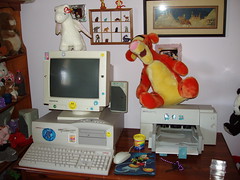
Compaq Presario with Magic and Tigger

We just got a new computer at home and have vouchers for recycling two items, like a PC and a monitor. We have two old PCs in the house. Perhaps the obvious choice to recycle is this Compaq Presario from 1996. With the other older PC being a Dell from 2001, this should not be an issue.

However, I have a sentimental attachment to the old Compaq. It was our first color computer - we had a pre-Windows computer with an amber on black text display before the Compaq. The Compaq has never had a problem and works as well today as it did when we got it ten years ago. It was never connected to the Internet, so it never got a virus. We can write letters, listen to music, and play games. I prefer it to the 2001 Dell for Hearts, Space Invaders, Scrabble, and such. It has also been very nicely decorated with stickers of Rainbow Fish, Winnie the Pooh and his friend Piglet, Blues Clues, and smiley faces.

The 2001 Dell is Internet ready should we set up a network and can play DVDs. It has more powerful office software and can do more with photos. It was been twice infected with viruses and often with spyware and takes ten minutes to start. I do get in some reading of books while waiting for some programs to respond. With more RAM and a thorough cleaning, it could be a better PC.

So, do we make a sentimental choice or a practical one? What do you think?

Friday, February 24, 2006

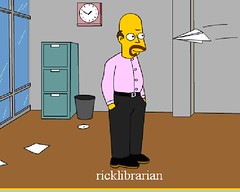
simpson ricklibrarian


Simpson ricklibrarian 2
Originally uploaded by ricklibrarian.
I'm getting balder all the time.

This is the first blogging I have done with our new computer. I thought it ought to be something special. I figured out how to move the DSL from one computer to another and it works. Yeah!

By the way, there is a Springfield Public Library Pool at Flickr.

Thursday, February 23, 2006

Gifts by Ursala K. Le Guin

It has been a long time since I read an Ursala K. Le Guin novel. I remember enjoying the first three Earthsea books (I have not read the others) and Left Hand of Darkness. In each of her books, Le Guin creates a world similar to ours in many ways but with some radically differences. Because of these twists, her books are labeled as fantasy. In Gifts, Orrec and Gry are teens maturing in a feudal society of uplanders and lowlanders that seems much like medieval Europe. Fighting between rural clans is at times fierce but is tempered by the distances between family domains. Without modern transportation and communication, encounters are few. Much effort has to be made to rob or attack the neighbors.

Orrec and Gry are expected to develop the powers of their parents. Gry is able to call animals to her, making her an able trainer of horses. She can also call game animals to hunters, but she feels this is a misuse of her gift, a betrayal of animal trust. Orrec is struggling with his feared gift of "unmaking." With a glance and the outstretching of his hand, he is supposed to be able to will the destruction of things, beasts, or people, but his control of the gift seems to have gone wild. Orrec voluntarily blindfolds himself to protect his loved ones from his anger.

What is interesting in Le Guin's works are the family relationships and the different ways that societies work. A main question is whether Orrec and Gry will do what their parents ask. The stories do not rely of the strangeness of situations to remain interesting. While aimed at teen reader, Gifts can be read and enjoyed by anyone.

Le Guin, Ursala. Gifts. Orlando, FL: Harcourt, Inc., 2004 ISBN 0152051236

6 compact disc. Prince Frederick, MD: Recorded Books, 2004. ISBN 1419332023

Wednesday, February 22, 2006

American Libraries Direct Readers Polled on Offering Tax Forms in the Public Library

Here is some news to follow up yesterday's post to this blog. If you got American Libraries Direct in your email today, you will see a goldenrod colored box (a kind of dark wheat color) asking for opinions. Today's question is "Should public libraries continue to serve as a distribution point for IRS forms?" As of 6:00 p.m., "yes" is running at 75 percent.

Tuesday, February 21, 2006

Death and Taxes at the Library: Stories of Service

As predictable as the pitchers and catchers arriving at spring training in Arizona and Florida is the arrival of citizens looking in the library for tax forms. Every February the stream increases, and we stock and restock the stacks of federal and state income tax forms often. Most of the people need no help, and we miss getting anything more statistically than a traffic count at our front door. It may appear to be a mundane event, hardly worth noting, but I pose that it is really quite important. There are very few places to get printed forms, the supply in the library has to be replenished often, and behind every person taking a tax form has a story. We get to hear some of them.
After a conversation last week, I really question how the IRS identifies its forms. An older woman came to the reference desk to ask whether she had the right forms. She was told by someone (family, friend, tax preparer?) to get 1040A and mentioned needing to list her interest and dividends. In her hands, she had the federal Form 1040A and the Schedule A/B that goes with the Form 1040. I explained to her that she would need a Schedule 1 for the Form 1040A if she wanted to file the Form 1040A, or she needed to have a Form 1040 to go with the Schedule A/B for the Form 1040. She also asked for a Form 1040A for Illinois, which does not exist, and asked for a form to list her interest and dividends for Illinois, which is not required. Has this got you confused? Just as I thought we had it all straight, she would say, "So, I still need to find a Schedule A to go with a Form 1040A?" or "So, do you have an Illinois 1040A?" We went through the forms again. As we were doing so, I was guessing that she has never done her own taxes and wondering if her life has changed in the past year. On several occasions I have had older people tell me that their spouses, who had recently died, had always done the taxes and the banking and they were having some trouble with all the new responsibilities. I often try to steer them to the local senior center that has volunteers to help in these cases.

When I think of the need we are serving, I am able to accept the stacks of forms on my work desk better. I also think about a strange conversation I had several years ago. A man who identified himself as a lawyer asked if we had any forms. I told him that we did and that he could take some if he wished. He snapped back at me that he could take all of them if he wished. He started lecturing me that the forms belonged to the federal government and that I had no right to limit their distribution. I pointed out that we were providing them for anyone in the community and were hoped that people only to take what they needed so there would be forms for others. He replied that if he wanted all the forms he would jolly well take them all and he was a lawyer and he might file a lawsuit against me and the library if we denied him any forms. Then he hung up. I never heard from him again, for which I am grateful. I never put all the forms out anymore. I have supplies around my desk is in reserve in case he or some other person decides to take everything on display, which has happened with some forms. (Isn't that a good tax season story?)

I am wondering if there is another story that I do not as yet know. One of our regulars at the library is a volunteer who helps seniors with their taxes. For years he has come in to use our Internet computers to take IRS online training, get IRS news, and ask us to help him with IRS laptops. We have spent much time troubleshooting technical problems with him. He always has a broad smile when he has another challenge for us. While writing this piece I realized that I can not remember the last time I saw him. I hope that he is okay.

I must admit that I will feel some relief when tax form season is over, for we can clear off the counters and desks that are now covered with forms and I will be able to move some boxes away from my desk. I do not, however, regret that we have the local tax form monopoly. Some libraries around us stopped carrying forms several years ago, saying they were not going to serve as lackeys of the IRS. They claimed that their work loads became too heavy and that taxpayers passed their bad feelings about the IRS on to the library. I have never experienced this at our friendly library. We see people we do not normally see and most seem very glad to find the only place in town that would carry tax forms. Making people happy is why we are here.

Monday, February 20, 2006

Time Was Soft There: A Paris Sojourn at Shakespeare & Co. by Jeremy Mercer

What do you do if you have written a true crime book using real names and subsequently are threatened with death by one of the named persons? You drop everything and flee to Paris with your meager saving, of course. You find a cheap place to stay, eat as little as possible, and wonder how you can work without French papers. Eventually, you have to do something to keep from starving. This was Jeremy Mercer's situation when he ducked into the famous bookstore Shakespeare and Company to get out of the rain. Had he looked up at the doorway, he would have read "Be not inhospitable to strangers lest they be angels in disguise" and not been surprised by the sudden invitation to the tea party upstairs.

Time was Soft There is Mercer's account of his lengthy stay among the books at Shakespeare and Company. It is as true as he can make it at this time, he claims. In his "Author's Note," he admits to reordering some of the events and changing a name. He also explains in the book that there have been two stores known as Shakespeare and Company. The first, which was started by Sylvia Beach and famous for the authors who visited in the 1920s, was shut down during the German occupation of Paris in World War II. George Whitman (not really the son of the poet Walt Whitman despite his hints) adopted the name for his store in the 1960s, a time when he was often under suspicion as a subversive. Thousands of writers and artists have lodged free of charge in his bookstore in its half century of existence.

It is not easy being George's angel. While he is very generous, he is eccentric and makes strange demands. Everyone is required to read a book of George's choosing every day. All the common guests (not the renowned visitors) carry book displays onto the porch in the morning and haul them in at night and do odd jobs around the store. They also run errands and gather food from dumpsters. Mercer is asked to expel another guest of whom George has tired; he wins George's favor by failing to do the task. Using his skills as a police beat journalist, he eventually discovers much about George's past.

Time Was Soft There is a quick read, filled with starving artists and misfits living together in a small space. I recommend it to memoir readers.

Mercer, Jeremy. Time Was Soft There: A Paris Sojourn at Shakespeare and Co. New York: St. Martin's Press, 2005. ISBN 0312347391

Saturday, February 18, 2006

Auschwitz Album: A Book Based Upon an Album Discovered by a Concentration Camp Survivor Lili Meier: Text by Peter Hellman

I became aware of The Auschwitz Album on Monday when I saw a small but emotionally moving exhibit at the Field Museum of Natural History in Chicago. The photographic exhibit displays dozens of the photographs that were found by Lili Jacob (her maiden name) in a vacated SS barrack being used as a hospital in April 1945. The photographs in the album showed the "welcoming" of Hungarian Jews to Auschwitz. Looking in the album, Jacob found her rabbi, members of her family, and herself. Feeling that she was destined to find this album, she kept and protected it through her journey back to her home town of Bilke and on to America.

What is remarkable about The Auschwitz Album is that there is no other photographic collection of the Jewish death camps. Scared of the reaction that might follow international knowledge of their genocidal activities, the Nazi command usually forbad photographs. So, why were these photographs taken? Peter Hellman speculates that the SS wanted to use them in propaganda showing how well the Jewish workers were treated. There had been some efforts to reassure authorities in other countries from which the trains came that no Jews was being mistreated. All but one photograph in the collection shows passive waiting, walking, and working. The people in the photographs mostly believed they were going to work in family camps. They still had some hope. Someone in the SS must have realized that the distribution of the photographs would not help the Nazi cause. Who would be reassured by images of hungry people with shaved heads being herded like cattle?

There have been several books of the collection published. The latest is a deluxe edition from Berghahn Books, list price $90.00, ISBN 9653081497. The Field Museum Store is selling it for $72.00 ($64.80 for members), less than Amazon, Barnes & Noble, and Baker & Taylor. It seems to be the only edition in print. I am surprised there is not a more affordable edition available, one that more museum visitors would buy and that libraries with tight budgets would consider.

Fortunately for readers, some libraries still have older editions. I read the most available edition, a 1981 Random House publication. Libraries that sometimes buy used books can easily get a good copy at a reasonable price from several of the online used book markets. Should you see a copy in your donations, keep it.

The Auschwitz Album: A Book Based Upon an Album Discovered by a Concentration Camp Survivor Lili Meier. Text by Peter Hellman. New York: Random House, 1981. ISBN 0394519329

Friday, February 17, 2006

Pinstripes Invading Blogosphere: Commercial Blogs, Execs' Journals Raise Suspicion by Greg Burns

I have been thinking about this article that appeared on the front page of the Chicago Tribune last Sunday. The author writes as though we should be surprised that corporations are making use of blogs as marketing tools, as though the world of the blogs could be kept pure for personal expression, community building, and the greater good. Why would corporations, which already have advertising for which they spend billions of dollars, turn to blogs that can often be free or inexpensive to transmit their messages? Why? Blogs are trendy and often noticed by the young, and it does not cost much for the profit-driven corporations to try their hands at blogging.

The author details two trends:

1. Corporate executives are blogging. At least they appear to be blogging. Donald Trump has a blog, as does Bob Lutz of General Motors. How much of the content really comes from the bigwigs themselves is questioned.

2. Corporations are creating blogs that appear to be the work of everyday people. Why this should be a surprise is beyond me. Look at television advertising. Much of it is testimonial, showing supposedly everyday people using and praising products. The sham is that these are people with no self-interest in saying what they are saying. Of course, most are actors. Advertising is persuasive fiction, and blogs can serve the needs of advertisers in the same way as the television commercial. These fake blogs are sometime called flogs.

Is there anything the blogging community can do? Yes and no.

1. No. We can not keep corporations away from blogs. One of our ideals is that the blogosphere belongs to everyone.

2. Yes. We can blog about the dishonesty we see. This is already happening. Many of the flogs have been exposed, embarrassing the corporations who funded them. (I wish that we could put an exposing public service announcement on television for each advertisement including a lie. Television would be much more interesting. Alas, corporations control television.)

Do you believe everything you read in a newspaper, magazine, or book? Do you believe everything you hear on radio or television? Blogs are no different. Question. Check your sources. Be skeptical.

Burns, Greg. "Pinstripes Invading Blogosphere: Commercial Blogs, Execs' Journals Raise Suspicion." Chicago Tribune. Sunday, February 12, 2006. Section 1, page 1.

Wednesday, February 15, 2006

Dancing Girls and Other Stories by Margaret Atwood

I am putting Margaret Atwood on my list of authors to read more frequently, along with Wendell Berry, Edwidge Danticat, William Faulkner, Muriel Spark, Eudora Welty, and Edith Wharton. I also have a less serious list from which I frequently read, which includes Margery Allingham (it is hard to find Campion books in bookstores these days), Jo Dereske, Tony Hillerman, Charlotte MacLeod, Alexander McCall Smith, John Mortimer, Ellis Peters, and P. G. Wodehouse. As long as I have these in reserve, I should never be without a reading goal and should always be able to find something good to read in any library.
Back to Margaret Atwood. In 2003 I read the cataclysmic novel Oryx and Crake, which belongs on reading lists with Brave New World and 1984. Now I have read something completely different, Dancing Girls and Other Stories, a collection of short stories penned between 1971 and 1977. Unlike Oryx and Crake, which takes place in environmentally disturbed future, most of the short stories in this collection are grounded in the middle years of the twentieth century. When Atwood describes the apartments, the clothes, and the attitudes, I remember those years. Her characters are often short on funds, love, and hope, and all face moments of decision. Should they stay in a town? Should they stay in a relationship?

I particularly liked "Betty," a remembrance of a couple of neighbors from a young women's childhood; meeting the woman years later, she is struck by Betty's changes, making her question her memory. "Hair Jewelry" was easy to visualize as the young woman visits places I have been - Filene's Basement in Boston and the waterfront in Salem; its final paragraph includes the thought "banality is after all the magic antidote for unrequited love." Atwood certainly gives the readers something to think about in "The Sin Eater." The book ends with a realistic story "Giving Birth." None of the stories is longer than 30 pages. They should be read over several days.

Margaret Atwood is a prolific author with novels, short stories, poetry, and essays. I won't be running out of reading any time soon.

Atwood, Margaret. Dancing Girls and Other Stories. New York: Simon and Schuster, 1977, 1982. ISBN 0671242490

Tuesday, February 14, 2006

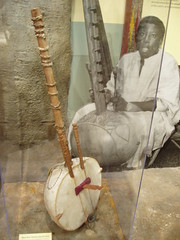
The Kora, a Stringed Instrument from Senegal


Kora
Originally uploaded by ricklibrarian.
In the hall on Africa in the Field Museum is a video of a traditional musician playing a kora. In the video, he grips the two shorter spindles and plays the strings very quickly with his thumbs. The sound is incredible. I would like to find someone to play the kora at a library program.

Looking at our SWAN catalog, I find that there is a CD with Foday Musa Suso playing kora on Orion by Philip Glass, Toumani Diabate plays kora on a Ali Farka Toure CD called In the Heart of the Moon, Yakuba Sissokoh plays a kora on Rain of Blessings Vajra Chants, and Ravi plays the instrument on The African Kora Journey of the Sunwalker. I do not know any of this music, but I have placed some holds.

As slow and clunky as it is, our SWAN catalog is still an incredible tool. I remember how little we could do with old card catalogs.

I've Been Tagged: Four Things

I have been tagged by Meredith of Information Wants to Be Free for the Four Things Meme.


I have looked up the word "meme" and still do not have a good handle on it. It appears that it has something to do with replication with modifications. Whatever, there is the Four Things Meme bouncing around library blogs. Bloggers answer the questions and then ask four other bloggers to answer the questions. It seems to be a good way to get to know other bloggers.


Four jobs I’ve had:

1. Disc jockey/radio announcer for a very small radio station in West Texas for $50 a week - the owner said I actually should be paying her for the experience I was gaining.


2. Wheelchair attendant helping students in wheelchairs get to classes at the University of Texas - they called me a "pusher."


3. Clerk in the school supplies section at the University Co-op in Austin - I sold 100-count packages of data punch cards to computer science students for 69 cents.


4. Desk assistant at the Howsen Branch of the Austin Public Library - I also got to help with the puppet shows.


Four movies I can (and do) watch over and over:

1. Lord of the Rings trilogy
2. Monty Python and the Holy Grail
3. all the Harry Potter movies
4. Mary Poppins (I still love this movie.)

I also want to mention Much Ado About Nothing and Field of Dreams and Room with a View and Amadeus.


Four places I’ve lived:

1. Big Lake, Texas - it does not look like the town shown in the movie The Rookie.
2. Austin, Texas - everything you hear is true.
3. Columbia, Missouri - I still have occasional Daniel Boone Regional Library dreams.
4. suburbs of Chicago - Riverdale (where I heard the trains day and night), Brookfield (with its wonderful zoo), Downers Grove (with its wonderful library)


Four TV shows I love:

1. Star Trek Next Generation
2. M*A*S*H
3. Masterpiece Theater and Mystery
4. Monty Python's Flying Circus


Four places I’ve vacationed:

1. Kenya and Tanzania twice (with wonderful friends)
2. Greece once (Bonnie and I riding the Greek buses with the Greeks)
3. Costa Rica once (with a Brookfield Zoo tour)
4. South Dakota once (with wonderful friends)


Four of my favorite dishes:

1. Carrot cake, which Bonnie makes for my birthday every year
2. Greek sampler at Greek Islands, which has all my favorite Greek items
3. Enchiladas, any kind
4. Raspberries from our yard

A lot of favorite foods are left out of this list, such as many of the pot luck items at our library luncheons. We may have the best food of any library on the planet. I wonder how this could be verified.


Four sites I visit daily:

1. Thomas Ford Library website
2. Bloglines
3. Writely
4. Flickr


Four places I would rather be right now:

I am really quite happy where I am, here at home with the PC, with a nice family, in a nice community. Still, I would enjoy being:
1. On the north rim of the Grand Canyon
2. In the first balcony in the Auditorium Theater in Chicago
3. In the Ngorongoro Crater in Tanzania early in the day before the middle of the day tour crowd arrives
4. In the stadium in Delphi with a slight breeze whispering through the evergreens


Four books (or series) I love:
1. The Lord of the Rings trilogy by J. R. R. Tolkien
2. No. 1 Ladies' Detective Agency series by Alexander McCall Smith
3. anything by Wendell Berry
4. anything by Muriel Spark


Four video games I can (and do) play over and over:

1. Hearts
2. Minesweeper
3. Tetras
4. nothing compares to the first three


Four bloggers I am tagging:
1. Aaron at Walking Paper (He was tagged before, but never responded.)
2. Jane (not really her name) at Wandering Eyre
3. Michael at Library Dust
4. Kelli at 'Brary Web Diva


47 by Walter Mosley

Walter Mosley has written an interesting novel. He mixes a very realistic account of slavery on a cotton plantation in the early part of the nineteenth century with elements of science fiction in his 2005 book 47 . While that sounds like a strange combination, it works well. The author uses the visitor from another time and place as an agent of change. Before his arrival the slaves have no ideas for challenging their status in a brutally unjust society.

47 is a fourteen year old slave whose mother died at his birth and whose father is unknown. He has always been called Baby Child, never getting a name of his own on a plantation where the master uses numbering to account for his slaves. He is designated as 47 when he is sent from duty in the barn to the cotton fields. His initiation is the branding of the numbers into his shoulder. The runaway slave Tall John then comes out of the woods with a mysterious yellow bag and a message for 47, "Neither nigger nor master be."

On his own website, the author has posted his Lecture on 47 which he delivered at the 2005 American Library Association Conference.

I enjoyed listen to 47 read by actor Ozzie Davis whose gravelly voice fits the story well. Most libraries seem to have the book in their teen collections, but I think many older readers will also enjoy this novel. The ending of the novel suggests that 47 may have future adventures. Watch the review journals.

Mosley, Walter. 47. New York: Little Brown, 2005. ISBN 0316110353.

5 compact discs edition. Random House Audio, 2005. ISBN 0307206629

Monday, February 13, 2006

Les Miserables: A Musical at Sterling High School in Sterling, Illinois

If you had asked me before this weekend, I would have said that Les Miserables would not be a musical for high schools to attempt. It needs lots of good voices who can sing for hours, as there is no dialogue to link songs. The music is itself tough. There are some recurring melodies, but I would think it would take much time and practice to memorize the lyrics. Of course, I am no singer. Maybe it is easier than I think. I doubt it.

So, I was very impressed by the performance of Les Miserables: School Edition at the Sterling High School in Sterling, Illinois. The leads had beautiful, strong voices, the chorus was good, and the pit band played well for nearly three hours with only one intermission. The costumes were very professional, and the set was well-built. The stage even had a hand-operated turntable, just like the production we saw at the Auditorium Theater in Chicago. The faculty and students in Sterling should be very proud of their production.

The choruses rendering of "Do You Hear the People Sing" was rousing, and the battle scene on the barricade was very sad. At the end, tears were slipping out of the corners of my eyes when Fantine and Eponine sing to the dying Jean Valjean. It is an emotional musical.

Les Miserables is based on the book by Victor Hugo, and reading the book does help you understand the musical. The size of the book may scare you, but that will not matter if you give it a chance and get into it. The story is great. Valjean and Javert are some of the great characters in literature. Reading Les Miserables may be the highlight of your reading year and you will remember the story for years.

If you do not know the music, check out the compact discs of Les Miserables: The Musical That Swept the World, a tenth anniversary concert at the Royal Albert Hall.

Also, wherever you are, go to you local high school's plays and musicals. You may be stunned by the talent and dedication.


Saturday, February 11, 2006

A True Story of Living in the Library

When I am the first one in the building or the last one out, I sometimes think that our library would be a nice place to live. I think a shower is the only missing necessity. I guess I could also use a bed, but I might just fall asleep reading books in the comfy chairs close to the fireplace.

I was surprised to find an article in the February issue of American Libraries by a woman who grew up actually living in libraries in New York City. How lucky can you be? She could wander around alone on Sundays and have family parties in banquet rooms! Please read "Mr. Mitchell and His 'Liberry' Girls" by Carolyn Mitchell Rhodes in American Libraries, February 2006, pages 30-31.

Slavery and the Making of America

Several of my reviews have involved books about slavery. It is not an issue that goes away. 140 years after it was declared illegal, we are still recovering from the harm it brought our country. The institution still survives in some third world countries, especially in the Sudan. Read Slave by Mende Nazer and Escape from Slavery by Francis Bok. Recently, news articles suggest that Asians have been enslaved to work for contractors at U.S. miltary bases in Iraq. We can not afford to forget and let down our guard.

It is in this light that I recommend viewing the four part PBS series Slavery and the Making of America, which follows the institution in the United States from its origins in early colonial days to the end of the nineteenth century. Viewers who have not studied the subject may be surprised to learn that all the states, including the northern states, had slavery at the time of the Revolution, and northern business interests supported the continuation of the institution in the South past the time it disappeared in the North. Slavery was a national problem, not a regional issue.

I was especially moved by episode three "Seeds of Destruction," which included the story of Harriet Jacobs, who hid in an attic for over a dozen years to escape the sexual advances of her owner and to allow her children to be free. All the episodes included dramatic reenactments, often in original locations. Noted historians provided comments. The series was narrated by actor Morgan Freeman.

PBS has an extensive website with information about the program and the topic.

Many libraries have the book on which the series was based. They should add the DVDs as well.

Slavery and the Making of America. New York: Ambrose Video, 2004.


Friday, February 10, 2006

Animals from Children's Books on Postage Stamps

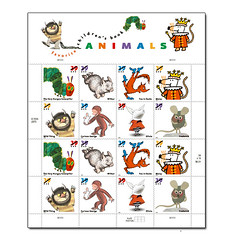
Bonnie brought home some neat postage stamps showing animals from popular children's books. There are eight different stamps on a sixteen stamp panel, all showing 39 cents, our new postal rate. They look really good, and I look forward to using them. I think the best looking stamps are the Hungry Caterpiller and the Wild Thing. My favorite as a character is Wilbur from Charlotte's Web.

I am not sure how these animals were chosen (I am sure there is an explanation somewhere), and I have no argument with them, but they are not my personal favorites. I have been thinking about the stamps celebrating children's books that I would like to have to put on my letters to friends, birthday cards to my family, and even payments of the water bill. Here's my own list.

1. George and Martha from the books by James Marshall - Who celebrates friendship better than George and Martha?

2. Frog and Toad from the books by Arnold Lobel - They are also great friends, and I am sure Chris and Judy would like a letter with them on the envelope.

3. Babar from the books by Jean du Brunhoff - Laura and I read a lot of Babar books and I never see the elephant without smiling.

4. Little Critter from books by Mercer Mayer - Who is cuter than Little Critter?

5. Max and Ruby from the books by Rosemary Wells - Max makes such a mess and Ruby always cleans him up.

6. Arthur from the books by Marc Tolan Brown - I bet the Postal Service could turn a profit on Arthur stamps. Every kid in America would want to write a letter to use this stamp.

7. Carl from the books by Alexandra Day - Who represents the love of pets better than Carl?

8. The sheep from Sheep in a Jeep by Nancy Shaw - I laughed so hard when I read this book aloud for the first time.

Who would you like to see on a stamp? There are many worthy candidates.

Thursday, February 09, 2006

Lone Surfer of Montana, Kansas: Stories by Davy Rothbart

If you like short stories about people down on their luck, mostly because they have absolutely no idea of how to cope with life, I have the book for you. You should read The Lone Surfer of Montana, Kansas by Davy Rothbart. I think every story has a connection to prison. The characters are either in or just out of prison or, if they are young, their parents are in prison. They are all adrift. The young men are all hopelessly in love with women who flirted with them but have no long time interests. Many of the central characters are beaten up at some point in the story. Violence is random. No one can hold a job. Rothbart's universe is very bleak.

I did not plan to read this book right after seeing the movies Walk the Line and Capote, but it is a good follow-up. The book is well-written, and I think I will remember the stories for a long time. Filled with strong language, they are not for easily offended readers. The stories could be read as cautionary tales: "Do not live like this."

Rothbart, Davy. The Lone Surfer of Montana, Kansas: Stories. New York: Simon & Schuster, 2005. ISBN 0743263057

Tuesday, February 07, 2006

I Feel Like I've Been Cleesed: A Reference Interview Gone Wacky

My strangest reference interview of the afternoon (of the week, of the month) was right out of Monty Python. One of the reasons many people love the old comedy show so much is it shows life through a slightly warped lens, but only slightly warped. There is more truth behind each silly Python situation that some people admit. Yesterday's experience reminds me of interview skits with John Cleese. Cleese invariably turns away from his interviewees to yell at other characters, many of which are imaginary. Michael Palin or Eric Idle sit in shock and bewilderment, uncertain what to do.

Here is what happened with no names or identifying references. A woman called the library to request that we check our shelves for an item. I had trouble understanding her. Her voice was fuzzy and there were loud children's voices in the background. I think she was in a kitchen on a speaker phone. I had to ask her twice the title of the item. Just as I understood, she yelled, "Leave him alone! I told you to leave him alone!" I identified the item in the catalog and told her I was going to check the shelf.

When I got back to the phone, she was gone. Then the phone rang. "We got disconnected," she said. "Nicky! Put that down!"

"I have (library item)," I replied. "Can I put it at the Checkout Desk for you?"

(Loudly) "What did I tell you, young man?" (Less loudly - slightly) "Yes, how do I get to your library?"

"From where are you coming?" (Notice the "from" is not at the end of the sentence. I'm proud of that.)

"(Name of another suburb)," she said. (More loudly) "Now you've done it!" (Slightly less loudly) "Wait a minute!"

At this point she left the phone. I heard what could have been chairs moving across a kitchen floor and bowling balls being dropped. The sound of the woman lecturing a child or children faded in and out. I wondered how long I should wait. Her voice started getting closer. Then I heard her say, "How did you get in there? Come out of there!" Her voice faded away again. A child's voice got closer. Then I heard, "Don't touch that!"

"Hello?" I said, hoping I could be heard, if it was a speaker phone. "Hello-oh!"

"How do I get to your library?" she snapped.

I tried to give her directions. Though they only involved two turns on two major streets, I had to repeat them three times, because she kept speaking to the children while I spoke.

"Wait till your father gets home! Did you say you're on a corner? I'm angry now! You just wait! What corner was that again?"

I described the corner and the library, she scolded the child and asked me our closing time, and, finally, the interview ended. I noticed how quiet it was in the library.

Note that the library user did get what she requested, if she was able follow the directions to the library.

I wish I had it all on tape. It was as good as calling Python for some verbal abuse. I was cleesed!

Seriously, while this is funny, it is also disturbing. The woman needs parenting counselling.


In the Company of Cheerful Ladies by Alexander McCall Smith

Mma Ramotswe and J.L.B. Matekoni face some pretty big challenges in In the Company of Cheerful Ladies, the sixth book in Alexander McCall Smith's popular No. 1 Ladies' Detective Agency series. A visitor who knows about Ramotswe's past threatens to reveal a mistake she has made, which could harm her reputation and livelihood. To complicate matters, Mma bumps a bicyclist with her beloved minivan. Will her lack of attention while driving lead to a lawsuit? Meanwhile, Matekoni learns that the tenants of his old house are breaking the law, and one of his apprentice mechanics quits the Tlokweng Road Speedy Motors after a dispute over a teapot. As the couple's troubles multiply, even their adopted children begin to believe their happiness will soon end.

Not all of the problems are solved by the end of the book. This has happened before in the series. In these books, as in life, we set aside some of our troubles for another day, a time when we may have inspiration for better solutions. Mma Ramotswe does not rush anything. It is not the Botswanan way. It also links the books in the series.

While reading these books, I find many passages that speak to me. I particularly liked the thoughts on page 163:

"There was no doubt in Mma Ramotswe's mind that Botswana had to get back to the values which had always sustained the country and which had made it by far the best country in Africa. There were many of these values, including respect for age - for the grandmothers who knew so much and had seen so much hardship - and respect for those who were traditionally built. It was all very well being a modern society, but the advent of prosperity and the growth of the towns was a poisoned cup from which one should drink with the greatest caution. One might have all the things which the modern world offered, but what was the use of these if they destroyed all that gave you strength and courage and pride in yourself and your country?"

I think that should speak to all of us.

Alexander McCall Smith is a unique force in current literature. I can not think of anyone who is juggling so many series so well. Are McCall Smith read-a-likes being produced? I have not seen them. I await more of his books.

McCall Smith, Alexander. In the Company of Cheerful Ladies. New York: Pantheon Books, 2004. ISBN 0375422714


Friday, February 03, 2006

Chicago in Maps 1612 to 2002 by Robert A. Holland

Chicago in Maps is the fifth book in a series by Rizzoli. Like Manhattan in Maps and Washington in Maps , it reproduces historical maps held by libraries and archives, such as the Newberry Library and the Chicago Historical Society, and collects them with brief accounts of the history they represent.

Chicago in Maps can be read front to back, as I did, to get a sense of the story of the city. The early maps were drawn by French explorers and missionaries seeking routes through the area to establish trade routes to China. Objectives soon changed to finding routes for the fur trade and commerce with New Orleans. Chicago, with its short but sometimes difficult portage from the Chicago River, which feeds into Lake Michigan, to the Des Plaines River, which flows ultimately into the Mississippi River, was soon identified as a strategic location. The maps that follow show the growth of a small trading post into a large city.

Chicago in Maps will be used more as a reference book than a book to read. The maps in this book show how rail lines entered the city, where the cable cars ran, how far the 1871 fire spread, and how Daniel Burnham wanted to change the city with his 1909 plan. Some of the most interesting maps are ones showing the underground tunnels in the city center, the layout of Graceland Cemetery with its many famous graves and monuments, the grounds of two world's fairs, the vast territory of the Union Stock Yards (can you imagine the smell?), and the distribution of ethnic groups in the neighborhoods.

Bonnie said, and I agree, that it would have been better if pages of this book were larger or folding maps were included, as the maps are sometimes too small to read street names and other details. Still, the book is attractive and useful. I recommend it to all libraries collecting Chicago history.

Holland, Robert A. Chicago in Maps, 1612 to 2002. New York: Rizzoli, 2005. ISBN 0847827437

Wednesday, February 01, 2006

Email Reference is Up at Thomas Ford

January was a busy month at the Thomas Ford reference desk, as we had our second highest count of reference transactions ever. Most of the count is still people coming to the desk to ask us for help or calling us on the telephone. Our Internet-based reference did well as well.

The trend I see that surprises me is email reference. For years we have been touting that we would answer reference questions by email, but we rarely were asked. Into 2003, it was so rare to get an email question, that I did not even track them as such. That fall I noticed our email was picking up so I started counting.

In 2004 we had 164 email reference question. In 2005 we had 293. In January 2006 our one month total for email was 61 questions!

If you follow conversations in virtual library circles, you often hear that email is dead. That is not what I am seeing. There is a portion of the library public that follows pretty far behind the cutting edge of technology. With them, email is just now coming in to its own.

The questions vary from easy to involved. Some of our clients are asking if we can identify books and reserve them. Some want to know about community events or local history. A few want help with their academic research. Many are asking for obituaries.

At Thomas Ford, we are trying to get the questions any way we can. Our instant message reference is steady, but it could be bigger if we monitored IM more of the time. Our virtual reference count is slipping, but we are about to be absorbed by the new State of Illinois virtual plan; I have no idea whether that will be the kiss of death or revive the service. Whatever, email will hang in there as a part of our plan.

Tuesday, January 31, 2006

Bonnie with Tolkien's Desk


Bonnie with Tolkien's Desk
Originally uploaded by ricklibrarian.
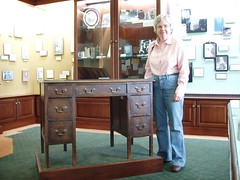
We took a quick trip to Wheaton College today, where you can see Tolkien's desk and Lewis's wardrobe. I was struck by how small Tolkien's desk is. He wrote, typed, and illustrated the Hobbit on this desk. He worked on the Lord of the Rings at it, as well. I can hardly imagine getting my knees under it. Lewis's wardrobe seems huge in contrast. They even let you open the wardrobe!

A Crack in the Edge of the World: America and the Great California Earthquake of 1906 by Simon Winchester

I finished A Crack in the Edge of the World by Simon Winchester yesterday. I enjoyed reading this account of the earthquake that struck San Francisco 100 years ago, but as soon as I finished I felt disappointment. It had been filled with interesting information, but something was missing. Having read the author's book Krakatoa, I expected more about the people involved.

In Krakatoa, Winchester wove into the scientific and historical accounts the stories of individuals on the islands and the ships near the great volcano. He told of their actions before, during, and, if they survived, after the event. In A Crack in the Edge of the World, he introduced five people in the Prologue. I expected that I would read more of their stories, but they were only briefly mentioned later in the book. Other individuals are introduced later in the account, but the author does not enlist any of them as recurring narrators as he did in the previous book.

I do understand much more about the San Andreas Fault and plate tectonics, and I enjoyed the brief accounts of the Lisbon, Charleston, and New Madrid earthquakes. The book succeeded more as science than history. It will not be as good a discussion book as Krakatoa or Erik Larson's Isaac's Storm.

If you wish to know more about the San Francisco Earthquake, go to the Bancroft Library's special website. Thanks to Sarah at Librarian in Black for the tip.

Winchester, Simon. A Crack in the Edge of the World: America and the Great California Earthquake of 1906. New York: Harper Collins, 2005. ISBN 0060571993

Monday, January 30, 2006

Fiction Alert: Under the Greenwood Tree by Thomas Hardy

I just received notice from one of our speakers that Masterpiece Theater will be showing a new production of Under the Greenwood Tree by Thomas Hardy in late April. I am pretty familiar with English literature, but I do not remember hearing of this novel before now. Bonnie Hilton, who will be doing a program about Hardy and the book for my library, says that it is a lesser known book. Because Hardy wrote it in the vernacular, she says, it is a tougher read.

I looked in our SWAN catalog to see if we own the book. We do not, as most of our libraries do not. In the seventy plus libraries in the consortium, there are nine copies of the novel, seven of which have a 1949 copyright. There are also two Oxford University Press editions from 1985 and 1999. Our libraries are not very ready for the requests that will accompany the showing of the one episode production.

Most of the booksellers also seem unprepared. Perhaps it is still early. Baker and Taylor has no stock of any of edition. Amazon says that the $4.95 paperback from Oxford ships in one to three weeks and that a Penguin edition that lists at $10.54 (that's what it says) ships in two to five weeks. Barnes and Noble says it has a Penguin edition (ISBN 0140435530) that ships in 24 hours. The PBS store does not seem to have any edition on its website; the PBS catalogue we received in today's mail did not offer the title either.

Looking at the webpages with discussion questions for Under the Greenwood Tree, I found an image of a Penguin edition with a Masterpiece Theater logo, with no bibliographic data. The Penguin website does not have this image, but does indicate that the 1999 edition (ISBN 0140435530 again) is still available. Perhaps it is getting a new cover.

So, what did I do? I ordered from Baker & Taylor one copy of the 1999 Oxford paperback, which it indicates some other libraries are back ordering. I also placed an order for two copies of the Penguin edition, for which Baker & Taylor has a listing but no inventory information, which I suspect is the official edition. With discounts, I have just spent about $16.00.

Friday, January 27, 2006

Favorite Places in the Library

I often wish that we could get more people just to wander through the bookshelves and look at the books around them. I am sure if more took time to look around, they would find more books and borrow more books and read more books and come back for more books. In the past, I have thought that a video of a well-spoken reader describing his trip through the bookshelves, holding out the favorites he finds, might inspire more browsing.

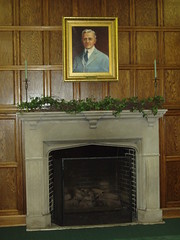
With similar intent, here is a slideshow of some of my favorite places in the library.


The painting above the mantel is Thomas Ford, the man after which our library is named. The books are on shelves in various locations in library.

Taking photos of books on shelves is not as easy as it looks. In narrow aisles, the flash can wash out the books, especially those in plastic covers. I am still trying to perfect my methods.

Update: It appears that most aggregators do not show the slide show. It does work on the blog.

TV a-Go-Go: Rock on TV from American Bandstand to American Idol by Jake Austen

There is a lot learn from reading TV a-Go-Go by Jake Austen:

  • How Bo Diddley introduced rock and roll to national television on The Ed Sullivan Show
  • How Dick Clark made so much money running American Bandstand, even after testifying to Congress
  • Why lip synching is not so bad
  • Why The Monkees succeeded while other made-for-TV rock series failed (though The Partridge Family did pretty well)
  • How the Archies got the song "Sugar Sugar"
  • Which musicians got their own weekly shows in the 1970s
  • How MTV started and grew
  • How Making the Band and American Idol began

Austen includes stories for young and old, and ends with an entire chapter devoted to the story of Michael Jackson and television. While documenting the history of rock music on television, the author also states his opinions without reservation. TV a-Go-Go is interesting reading for television and music fans.

Reference librarians will like the inclusion of a lengthy index and a thirteen page bibliography. Appendix 2 has reviews for television episodes the author wishes every one could see again, including Mister Rogers' Neighborhood episode 1509 with blues musician Otha Turner.

Not many libraries have this book yet. It is a good addition to a television history collection.

Austen, Jake. TV a-Go-Go: Rock on TV from American Bandstand to American Idol. Chicago: Chicago Review Press, 2005. ISBN 1556525729

Thursday, January 26, 2006

Flaubert's Parrot by Julian Barnes

Books are where things are explained to you; life is where things aren't. Books make sense of life. The only problem is that the lives they make sense of are other people's lives, never your own. In Flaubert's Parrot by Julian Barnes, p 168

With all the news about highly fictionalized biographies and memoirs in the news, it is interesting to find a book posing as fiction that could with a few changes be considered for the library's reference collection. The book is Flaubert's Parrot by the British author Julian Barnes, which includes much about Gustave Flabert, 1821-1880, author of Madame Bovary. The book includes several chronologies of Flaubert's life, a bestiary regarding the animals in his life and writings, profiles of his friends, family, and lovers, and even a mock exam to give to Flaubert students. There are many quotable passages taken from Flaubert, and much is said about the parrot.

Readers have to be patient to find the storyline. Geoffrey Braithwaite, a doctor obsessed with Flaubert, is the amateur assembling all this reference material. It is what he does to keep from despairing over the death of his unfaithful wife. It takes him on many trips to France.

Julian Barnes has taken a very unconventional approach in writing Flaubert's Parrot, but it works. I now want to know more. I might even try again to read Madame Bovary.

Barnes, Julian. Flaubert's Parrot. New York: Alfred A. Knopf, 1985. ISBN 039454272x

Wednesday, January 25, 2006

North Carolina State Catalog

Our SWAN Catalog in the southern and western suburbs of Chicago has had lots of problems lately. The most recent software release from Innovative Interfaces came with some serious bugs that had to be fixed with a series of patches. I was a bit surprised, as III has given us a pretty good system for a number of years, but it may be time to search for other alternatives, as SWAN seems old-fashioned and slow. At least, that's my reference librarian's perspective.

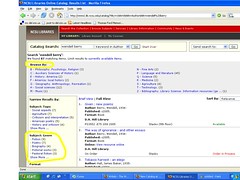
A lot of praise is being given to the new catalog at North Carolina State University (http://www.lib.ncsu.edu/catalog/). I have played around with it and am impressed. I did a search for items by Wendell Berry, one of my favorite authors. Look at the "Browse by" area of the screen shot. (Click on the photo to get a bigger image.) All the books by this prolific author have been divided in to LC categories. I assume this could be changed for public libraries to Dewey groups. Even better is the side column, where Berry's books are divided into fiction, poetry, biography, and so forth.

I also tried a keyword search for "depression," a word that can have many meanings, to see the results. In the "Browse by" area were many discipline selections that could help the user narrow her focus. Along the side were recommended refinements to subjects "depression mental" and "economic conditions," as well as genre choices "biography," "fiction," and "popular works."

I like the look, but I am not sure how the average library user in the public library would react. Of course, the problem is there is no average library user. The web savey users would probably appreciate it. Our less computer literate users would bemoan more change. What's a librarian to do? Study and make wise changes. They won't please everyone.

Tuesday, January 24, 2006

Library Thing: The Personal Libraries of Librarians Catalogued Online

As a reference librarian in a public library connected to many other public libraries through a shared catalog, I hardly need to buy any books myself. I borrow rather than buy. I only purchase books that I think my libraries will not buy or books I want to use regularly or books I really love. I sometimes get books as gifts, but I only keep them if I really really want them. After I have read them, most find their way in to public library collections or the library friends' book sale. So, it was interesting creating my own catalog using Library Thing . I see things about myself I had not realized.

I have created a sixty-two item catalog, which is small enough to fall in the free category. People cataloguing 200 or more books are required to pay $10 per year or $25 for a lifetime membership. My catalog, which barely gets onto a fourth page, only took me a few days to create, adding 4 or 5 books at a time when I had time. Most books were easy to enter, as Library Thing pulled the bibliographic information from Amazon. I just entered the ISBN numbers and the records popped up. I also found several of the items by entering title or author. I see now that I could have set the service to search the Library of Congress instead of Amazon; if I had, I might not have had to catalog two older books from scatch. I also edited a few of the records to complete publication data and make my title list display alphabetically; Library Thing does not know to ignore "a" and "the" when alphabetizing.

While adding the items, I also added tags. There is no authority for the tags, so I sometimes added variations to make the items more findable. My bird books got the tags "birding," "birdwatching," and "birds." I also tagged one "bird behavior." Now anyone can search my collection by tags and also search across the pool of catalogs to see what other readers own. You can easily see what are the most popular subjects in my collection by looking at my tag cloud .

While adding items, I also rated them up to five stars. Most of my books get four or five stars. I have no desire to keep anything I would assign fewer stars.

Users of the Library Thing service can add reviews to their book records, I added only two so far, as I have been writing reviews about library books I borrow more than books I own.

From each record you can see how many other people own a title. If you click on the faceless person icon over to the right above the number of owners, you can see the screen names of the other people, their ratings, and their tags for the book. I do not know what it says about me, but forty of my sixty-two books are not owned by other participants.

From looking at my collection you might think our house has few books, but it is not so. Bonnie and Laura have books, and there are books that belong to the whole family that I did not list. My library does not stand alone at home or on Library Thing.

I know of two other blogging librarians using Library Thing. Michael Stephens has tested the service. Jessamyn West has catalogued 364 of her books. If you search users for the word librarian, you get 51 screen names, but many link to accounts that have not actually entered any books. SilverLibrarian has a nice collection mixing children's and adult books.

Have you catalogued your books using Library Thing or other online service? If so, leave a comment so we can see.


Saturday, January 21, 2006

Kathyrn and John Atwood at Friday at the Ford

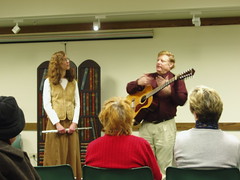
Twenty-one people braved the impending winter storm to attend our Friday at the Ford concert yesterday. Our performers were Kathryn and John Atwood, who sang songs heard at coffeehouses during the 1960s. My favorites of the night were "Mr. Tambourine Man," "Big Yellow Taxi," "You've Got to Hide Your Love Away," "North Country Maid," "5D," and "Song for a Seagull." Also, Paul Simon's "America." The couple would like to take their performance/lectures to other libraries. Contact information is on their website www.historysingers.com.

Forever Young: Photographs of Bob Dylan by Douglas R. Gilbert

It was 1964. Douglas R. Gilbert had just graduated from Michigan State University and started working for Look, a very popular magazine that featured photographic essays on current events and society, when he pitched the idea of photographing Bob Dylan. Dylan had several albums out, but was not really well-known by the general public. Columbia Records was releasing another album soon and approved the idea. Dylan was receptive, so Gilbert spent nine or ten days shadowing the singer/songwriter in and around Woodstock (before it was famous), New York City, and Newport, Rhode Island, site of an annual folk festival. The result was many photographs of Dylan at writing, performing with Joan Baez, and socializing with friends, like John Sebastian and Allen Ginsberg. (I did not recognize Sebastian without his glasses and with shorter hair.)

Look never ran the photos. Gilbert was told that Dylan looked too scruffy. He also heard later that the advertising department wanted the essay canned. Looking at the photos now, Dylan looks relatively fresh-faced and at times almost sweet. I would think the tobacco advertisers would have liked the photos, many of which show him smoking. Gilbert kept the photos safe until 2004, when he learned that he owned their copyright.

2005 was a great time to publish Forever Young: Photographs of Bob Dylan , as it is a good companion piece to the film No Direction Home by Martin Scorsese. Along with photos is a text by long time rock music critic Dave Marsh that tells about Dylan's early years and Gilbert's photographic efforts. Forever Young takes only an hour or two to read. I recommend it to music fans.

Gilbert, Douglas R. Forever Young: Photographs of Bob Dylan. Cambridge, Massachusetts: Da Capo Press, 2005. ISBN 0306814811


Friday, January 20, 2006

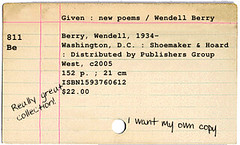
Old Catalog Card for a New Book


cardimg.php
Originally uploaded by ricklibrarian.
The Ann Arbor Public Library has put an fun feature onto its computer catalog. (Do you ever think of catalogs as fun? Do you think vendors of library catalogs ever think of fun? Isn't it time to loosen up?) I wish we had this on SWAN.

Go to http://www.aadl.org/catalog and search for a book. On the record, right under "Request This Title," is a link "Card Catalog Image." Click that link and you get an image of an old fashioned catalog card. You can even scribble comments onto the card. Then you can save the image and do whatever you want with it.

It appears that the next person to go to that card in the catalog, will see your comments.

If you want to know how Ann Arbor created this tool, go to http://www.blyberg.net/2006/01/19/creating-a-virtual-card-catalog/

Thanks, Aaron, for the tip.

Should A Million Little Pieces Be Moved to Fiction?

Should A Million Little Pieces by James Frey , which has been exposed as a very fictionalized account of the author's youth, be moved from nonfiction to fiction in library collections? My first inclination is to say "yes," but when I stop to think, I realize that there is more to be considered than truth and falsehood when dealing with nonfiction. (This is not really a new topic but a continuing issue which is probably not debated as much as it should be.)

The situation reminds me of the debate over The Education of Little Tree by Forrest Carter . When first published in 1976, the book was presented as autobiography, though no one knew who Forrest Carter was. Some questions were raised right away, but the real debate began in 1991, when the New York Times, Newsweek, and Time identified the real author as Asa Earl Carter, a segregationist and former speech writer for George Wallace, and Carter was accused of being a former member of the Ku Klux Klan. Of course, these revelations really had nothing to do with the story. Carter's widow insisted that his grandparents were Cherokee and that he had not gone beyond the lines of literary license. (Masterplots II: Juvenile and Young Adult Biography Series)

Looking at the SWAN Catalog of the Metropolitan Library System , I see four responses by librarians to this debate. A few libraries did move the book to their fiction collections. Some others sought a middle ground and moved the book into the Dewey 810s, where it could be called "literature." The publishing of a paperback edition let some libraries just put it onto their uncategorized paperback racks. Many libraries simply left it with biographies.

Another book that drew some scrutiny was Mutant Message Down Under by Marlo Morgan . The author claims that she took a three month walkabout with a group of Aborigines that reject modern civilization and hide in the Outback. Many critics say the story is pure fiction. (Australian Literary Studies, 2004, Vol. 21 Issue 4, p150-164) Morgan's American publisher decided to sell the book as fiction (despite the author's claims) and all our local libraries agreed with the publisher.

Bonnie brought up the much-loved books by the veterinarian James Herriot. The author used a pseudonym. He changed the names of his partners and clients, as well as the pet names. He sometimes merged incidents with several animals into one fictionalized story. (Cyclopedia of World Authors, Revised Third Edition) I have not found any library that has moved these books to fiction.

One of the strangest cases is that of Dutch: A Memoir of Ronald Reagan by Edmund Morris . The author wrote as though he had been with Reagan through all of his years, even at high school football games, witnessing and taking part in the story. There is a warning statement of sorts in the front of the book and any smart reader sees the impossibility of the device. (Magill Literary Annual 2000) No library has put the book in fiction.

Why are the books treated differently? One thing I notice is that the authors that insist that their stories are true when they are not may get their books moved. The authors who warn their readers that they have taken some liberties get to keep their books in nonfiction. (You may have examples to bust this theory.) When fiction usually circulates better than nonfiction, it may not be much of a punishment to have a book moved.

What should librarians do? I think we have to accept the books as they are marketed. We may cause more problems if we start testing each book for truth. Just think about all the right wing and left wing political books that have been published in recent years, or think about all the books that mythologize American history. We are bound by our missions to provide all viewpoints without comment. Moving these would be making our own statements about them.

We should also make sure we have critical works exposing falsehoods readily available. We should help our readers find materials that will help them make their own judgments. Total and fair access to information and opinions is our mission.

A Million Little Pieces gets to stay where it is.


Thursday, January 19, 2006

The March by E. L. Doctorow

E. L. Doctorow is an artist with words. In The March, his novel about the Union campaign through the states of Georgia, South Carolina, and North Carolina at the end of the American Civil War, he draws a wide and sweeping landscape and fills it with many characters fictional and real. In the center of the story are daughters from plantation families free and slave. Other story lines follow traveling photographers, escaped convicts, an immigrant doctor, infantrymen, and General William Tecumseh Sherman. Through small towns like Milledgeville, plantations, small farms, marshes with quicksand, cities of Savannah and Charlestown, and dark forests, the long blue snake of Union soldiers is followed by desperate civilians. Should any of them look back, they would see a treeless, burned, crop-free, livestock-free, rubble-covered scene.

The March is a nightmare. What is surprising is how sympathetically Doctorow can portray characters who do horrible things. Sherman even seems to be a soul who needs protecting by his aides. The author also puts in a couple of characters who are absolutely crazy, adding much tension to an already gripping story.

An interesting question for a book discussion is "If The March were a play, who would come out last to bow to the audience?" There are many worthy characters, but I would give my vote to Pearl.

I listened to the book read by Joe Morton on unabridged compact discs through errands, chores, and driving to work, finishing the 11 hour reading in five days. If I had not had other obligations, I would have finished sooner. I did not want to stop listening.

It was announced this week that The March is nominated for the National Book Critics Circle fiction award, as is Never Let Me Go by Kazuo Ishiguro. I would hate to have to choose. I recommend them both.

Doctorow, E. L. The March. New York: Random House, 2005. ISBN 0375506713

10 compact discs. Westminster, Maryland: Books on Tape, 2005. ISBN 1415924201


Wednesday, January 18, 2006

Confusion Over Translations of Night by Elie Wiesel

Bonnie and I celebrated our twenty-second anniversary a couple of weeks ago. We still talk about library issues frequently. Our daughter could probably place out of library school, if she were so inclined, which she is not. I get lots of my best information and ideas from Bonnie. She told me what she learned about Elie Wiesel's Night this morning.

I know now that I gave a reader interested in following Oprah's book discussion the wrong edition of Night yesterday. The official Oprah book is a new translation by the author's wife Marion Wiesel, which is touted as longer and more accurate than the 1960 edition translated from French by Stella Rodway (often republished). The new edition also has a new introduction by the author and his 1986 Nobel Peace Prize presentation and acceptance speeches. (The Farrar Straus and Giroux website indicates "speeches".) The ISBN is 0374500010 in paperback and 0374399972 in hardcover.

Bonnie learned this on Monday as Oprah announced the book and the requests started coming in to the Downers Grove Public Library. She started to order copies of the older translation but noticed very few in stock at Baker and Taylor, a strange situation for an Oprah book. So she started looking at the Oprah announcement and got the ISBN. At that point, Farrar Straus and Giroux were listing the book with an April publishing date. Was this a red herring? This has since been updated. Returning to Baker and Taylor with the ISBN she found the edition, which is hidden under the title Oprah Book Club Selection #55. As of this morning, it is still listed this way and not searchable by author or title.

Trying to get a copy quickly on Monday, she found that a local bookstore had been confused and was trying to order the wrong translation. The big box bookstores, however, were in on Oprah's secret and have plenty of copies.

So, librarians, be advised that you probably should not rely on your countless older copies of Night to get you by this time.

Monday, January 16, 2006

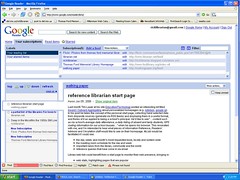
Google Reader


Google Reader 2
Originally uploaded by ricklibrarian.
Last week I became aware of Google Reader, a new aggregator for reading any RSS feed content. To my surprise, I already had an account, as does anyone else who has a Google Mail account. I subscribed to several of the feeds I already read through Bloglines and sat back a few days to see what would happen.

Google Reader seems to be pretty easy to use. It was easy to subscribe to feeds and easy to read them. From the main page, all the most recent content from all the feeds is together. Click the "your subscriptions" tab and you can look at one feed at a time. Unlike Bloglines, the items seem to stay on the list after you read them. Could it be like Google Mail with vitually unlimited storage?

Google Reader is a more private tool than Bloglines. Bloglines lets you share your feedlist with others. Bloglines also tells you how many others are subscribing to a feed.

You can forward content to a blog or as email. You can can also add labels (tags) to the items to help you find them later.

I do not know if there is anything else you can do. There are no instructions or help page.

If you already have Bloglines, there is no reason to switch. If you are new to reading blogs through an aggregator, it is easy to set up and use.

Sunday, January 15, 2006

Tutankhamun and the Golden Age of Pharaohs by Zahi Hawass

We have tickets to see King Tut at the Field Museum in Chicago in August. It seems like a long time from now until then, but my library already has the companion book to the exhibit, Tutankhamun and the Golden Age of the Pharaohs by Zahi Hawass with photographs by National Geographic's Kenneth Garrett. It is a gorgeous book filled with essays and descriptions of artifacts in the exhibition. It looks like the show will deserve its blockbuster billing. I hope I will be able to see through the crowd.

When I attend big art or archeology exhibits, I tend to read every sign in the front rooms but eventually I tire and begin to skip some. Having now read this book, I will concentrate on the artifacts themselves - just look and admire. I am already prepped with the vocabulary. If you too are planning to attend, here are some words to study:

uraeus
cartouche
canopic
ankh
was
faience
ba
ka
sarcophagi
shabti

The reason that there is so much to see is the ancient Egyptians believed in an afterlife that would be greatly enhanced by stocking up on necessities before death. The chambers of the tombs were stuffed with food, jewelry, clothes, furniture, weapons, chariots, and figurines of the many servants the pharaohs would need in the afterlife. When the pharaohs died (or other prominent people), all of their provisions were moved into their tombs. In fact, preparations began many years before death, and some artifacts even seem to name the subjects who gave the items to their pharaohs. I can almost imagine a pharaoh preparing for the great day registering his funerary needs at the local department store: one royal flail, one royal crook, four canopic jars, three nesting coffins, dozens of golden rings, folding stools, and unlimited shabti. Wrap in linen and deliver to the Valley of the Kings.

I could list all my favorite pieces in the book, but you have read enough of this review already. Get the book.

Hawass, Zahi. Tutankhamun and the Golden Age of the Pharaohs. Washington, DC: National Geographic Society, 2005. ISBN 0792238737

Saturday, January 14, 2006

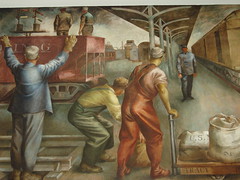
Mural in Downers Grove Post Office

The best feature of our local post office is its mural, which was kept when the building was remodeled in the late 1990s. The mural was painted by Elizabeth Tracy and installed in 1940. This image is of the left half of the mural.

Friday, January 13, 2006

Traveling Literary America by B. J. Welborn

Across the U.S., in places large and small, local organizations and government bodies maintain literary landmarks for students and travellers to visit. Many are homes of famous authors, like Edgar Allan Poe or Flannery O'Connor. Looking through Traveling Literary America by B. J. Welborn, I see some hotspots, particularly Concord, Massachusetts, and Hartford, Connecticut. Some author landmarks are in remote locals, requiring long drives. I have many still to visit.

Traveling Literary America combines practical information, such as locations, hours, and what to see, with background on the authors honored by landmarks. Most authors even get a bibliography. Having been to Louisa May Alcott's Orchard House in Concord and the O. Henry House in Austin, I think their entries are good. The book lacks (1) indexes by author and place, (2) national and regional maps showing the distribution of landmarks, and (3) photos of the landmarks. I hope the author considers adding these features if another edition is considered.

Even with its shortcomings, I have enjoyed looking at the book. Going to Hartford, Connecticut is now on my wishlist.

Welborn, B. J. Traveling Literary America: A Complete Guide to Literary Landmarks. Lookout Mountain, Tennessee: Jefferson Press, 2005. ISBN 0971897425

Thursday, January 12, 2006

Wiki World with Meredith Farkas

Aaron and I attended an national online workshop this afternoon without leaving the building. We took part in Wiki World which was presented in the OPAL Auditorium (an online presentations space). We did have to install a small plug-in, which found at the link before getting into the auditorium. It worked pretty well, though some of the web page pushing was a little slow. At one point I noticed 119 registrants connected.

Meredith Farkas spoke about the purpose of wikis and how to set one up. Her slideshow can be found on her wiki Libary Success: A Best Practices Wiki. It inspired us. In fact, as I typed this, Aaron downloaded some open sorce software and installed it. Who knows what we will do next!

Another Way for Librarians to Help New Orleans

The American Library Association has announced that it is coordinating volunteer efforts for librarians attending this summer's conference in New Orleans. You may choose to help New Orleans Public Library, Orleans Parish School District, or other unnamed as yet institutions as a one-day volunteer. For $10 you will get transportation to a project, lunch, and a T-shirt. It sounds like a great opportunity to do something to help the battered community. The ALA announcement has contact and registration information.

Wednesday, January 11, 2006

Where to Retire, a Magazine for an Older Audience

Should I retire to Hot Springs or Rancho Bernardo?

Julie, our magazine desk supervisor, is always looking out for new titles to add to our periodicals collection, which I think is quiet good for a medium small library. Today, she showed me Where to Retire. I had not heard of it before, but it looks like a definite fit for our library. I looked at the January/February 2005 issue, which had full profiles of six retirement-friendly communities and numerous other useful sounding articles. The profiles included climate, cost of living, housing, tax, transportation, school, and health care information. Among the articles were articles offering advice on moving, financial planning, and buying pre-fab houses.

Anyone looking at the magazine will probably notice the numerous brightly colored advertisements for retirement communities. They all seem to show active adults out in the sunshine playing golf or tennis, swimming, or bicycling. Also, they throw in many photos of older couples dancing romantically in the moonlight. In a way these ads are humorously predictable, but the house prices, average square footage, phone numbers, and web addresses included are of interest to the targeted readers.

According to our shared catalog, only a few libraries have this title, though it seems to have been published since 1991. You can get a free trial issue from its website. We're going to add it.

Maybe I should consider Corpus Christi. How about Winter Garden? No, too humid.