The author Louise Erdrich went on a spirit quest through the land of the Ojibwe, boating through Minnesota and Ontario, visiting islands in Lake of the Woods and Rainy Lake. In her 1995 blue Windstar minivan, with her eighteen month old daughter, she left Minneapolis to seek out the literature of her tribes (Ojibwe and Caucasian) captured by the atisikan or eternal paint on the rocky islands and found in the collection of a special library of rare books on an isolated island. Books and Islands in Ojibwe Country, a title in National Geographic’s The Literary Travel Series, is her account.
Though Erdrich is a modern woman who has forsworn smoking, she took tobacco to offer to the spirits, to strengthen her connection to the past by practicing its traditions. Her daughter enjoyed sprinkling the bits of tobacco from the bags before the ancient symbols. At very special places she also left food and ribbon shirts. She sought comfort and good fortune for herself and her daughters.
The author thought Ojibwemowin had become like Latin, a language of prayer, until she found on a previous trip the older people who speak it daily. Now she studies to learn the many verbs; two thirds of the vocabulary is descriptive verbs that need few adjectives. Erdrich says that the best speakers of the language are always creating new words; there are now words for computers, animals from other continents, and other ethnic groups; Asians are “the tea people” and Europeans are “frog people.”
A small foundation granted Erdrich an invitation to visit the island that was the home of Ernest Oberholtzer, who collected thousands of books and studied the Ojibwe and their language. Spending days thumbing through his vast and varied collection, she mused that children could learn much if they were given one school year devoted strictly to undirected reading; she would put children in libraries and let them discover literature for themselves.
The author has the book collecting addiction. Recently, as an antidote, she started an independent bookstore called Birchbark Books in Minneapolis. In the final chapter she discusses its operations and the joy she has arranging the displays when no one else is there.
Readers of Erdrich’s novels and book lovers in general should read this personal travel account, which reveals much about the author’s reading and literary culture.
Erdrich, Louise. Books and Islands in Ojibwe Country. Washington, D.C.: National Geographic, 2003. ISBN 0792257197
Thursday, October 06, 2005


Tuesday, October 04, 2005
Information and the Quality of Life: Environmentalism for the Information Age by David Levy
I was very pleased to learn the final keynote speaker at the LITA Forum in San Jose was David Levy. I heard Dr. Levy, a professor from the Information School at the University of Washington, at the Public Library Association Conference last year in Seattle. I was impressed with his presentation then and have since read his book Scrolling Forward: Making Sense of Documents in the Digital Age. This year's presentation was Information and the Quality of Life: Environmentalism for the Information Age.
Dr. Levy began his presentation reminding us of a train accident that occurred in Japan earlier in the year. The train was running 90 seconds late and the engineer was running the train beyond the recommended speed trying very hard to get the train on schedule. Being late was unacceptable. Many people died. The author Richard Ford recently said, “The pace of life seems morally dangerous to me.”
Dr. Levy told a personal story. His daughter had a very busy imaginary friend when she was young; when asked about the friend, she would say that the friend was too busy to talk that day. Even five year olds know about information overload and the hectic pace of life.
All of us are too busy. Dr. Levy says his addiction is his email. There are many fine things about email, but he gets too much of it and he feels compelled to answer it all. He anticipates getting wonderful messages, such as news of grants or acceptance of his writings in publications, and dreads bad news. He will not check email on the Sabbath, but finds himself thinking about it anyway. He is still trying to work out a sane way of dealing with it.
In 1945, Vannevar Bush, science advisor to President Roosevelt, said that people were suffering from too much information, and he suggested a “memex,” a device that would store and make retrievable data from books, records, and communications. The memex would help organize the information and give people more leisure. The computer does everything that Bush hoped the memex would do, except it does not lessen the stress of information overload; instead, the load is heavier.
Dr. Levy said that the dangers of the stress of information overload include poorer physical health, poorer mental health, falling productivity, decreasing quality of work, less satisfaction from work, bad decision making, less socialization, and less democracy.
In his book Leisure: The Basis of Culture, Josef Pieper claims that work has become the sole purpose of being for many people. Our society needs to provide leisure to allow individuals to reclaim perspective. Attending football games, racing cars, partying, surfing the web, listening to Ipods, are not leisure. Pieper means contemplation and stillness. “Only the person who is still can hear.” People need to find silence and sanctuary.
Dr. Levy said that there are two types of thinking: ratio (pronounced ratzio) and intellectus. Ratio is based on taking facts, doing research, calculating. Intellectus comes by just looking, contemplating, meditating. The Web and information technology is strong on ratio and weak on intellectus. To restore quality of life in our hectic lives, we need to create an ecology that balances ratio and intellectus.
Dr. Levy described the movement of which he is a part. He organized the Conference on Information, Silence, and Sanctuary last year and will be leading The Workshop on Mindful Work and Technology in March 2006. He is starting a Center for Information and the Quality of Life at the University of Washington. Redesigning technology and promoting new applications that offer contemplation are some of the goals of the movement. An important book is Coming to Our Senses by Jon Kabat-Zinn.
The question and answer period following the formal presentation was lengthy. Many librarians asked questions about the library role in bringing a balance to the world of information. Dr. Levy noted that libraries already have a reputation as a place to go for quiet, though the reality is that libraries are often busy places. He thinks libraries should restore the reputation somewhat and market it. There would be many grateful people.
Sunday, October 02, 2005
Clearing by Wendell Berry
Clearing by Wendell Berry is a collection of poems, all between four and fourteen pages in length, that deal with stewardship of the earth in general and more specifically with the caring for a farm. Berry has been a farmer, poet, and novelist since the 1960s, and is revered by environmentalists. This book is one of his best.
Berry selected a very appropriate quote to highlight in the introductory pages:
What has been spoiled through man’s fault can be made good again through man’s work.
I Ching
Like Walt Whitman in Leaves of Grass, Berry says that history and the future are present in the present moment. Berry refers specifically to the spring, when life arises out of the frozen ground; without the springs of the past there would be no present life, which is preparing for future life. The poet refers to his farm labor also, which follows the work of the sod busting farmers and which he will pass on to future generations. In his poem “History” he says:
All the lives this place
has had, I have. I eat
my history day by day.
In the title poem “Clearing” he takes up the theme of restoration, a healing of the land after the bad practices of many poor farmers:
Vision reaches the ground
under the sumac and thorn
under the honeysuckle,
and begins its rise.
It sees clear pasture,
clover and grass, on the worn
hillside going back
to woods, good cropland
in the bottom gone to weeds.
Healing work is a calling, according to Berry, and no person can be truly happy who does not work for good. Work is to be enjoyed. It is to be a song and should bring people together.
We will write them a poem
to tell them of the great
fellowship, the mystic order,
to which both of us belong.
It would truly be a good earth if every person, urban and rural, loved their work and made of it a song in the manner of Wendell Berry. This older collection of poems should be retained and read.
Berry, Wendell. Clearing. New York: Harcourt Brace Jovanovich, 1977. ISBN 0151181500
Saturday, October 01, 2005
Blogging Out Loud: Shifts in Public View
Danah Boyd is not a librarian; she is a Ph.D student at the School of Information Management and Systems at the University of California, Berkeley. She appeared before the LITA Forum as a keynote speaker in a big furry hat, which made her look like a wolf, and she was not at all happy that Roy Tennant had called Google and Amazon the enemy in his presentation. She believes that she heard a call for librarians to be the gatekeepers of information in Tennant’s keynote speech and she is alarmed. She desires a more democratic system of information. She wants librarians, who so strongly support civil liberties, to extend a hand to bloggers, remixers, and other innovators of digital communication.
Boyd took exception to Michael Gorman’s complaints that blogs do not meet the traditional standards of journalism. She first said many of the charges made against blogs can often be made against news sources - who can claim that FoxNews is unbiased? The main point she said was that blogging is not journalism or publishing; she says it is correspondence or communication. Blogs should be compared with letters, which archivists collect for future researchers.
Boyd is a social scientist who has worked for both Google and Yahoo. She has studied the ways that youth use various services on the Internet for social interaction. She suggested that these services work as important forums and safety valves. She told of how suicides among gay youths have fallen as more youth became involved in Internet communications; they were able to find others of like minds; they no longer feel alone.
Blogging is increasing in popularity; Technorati reports that the number of blogs doubles every five months. A blog can do everything a piece of paper can: tell a story, show a picture, promote a product, etc. Blogs empower individuals to speak their minds and can be a check on the mainstream media that reserves comment to those selected by the news industry.
Boyd said librarians need to decide how to react to blogs. She doubts there is real value in archiving all blogs, but there is some preservation worthy work. She urged librarians to read blogs and use them in their work.
Boyd gave very articulate answers to the many questions after her formal presentation. I would have enjoyed listening to her longer. One of her blogs is apophenia. Her presentation was definitely one of the high points of the conference.
I am missing some of the many things that she said. You can find more about Boyd's speech from LITA bloggers Sarah Houhton and Michelle Boule
Friday, September 30, 2005
The LITA Forum in San Jose
The 8th Annual LITA Forum in San Jose began Friday with a welcoming presentation by Roy Tennant (User Services Architect at the California Digital Library and a columnist for Library Journal) called Googlezon, Episode VI: Return of the Librarians. First he showed a little film that he made that tells the history and future of Google. Stating afterward that he can not really predict the future, which is "always more bizarre than we expect," he wanted to make the point that Google may seem strong right now, but it could be gone in five years; it is a public company with a commitment to stock holders; big companies fall; it could be bankrupt and gone. Libraries are here “for the long haul.” We have to adapt to survive, but we can do so.
To outlast the Internet giants, libraries need to learn from them. They all became big by taking simple ideas and applying them to new services. Not only should we use their methods, we should use their services to push our content through their pages.
I gather from reading other reports that Tennant has some oft repeated statements, including one he used today: “Librarians like to search, everyone else likes to find.” He especially picked on library catalogs, saying they need to be scrapped and replaced by better systems. “Stop putting lipstick on pigs,” he repeated several times.
Google, Yahoo, Amazon, and Microsoft have lots of money, but libraries have lots of skilled, dedicated people. He thinks we can beat them.
There is a more detailed report on his presentation at LITA Blog. You will also find my report on the difficulties of web harvesting government information at LITA Blog.
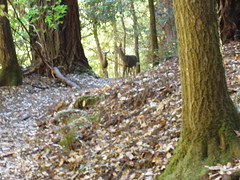
Portola Redwood State Park in California
I spent several hours hiking in a park that I think very few people find called Portola Redwood State Park yesterday. I was driving along Skyline Drive, meeting very few cars despite being only a few miles west of the highly populated Santa Clara Valley. I saw a sign for the park, noting the wood redwood, and turned at the next road. If I had known it would still take half an hour of driving narrow twisty roads, I might not have gone; I would have missed a beautiful park. At 9:45 a.m., I was only the second visitor of the day. If you like hiking and solitude, I recommend Portola.
Thursday, September 29, 2005
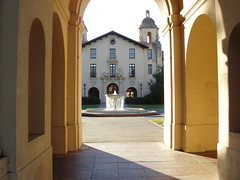
Glimpse of a Fountain at Stanford University
Stanford University has one of the most beautiful campuses that I have ever seen, mixing Mediterranean architecture and California landscaping. Unlike most universities with buildings spanning many decades, Stanford has kept a consist look about its buildings; they all have the clay tile roofs and the creamy colored stone. The Main Quad is a stunning space; no photo can really represent its vastness. I can imagine anyone lucky enough to work or study at Stanford would be very sorry to leave.
I got a little lost getting to the campus. I made a wrong turn off of Pasteur Drive and found myself boxed in by medical centers and then I was in a shopping complex. I eventually made my way through the Arboretum to approach the Oval and the Main Quad. Because it was after 4:00 p.m., I was able to park across from the Cantor Center for the Visual Arts for free. There I found the Rodin Sculpture Garden. There is a lot to find if you can find it. Look at a map carefully before you attempt to visit the campus.
I saw more people on bicycles on the Stanford campus than I have ever seen anywhere. I was reminded of Chinese bicycle commuting. I took a lot of photos. Click on this one to find more.
I got a little lost getting to the campus. I made a wrong turn off of Pasteur Drive and found myself boxed in by medical centers and then I was in a shopping complex. I eventually made my way through the Arboretum to approach the Oval and the Main Quad. Because it was after 4:00 p.m., I was able to park across from the Cantor Center for the Visual Arts for free. There I found the Rodin Sculpture Garden. There is a lot to find if you can find it. Look at a map carefully before you attempt to visit the campus.
I saw more people on bicycles on the Stanford campus than I have ever seen anywhere. I was reminded of Chinese bicycle commuting. I took a lot of photos. Click on this one to find more.
Unformed Landscape by Peter Stamm
Peter Stamm sets Unformed Landscape in the remotest area of Norway, in a village that can only be reached by boat, where most people either fish or work for the fish factory. It is near the borders with Sweden, Finland, and Russia. Stamm describes the political borders, covered by snow and darkness, as irrelevant and ignored. "The real borders were between day and night, between summer and winter, between the people.”
The central character is Katherine, a young woman who works for the customs service; she spends much of her time inspecting Russian boats for illegal cigarettes and vodka. She is only twenty-two at the beginning of the story, but she is already divorced from the father of her son, a boy who is never referred to by name until half way through the novel. She likes her job because she meets many people who have seen the outside world; Katherine has been to Hammerfest twice, but she has never been south of the Arctic Circle. The best day of her life was the day she rode in a helicopter to make a raid on a Russian trawler; she enjoyed seeing the fjords from the air. She has very few options in her life. She is agrees to marry Thomas because it might improve her situation; this proves to be a bad decision.
I do not want to reveal too much, to spoil the mystery of the story, which covers six years of Katherine’s life. It takes most of the novel for the reader to come to know the quiet woman, whose past is revealed very slowly by the author.
Reading Unformed Landscape feels a lot like watching a Scandinavian film; I was surprised to learn the author is Swiss. He probably has seen many European films; he has one of his characters watch Truffaut's Belle du Jour. I suspect anyone who enjoys Ingmar Bergen films will enjoy this novel.
Stamm, Peter. Unformed Landscape. New York: Handsel Books, 2004. ISBN 1590511409
I learned about this book by reading the Review-A-Day from Powell’s Books.
Wednesday, September 28, 2005
I'm Heading to the LITA Forum in San Jose
I am flying today to California to attend the annual LITA Forum, which is being held in San Jose this year. The LITA Forum is a gathering of several hundred librarians interested in information technology, which runs Friday through Sunday. During that time (and for the next day or so) I will be blogging on the LITA blog, which is called LITA Blog. Activity on this blog was heavy during the American Library Association Conference in Chicago this summer, as a dozen or more members of the organization reported on the programs and events that they attended. I expect the Forum will be very well covered. I know I am going to report on programs about the Michigan eLibrary and Blake Carver's LISNews. Feel free to follow the reports.
During this time, I may post to ricklibrarian as time allows, especially if I finish reading a book or two or take an interesting photo.
Updates
I wore my new reading glasses hanging from my neck today for the first time. I got a couple of "oh, my!" comments, but I never lost my glasses.
You may still sponsor me for the October 16 CROP Walk in Downers Grove. Go to my CROP Walk webpage to contribute. I have almost met my goal. I would be very happy to exceed it with many $10 contributions.
Sam from Writely is working to troubleshoot the bug that keeps me from sending text directly from Writely to Blogger. I have used the web-based word processor to work on several of my postings, and The Big Read group to which I belong has used it to collaborate on a page for our website.
Tuesday, September 27, 2005
Identifying Scientific Journal Articles Though Blog Engines
Can blogs be useful reference tools?
Yesterday a library user asked me for a just-released journal article about panic disorder and cardiovascular disease that was highlighted on one of the local television stations. The station promised further information on its website, but our client could not remember which of the local stations ran the story. We visited the websites of Chicago's ABC, CBS, and NBC affiliates, scrolling through lists of recent stories and trying keywords in search boxes; we found nothing. We then tried EBSCO and Firstsearch databases, hoping the article would be indexed, but we found nothing. After a Google search yielded nothing, I tried Google Blogsearch. There I found several bloggers who were commenting on the three-day-old article and one gave a full citation.
I then tested Technorati and Feedster and found many of the same blog postings. So, yes, blogs can help the reference librarian. Try the search engines devoted to blogs when you need very recent information.
The Demise of Marshall Field's: A Librarian's Viewpoint
A lot of people in the Chicago area are stirred emotionally by the announcement that May Department Stores is going to retire the Marshall Field's name and replace it with the Macys logo. Many people who have known and loved the Chicago store and its famous public service are upset by what they feel is a senseless and heartless act. They feel something is being ripped away from them. The men in suits respond that it is a good business decision. Their vision is of opportunities for national marketing - a homogenization of our country.
Many people in this area have Marshall Field's stories. Mine actually has a library tie-in. When I arrived in the Chicago area in the early 1980s I had no credit cards; I had believed that I needed little and that I was better off without a temptation to go into debt. The realities of commerce were changing and writing checks was getting to be a hassle, so I decided to get some credit cards. It was not so easy, because I had no track record, having gotten into my late twenties without ever testing credit. I got several rejections, including one from Marshall Field's Department Store. Having read a booklet on credit from my library's pamphlet file (remember pamphlet files?), I went to the offices of Marshall Field's in their State Street store and asked to speak with a credit reviewer. I was taken to the desk of an older woman who looked at my application and my bank statement and said that she saw nothing on which to base a recommendation. (With my library salary, I could have qualified for public housing.) Then she said, " I see you are a librarian. Did you have to go to college for that?" I affirmed that I did, telling that I had a master's degree, to which she replied, "If you have a master's degree, you deserve a credit card." I have shopped at Marshall Field's ever since.
Eric Zorn's column in the Chicago Tribune on Thursday, September 22 was an eye-opener. He listed many Chicago and national business names that have disappeared during the last twenty-five years: Montgomery Ward, Kroch's and Brentano's, Poppin' Fresh, Stuart Brent Booksellers, Chas. A. Stevens, Illinois Bell, Polk Brothers, Wiebolt's, Union 76, Rose Records, and many more. (Oh, I loved Rose Records store on Wabash - three floors of LPs - heaven!) I can imagine taking a time machine back twenty years to any Chicago area shopping district or mall and being surprised by all the old names. We have lost so much tradition. At least our public libraries are still here with the same names. Mostly.
When I think about it, our libraries have changed much in the past twenty years and not all of our clients have been thrilled with the changes. While I see much good from our technical advancements and new buildings and new ways of providing services, some longtime residents have not kept up. Perhaps some are no longer inclined to adapt: they have seen too many changes and symbols of their pasts are being taken away; they have fond memories of the old, poorly-lit buildings where the books overflowing the shelves. We have to be more sensitive than the men in suits and try to find ways to soften the shock to our public when we institute change. We want them to stay with us through the changes.
We have not totally escaped the name change phenomenon here in Illinois. On the positive side, a couple public libraries merged to form a bigger, stronger library with more resources: the Indian Prairie Library was the result of merger; it is unfortunate that so few communities were able to do what Darien and Willowbrook did. All other public libraries that I know in our area are under the names they were twenty years ago.
A bigger name change in our area came from the Illinois State Library's push to consolidate regional library systems. The Suburban Library System combined with a portion of the old Chicago Library System (minus Chicago Public Library) to become the Metropolitan Library System. Not everyone was thrilled, and fifteen months after the official merger, not much has happened to excite reference librarian about the new name. In time, we may have the promised collaborations between city and suburbs and involving public, academic, and special libraries, but I see no structure to foster joint projects yet. We lost the system's reference service and the resources to which it subscribed in the state of Illinois' underfunding of library systems. MLS seems a lesser entity. Like the name Marshall Field's Department Store, the name Suburban Library System evokes some good old memories.
Will I shop at Macy's Department Store? My first reaction is "No." I may eventually find myself there, but I will never have any fondness for it. It will always just be a corporate box filled with dry goods. I am sticking with the Metropolitan Library System; there is still hope for good times to be remembered later.
Monday, September 26, 2005
Encyclopedia of an Ordinary Life by Amy Krouse Rosenthal
Amy Krouse Rosenthal may claim that she has led an ordinary nothing-spectacular-kind-of-life, but she has an extraordinary drive to write and comment on her experiences and observations. She has been hawking her compositions to publications like Might, Parenting, Utne Reader, and the Chicago Tribune for the last eight or so years, and she has been a commentator for WBEZ radio in Chicago during part of that time. She started a zine/newspaper called Oyster and a CD-based audio magazine called Writer’s Block Party, both of which were loved by a few and ignored by many. She has written several books, including The Mother’s Guide to the Meaning of Life: What I’ve Learned in a Never-Ending Quest to Become a Dalai Mama, the humorous The Book of Eleven: An Itemized Collection of Brain Lint, and the children’s book Little Pea. The author has also been raising three children and managing a husband. I imagine that her fingers are always on her laptop.
Her latest effort is Encyclopedia of an Ordinary Life, which has a subscript “Volume One.” I suspect that she could easily put out a second volume; she probably has an extra disc drive to attach to her laptop loaded with her stories and comments. I hope she gets a call from a publisher saying “Do it!” Reading her book is a lot of fun.
Why will readers enjoy this book? They will identify with her. Too much analyzing will spoil the humor, but let me say that I found myself nodding my head in agreement with her comments often. Like Rosenthal, I want to know what happens when movies end; I agree that chain-letters are a total waste of time; I feel better when we use up the groceries that are filling our refrigerator; I too try to cross a street quickly when there is a car waiting. Like the author I usually prefer reading nonfiction to fiction. I also differ from the author: I do not enjoy sleeping late; I don’t drink coffee or read many magazines, staples in the author’s life; I would never leave money in public places as a social experiment.
What kind of book is Encyclopedia of an Ordinary Life? The Library of Congress and many other libraries seem to agree that it is a biography. Granted, there are details of the author’s life in the chronology section and some tragedies are listed in the entry “Lows,” but the items only outline her life. A case could be made that the alphabetically arranged entries work together to build a profile of the mind of Amy Krouse Rosenthal. Still, if it is a biography, it is very unconventional. The author claims that it is a harvest of details from an ordinary life, which could be the reader’s life as much as hers, but the reader may notice there are some surprising stories. This may be her point: even ordinary lives are filled with wonder, drama, and heartache.
Being the hip person she is, Rosenthal has a companion website to go with her book. Visit www.encyclopediaofanordinarylife.com and leave a Purple Flower Moment or a Moon Description, if you are so inclined.
Rosenthal, Amy Krouse. Encyclopedia of an Ordinary Life. New York: Crown Publishers, 2005. ISBN 1400080452
Sunday, September 25, 2005
Reading Glasses
I have new contact lenses that give me better distance vision, so I should be able to read highway and street signs from greater distances, but the change comes at the expense of my close vision - vision I need every day in the library. I had been living with a compromise, trying to balance my near and far vision in a single prescription, but it was no longer working. My optometrist thought my cornea was too steep for bifocal contact lenses, so I now have reading glasses, an inexpensive pair that I purchased at a drugstore. It has been two or three (or four) weeks, but I have not figured out yet when to have the reading glasses on hand and when I do not need them. It seems a small change in my life, but I need to stop and think about my routines - which may be a good thing.
I have amused colleagues and friends at the library in these weeks, as I am constantly putting the glasses on and taking them off and laying them down and having to find them. Several people have told me I look cute in glasses, when I can find them, which is a surprising thing to hear. I am getting fashion advice about frames as well. It has been a long time since I got so much attention.
I really goofed Saturday and left my reading glasses at home. I was able to use the computer without any problem; I could have enlarged the print but did not do so; I can sit fairly far from the screen and the back lighting must help. At arms length most of our reference books were still readable, but some circulating nonfiction books were fuzzy, the newspaper was difficult, and I had to look at a Baker and Taylor bill very carefully to distinguish an 8 from a 9. Telephone books were impossible to read. I don't know where the magnifying glass went. I also has trouble with spine labels in aisles with dim lighting. I am getting a lesson in how dependent I am on my vision.
The solution to my problem is two-fold. I will buy more reading glasses and leave them everywhere I need them, and though I have hesitated to do so, I will hang a pair of reading glasses around my neck; it will probably make me look like (gasp) a librarian.
Saturday, September 24, 2005
Dreaming About Old Libraries
In Free Range Librarian two weeks ago Karen Schneider wrote Being a Good Former Employee; she set out helpful guidelines for anyone leaving one job to go to another. I have left several wonderful jobs in the past to take on new challenges and I think I behaved well according to Karen's ten rules for leaving. As she would probably agree, these rules were easy for me to follow in most cases because I moved to another state; I had no opportunity to stay involved in the affairs of the libraries I left; my moving predated widespread Internet, email, and instant message access. Now there are easy ways to violate rules 7, 8, and 9 from wherever you are, but you should not. I recommend everyone who will be changing jobs take a look at Karen's essay.
Karen wrote her essay after dreaming about an old job, a position she obviously enjoyed with people she liked; in her dream something went amiss. This struck a cord with me, for I also have had dreams about my old libraries. In most of these dreams, I have gone back to the Daniel Boone Regional Library in Columbia, Missouri, where I had my first professional library job as a reference librarian with a desk right beside the reference collection. The big picture windows to the north are still there and I look forward to again watching the drama of approaching storms. The second floor still overlooks the first and I look forward to the annual hanging display of quilts, which added so much color to the public space when I was there. Many of my former colleagues are still there in my dream, and I am eager to answer reference questions. Upon entering the dream everything is perfect, but then complications arise. I get lost in the new underground passage to the new staff room, or I misplace my desk, or I realize than I am still in my pajamas (or worse) and need to run home to change. I never answer a reference question. I awake with a melancholy feeling.
In reality, the Daniel Boone Regional Library has a totally new building. I am sure most of the staff have changed as it has been 24 years since I was there. I would like to see it some day. Daniel Boone had the most impressive community outreach program I have ever seen, and we had an energetic public service team. As my dreams indicates it still has a place in my heart.Friday, September 23, 2005
Request for Crop Walk Sponsors
With another hurricane bearing down on the Gulf Coast, this is a good time to ask for your help. I will be cropwalking in Downers Grove, Illinois for Church World Service on Sunday, October 16 and am in need of sponsors. This is my twelth Crop Walk, but the first for which I have my own Crop Walk web page. You may click here to get to my page and make a small donation.
Church World Service works to eradicate hunger and poverty and promote peace and justice in the US and around the world. The organization has posted statements about its hurricane relief efforts here. Click here for report on Church World Service from Charity Navigator.
The South Dupage Crop Walk through Downers Grove and Westmont is always well attended, but there is always room for more walkers. Join us if you can or join a Crop Walk in your region. Thanks.
Thursday, September 22, 2005
Writely: A Web-Based Word Processor
Several years ago Bill Gates said that we soon would have web-based software and not bother having any on our desktops and notebook computers. His forecast was a little premature; people seem to like having software on their computers and are a little frightened by the idea of all their work in cyberspace; they can work offline with computer-bound software. Still many people have gone to totally web-based email; the precedent is set.
Yesterday I learned about Writely - The Web Word Processor while reading the blog The Distant Librarian. It is so new that the instruction page is not complete; there are several gaps were the editors have not yet decided what to say. What they do say is that their web-based word processor is free for anyone to use in its beta phase; later there will be a variety of free and fee versions. They suggest the product will be useful for people who like to collaborate with others; start a document and tell your friends by adding their email addresses to the permissions for document access; they can then add to the document online. The editors also suggest Writely will be handy for people who travel; if they can get to the Web, they can get to their documents.
I am composing this document on Writely. I am assured that I can post it directly to Blogger when I am ready; Blogger is the only weblog that is so supported at present, but the editors are taking requests. I have given Aaron access to the document, so he can collaborate.
I tried to post directly from Writely to Blogger, but it did not work. I kept getting an error message : " 'o' is an undeclared namespace. Line 1318, position 2." I have no idea what that means. I double-checked my blog settings. So I pasted the message here instead. Maybe the beta product is having a blogging problem. I'll try another item in a few days.
The word processor itself seems at first glance to have all the basic features I use. You can see this document at www.writely.com/View.aspx?docid=aks2wccr3jj. Maybe Aaron will have added a comment.
Wednesday, September 21, 2005
Poetry for Cats by Henry Beard
Readers of Poetry for Cats: The Definitive Anthology of Distinguished Feline Verse by Henry Beard will notice how much influence humans have on cats. Cats will not enjoy having this pointed out. They work hard to protect their free will and try to dictate the terms of their relationships with humans. You can not just pick up a cat and expect it to be happy being held; you have to wait until the cat is ready. Cats will not play with toys just because you want to play. Cats appear to think independently, but their poetry betrays them.
Here is a bit of verse written by Henry Wadsworth Longfellow’s cat:
I chased a mouse beneath the stair,
It went to ground, I knew not where;
For, so swiftly it ran, my sight
Could not follow it in its flight.
Sound familiar?
There is more. Samuel Taylor Coleridge’s cat wrote the following:
In Xanadu did Kubla Kat
A splendid sofa-bed decree
With silken cushions soft and fat
A perfect feline habitat
Set on a gilt settee.
Here is another sample, this time by William Shakespeare’s cat:
To go outside, and there perchance to stay
Or to remain within: that is the question:
Whether ‘tis better for a cat to suffer
The cuffs and buffets of inclement weather
That nature rains on those who roam abroad
Or take a nap upon a scrap of carpet …
Have you noticed a trend? It appears that cats listen more than they let on, and they even identify with the humans with whom they relate. They certainly borrow verse as freely as they claim their favorite chairs.
Cats do deserve some credit for knowing what poetry to borrow and adapt as their own. They are able to turn bits of Chaucer, Keats, Frost, or Ginsberg into works that serve their purposes, such as catching goldfish, breaking vases, or berating Whitman for sleeping too late. In near unison they raise their voices to complain about their vets.
One thing that surprises me about Poetry for Cats is that Henry Beard never reveals the cats’ names. I can not imagine that Emily Dickinson had a nameless cat!
Poetry for Cats is an attractive book with colorful illustrations and is still in print after eleven years. I found our copy when inventorying the poetry collection. I am afraid few people have borrowed it lately, so I am going to put it on display. The cats need to be heard.
Beard, Henry. Poetry for Cats: The Definitive Anthology of Distinguished Feline Verse. New York: Villard Books, 1994. ISBN 0679435824
Sunday, September 18, 2005
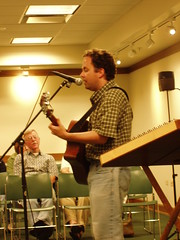
Andy Young Singing at the Thomas Ford Memorial Library
When I took over my job, I did not suspect that I would enjoy running our occasional coffee house called Friday at the Ford as much as I do. I've gotten to hear a lot of great music and meet many wonderful people. We enjoyed Andy Young from Chicago last Friday night, who played mostly Scottish and Irish tunes on hammer dulcimer, tin whistle, Irish flute, and guitar. He'd like to play more libraries.
Saturday, September 17, 2005
A Look at Google Blog Search
Google has released a beta version of Google Blog Search, which it promises will do a better job of searching blogs than Google; it will be more precise than the main search engine in finding items posted on blogs. I have noticed in the past when searching for a specific review that I had posted that regular Google sometimes pointed me to a later review that had the wanted review as a previous postings link on the left side of the blog page. In some cases Google only pointed to my reviews in the monthly archive instead of the individual postings.
I have taken a quick look at Google Blog Search, comparing the results with my postings list in Blogger, which is also owned by Google. Only one of my last 50 postings is missing. Every entry is an individual post; I do not see the archive. Nothing posted before April 27 is represented.
Searchers can have their results list sorted two ways – by relevance or by date. By relevance brought all my postings including photos to the top. Do photos have more weight in Google’s algorithm?
Google Blog Search looks a lot like Google, so people will probably find it easy to use. Results can be updated as Atom or RSS feeds.
Friday, September 16, 2005
The Value of a Good Old Textbook: The Riverside Shakespeare
As students have been returning to their campuses, much has been written and said about the cost of college textbooks. The Wall Street Journal reported in its August 16 issue that textbook prices were increasing at twice the rate of inflation. On August 25 the Chicago Tribune reported that the first year, fulltime student at the University of Illinois at Urbana-Champaign, who must take a range of introductory courses, spends on average $698 for used textbooks or $931 for new textbooks. An article in the Chronicle of Higher Education on September 2 told about ten college bookstores selling downloadable electronic textbooks.
All of this news was fresh in my head when I started moving everything in our house to have the carpets cleaned. We carried end tables, lamps, dining room chairs, the coffee table, crystal, china, record albums (vinyls), CDs, videos, DVDs, photo albums, high school annuals, and books out of the living room, dining room, and family room into the kitchen, laundry room, and extra bedroom. I found among the books the following:
The American Tradition in Literature, 4th ed. Grosset & Dunlap, 1974.
The Norton Anthology of English Literature, Revised, vol. 1. Norton, 1968
The Norton Anthology of Poetry, Shorter Edition. Norton, 1970.
The Riverside Shakespeare. Houghton Mifflin, 1974.
These four books used in my literature classes, some of the vinyls, a laundry bag, several letters from friends, a tool for splicing reel-to-reel audiotape (unused for 30 years), my last student ID, and my diplomas are all the physical remains of my six years at the University of Texas at Austin. I did not keep any old clothes or hats; I did not own a camera, so I have no photos; I have replaced my dictionary; I have none of my school papers. I used to claim that I was unsentimental, and I gave away or sold many things as soon as I decided they were of no use to me, but these four textbooks have never been in danger of my tossing them.
In the six years during which I got my bachelors and masters degrees, I owned a lot of textbooks. I recall spending about $100 on books each semester, which was about half of what I spent for tuition and fees each semester - attending the University of Texas in the 1970s was incredibly cheap! The most that I ever spent on a single book was $42 for a thin title required for a library class that the instructor never used; I am still a bit upset over the waste. I bought many used textbooks and sold most back to the bookstore at the end of the semester. When I left Austin, I had few of my textbooks.
I did keep some library school texts for a few years, but I found I was not using them. I donated my AACR2 and Sears Subject Headings to a sale run by the Friends of the Daniel Bonne Regional Library long ago. I do not even remember most of my library school textbooks.
The four books that I still have are special. They are really more anthologies of great literature than traditional subject textbooks and are never out of date. All but the Norton Anthology of Poetry are hardbound and still look good on the shelf; I removed the tattered paper covers long ago. I still refer to them when I have a literature question or when I want to reread a short story or a poem or a play. They were all worth more to me than whatever I paid for them. Only the trade paperback poetry book has a printed price - $3.95.
My favorite is The Riverside Shakespeare, which I remember buying for a course in which we read a dozen of the plays. It was a handsome book that stood out among my ragged collection of textbooks. Even then, I thought that it was something to keep. Every other year or so I find myself reading one of the plays; Much Ado About Nothing and A Midsummer Night’s Dream are my favorites. It is still one of the best things I have, which is something to think about as my own daughter goes off to college in a couple years. What will she keep? I wonder.
Wednesday, September 14, 2005
Mimi and Toutou's Big Adventure: The Bizarre Battle of Lake Tanganyika by Giles Foden
As I read Mimi and Toutou’s Big Adventure: The Bizarre Battle of Lake Tanganyika by Giles Foden, I thought of how it could be made into a darkly comic movie. It has all the necessary elements. The central character in the story is Geoffrey Basil Spicer-Simson, a British naval officer who had been confined to a desk job after several disastrous assignments in England, Gambia, and China; he was adept at sinking and beaching ships under his command. No one really wanted to associate with him, for he was a ridiculous braggart; he was always claiming great acts of heroism that listeners could not possibly believe. He also told terrible jokes and broke into song, singing off-key. When the First World War began, the Royal Navy sent him on a seemingly impossible task in a remote region of Africa. Maybe he would not return.
The task was to transport two forty-foot wooden motor boats from London to Cape Town, South Africa and from there across the continent to Lake Tanganyika. When the Navy would not let Spicer-Simson name the boats Cat and Dog, he submitted Mimi and Toutou, which the Navy accepted, not knowing they meant “meow” and “bow-wow” in French. The train from Cape Town would only carry the boats part of the way to the destination; Spicer-Simson and his men would have to drag the boats through a jungle and over some mountains! Moviegoers will think of Werner Herzog’s Fitzcarraldo, of course. Once the boats arrived, the assignment was to sink a German ship five times their size that was controlling the lake. What the Royal Navy did not know was the German Navy had a ship twenty times their size on Lake Tanganyika as well.
Spicer-Simson’s behavior alternates from sensible to bizarre. No one can read his semaphore; he designs himself a skirt to wear in the heat; he enjoys showing his snake tattoos to the local Holo Holo people. If John Cleese were not so old, he would be the perfect cast. Also on the trip are the patient Dr. Hother McCormick Hanschell and the loyal, clever transport officer Lieutenant Wainwright, who is the real genius behind the transport operation. There would be many good roles for actors in a movie version of Mimi and Toutou’s Big Adventure. Even the title sounds good.
I should state before I go any further, that this is nonfiction. This is not comic novel.
The story has some disturbingly tragic elements. The English, Belgians, and Germans have no qualms about forcing the local tribes to haul their boats and build their ports and forts; many of the Africans were beaten into compliance. Many of the soldiers contract diseases, tropical and venereal, and when the navies finally do battle, some sailors die grizzly deaths. Mimi and Toutou’s Big Adventure would probably be rated R if the book were closely followed.
The concluding chapters of the book tell follow-up stories. One is about the making of The African Queen with Humphrey Bogart and Katherine Hepburn, a story inspired by a part of the Mimi and Toutou story. The final chapter tells about the author’s fact finding trip to Lake Tanganyika; he found one of the German boats is still in service, carrying thousands of local people and their livestock around the lake.
Until the movie is made, you will have to read the book.
Foden, Giles. Mimi and Toutou’s Big Adventure: The Bizarre Battle of Lake Tanganyika. New York: Knopf, 2005. ISBN 1400041570
Tuesday, September 13, 2005
News on Libraries in the Path of Hurricane Katrina
The American Library Association changed the URL for its page with news about libraries in Louisiana, Mississippi, Alabama, and other places touched by Hurricane Katrina or its aftermath. The new address is http://www.ala.org/ala/alonline/hurricanekatrinanews/katrinanews.htm.
Rating the Charities in Times of Need
With many people interested in helping the victims of Hurricane Katrina and with stories of charity scams in the news, it seems a good time to remind library users that they can research their charities before they write their checks. At the Thomas Ford Memorial Library, we subscribe to Charity Rating Guide & Watchdog, quarterly publication that also has a website. Other online sources to check are Charity Navigator (which has some nice articles on avoiding scams) and Give.org (which is a service of the Better Business Bureau).
By the way, libraries that are collecting for hurricane relief should check to make sure the funds they are passing on get into the right hands. We, too, should do our homework.
By the way, libraries that are collecting for hurricane relief should check to make sure the funds they are passing on get into the right hands. We, too, should do our homework.
Monday, September 12, 2005
Meredith's Survey of Library Bloggers
Meredith Farkas, who is the new Distance Learning Librarian at Norwich University in Vermont, has posted the results of her survey of library bloggers at her blog Information Wants to Be Free. Some of the results are what you would expect, while others are a bit surprising.
I most liked seeing that I am not alone as an over 50 blogger; 19 of us admitted to being at least that old, 11.5 percent of the pool.
I was also surprised to see that more bloggers come from small public libraries than medium-sized public libraries, 10 to 5; actually that may make sense as small is defined as serving populations of 10,001 to 40,000 and medium-sized gets up to 99,999, and there may be many more small libraries than medium-sized by that definition.
I am not typical in that I read only a few blogs. Many of the people responding claim to read a lot of blogs.
Bloggers seem to do many jobs at many kinds of libraries, and most claim to be happy, which is contrary to the idea of bloggers as malcontents.
When looking at Meredith's survey, start at Survey of the Biblioblogosphere: Results.
A Year Down Yonder by Richard Peck
It is 1937 and Mary Alice has been sent down to southern Illinois to live with Grandma Dowdel, while her parents try to survive the Great Depression in Chicago. Mary Alice has never traveled by train alone; her brother Joe was with her every summer that she spent with Grandma; now he is in the Civilian Conservation Corps in California. With her radio, her cat Bootsie, and her trunk, Mary Alice meets Grandma on the station platform. There are no hugs; Grandma is not the hugging type.
If you read A Long Way from Chicago by Richard Peck, you know all about Grandma. Most of the neighbors are a bit afraid of her, as she is rather large, rarely smiles, and has been known to carry an antique rifle when she has a mind she needs it. She does what she needs to do to get by and is a bit of a Robin Hood. She slips under the barbed wire of the Piatt County Rod and Gun Club to catch catfish to provide a good meal for old Aunt Puss. When the bank tries to foreclose on Mrs. Wilcox’s house, she finds a way to leverage her friend’s antiques at a rummage sale with the banker’s wife. Grandma is clever and mischievous.
In A Year Down Yonder, Mary Alice loses a lot of sleep, as she and Grandma are often out in the dead of night catching privy tippers and gathering ingredients for pumpkin pies. Her math grades suffer, but she learns many valuable lessons otherwise. Being a city girl and being related to Grandma make finding friends at school harder, but she gets to play Mary in the Christmas play and even studies with the star basketball player. Grandma is always there to solve any problem.
I enjoyed the humor and the historical detail of both of these books. Almost every library has them, as they should. They may be aimed at young readers, but adults can enjoy them, too.
Peck, Richard. A Long Way from Chicago. New York: Puffin Books, 1998. ISBN 0141311827
Peck, Richard. A Year Down Yonder. New York: Puffin Books, 2002. ISBN 0142300705
Sunday, September 11, 2005
The Doctor's Dilemma by George Bernard Shaw
As the curtain rises in The Doctor’s Dilemma by George Bernard Shaw, the eminent doctor Colenso Ridgeon has just received word that he has been knighted, and all his friends in the medical profession come by his house to congratulate him. Sir Patrick Cullen, Mr. Cutter Walpole, Sir Ralph Bloomfield Bonington, Dr. Blenkinsop,, and Dr. Leo Schutzmacher are welcomed into Sir Colenso’s infirmary for a lively discussion of advances in medical science. Ninety-five percent of all disease is the result of blood poisoning, says Walpole. Stimulating the phagocytes is the best cure, any antitoxin will do, is Sir Ralph’s belief. Sir Patrick claims that he saw all the new cures thirty years ago. It is a lively discussion; Sir Colenso could not possibly find time to see the woman in the waiting room – but then he does.
Jennifer Dubedat’s husband Louis has tuberculosis, and she comes to Sir Colenso with a plea to save him, but the newly knighted doctor says that he has room in his clinic for only ten patients, which he has already chosen – ten people whose lives are worth saving. He could not possibly add another, he says, until she shows him Louis’ wonderful drawings. Perhaps he can make room for him. Then Sir Colenso learns that his friend Blenkinsop also needs treatment. Who should he save? Who is most worthy of being saved?
George Bernard Shaw and his socialist views were so well known by the time of the staging of The Doctor’s Dilemma in 1906 that he was able to incorporate a joke about himself to please the audience. Following his success with Major Barbara, he took aim at the hypocrisy of British physicians in the new play. He also characterized the young artist as a scoundrel, who rejects conventional moralities, but with good reasons for doing so; the audience is left uncertain whether to admire or dislike him – it is the audience’s dilemma.
I listened to The Doctor’s Dilemma on compact discs from LA Theatre Works, which staged the play with an audience for radio. I likes it so well I listened a second time. It would be a great addition to public library audio collections.
Shaw, George Bernard. The Doctor’s Dilemma. Los Angeles: LA Theatre Works, p2000. 2 discs.
Saturday, September 10, 2005
Mad Hot Ballroom
Do you know the steps to meringue, rumba, foxtrot, tango, or swing dancing? I don’t, but many eleven year old students in New York sure do; they get ballroom dancing instruction from the American Ballroom Theater’s Dancing Classrooms program, and they take it seriously. For ten weeks they learn the dances and prepare for competitions. The best team wins the city trophy for its school. Only one school wins the competitions, but all the students benefit: school pride is raised, each student’s sense of accomplishment is strengthened, and they learn how to dance, which will stick with them forever.
The cameras of Mad Hot Ballroom followed teams from three schools closely through the 2004 dance season, so moviegoers get to see the students from first lessons to the final competition, witnessing all the missteps and frustrations of children just beginning to mature. They also see what can be accomplished when dedicated people care enough to work with students in all economic classes.
I especially liked the interviews with the students. Michael from Public School 112 is really funny, talking about girls while playing foosball with his friends. All the girls in Public School 115 want to dance with Wilson, who already seems to possess quiet charm and ballroom style. Tara from Public School 150 is already planning to be an actress, dancer, and singer; you get to see her practice in front of her mirror. Because there are many kids involved, there are many stories to follow; I’d like to see the film again to get them all straight.
Aaron will be showing Mad Hot Ballroom as one of several documentaries in our fall film series at the Thomas Ford Memorial Library. People are already telling me they are coming. You can see a bit of the film at the Official Mad Hot Ballroom website.
Friday, September 09, 2005
Across Five Aprils by Irene Hunt
Jethro Creighton was only nine years old when word reached his family farm in southern Illinois that Confederate forces under the command of Brigadier General Beauregard had fired upon the 1st U.S. Artillery stationed at Fort Sumter in Charlestown, South Carolina. Important news traveled very slowly in April 1861; for four years the youngest son of the farmer Matt Creighton would rely on old newspapers and slowly delivered letters and wounded soldiers for news of the war and of the fates of his older brothers, cousins, and friends. Though he and his parents were many miles from the battlefields, the war brought sorrow and hardship to them daily. When his father fell ill, Jethro took on most of the farm work.
What I like most about Across Five Aprils by Irene Hunt is the authenticity of the story. In the notes at the back of the book, the author says that stories her grandfather told her inspired her novel to which she added much historical detail. The result is a blending of family saga and military history. The names of battles and generals become meaningful to the reader because they are important to Jethro, who must know what has become of his brothers and his sister’s fiancée.
Across Five Aprils has several great characters: Jethro’s sister Jenny who worked as hard as Jethro, her fiancée Shadrach Yale who was his school teacher and mentor, and the local newspaper editor Ross Milton who befriended the young man. It was Milton who explained that the freeing of the slaves by the Emancipation Proclamation was only a beginning in a long quest for justice and equality for blacks; he foresaw the Ku Klux Klan and bitter reconstruction of the South.
Southern Illinois was an interesting place during the Civil War. Many of the residents with families living in the southern states sympathized with the Confederacy; some of the young men joined the “Southern Cause.” Others hated the South; local vigilantes burned barns and killed livestock to punish anyone they thought disloyal. The woods also filled with deserters. The night was dangerous.
Across Five Aprils gives readers much to ponder. I recommend this Newberry Medal Honor book to readers of all ages. Every library should have a couple of copies.
Hunt, Irene. Across Five Aprils. New York : Berkley Jam Books, 2002, c1964. ISBN 0425182789
Thursday, September 08, 2005
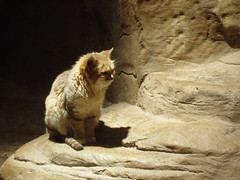
Sand cat at the Brookfield Zoo
We spent Labor Day at the Brookfield Zoo with friends. This sand cat in the Fragile Desert exhibit was posing for lots of pictures.
Tuesday, September 06, 2005
A Book to Discuss: When the Emperor Was Divine by Julie Otsuka
At the One Book, One Community program at the American Library Association Conference in Chicago this summer, I was given a bag of books, including When the Emperor Was Divine by Julie Otsuka. During the program, a representative from Random House Books promised us that this would be a good book for community discussions; it had already been popular in the Seattle Reads program. Now that I have finally gotten around to reading it, I agree.
When the Emperor Was Divine has a lot going for it as a community reading choice. It is a short, well written book about the experiences of a Japanese-American family that is divided by federal security officials and sent to internments camps during World War II. The father is carried off in the night without even being allowed to dress; the son and the daughter both dream later of their father returning to them still wearing only a robe and slippers. The children and their mother remain in Berkeley for several months, becoming poorer and more isolated, until they too are sent to a series of camps, mostly in forbidding locations; they suffer form heat, cold, saline dust and boredom. Most readers will sympathize with the family, whose habits and aspirations are so much like their own.
Though the setting of When the Emperor Was Divine is the 1940s, the book is timely: we still have the fear of foreign people leading to angry words being said and rocks being thrown through windows. We may someday have books like this one about the families of American Muslims who were unaccountedly held without ever being charged with crimes after September 2001. When we do, we should discuss them, too.
Saturday, September 03, 2005
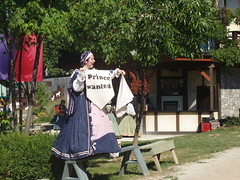
Prince Wanted
There were many reasons to go to the Bristol Renaissance Fair. Click the photo to find more photos.
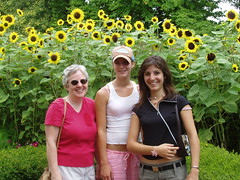
Sunflowers
It was a beautiful day at the Morton Arboretum. This was near the new maze. The new children's garden is opening soon.
Eats, Shoots & Leaves by Lynne Truss
My daughter Laura complains about my writing. My sentences are too short. Their structure is too simple. It looks pretty boring.
I have intended to read Eats, Shoot & Leaves by Lynne Truss since it came out in the United States in 2004. Now that I have, I have some more ideas to improve my writing: use more punctuation. I will start again.
My daughter Laura complains about my writing: my sentences are too short; their structure is too simple; it looks “pretty boring”. [Note British positioning of these marks.]
I wish I had read Eats, Shoots & Leaves earlier: it is very entertaining - I didn’t laugh out loud, but Bonnie did - and is full of useful punctuation advice. I now know why I have been confused about the use of quotation marks with other punctuation marks at the ends of sentences: the British and Americans have different rules; I read both. It might be interesting to compare British and American editions of books (will I ever have such time?) to see if the editors have changed the punctuation.
It would be nice if this book had an index to facilitate re-finding the rules and illustrations. Oh! It would be nice to have a package of Starburst (once called Opal Fruits), too!
Truss, Lynne. Eats, Shoots & Leaves: The Zero Tolerance Approach to Punctuation. New York: Gotham Books, 2004. ISBN 1592400876
Friday, September 02, 2005
Use of Google Maps to Show Hurricane Damage
The Katrina Information Map is a Google Map to which people are adding markers for specific addresses in Louisianna. There are a few markers in Mississippi and Alabama, too. Click on a marker and you may find out whether there is flooding at that location. The creator has asked people to only add markers if they have information, but some are using the map to ask for help. Some are leaving phone numbers and email addresses in the balloon that appears when you click on the markers.
Wandering around the map gives me the impression that ther are still people wandering around New Orleans. Could emergency personnel be stopping to add markers to this map? Maybe they are if the addresses are important to themselves or their friends. I'm sure a lot of people would like to know.
Wandering around the map gives me the impression that ther are still people wandering around New Orleans. Could emergency personnel be stopping to add markers to this map? Maybe they are if the addresses are important to themselves or their friends. I'm sure a lot of people would like to know.
Working: A Musical by Stephen Schwartz
Working is a different kind of musical: there are no main characters, no storyline, and no plot. What it has is what the Studs Terkel book on which it is based has – many voices, dramatic, comic, and tragic. I have been listening to a full-cast production by LA Theatre Works on compact disc while I commute to work, enjoying the songs and the many monologues of workers from all walks of life. I’m very glad I work at the library and not up on some girder high above the city nor in a cubicle deep inside some building!
The voices you hear while listening to Working are blue collar and white collar, young and old, happy and very sad. The most outlandish characters are the least effective; I do not think the one boss, who enjoys having thousands of workers do his bidding and who wants to pass his “values” to future bosses, was a very fair characterization; it did not fit with the many moving stories of other workers. The best are the steelworker, the immigrant who works in the produce department at a grocery, the receptionist, and the mother who stays home with her children; they all have good points about the unfairness of stereotyping. I was most incensed by the description of the job of the factory worker making luggage on an assembly line, who is always at risk of being hit by moving pieces or scalding steam. I was most disturbed by the newspaper copy boy who is about “to go postal”; I skipped his part the second time I listened.
Skipping is not easy: the two compact discs have no tracking. You have to sit on the fast forward button to move ahead. Tracking would help listeners who want to just hear the songs again.
My library purchased Working along with other compact discs, DVDs, and lots of books with an LSTA Weed and Feed Grant from the Illinois State Library. We spent $3200 improving our drama and theater collection this year. Last year we added many novels read by honors English classes with LSTA funds, and we hope next year to improve our science collection. In Illinois, the Weed and Feed Grants seem fairly easy to get, as long as you are willing to do a lot of paperwork.
We have Working if you want to borrow t, but I recommend you get one into your own library.
Schwartz, Stephen. Working: a Musical. LA Theatre Works, 2000. ISBN 1580811310
Thursday, September 01, 2005
Libraries in the Path of Hurricane Katrina
Here are a few items about libraries in Louisiana, Mississippi, and Alabama that have been hit by Hurricane Katrina. In many, libraries are just mentioned as part of the story.
Evacuees in West Shreveport, Louisiana are getting meals at the Shreve Memorial Library West Shreveport Branch again this morning. Library staff and patrons are arranging a buffet and will also entertain the needy with a children’s story time and a movie.
Libraries in the Shreveport area are providing Internet service for many evacuees trying to find their family and friends.
The Chicago Tribune reports on Gulfport, Mississippi, “In what was once the public library, wet books formed a mound of soggy pulp.”
Students slept in the library Tuesday night at Jackson State University.
The Mobile Register will be unable to run its Yesterday’s News column until its staff can get back into the public library to use the microfilm.
Libraries outside the three states are beginning to respond. Here are a couple of items.
The American Red Cross is training volunteers who will work at shelters at the Tyler Public Library in Texas.
Students at Kansas City’s Westport Middle School are raising funds for disaster relief by reading school library books a penny a page.
The websites for the New Orleans and Mobile public libraries are down. The website for Jackson, Mississippi is up but has no hurricane news.
A search on the website for the Times-Picayune retrieves only pre-hurricane items.
The American Library Association has set up a page with news items about libraries that suffered from the hurricane.
Wednesday, August 31, 2005
Brave New World by Aldous Huxley
I just finished listening to Brave New World by Aldous Huxley read by the veteran British actor Michael York. I think I dismissed it when I read it in a college English literature class. I thought it was just fancy speculation, excessively sensational, and I did not have much time to think about it then, having four or five other classes demanding my time. It still has an excessive quality, but I find it more disturbing now. I read about the expanding abilities of medical science every day. The scenario does not seem so far fetched. Genetic engineering, cloning, chemical mood modification, the social emphasis on entertainment, and the erosion of civil liberties are issues today. Brave New World is a nightmare of how it might all turn out.
I enjoyed listening to Michael York. At times I imagined he was throwing his whole body into the reading, making faces and gesturing. He is an energetic reader. Listeners can not fall asleep.
I think audiobooks of the classics circulate as well as recent fiction in my library. I recommend this title for all public libraries.
Huxley, Aldous. Brave New World. Auburn, California: Audio Partners, 2003. ISBN 1572703024 7 discs, 8 hours 20 minutes
Tuesday, August 30, 2005
Call Numbers Matter: A Review of The Art of the State Series from Harry N. Abrams
Between the years 1998 and 2001, the art book publisher Harry N. Abrams produced 22 books in its series The Art of the State. Starting with Iowa, New Mexico, Maryland, and California, these books presented an overview of the arts, history, culture, and literature of the states. In the preface of the book about California, an editor said the publisher intended to complete books for all the states. Something must have gone wrong. Several books were published just before the publisher reorganized in 2001, but none have been published since.
Though these small format books limited to 96 pages were attractive, they were a little light on content. They touched on many topics with brief texts and representative illustrations, mostly in color. All they could really do for a reader is introduce topics for further research. I liked them just to get an idea of what I wanted to see when visiting a state. I thought it might be helpful to have a full set in our library, but I did not buy them all, as our funds were short a couple of those years. I ordered mostly the popular travel states.
The books can be a little confusing to find through catalogs and databases. The series is Art of the State but the books are all subtitled The Spirit of America. You may have to try both to identify them.
The books must not have been a total loss to Abrams. Most of them still seem to be available through Amazon (several warn that there are only one or two copies but more on order), and Baker and Taylor shows them in print (though the company has few in stock). I still see them at the big bookstores and in the gift shops of museums and historical sites.
When I was weeding a couple of weeks ago, I found that Maryland: The Spirit of America, which we had purchased in 1998, had a total circulation of one. Just one, and I was the one back in 1998. I had been excited to look at it because some of my ancestors were from Maryland. Because the book was not moving, I withdrew it and gave it to our Western Springs Library Friends, and then I bought it.
Before I withdrew any more books in the series, I decided to see how they were doing here and at other libraries in our shared library network. I discovered a few interesting things.
1. Not many libraries ever bought the books. Some of the titles were in only three or four of our nearly eighty libraries.
2. Books on the high tourism states go out more than the ones of less popular states.
3. None of the books go out nearly so well as other travel books.
4. Call numbers matter. I saw that libraries divided between two numbers for each of the books. Some libraries put them in state travel area and others put them in state history area. In general, the books in travel went out more than the ones in history. The one exception was Illinois: The Spirit of America. We are in Illinois and many children do Illinois history projects, and the higher circulation counts were for the libraries that gave it a history call number.
What am I going to do now? The books do seem to be going out occasionally, and they are nice books. I am not going to seek out the ones we do not have, as they are starting to age a little already. If the choices are buy, sell, or hold, I say hold.
You can stop reading now, unless the sample statistics interest you.
Illinois: The Spirit of America was published in 1999.
Library 1, call number 917.73, 3 circs in 6 years
Library 2, 917.73, 4 in 6
Library 3, 977.3, 6 in 6
Library 4, 977.3, 9 in 6
There were actually more libraries with this book as 977.3. They ranged from 2 to 9 circs.
Texas: The Spirit of America, 1999
Library 1, 917.64, 8 in 6
Library 2, 917.64, 3 in 6
Library 3, 976.4, 0 in 6
Library 4, 976.4, 2 in 6
Hawaii: The Spirit of America, 1999
Library 1, 919.69, 12 in 6
Library 2, 919.69, 13 in 6
Library 3, 996.9, 5 in 6
Library 4, 996.9, 7 in 6
Iowa: The Spirit of America, 1998
Library 1, 917.77, 4 in 7
Library 2, 917.77, 2 in 7
Library 3, 977.7, 2 in 7
Library 4, 977.7, 3 in 7
Arizona: The Spirit of America, 1998
Library 1, 917.91, 11 in 7
Library 4, 979.1, 4 in 7
Neither library 2 or 3 has this title. Library 1 is the only site with 917.91. Four more libraries have this title at 979.1, none with more than 7 circs.
Friday, August 26, 2005
Clearing Land: Legacies of the American Farm by Jane Brox
Jane Brox crosses time in her latest collection of essays Clearing Land: Legacies of the American Farm to present a very personal view of New England history and what it has meant to her family. She tells how the collective fields of the early colonies were turned into small farms that supported families and why many of the descendants have sold out to either corporate agriculture or real estate developers in the past fifty years. Some other families have clung to the land by turning their farms into tourist destinations and their farm stands into stores selling fruits and vegetables from Chile and California.
“It’s nice to talk to someone who knows.” I think this simple statement by one of the farm women that Brox visits captures why she writes and why we should read her books. Though the author has done extensive research into the history of the region and quotes Thoreau, Jefferson, and Frost, the strength of her book is her telling about her family and of her own experiences. She knows why the farm is failing. She does not know yet what she will do.
Brox, Jane. Clearing Land: Legacies of the American Farm. New York: North Point Press, 2004. ISBN 0865476497
Thursday, August 25, 2005
Michael Gorman at LITA in Portland, 2000
With Michael Gorman scheduled to speak at the upcoming LITA Forum in San Jose, It seems a good time to pull out an old report I wrote about his keynote speech at the forum five years ago in Portland.
"High Tech/High Touch: The Human Aspects of Technology."
The presentation "Human Values in a Technological Age" by Michael Gorman, formerly Head of Technical Services at the University of Illinois Library, now at California State University, Fresno, opened the forum. Gorman, who was the editor of Anglo-American Cataloguing Rules, 2nd ed., author of The Concise AACR2, 3rd ed., and a founding member of LITA, asked listeners to put our time of change into a historical context. He said that people have always seen themselves as modern and have always lived in a time of great change; our era is not revolutionary in that sense. He went on to describe the period between 1890 and 1910, pointing out that nearly every major technical innovation of the twentieth century (including computers and telecommunications) had its beginnings in that period. That period was particularly known for development of transportation, which he felt had changed our world more profoundly than computers ever will. In both of the eras, technological changes have worked (at least in the short course) to make the rich richer and poor poorer. The third world always falls farther behind and becomes an easy victim to exploitation by the stronger nations. With this in mind, he urged us to control technological change and make it work for a better civilization. He urged us to be active using technology to provide library access to all. Gray-haired, impeccably dressed, and British, Gorman radiated sincerity, sophistication, and scholarship, and was the perfect keynote speaker.
I hope we can all put aside recent controversies and enjoy another Gorman presentation at LITA.
Wednesday, August 24, 2005
A Place Between the Tides: A Naturalist's Reflection on the Salt Marsh by Harry Thurston
Harry Thurston lives on the edge of a salt marsh in Nova Scotia. As a naturalist, he spends many hours watching the marsh from his window and wandering through it when the weather allows, noting the activity of its animal life. Using his journals, he has been able to identify seasonal patterns. He knows when the ice will break, when the alewives will run, and when to look for the resident foxes to leave their den. Still, he is surprised when storms bring in European birds or when a dam breaks and floods the marsh. In A Place Between the Tides, the reader learns through Thurston’s stories much about birds, fish, mammals, and people that inhabit an essential border environment. This is good reading for any season, but I think autumn, when all the leaves are falling and life slows down, might be best.
Thurston, Harry. A Place Between the Tides: A Naturalist's Reflections on the Salt Marsh. Greystone Books, 2004. ISBN 1553650352
Thurston, Harry. A Place Between the Tides: A Naturalist's Reflections on the Salt Marsh. Greystone Books, 2004. ISBN 1553650352
Monday, August 22, 2005
Librarians Should Support Hotel Housekeepers
When you attend a library conference, do you think much about your hotel housekeepers? If you are like me, you probably do not. I think most of us are used to having our beds made and bathrooms cleaned and think little of it, unless we actually see the maids (usually women) with their carts in the hallways.
According to a front page article in the Chicago Tribune today, the work of housekeepers is getting harder. The hotels are in a war to attract guests, and they are adding amenities, such as extra thick mattresses, more pillows, soft robes for guests, more coffees, more teas, more cups, more water glasses, and more toiletries. I know this is true. At our LITA hotel in Houston three years ago, we had heavily promoted new beds; I think the literature in the rooms called our beds “sleep systems.” At my PLA hotel in Seattle I had use of a soft bathrobe and at least ten pillows in my room. In my hotel bathrooms I always find not only soap and shampoo but also lotions, mouthwashes, and special sponges. Who sees that all these items are in the set in nice little baskets on clean bathroom counters? The housekeepers do.
Oscar Avila, the Tribune reporter, points out that most hotel chains are increasing the duties lists for their housekeepers at the same time they are decreasing housekeeping staffs. The maids are required to do more rooms on their shifts, while lifting heavier mattresses and straightening more layers on every bed. Is anyone noticing this demand on housekeeping? Is anyone noticing the increase in housekeeper injuries? Is anything being done to help the housekeepers?
The Illinois legislature passed a law requiring hotels in Cook County (why not the rest of the state?) to guarantee that housekeepers get two paid fifteen minute breaks during the work day. The corporations that run the hotel industry are very upset and their lawyers were able to get a judge to issue a temporary restraining order, preventing the law from being enforced. Marc Gordon of the Illinois Hotel and Lodging Association said that hotels can not stay profitable if they give breaks to their maids.
I think this is ridiculous. Breaks should be basic employee rights. Why are hotel housekeepers being exempted? Is this an example of gender, class, and racial injustice? Are shareholder dividends more important than the health and welfare of employees?
What can librarians do?
As individuals, we should be considerate of the maids. We should agree to reuse our towels and sheets when we are staying several days. We should not leave out things that maids have to move when vacuuming. We should not collect publicity from conference vendors just to dump it in the room. If there is a way to leave a tip for the maid, we should do so. In the surveys we complete after our stays, we should always say that we support breaks for maids.
As a profession we should ask hotels to verify that their housekeepers are guaranteed breaks before we book them for our conferences. If they do not, we should seek other hotels, if possible. Our conference planners should look into this.
If we own stock in these corporations, we should raise our voices at stockholder meetings. We should tell our elected officials that we always support employee rights.
Any other ideas?
Avila, Oscar. "Hotels Make Beds Cozier, But Maid's Day Lot Tougher." Chicago Tribune. August 23, 2005. Page 1.
A Simpler, Acrimony-Free Definition of "Women's Fiction"
What is “women’s fiction” and why do some people consider the term “sexist and contemptuous” is the topic of an essay by Roxana Robinson in the Books section of the Chicago Tribune, Sunday, August 21, 2005, section 14, page 1.
In her essay “A Simpler, Acrimony-Free Definition of ‘Women’s Fiction,’” she argues that everyone uses the term “women’s fiction,” but no one agrees what it is. Some would point to mass-market romances. Robinson describes the formula for many paperback romances, telling how they are escapist yet serve a societal purpose. She then describes thrillers and wonders why no one ever calls them “men’s fiction.” She claims that the thrillers are every bit as shallow and predictable as the romances, yet they seem to be admired. The hunt that leads to death seems to be regarded more highly than the hunt for love.
Literary fiction written by women also gets lumped into “women’s fiction,” according to Robinson, and is dismissed by men. Robinson points out that a majority of the readers of Updike, Cheever, and men are women. Why aren’t their novels “women’s fiction?”
As a librarian, I hope I never use the term “women’s fiction.” I know women who would never consider reading a romance. Some women read a lot of thrillers. I know women who read only nonfiction. I know men (including me) who have read literary fiction written by women. In fact, a lot of my favorite authors (Doris Lessing, Muriel Spark, Ursala LeGuin, Anne Tyler, and Edith Wharton) are women. Our readers are individuals not limited in their reading by gender. The term is not the least bit helpful in reader’s advisory. Let’s avoid it.
Saturday, August 20, 2005
How to Find the Carnival of the Infosciences
Bonnie showed me months ago that there is a weekly virtual gathering of cat photos called Carnival of the Cats. Each week a different blogging volunteers to host the gathering. This week it is Mind of Mog.
Carnivals snuck up on me. I see with a quick glange the Carnival of the Capitalists, Carnival of the Vanities, and the New Jersey Carnival. It looks like clubs are using carnivals to share their reports. Where have I been?
Yesterday I learned there is a new Carnival of the Infosciences, which is bringing library bloggers together. The first two were hosted by Greg Schwartz at his blog Open Stacks. Click here to find week 1 and week 2.
Week 3 is being hosted by Joy Weese Moll of St. Louis on her blog Wanderings of a Student Librarian. She is currently accepting blog postings to add to the mix. The deadline is Sunday before 6:00 p.m. (which time zone?). The Carnival is scheduled for Monday.
There are two topics for which Joy is seeking contributions.
1. The digital divide. A debate started with a posting on It’s All Good.
2. Walt Crawford spent a lot of time reading blogs by librarians and wrote a 24-page (his estimate) report on the biblioblogosphere and busiest 60 blogs. It has lots of tables with rankings and includes profiles to which some people are taking issue. Whatever the merits of the objections, the report does identify 60 blogs (who has time to read them all?) and concludes that there is much good and worthwhile reading (a response to Michael Gorman?).
Joy also seeks new topics. Should you be inclined to contribute, act quickly. Of course, there should be a week 4 soon.
Friday, August 19, 2005
Never Let Me Go by Kazuo Ishiguro
Never Let Me Go by Kazuo Ishiguro is not classified as a mystery, but it is very mysterious. I was listening to the second of eight compact discs before I began to understand the situation of the story.
The book starts with a short chapter in which Kathy H., the narrator, tells a little about being a carer for longer than anyone else she knows and about how she is now allowed sometimes to choose the donors for whom she cares. Most carers become donors after two or three years, but she is such a good carer, she has been allowed to stay one for over ten years. She is very tired. She will be retiring soon.
Then Kathy begins to tell about her years at Heilsham, a boarding school in the rural England, where the guardians were very keen to teach the arts to the students. It was very important to be able to draw well. The guardians were always taking the best drawings from the students for Madame's gallery, but Tommy never had one chosen. Tommy had other problems and sometimes had to be separated from the other students.
Ruth was Kathy's other close friend. She remembers the first time Ruth allowed her to join in her private games on the playground, the many disagreements they had, and how they always seemed to be drawn to each other, despite several serious betrayals.
I happened to be deep into Harry Potter and the Half-Blood Prince when I started listening to Never Let Me Go. In both, students attended classes, ate together, and started "snogging" in their teenage years, but in Ishiguro's new book, the students never received mail. They had no idea what lay outside school grounds, except for what the guardians told them. They could not go past the poplars on the hill or the rhubarb patch past the playing field until they graduated and were sent to the cottages to wait for their assignments.
Ishiguro is a very talented writer. In Never Let Me Go, he is able to introduce some very large ethical questions without spelling them out. He takes what seems to be ordinary life in contemporary times and twists recent history. His story makes readers think about the
implications of a new, not-so-impossible situation long before he ever reveals the answers to the mysteries. I think Never Let Me Go would be an excellent book for discussions.
Ishiguro, Kazuo. Never Let Me Go. New York: Knopf, 2005. ISBN 1400043395
Compact discs version. Santa Ana, CA: Books on Tape, 2005. ISBN 1415916292
Wednesday, August 17, 2005
Given: Poems by Wendell Berry
Readers of Hannah Coulter by Wendell Berry will remember that the author has many concerns about the way we live our lives and about the impact of our actions on the people we love and the earth that supports us. He questions whether the commonly accepted idea of progress, the proliferation of machines, pavement, noise, and crowding, is really a worthy goal for us. In the course of the story, he shows his readers a better way, people living thoughtful lives, caring for the world around them.
Many of the same concerns appear in the poems in his new collection Given. Many of the poems focus on the forest, the river, the soil, and the people that he knows well. Not all of these people are strictly real, as several of the poems and the short play in verse “Sonata at Payne Hollow” focus on characters from the world of his novels and short stories. Berry poses that people who care for the land on which they live are happier and more satisfied. There is gentleness in much of this verse, like in the following untitled work:
This is the time you'd like to stay.
Not a leaf stirs. Not a sound.
The fireflies lift light from the ground.
Berry does at times raise his voice in forthright criticism of current society. In his poem “Some Further Words,” he begins “Let me be plain with you, dear reader,” and continues with frank discussion of politics, science, and economics. His emotions peak in the following verse:
When I hear the Stock Market has fallen
I say, “Long live gravity, long live
stupidity, error, and greed in the palaces
of fantasy capitalism.” I think
an economy should be based on thrift,
on taking care of things, not on theft,
usury, seduction, waste, and ruin.
"Part IV: Sabbaths 1998-2004" is the largest and final section of the collection. These poems written on Sunday morning walks continue a series begun in previous collections, and they often deal on the surface with what Berry sees in the changing seasons. With them, he also expresses his Christian beliefs, as in the third poem in the subsection for 2000:
As timely as a river
God’s timeless life passes
Into this world. It passes
Through bodies, giving life,
And past them, giving death.
The collection can be read quickly, but I recommend taking a few poems at a time. Some readers will find many quotes to collect and keep. Given belongs in most public libraries.
Berry, Wendell. Given: Poems. Washington, DC: Shoemaker Hoard, 2005. ISBN 1593760612
Monday, August 15, 2005
Ogden Nash: The Life and Work of America’s Laureate of Light Verse
When I think of Ogden Nash, I think first of a poem I read in school a long time ago titled “The Purist.” I have read it too many times to actually laugh out loud again, but I still smile when I read it. I become the kid I once was somehow, happy to hear the joke over and over again.
I think Ogden Nash brings back memories for many older Americans. When I was reading the new biography Ogden Nash: The Life and Work of America’s Laureate of Light Verse by Douglas M. Parker, while eating a sweet roll in Panera last week, an older man noticed. As he passed my table he said, “Ah, Ogden Nash, he was a wonderful man.” I noticed the older man, who looked like a retired executive, having a look of competence and industry, was cleaning tables. Was he laid off by a corporation, replaced by someone young? Was he working at Panera because he was unable to find a management job in the new economy, which disvalues the older, experienced worker? Is Nash for him a link to a happier time, his time?
Nash has often been a bright spot in a dark time. He became popular for his humorous poetry during the Great Depression when his works began to appear regularly in The New Yorker, Saturday Evening Post, and other magazines. Because he was never paid much for his poems, he had to write and sell a lot of them, which he continued to do into the 1960s, when changing tastes made his work harder to sell. By the time of his death in 1971, he had published over a thousand poems.
Nash did not only write poetry. He tried his hand as a book editor, magazine editor, screen writer, playwright, lyricist, and game show panelist. He was valued as an editor at Doubleday and other publishers, but the pay was poor and he left the profession to write fulltime. His efforts in Hollywood and on Broadway always started with lots of promise but usually fizzled. Radio and television appearances eventually paid fairly well, but poetry was his steady income.
Being a writer, he often worked from home. Unlike many men of his era, he seems to have spent much time with his two daughters. On several occasions, he was the primary parent as his wife took long European vacations. It may not have been difficult to do, as the family always had servants. His wife had her own money inherited from her “old family” Baltimore ancestors. She and Nash were always able to live the country club and martini life.
I think readers will enjoy learning how involved Nash was in the literary scene of the 1920s and 1930s. He knew Dorothy Parker, F. Scott Fitzgerald, E. B. White, and many others. Douglas M. Parker also tells much about mid-twentieth century world of publishing. Fans of The New Yorker will especially want to read this book.
Some will enjoy the book for their own memories. There are many Nash verses scattered throughout the text.
Read “The Purist.” The punch line ends with a word that rhymes with “smile.”
Parker, Douglas M. Ogden Nash: The Life and Work of America’s Laureate of Light Verse. Chicago: Ivan R. Dee, 2005. ISBN 156663637X
Go to rickindex to find more book, movie, and musice reviews.
Subscribe to:
Posts (Atom)


