Friday, July 31, 2009

The Times of My Life and My Life with the Times by Max Frankel

I have never been a regular reader of the New York Times, though I might consider it now that the Chicago Tribune has mostly given up the news business to entertain. Being a Midwesterner who keeps up with news fairly well, I did not recognize the name Max Frankel, a reporter and editor for the NYT. So, I had no idea what I would hear on the audiobook version of The Times of My Life and My Life with the Times by Frankel. With a shortage of good nonfiction audiobooks, I often just take what I can find. I was mostly pleased.

On the first of six discs, read by the author, the author tells about his childhood in Germany as a "Polish Jew" and his escape to America at the beginning of World War II. The story of his family being exiled to Poland and his mother's dangerously venturing back into Germany to obtain their visas from U.S. officials is engrossing. Many problems arose with the transactions, and he and his mother got out just in time. His father, however, spent the war in the Soviet Union, including a stint in Siberia. I had to keep listening well into disc two before I could stop.

His account of becoming a student and trying to lead a very American life while his parents tried to preserve old ways follows. He barely made it through school until a teacher involved him in journalism. The only problem that I have with his story of his becoming a reporter and editor of the newspaper at Columbia University and getting a job as a reporter at the New York Times is that it all sounded too easy.

My favorite part of the book is his memories from his time as a foreign correspondent in Moscow and Cuba and as a Washington press corps member during the Kennedy, Johnson, and Nixon years. His comparison of Nikita Khrushchev and Lyndon Johnson is thought provoking, as is his explanation of how well kept the secret of John Kennedy's infirmities and affairs were. He also claims that Kennedy never really considered the loss of military and civilian lives as he dealt with the Cuban missile crisis and Vietnam. The Cold War was just a thrilling game for the young president. Frankel's account of how The Pentagon Papers were published in his newspaper is good listening.

The final discs tell about Frankel's time as editor of the New York Times. While the description of daily meetings to choose stories for page one was interesting, I did not find the account of office politics and newspaper business compelling. If I had a time machine, I'd go back and stop early on disc five, but I have no regrets. I enjoyed revisiting the middle years of the 20th century in this reportorial memoir.

Frankel, Max. The Times of My Life and My Life with the Times. Airplay, 2000. ISBN 1885608233

Wednesday, July 29, 2009

Newton and the Counterfeiter: The Unknown Detective Career of the World's Greatest Scientist by Thomas Levenson

A surprising benefit of listening to science podcasts is finding lots of books to read. Listening to Science Friday from NPR a few weeks ago, I heard an engaging interview with Thomas Levenson, author of Newton and the Counterfeiter: The Unknown Detective Career of the World's Greatest Scientist. Levenson told how he stumbled upon information about Sir Isaac Newton, sometimes heralded as the first real scientist for his adherence to the scientific method, pursuing criminals in his capacity as Warden of the Royal Mint.

Throughout history, little was expected of the Warden of the Royal Mint, except the drawing of a large salary. The position was usually a political reward to a supporter of the king or queen. Due to a monetary crisis caused by the silver in British coins being of far greater value than denomination value of those coins, the coins were regularly and illegally being shaved or melted down. With a shortage of currency, counterfeiters had an opening to reap high profits. With no police force in London and the establishment of Scotland Yard still more than a century away, the job of enforcing the king's currency laws fell to Newton, who was at first unwilling to carry out his duty. According to Levenson, however, when the mathematician-physicist-philosopher took on the task, he pursued counterfeiters with determination. He was especially keen to bring to trial and convict the brash metal smith William Chaloner. Levenson credits Newton with establishing criminal investigative methods.

In the first half of the book, Levenson relates how both Newton and Chaloner became middle-aged enemies. The historical details slow the story a bit in the middle, but the later part of the book in which the warden and the criminal seek to destroy each other is compelling reading. Throughout the story, readers learn much about the world of scientific gentlemen and London crime figures. Near the end, the descriptions of the hanging and evisceration of criminals is a bit horrifying.

Most libraries have put this book in their science sections, but I think it fits better in crime or history sections. It also works fairly well as a biographical sketch of Newton.

Levenson, Thomas. Newton and the Counterfeiter: The Unknown Detective Career of the World's Greatest Scientist. Houghton Mifflin Harcourt, 2009. ISBN 9780151012787

Monday, July 27, 2009

The Veermer Interviews: Conversations with Seven Works of Art by Bob Raczka

There are some children's books that I think please adults more than children. One of those may be The Veermer Interviews: Conversations with Seven Works of Art by Bob Raczka. I can not imagine many children really caring about this book unless an enthusiastic adult draws them in by sharing it with them. I, however, like it very much.

The premise is that the author interviewed the models in seven of Jan Veermer's paintings to learn how the artist came to paint them and the methods that he employed. The woman in "Woman in Blue Reading a Letter" reveals who sent her a letter. The woman in "Young Woman with a Water Pitcher" explains why there is a map on the wall. The couple in "The Music Lesson" tell us about their relationship. In all of the interviews, we learn about perspective, light, and shadows. Though I have seen these painting many times in books, the interviews directed my eyes to details I had never noticed.

The Veermer Interviews might be a good book to use with art instruction. Otherwise, it is good to just have lying around for discovery by a child or adult with an unplanned afternoon.

Raczka, Bob. The Veermer Interviews: Conversations with Seven Works of Art. Millbrook Press, 2009. ISBN 9780822594024

Friday, July 24, 2009

Washington Schlepped Here: Walking in the National's Capital by Christopher Buckley

Right off the bat Christopher Buckley tells his readers that he is not a historian, but he promises that as a high level bureaucrat he knows how to steal good material for his book Washington Schlepped Here: Walking in the National's Capital. With just a tiny bit of right wing banter, he delivers an entertaining tour of many of the major sites of central Washington, D.C.

In his commentary, Buckley aims for laughs when he can, sometimes at the expense of the Founding Fathers, eminent politicians, and even himself. As a former member of the elder Bush administration, he has some inside stories to tell about Washington affairs. These mix well with the scoops that he gets from tour guides (the human kind) and guide books, showing that controversy has been a resident of the capital from its beginning.

Having spent a week in Washington two years ago when we attended the American Library Association conference, I recognized many of the places about which Buckley speaks. As he makes his way around the Mall, he reveals that there were political fights over the erection of nearly every building and statue. He does not mention the Botanic Garden and the National Museum of the American Indian, the latter having opened after he wrote the book. After crisscrossing the Mall from the Capitol to the Lincoln Memorial, he also walks Lafayette Square and Arlington National Cemetery.

I listened to Washington Schlepped Here read ably by Grover Gardner, which I suggest for readers who are contemplating a trip or simply looking for lighthearted history.

Buckley, Christopher. Washington Schlepped Here: Walking in the National's Capital. Books on Tape, 2003.

Thursday, July 23, 2009

Just One Reference Book from Gale

I was just reading the new Points of Reference blog from Booklist in which Mary Ellen Quinn tells about the upcoming Fall Reference Preview. Her piece is a preview of the preview. In the first paragraph she states that Gale Publishing submitted information on only one reference title for the preview.

I am now trying to remember ten days ago in Chicago. Were there any books at all at the Gale exhibit at the American Library Association Annual Conference? I remember lots of monitors and keyboards and Gale staff ready to sell databases. I don't remember seeing any bookshelves. Had I forgotten that even Gale sells books? Were they around some corner I did not turn?

At the Booklist program Rethinking Reference Collections, panelists mused that the days of mostly digital reference sources are coming. Maybe they are already here. Our reference dollars will all go to big companies that can afford to build towers above the exhibit floor.

Wednesday, July 22, 2009

The Girl from Foreign: A Search for Shipwrecked Ancestors, Forgotten Histories, and A Sense of Home by Sadia Shepard

Where truly is your home? Where do you belong physically and spiritually? Is it in the place of your ancestors? In The Girl from Foreign: A Search for Shipwrecked Ancestors, Forgotten Histories, and A Sense of Home, Sadia Shepard spends a year in India. Her Fulbright Scholarship specifies that she is documenting the history and remains of the Bene Israel community, a little-known enclave of Jews in India established two thousand years ago, but she is really there to discover her grandmother's spiritual roots.

Shepard is a truly multicultural person, the descendant of many cultures. Her grandmother was Jewish raised in India, her mother Muslim raised in Pakistan, and her father Christian raised outside Boston. Because her grandmother lived with her family outside Boston, Shepard receive equal amounts of instruction in the three religions as a child. Luckily for her, the household was filled with tolerance and respect, but now that she is an adult, people are urging her to choose one path, something she is reluctant to do.

The Girl from Foreign: A Search for Shipwrecked Ancestors, Forgotten Histories, and A Sense of Home is just my kind of book, a memoir from an American who traveled abroad, full of observations about other countries and their cultures. I especially like that she shows why people love their homelands, even the places that the media so often depicts as dangerous places. I suspect many readers will identify with Shepard's sense of being an outsider wanting to be let in. Don't we all want this?

Shepard, Sadia. The Girl from Foreign: A Search for Shipwrecked Ancestors, Forgotten Histories, and A Sense of Home. Penguin Press, 2008. ISBN 9781594201516

Tuesday, July 21, 2009

Place Names of Illinois by Edward Callary

As a reference librarian, I like reference books, even ones that seem fairly plain, such as a simple subject dictionary. So, I am inclined to like Place Names of Illinois by Edward Callary. It may indicate my bookishness, but I find fun browsing the brief entries about the names of rivers, lakes, towns, cities, counties, and other populated places. Most tell when names were first used, origins, the names replaced, and when post offices were established.

What have I learned from the book?

Africa was a settlement of freed slaves. Alhambra was named by Washington Irving readers. There was a grain elevator in Cereal. Custer was probably named for General George Armstrong Custer. Maud was named for a county judge's daughter. Minooka means "good land" in Algonquin. Roaches was formerly Roach Town and Roachville. There are two Vermilion Rivers. Zif might be named for the eighth month of the Hebrew calendar.

Some of my favorite names:

  • Burden Creek
  • Dog Hollow
  • Drowning Fork
  • Henpeck
  • Illiopolis
  • Joy
  • Jubilee
  • Limerick
  • Little America
  • Paradise
  • Pharaohs Garden
  • Polecat Creek
  • Wonder Lake
  • Young America

Place Names of Illinois does the job it sets out to do and should be in most Illinois libraries. We have put our copy into circulation so anyone can take it home and enjoy browsing through the curious names.

Callary, Edward. Place Names of Illinois. University of Illinois Press, 2009. ISBN 9780252033568

Monday, July 20, 2009

Treasure Island by Robert Louis Stevenson

I have been thinking about pirates since we visited Real Pirates: The Untold Story of the Whydah, From Slave Ship to Pirate Ship at the Field Museum in Chicago. Also, I have been thinking about Robert Louis Stevenson recently because I listened to the audiobook version of Sailing Alone Around the World by Joshua Slocum, in which the world traveler describes meeting Stevenson's widow. So it seemed a good time to listen to Treasure Island, Stevenson's classic and often adapted novel.

Listening to Treasure Island, I found I remembered most of the character names - Jim Hawkins, Captain Smollett, Squire Trelawney, and Long John Silver - but I at first recalled them as the cast of Muppet Treasure Island. Kermit the Frog was the Captain, Fozzie Bear was the squire, Tim Curry was Long John, and Miss Piggy was someone Stevenson never imaged, the Captain's old girlfriend. Listening I was surprised how the early part of the book and the movie really run parallel. Jim works for his family in an inn. Captain Bill Bones shows up with a chest and gets the black spot. Pirates wreck the inn looking for the map. The squire lets Long John choose the crew. Jim even heard Long John's mutinous scheme from inside an apple barrel.

Once the Hispanola reaches Treasure Island, late in the movie and early in the book, the plots diverge. I still imagined Tim Curry as the embodiment of Long John, while the rest of the characters became more realistic in my vision. That is not to say that Long John remained a cartoon. Quite the opposite. Stevenson's depiction of the one legged pirate is complex and puzzling. Critics can argue the pirate's pros and cons without true resolution. He is rightfully one of the great characters of literature.

One of the traditions of summer is picking appropriate reading for the beach. What could be better than a pirate book?

Stevenson, Robert Louis. Treasure Island. 1883.

Friday, July 17, 2009

We Are the Ship: The Story of Negro League Baseball by Kadir Nelson

I noticed We Are the Ship: The Story of Negro League Baseball by Kadir Nelson in the June issue of American Libraries. It had won two different children's books awards. Being a big fan of both baseball and books, I had to see it. Luckily for me, when I sought the book, it had just been returned to the library and had not made it back to the new book display. Surely it would have gone back out right away.

I was impressed. Nelson is multitalented, both at storytelling and at illustration. He tells the story in the voice of an unnamed black ballplayer, often using the pronoun "we," making the story seem very personal. Within 88 pages, he tells the major stories of the league and describes the daily life of the players. There are dozens of arresting reproductions of Nelson's oil paintings depicting the ballplayers, including Josh Gibson, Satchel Page, and Cool Papa Bell. I can imagine this book doubles as both a children's storybook (older readers) and a museum catalog. The pictures would look good on a set of baseball cards.

Now I need to return it and let someone else enjoy this fine book. It would be a nice item to actually own, especially if you have young athletes in your home.

Nelson, Kadir. We Are the Ship: The Story of Negro League Baseball. Jump at the Sun, 2008. ISBN 9780786808328

Thursday, July 16, 2009

Time's Magpie: A Walk in Prague by Myla Goldberg

In her column in the June 2009 issue of Booklist, Joyce Saricks mentions looking for audiobooks to match the travel time of her driving trips. If she has only a three hour drive, say Downers Grove to Springfield, both in Illinois, I suggest Time's Magpie: A Walk in Prague by Myla Goldberg. In this audiobook read by Bernadette Dunne, Myla Goldberg recounts her 2003 stay in Prague, Czech Republic. Her account is heavy on description; she paints detailed pictures of the old city with its historic architecture, beautiful parks, and active street life. She also tells stories, including her being fleeced for jaywalking by a couple of crooked cops.

Librarians will especially enjoy her account of visiting the national library, which at the time of her visit was struggling to provide services with scant funds. The building and its collection date back to the 15th century when Jesuits started a college on the grounds of a Dominican monastery. Both have survived many transfers of ownership and authority, as has most of Prague itself.

While in Prague, Goldberg witnessed demonstrations against the invasion of Iraq and found Kafka's well-kept grave surrounded by a mostly abandoned cemetery, where many headstones had no names. I found these and other reports compelling listening as I tended our garden. It is easy to spend three hours in the garden, especially with a good audiobook.

Goldberg, Myla. Time's Magpie: A Walk in Prague. Books on Tape, 2004. 3 compact discs. ISBN 1415907773

Wednesday, July 15, 2009

Things That Go Bump in the Stacks: Whole Collection Advisory for Paranormal Fiction

Sunday at the American Library Association was my day to attend programs on subjects about which I knew little. I started with Things That Go Bump in the Stacks: Whole Collection Advisory for Paranormal Fiction, introduced and moderated by Neil Hollands of the Williamsburg Regional Library. Neil presented a brief history of these books with their vampires and other dark creatures. They differ from fantasy in that they bring magic into the everyday world. They spring from horror and often include appeal factors from romance and mystery. Some are even literary. Their rise has been spotlighted by the success of the Twilight novels by Stephanie Meyer.

With Neil were three authors. Marjorie Liu has spent much of her life in foreign countries and draws on her travel and diplomatic experience in crafting settings. She began her writing career in 2005 with Tiger Eye, a paranormal romance paperback. Liu says that she includes many forms of creatures in her novels, including her Dirk & Steele and Hunter Kiss series. she already has over a dozen books.

Charlie Huston is a classic rags to riches author, having been everything from a struggling actor to a bartender before becoming a successful author. His books are violent and often reflect life in the underside of society. Since his debut with Caught Stealing in 2004, he is known for the Hank Thompson trilogy and the Joe Pitt series. He jokes that he writes for maladjusted young men. "Splatter" is his favorite word.

Charlaine Harris is the most known of the panelists. She began her career writing Southern mysteries and segwayed into paranormal in 2001 with Dead Until Dark. Her latest book Dead and Gone, the ninth title featuring Sookie Stackhouse, debuted at the top of the New York Times Bestseller List.

Harris sympathized with librarians asked to recommend paranormal novels to readers. She said they range from cute and sweet books to titles filled with violence. She urged us to discover the differences before we put the books out. Huston agreed, admitting that his books are not for every reader, especially the young.

Neil listed appeals for paranormal fiction:

  • magic
  • blending of genres
  • paranormal characters
  • strong women
  • real world issues beneath the story

What I found most interesting during the session was the discussion about how one writes fiction. None of the panelists were like J.K. Rowling, having planned out the story for a whole series of books. Each book is a revelation to them. Harris also said she sometimes finds herself writing in parts that she does not particularly like. She said that she really like Sookie's grandmother, but she had to kill her off for the sake of the story.

Many titles were mentioned throughout the program. You can find many of them on the paranormal cheat sheet at the Readers Advisory website. With the cheat sheet are lists of TV, film, and music links for paranormal fans. Most importantly, there are paranormal titles suitable for younger readers.

Tuesday, July 14, 2009

Chicago as ALA Conference Site: Is It Really Working?


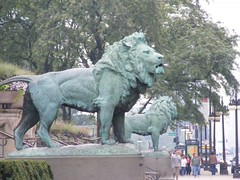
ALA Chicago 2009 013
Originally uploaded by ricklibrarian.
Nearly every librarian I know enjoys coming to Chicago. The city is especially beautiful this time of year, filled with flowers. There are more than ever since Mayor Daley has put planters everywhere and the parks have installed more gardens. The city is also full of museums, zoos, and great architecture. Having the American Library Association Annual Conference in the city is a popular idea.

As a librarian residing the western suburbs of Chicago, I benefit from having the conference here. I can send everyone in my department to the conference in shifts - we do still have to run the reference desk. My library's librarians benefit from all the opportunities the conference offers. The enthusiasm is high.

The organizers worked hard to present a good conference and people are leaving with many good memories and many ideas for their libraries. Still, I have to question whether Chicago is a good city for the conference.

I see one big, big problem - the distance between McCormick Place (the convention center) and the city center where all the visiting librarians stay during the conference. Complicating matters is the practice of holding many meeting away from the convention center. I heard numerous complaints on the buses about the distances and short times to get between meetings.

The real indication of a problem is the attendance at the remote meetings. I attended programs at the Intercontinental Hotel (where there is a bottleneck at the elevators to get to the seventh floor) and the Hyatt Regency. There were plenty of empty seats at the LITA Technology Trends forum and the RUSA President's Program on Readers' Advisory. I heard friends say that they did not attend because it was such a hassle to leave the convention center and get back for other meetings. I believe ALA needs to look at program attendance figures and see how the remote programs are not working well.

McCormick Place is clean and expandable, but not really warm and inviting. Food vending at this conference was definitely inadequate. Still, it might have been better to have all meetings at the center. There were more rooms. I know I could have attended two or three more programs if I hadn't been off on buses.

Still, there is a benefit from getting out of the sterile environment of the conference center. The city has many restaurants, shops, and parks that are just waiting for visitors between meetings.

If Chicago had a light rail to get people back and forth from McCormick Place, much of the problem would be solved, but that should have been put in place years ago. It would be more environmentally responsible to have the conference in a city that would not require so many bus and taxi rides. People like to walk. I suggest that we try Minneapolis, Indianapolis, or Milwaukee, cities with more accessible conference centers.

Sunday, July 12, 2009

Death at the Ballpark: A Comprehensive Study of Game-Related Fatalities by Robert M. Gorman and David Weeks


Death at the Ballpark
Originally uploaded by ricklibrarian.
I think that there may now truly be a book on every subject. At the McFarland Publishers booth at the American Library Association's annual conference, I found Death at the Ballpark: A Comprehensive Study of Game-Related Fatalities, 1862-2007 by Robert M. Gorman and David Weeks. Inside are listings for deaths of players, fans, umpires, or anyone else who happened to be a baseball game over a 145 year period. The authors have gathered their data from all levels of baseball, from youth to professional. The listings also tell cause of death, including suicide, violence, hit by pitch, foul balls, heart attacks, etc. McFarland has a number of interesting baseball books. I could spend the rest of my conference at the exhibit.

Books and Blogs, Made for Each Other?

The verdict on whether the Internet is killing reading is still out, as evidence presented often says more about its source than the readers being studied. What is clear is that an attempt is being made to utilize the web to increase reading, especially of books, as a community of book lover bloggers has grown. Included is this community are readers, librarians, authors, and publishers, each contributing to the promotion of books, but often for different reasons. At Booklist/Booklist Online: Books and Blogs, Made for Each Other?, Keir Graf of Booklist and a panel of bloggers discussed the relationship of blogs with books and its prospects for the near future.

The panel included the following:

  • Mary Burkey of AudioBooker, who started her blog to keep track of audio titles that she had read. Her independent blog was later acquired by Booklist.
  • John Green, a former Booklist employee, who with his brother posts videos to You-Tube as Vlogbrothers. He has also written a novel Looking for Alaska.
  • Kaite Mediatore Stover of Kansas City Public Library, who posts to Book Group Buzz for Booklist.
  • Nora Rawlinson, who has never been a Booklist employee. She was, however, the librarian at Baltimore County Public Library who uttered "give them what they want" and has worked as an editor for both Library Journal and Publishers Weekly. She is now writing the blog, EarlyWord, which is a for-profit effort.

Keir listed some qualities that make blogs useful to book professionals:

  • Blogs offer immediacy. Bloggers can address issues quickly and can discuss books at the time they are published or are otherwise in the news.
  • Blog writing is more personal and casual, allowing for a friendlier feel, attracting some loyal followers.
  • Because blog postings are often short, writers have to hone more concise writing skills.
  • Comments from blog readers start conversations that may bring forth issues that the blog writer did not address. They may also correct errors or otherwise keep the blog writer honest.
  • Through comments, bloggers know their readers better.

Here are some highlights from this discussion:

Authority is something in which print excelled in its prime. Readers trusted the reviewers in newspapers and magazines, such as the New York Times, Wall Street Journal, or Atlantic Monthly. Now that these publications have their own blogs, that authority has transferred to its blog writers. Nora thought this advantage would in time diminish as other brand names are established. Some bloggers have name recognition for being on the scene early. Kaite said that with so many people blogging it is now difficult for a new blogger to get recognized.

Few book bloggers make a profit - or anything. They do not often get readers the way that niche technology bloggers do. Book bloggers blog for love of books.

Well-produced book trailers may be a passing fad. There is not enough money in the book market to support most expensive publicity, and the panel opinion was that the novelty will soon wear off. John said that most blog readers seek authenticity and are suspicious of slick marketing.

None of the panelists thought that writing blogs hurt their print writing style. Mary thought that bloggers free of institutional ties are franker in their blogs.

None of the speakers thought that Twitter would replace blogging. It is a good vehicle for posting links to reviews on blogs or telling others what you are reading. John said that Twitter is more important to people in Third World countries because they can tweet and read from cellphones, which seem to be harder to restrict than Internet access.

Kaite liked that bloggers sometimes review old books. It is not all about buzz.

Libraries in Hard Times: The ALA Membership Meeting

For the last week, I have receiving emails and flyers urging me to attend Libraries in Hard Times at Saturday's ALA Membership Meeting. The marketing was well done, so my hopes were raised that it would be an interesting program. It was, but not really in the way that I expected. Patricia Wong summarized efforts of California Public Libraries to help the jobless and needy. Christopher A. McLean of the ALA Washington Office then reported on the federal government's stimulus package and what parts of it hold promise for library funding. The information was good (if a bit too general) but the setting and presentations and the timing did not do the subjects justice. The assembly hall was huge and the attendance slight. It was late in the day. We were very far from the speakers. I expected first hand stories from librarians telling what they are up against and what they are doing. I appreciate that the topic is being acknowledged before the assembly of membership, but it needs more coverage and debate in more intimate meetings where there will be more energy and passion.

On the up side, there were some useful web sites promoted, including Advocating in a Tough Economy Toolkit for the ALA President's Office. Another was the Library Use Value Calculator from Huntington beach Public Library.

Saturday, July 11, 2009

Pride and Passion: The African American Baseball Experience

I almost went to a management program at the American Library Association conference this morning, but my love of baseball (and my sweetheart) drew me to "Pride and Passion: The African American Baseball Experience" instead. I should listen to love more often. It was a wonderful program that I would not want to have missed. Not only did I hear Negro Leagues historian Lawrence Hogan recount his friendships with the old players, I heard Sharon Robinson tell about her new children's book about her father, Jackie Robinson, and I heard Kadir Nelson explain how he wrote and illustrated his award-winning We Are the Ship: The Story of Negro League Baseball. I will want to see Robinson's book (illustrated by Nelson) this fall. I have seen We Are the Ship and will post a review soon.

Anytime time there is a baseball reunion, there are good stories. They resonate because they are loaded with more meaning than just sport. To Hogan baseball is American history and to Robinson it is also family history. For Nelson it is beauty and inspiration.

This celebration of African American baseball launches the ALA traveling exhibit "Pride and Passion: The African American Baseball Experience." Two sets of illustrated panels are traveling to libraries around the country. One is in St.Louis currently while the other is on the ground floor of McCormick Place during the conference. It will then go to Milwaukee. The tour continues into 2013.

With My Book at ABC-Clio


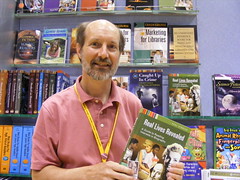
With My Book at ABC-Clio
Originally uploaded by ricklibrarian.
This is the day for which I have waited. My book is on sale at ALA! It is among the many titles on readers' advisory and library management at the Libraries Unlimited section of the ABC-Clio exhibit.

If you look over my right shoulder (left side of picture), you will see The Inside Scoop by Sarah Statz Cords. I seem to be right in front of all the Read On ... books. Sorry, Barry.

Bonnie said that ABC-Clio was serving champagne this afternoon. Could it have been to celebrate my book? Probably not.

The Riverside Shakespeare Purse


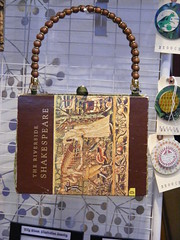
Riverside Shakespeare Purse
Originally uploaded by ricklibrarian.
There is a booth in the exhibit hall at the American Library Association that has display of purses made from old books. I wonder if Annie at my work could figure out how to make them and turn it into a library program? I know regular program attendees who would enjoy another project.

The Unconference at ALA

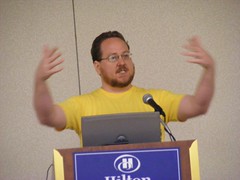
This is Jason Griffey of the University of Tennessee at Chattanooga, who opened yesterday's Unconference with a seven-minute presentation "The future of libraries in a ubiquitous computing world." It was a good beginning for a day full of conversation. You can find my full report on PlaBlog.

I will spend all day today in McCormick Place attending programs and wandering the exhibition hall. I hope to see my book.

Friday, July 10, 2009

Let the Conference Begin

Today, I start my American Library Association Conference experience with attending the Unconference. I plan to report on the programs I attend both here and at PLABlog. I will also post photos on my Flickr site.

Librarian at the Farmers Market

We have been told to take the library to wherever the clients are. I spent yesterday at a library table at the farmers market in Western Springs. It was the first time I have done such a thing, after several years of thinking that we should. I learned a lot of things right off the bat.

  • Big posters work like sails. It might seem like a calm day, but even the slightest puff of air will catch the poster and you will fly.
  • You need lots of rocks to hold down your handouts. Again the wind that you hardly notice will lift your papers and send them away.
  • Laptops are difficult to view in the sun. We wanted to do some reference from the table, but it was tough. Maybe someone can recommend outdoor PCs.
  • Do not expect people to rush the library table. People have come for the fruits and vegetables. You are a curiosity.
  • Do not expect all of your regulars from the library to recognize you. You are not where they usually see you.
  • Talk will be your most popular offering. You may return to the library with most of your handouts and books.

It was fun. The weather was beautiful and I enjoyed hearing Annalee, a folksinger raising funds for World Bicycle Relief, sing throughout the afternoon. I especially liked the Joni Mitchell tunes. She wanted to take bicycles to children in Zambia. We were all there in a good cause.

Thursday, July 09, 2009

Answers to the Biography Pop Quiz

Here are the answers to last week’s biography pop quiz. All answers can be found in my new book Real Lives Revealed: A Guide to Reading Interests in Biography.

Multiple Choice Questions

1. In Eminent Victorians, Lytton Strachey did not write about (b) Matthew Arnold. Strachey wrote about Thomas Arnold.

2. Supreme Court Justice John Marshall wrote a biography of (c) George Washington

3. Sheriff Pat Garrett shot the outlaw know as (d) all of the above, which were names used by the outlaw known as Billy the Kid.

4. Journalist Martha Gellhorn died from (b) suicide.

5. On Illustrious Men (De Viris Illustribus) was written by (d) all of the above. It was popular name to use in Latin collected biographies.

6. Singer Michael Jackson claimed that his life was changed by reading a biography of (c) P. T. Barnum, who wanted to present the "greatest show on earth."

7. Elizabeth Barrett Browning had a dog named (c) Flush, who was dog-napped several times. The author defied her father to pay the ransoms. This may have helped her finally break away from her domineering parents.

8. President Abraham Lincoln's friends did not included (b) the late David Herbert Donald who was a Lincoln biographer, not a contemporary, though you might suspect he would have liked to be a Lincoln friend.

9. After their baseball careers ended, Ty Cobb and Babe Ruth developed a friendship while (c) golfing.

10. J. Randy Taraborrelli has not written a biography of (c) Barbara Streisand.


True or False?

11. True - Ray Charles learned to play boogie-woogie piano before he was classically trained.

12. True - The pirate William Dampier was also a noted scientist who chartered ocean currents and drew tropical birds.

13. True - Ballet dancer Rudolf Nureyev was born on a train near Lake Baikal in Siberia.

14. True - Martha Washington burned all of her letters to and from her husband George.

15. False - Jonas Salk DID NOT suffer from polio as a child.


Bonus Question

16. Name the author of the first biography?

d. Ion of Chios is the best answer, as he wrote sketches of Pericles and Sophocles in the fifth century BCE. Scholars, however, do not agree on what a biography is, so the question is really hard to answer.

If you got any of the answers right, consider yourself pretty well-read.

Wednesday, July 08, 2009

Coop: A Year of Poultry, Pigs, and Parenting by Michael Perry

In his new book Coop: A Year of Poultry, Pigs, and Parenting, Michael Perry of northwest Wisconsin has moved with his new family into an old farmhouse with thirty-seven acres that could lie fallow while he prospers by writing. Having been raised on a family farm, however, Perry lives by principles, which include making the most of what you have. Though he never intended to become a farmer and is still reluctant to call himself one, he buys chickens and pigs.

Raising chickens and pigs is more work than you might imagine if you've never lived on a farm. A good portion of his year involves planning to build a chicken coop and pens for the pigs, learning about breeds, shopping for his livestock, feeding and caring for the creatures once he has them, and slaughtering them for meat. A less talented writer could make this pretty boring, but Perry uses it all to connect with his childhood and to muse on his future.

Readers may sense that Perry has lost some of the harder edge that he had in Population: 485. That's okay. Falling in love in Truck and raising children in the new book give him a new sense of purpose that requires a softened heart. He can, however, still write with clarity and honestly, free from sentimentality. Perhaps this skill comes from the same reserve that allows him to wring the necks of chickens with personal names.

As in Population: 485, there is tragedy, this time a nephew's death. In its wake he writes the following when visiting his parents' house:

And finally I climb the stairs to bed, to one of my childhood bedrooms, and stare straight up in the dark. I am remembering that before Jane was born, I was talking to a friend about how it was when he went from one child to two. "Love expands," he said, "to fit the need." I am wondering grief can do the same.


I found the stories of his parents fostering and adopting many children quite interesting. They certainly expanded their hearts. Readers may, too.

Perry, Michael. Coop: A Year of Poultry, Pigs, and Parenting. Harper, 2009. ISBN 9780061240430.

By the way, Citizen Reader in including Population: 485 in her summer book menage.

Tuesday, July 07, 2009

What I'm Doing at ALA

I have been looking through all of the offerings at the American Library Association Conference that starts July 10 in Chicago and have come up with this plan.

Friday, July 10

The Unconference, 9 a.m.-5 p.m. I am facilitating a discussion about nonfiction readers' advisory using the web.


Saturday, July 11

Gregory Maguire, 8 a.m.-9 a.m. The author of Wicked will speak at the Auditorium Series. It is pretty early and I have to drive in, so I might be late.

Open Knowledge Commons, 10:30 a.m.-noon. Digitized books from someone other than Google.

Booklist Online: Books and Blogs, Made for Each Other, 1:30 p.m.-3 p.m. I'm obviously interested in this.


Sunday, July 12

Net Neutrality and Its Implications for Libraries, 10:30 a.m.-noon. I might get the gist in half the time.

Top Technology Trends, 1:30 p.m.-3 p.m.


Monday, July 13

Lexis/Nexis Breakfast with Bonnie.

Rethinking the Reference Collection, 10:30 a.m.-noon. I am a reference librarian first. This is about the heart of my work.

From the Book and Beyond, 1:30 p.m.-3 p.m. More readers' advisory.

Tracy Kidder, 3 p.m.-4 p.m. I enjoyed Mountains Beyond Mountains and My Detachment: A Memoir.

Cokie Roberts, 5 p.m.-6:30. I heard Roberts in New Orleans and would enjoy hearing more.


I will probably add other presentations. I will be blogging about the programs I attend at both PLABlog and here at ricklibrarian.

I will also be checking in at the ABC/Clio exhibit to see my book.

Nonfiction Readers' Advisory in the Online World: For the Unconference

On Friday, I will facilitate a discussion about nonfiction readers' advisory and the role of the Internet at the Unconference before the American Library Association Conference in Chicago. If you are going to attend, here are some questions and statements to consider. Even if you will not be here, weigh in anyway with some comments.


Roles of the Internet in Nonfiction Readers' Advisory

· Tool for Assisting Face-to-Face Client

· Instruction Media for Readers' Advisory Librarian

· The Librarian's Rival for Readers' Advisory

· The Librarian's Platform for Readers' Advisory


Discussion Questions

· Is there a difference between fiction and nonfiction readers' advisory resources online?

· Are online RA resources easy to use with face-to-face readers?

· In an online world, who are our clients?

· Is the Internet better for indirect readers' advisory?

· Can we enlist our population of readers?


Web Sites and Services with Readers' Advisory Applications

· NoveList Plus

· Reader's Advisor Online

· Shelfari

· LibraryThing

· Amazon

· Barnes and Noble

· BookTV

· ChiliFresh

· Twitter

· BookLetters

· YouTube

· Google Books

· blogs

· podcasts

· chat and text


Nonfiction Readers' Advisory Observations


NoveList Plus has records for 47,157 adult nonfiction titles as of June 6, 2009. 108,604 adult fiction.

NoveList has genre based Recommended Reads: biography and memoir; business writing; current events and politics; food writing; history; humor; nature writing; religion and spirituality; travel writing; true crime.

To find read-a-likes, NoveList searches subjects and broad categories, not appeal factors. If library catalogs were more powerful, they could do as well.

Reader's Advisor Online collects the content of Libraries Unlimited books, few of which are nonfiction.

Reader's Advisory Online Blog and Early Word have lots of nonfiction alerts.

Shelfari genre groups vary in level of response to discussions. Some have growing memberships and active administrators. Some groups seem to duplicate already existing groups.

Librarians Who LibraryThing is the service's most populous group.

LibraryThing groups seem to respond to original discussion queries but rarely comment on the responses.

LibraryThing title records include member ratings. Could they be more reliable than Amazon ratings which can be manipulated by authors and publishers?

Twitter does not seem designed for RA, but users still broadcast requests for book help. Do librarians go to the readers? Is there a good way to harvest these tweets?

NPR Books, New York Times Book Review and Washington Post Book World podcasts lean toward nonfiction.

Charlotte-Mecklenburg County Public Library does a good job of getting readers to share reviews.

BookLetters and NextReads include customizable emails for nonfiction genre.

Book Ratings on LibraryThing and Amazon

I was wondering how similar or different reader ratings in LibraryThing and Amazon would be. So I tried a title. To the left is the result. The reader consensus is just about the same.

Of course, this needs more study. Has anyone else already done this?

I am wondering whether Amazon ratings can be more easily manipulated by authors, publishers, or publicists. Is this really something worth worrying about?

Any thoughts?

Monday, July 06, 2009

Montmorency: Thief, Liar, Gentleman? by Eleanor Updale

Thanks to Heather Booth, who had a stack of teen fiction on the reference desk, I now have a new series of books to read: Montmorency by Eleanor Updale. I liked how the covers of the books in the series evoked a foggy nineteenth century London. I anticipated something dark and cerebral and was not disappointed in the first book Montmorency: Thief, Liar, Gentleman?

The story begins in 1875 when a young surgeon saves the life of a criminal who is badly injured in falling through skylight. As the surgeon takes his patient to various scientific society meetings to show off his handwork, the criminal is introduced to both scientific thinking and the lives of gentlemen, sparking a desire for a better life than that of a petty thief. At first, his vision is simply being of a higher class of criminal. With diligence and ingenuity, he sets forth to realize his dream of comfort and achievement through burglary.

What seems unusual to me about Montmorency: Thief, Liar, Gentleman? is that readers are asked to cheer for a master criminal. To any reader who has difficulty with that idea I recommend just accepting that a criminal can be a heroic character. I do not want to say too much and spoil the plot. I will say that some of the incidents are quite amusing. I enjoyed contemplating execution of the crimes, and I think others will, too. Perhaps there is a master criminal in each of us.

Updale uses her deep knowledge of Victorian England in telling a compelling story. I particularly enjoyed learning about Joseph Bazalgette and the engineering of the London sewer system. The details of men's clothing are also finely done. I think fans of English literature and readers who like clever characters will enjoy this quick reading book.

Updale, Eleanor. Montmorency: Thief, Liar, Gentleman? Scholastic, 2003. ISBN 0439580366

Friday, July 03, 2009

Magyk by Angie Sage

One of my goals for this year is to learn more about books for teens and tweens. In our library's remodeling late in 2008, the teen collection moved much closer to the reference desk, which has resulted in a great increase in readers' advisory for middle school students. While I have read and even reviewed some good books intended for teens, I still do not know enough. Needing more audiobooks anyway, I am trying to mix work and pleasure with listening to teen-oriented audiobooks.

Last week I listened to Magyk by Angie Sage, the first of the titles in the Septimus Heap series, books about wizards, princesses, evil bureaucrats, and magical beasts. That is almost all I want to say about the fast-moving story as there are many plot twists that should not be foreshadowed in reviews. I did look at some reviews after finishing the audiobook, trying unsuccessfully to learn the name of the magical world that Sage has created. Almost all of the reviewers gave plot secrets away. I am glad I listened with no preconceptions.

A reader of fantasy will, of course, find elements in the story that remind him or her of other series, especially Harry Potter, but I found enough new ideas to be entertained. Magyk is widely available in public libraries.

Sage, Angie. Magyk. Recorded Books, 2005. ISBN 1419338048

Thursday, July 02, 2009

Digital Photos Management: A Presentation at Thomas Ford

With many of our residents about to take summer vacations and vacation photos, I presented a program Digital Photos Management to twenty-five library users in our downstairs meeting room last week. I knew from the first that I had a lot to cover, so I got us started right away. My plan was to just briefly mention buying and taking photos. The emphasis of the presentation was what to do with photos after taking them. My assumption, which proved a little naive right away, was that everyone moved their photos from their cameras to their computers. A handful of the participants did not want to have anything to do with computers! Instead, they regularly take their cameras to Walgreens, Fox Photo, WalMart, etc., and use the printing services there. Some have mastered the self-service machines, but others always get staff assistance. Even though my publicity specifically mentioned use of a computer, a few people had different expectations for the program. Unfortunately, they got little from my program, and some left early.

In an hour and a half, I demonstrated loading photos onto a computer, arranging files in Windows, simple photo editing with Picasa, uploading photos to Flickr and Kodak Easy Share Gallery, attaching photos to email, and posting a photo on a blog. We discussed how to store your photos on CDs, DVDs, and extra hard drives, backing up photos before you edit them, and the idea of sharing your photos via the Internet. It was an ambitious program, which might have been better presented as a series, I now conclude.

From discussions with several of the participants as they dropped by the library in the days following the program, I gather that they did learn something valuable. Some were exposed to ideas that they had not encountered. Each of them seems to have a certain goal, such as better editing or sharing their photos with family. I told them that I am available to help them further through our "Book a Librarian" service. I expect to see several amateur photographers this summer. I've appointments with three already.

I was also asked to take photos at a wedding, but I declined.

Why People Read

Cindy Orr at RA Online has a great post Why People Read. She searched the Internet and found dozens of great statements. It seems like they should be used and spread around.

Wednesday, July 01, 2009

Drinking the Sea at Gaza: Days and Nights in a Land Under Siege by Amira Haas

When you belong to a book club, you will at some point book read books that you never had on your list. That was the case with me and Drinking the Sea at Gaza: Days and Nights in a Land Under Siege by Amira Haas. It is already an older book (translation 1999) that I did not recall. It deals with the Gaza Strip, one of the Palestinian enclaves with the state of Israel, not a subject that I long to contemplate. The troubles in the Middle East have been daily news for sixty years. What more could I learn that I have never heard?

The problem with relying on broadcast or even print news is that it rarely gets under the surface of the story. Reporters drop in and soon leave, just reporting what they learn from a little observation and listening to official spokespeople. Amira Haas, an Israeli journalist and a Jew, however, became a Gaza resident to observe the lives of Palestinians over the course of several years. What she found was quite troubling, an entire society being repressed.

While Haas tells intimate and compelling stories, the net effect of the book is overwhelming. I took nearly two weeks to read her book filled with many accounts of injustice and hopelessness. Palestinian authorities and Israeli political and military leaders have all failed to even consider the lives of the powerless men, women, and children of Gaza, many living in refugee camps since 1948. 1948 is a long time.

Our discussion of Drinking the Sea at Gaza was lengthy and not confined to the content of the book. A couple of people had wished that the stories had been arranged more chronologically, to help readers understand the events. We naturally included a discussion of American policy toward the Middle East. The consensus was that our government has enabled injustice, but we had no firm ideas of what would have or can help.

The story Haas tells has, of course, been dismissed by Hamas, Fatah, and Israeli partisans, which is itself a good reason to have it in libraries, available to readers. Not many of our libraries seem to have it. Will the stories be forgotten?

Haas, Amira. Drinking the Sea at Gaza: Days and Nights in a Land Under Siege. Metropolitan Books, 1999. ISBN 0805057390