Wednesday, June 30, 2010

8:55 to Baghdad by Andrew Eames: A Second Reading

I just reread 8:55 to Baghdad by Andrew Eames for a book club discussion. I was surprised how much I had forgotten about the book. I remembered that he traveled as much as he could by increasingly dilapidated trains to visit sites from Agatha Christie's life and that he described events from both her and his lives. In my memory, however, there was more of hers and less of his. In fact, on rereading I find the opposite. His London to Baghdad trip in the days just before the American invasion of Iraq dominates the book.

I believe I focused more on the Christie story in the first reading, as the events of her life were newer to me as a reader then. I have since read much more about her. So this time, I see how Eames really just introduces the story of the famous mystery writer traveling alone to the Middle East and falling in love with a younger archeologist. But he did tell this story well enough to get me to read more.

In my memory, 8:55 to Baghdad was a light reading choice. I am surprised on rereading to find several very crude, sinister characters and a deep sadness about the breakdown in society and the loss of hope for some cities in Eastern Europe and Asia Minor. I had forgotten the whole "these Iraqis may die soon" aspect of the final chapters. Eames reminds us of the anxiety hanging about before the spring of 2003.

I do not often reread books other than classics like The Hobbit or The Scarlet Letter, but I can see how it can be a useful study in assessing my own memory.

Eames, Andrew. 8:55 to Baghdad. Overlook Press, 2005. ISBN 158567673X

Monday, June 28, 2010

The Time Machine by H. G. Wells

Thomas Ford Memorial Library is featuring science fiction and fantasy in its summer reading program for grownups this year. We have made lists of classic science fiction, magical realism, science fiction for the reluctant, high fantasy, and science fact behind the fiction to help readers choose titles. From those lists, I chose to read a pioneering title, The Time Machine by H. G. Wells.

Readers get a double treat when reading Wells. Some of his scientific ideas still hold a lot of sway in science fiction genre and media. Moving about in time is utilized by many authors in stories, ranging from the stories of Andre Norton and Robert Silverberg to episodes of Doctor Who and Star Trek. In addition to science ideas, readers get a peak at the past. When Wells wrote science was just emerging from the era of amateur scientists, often gentlemen who belonged to academic societies. The central character in The Time Machine, called simply the Time Traveler, invites prominent Londerers, including doctors and newspaper editors, to witness experiments in a lab of his Victorian home. The time machine itself is built of a mixture common and rare materials, all known in the late nineteenth century. The gentlemen express the idea that the result of science investigation is undoubtedly world improvement. Wells, however, uses his story to question the assumption that a better world will be made and maintained.

I listened to The Time Machine read by British actor Simon Prebble, who sounds just like a gentleman scientist who puts his life on the line for science aught to sound. At four hours (one on each of four compact discs), the story may be heard in an afternoon of driving or gardening. I enjoyed the book and may try other Wells stories available as audiobooks as part of my revisiting science fiction this summer.

Hells, H. G. The Time Machine. Standard Publications, 2008. ISBN 9781605978871

4 Compact Discs. Recorded Books, 1996. ISBN 9781402549776.

Saturday, June 26, 2010

Chocolate Cosmos at the Chicago Botanic Garden


Chocolate Cosmos
Originally uploaded by ricklibrarian.
Usually chocolate flowers come wrapped in foil from the candy shop, but this chocolate cosmos that we saw today the Chicago Botanic Garden is real. The color is a glowing reddish brown and it even smelt slightly of chocolate. We saw it in the Sensory Garden, along with straw flowers, which are living but feel as if they are dried or made from paper.

If you live in the Chicago area and have never been to the Chicago Botanic Garden, check your library to see if it has passes available through the Museum Adventure. The pass for the garden allows for parking, as the garden itself is free.

Wednesday, June 23, 2010

We Still Need Old Newspaper Databases

I am writing an abstract of When Money Was In Fashion: Henry Goldman, Goldman Sachs, and the Founding of Wall Street by June Breton Fisher for my next readers' advisory book. In these abstracts of biographical books, I include birth and death years in parentheses by the subjects' names in the abstracts. Because Fisher never actually states the birth date in her tribute to her grandfather (which I am including in a list of biographies written by friends or family), I have had to do a little research.

I resisted looking first at Wikipedia. Instead I tried the biographical databases from both Gale and EBSCO. Neither even includes Goldman, which I found interesting. Fisher suggests that her grandfather (son of Goldman Sachs founder Marcus Goldman) was written out of most corporate histories because he vocally supported the German cause during World War I. He also did not appear in The Encyclopedia of World Biography, the World Book Encyclopedia, or the Funk and Wagnall's New World Encyclopedia. So, I returned to Wikipedia, where I found Goldman mentioned without dates. Then I just tried a general search of the Internet without luck.

Remembering my roots as a reference librarian, I logged into the New York Times Historical 1851-2006 database, to which I have access as a library card holder of the College of DuPage. There I found an article and an obituary for Henry Goldman stating that he was born September 21, 1857.

It still helps to have authoritative sources.

Monday, June 21, 2010

Tough Times: Thoughts on the Library Job Market from a Department Head Who Just Hired a Reference Librarian

Library funding news has been bleak for the last couple of years. Municipal budgets are flat or declining, and loss of funding from state governments is hitting all types of libraries particularly hard. Not many full time library positions are being offered on the job lines. Knowing all of this, I was still surprised by the huge response to the posting of a full time reference librarian's position at my library. In the past, we had never gotten more than about forty applicants for a job that we posted, and even then a third of the job seekers were people from other fields thinking that they could bypass the requirements for library training and experience. After I posted our position in April, I received seventy-eight applications with resumes from fully qualified librarians or library students close to qualifying.

Reading through over seventy letters (a few foolish applicants failed to send cover letters), I got a look into the very deep pool of library talent that is currently available for hire. Many qualified, experienced, and creative librarians are currently either unemployed or under-employed. From my reading of the letters and resumes, I sense that under-employed is the new norm for young librarians. Quite a few have been working in part time library positions for several years, perhaps supplementing that employment with work at restaurants, discount stores, and such. Many have been volunteering at libraries or social services agencies that they feel translate into relevant experience. A fortunate few are making ends meet with two part time library jobs. Many get glowing references from employers who wish they could give them full time hours. New graduates from library school have these now experienced librarians competing for the same few jobs.

While I did not sense despair from the letters, there seemed to be a heightened urgency to get a library job that actually paid a living wage. The applicants are ready to work. Several expressed that the open position was just what they had been seeking – a position that sparked their imagination. They were sure that they were perfect for the job. I am sure that many of them would have done well. My first call folder was rather thick.

It always stings not to get a job for which you are qualified and enamored. Nothing I can write here can lessen that sting for the many hopeful applicants that did not even get an interview. At this point all the applicants know the outcome, for I did contact them to announce the position was filled.

A second round of surprises came after my carefully worded closing letters. Around a dozen applicants thanked me for letting them know that the job was filled. While the news was not good for them, it was an acknowledgment of their offering themselves to my library and ended any doubt that they had as to their status in the process. Another handful of applicants asked me through email or even by phone call what they had lacked to be considered. Here I answered carefully, saying what I had sought (a reiteration of the job announcement) instead of dissecting what the candidates lacked. They could then make their own analysis. By doing this, a potentially awkward question (which I would not deny them) became a more positive conversation.

I have spent weeks thinking about the experience and have a few observations for people applying for jobs.

1. Send a well-written cover letter of no more than three paragraphs that covers about three quarters of a page. Address how you meet the job criteria. Don't stray into your irrelevant (to the job) interests and activities. Be positive without boasting.

2. If you are sending cover letters and resumes by email (which most people do), be very careful to send the right ones specific to the job for which you are applying. Sending letters addressed to other parties does not engender any confidence in your ability to do good work. If you are applying to a public library, do not state on your resume that your objective is to work in a government archive. This seems pretty obvious, but I saw six or seven cases of incompatible objectives.

3. For the benefit of the prospective employer, who might be collecting Word documents or PDFs in a folder, put your name in the document name. It saves the employer from having to rename dozens of documents named "resume."

4. If sending paper letter and resume, be sure to include your email address so the prospective employer can quickly verify that it was received. Not including an email makes you seem out of touch.

5. PDFs often look better when opened by the prospective employer, whose Microsoft Word might have different margins than the applicant's Microsoft Word.

6. Have patience. Looking through applications and setting up interviews takes time. Calling or emailing the prospective employer to ask when your interview will be the moment the application period ends will not portray you as the calm and confident candidate that the employer seeks.

Here are a few thoughts for the profession as a whole.

1. This is not the time to push prospective librarians to attend library school. Only those people who know the current conditions and who either have a job already lined up or are willing to risk spending a few years under-employed should start working for a degree.

2. Library schools need to scale back to survive. If too many degrees are issued causing an overabundance of librarians, the news will eventually reach prospective future students and registrations will fall.

3. Finding satisfying non-traditional jobs for current and future library students is also needed.

Thousands of librarians are meeting at the annual conference of the American Library Association this week in Washington, D.C. I suspect there will be many there seeking jobs. I hope to read how well they did finding them and how the issue of jobs for librarians is address at the conference.

Friday, June 18, 2010

Melrose Park by Fidencio Marbella and Margaret Flanagan

I wonder how many librarians have written Image of America series local history books? I remember that Barbara Paul was the co-author of two titles about Chicago Heights, Illinois. Now I have read Melrose Park by Fidencio Marbella and Margaret Flanagan with help from the reference staff at the Melrose Park Public Library. Heidi Beazley, who we just hired at the Thomas Ford Memorial Library, gets a special thanks in the Acknowledgements.

In some ways, Melrose Park mirrors the other suburban communities that formed in the late nineteenth century. The village rose around a station on the Galena and Chicago Union Railroad. Established to help farmers get their crops to the city, the station soon sent workers into the city and later attracted industry to the area. The village had a period of rapid growth during which schools, churches, and governments were formed. Waves of immigrants changed the community character. Industry brought more jobs to the area. Sons and daughters went off to war. In the post-World War II era, developers built many houses.

Having made the statement about typical development, Fidencio and Margaret show how Melrose Park developed its own character. I was particularly struck by Chapter Five: Food, Fun, and Festivals, which shows among other things (1) Kiddieland Amusement Park, a small local amusement business that bucked economic and cultural trends to survive over many decades, and (2) the community's long-running Festa della Madonna with its Feast of Our Lady of Mount Carmel procession and the display of icons in yards. I also think Chapter Six about the Palm Sunday Twister, a highly destructive tornado in 1920, and Chapter Seven, showing 1907 and 2007 scenes, are particularly compelling.

My library is fortunate to have a special fund that helps us get local history publications. We have gotten quite a few of the Chicago and suburban Image of America titles which not only help history fair students but also resonate with our long time residents. The quality of editing of these titles sometimes varies. Maybe having reference librarians involved is an especially good thing, as Melrose Park is one of the best of the series that I have seen. What other titles are by librarians?

Marbella, Fidencio and Margaret Flanagan. Melrose Park. Arcadia Publishing, 2009. ISBN 9780738560939.

Wednesday, June 16, 2010

The American Robin by Roland H. Wauer

A week or so ago, I got an email from my aunt, telling me how one of her friends married a man who became prominent birder and wrote wildlife guides while working for the National Park Service. Marian Sue told me this after noticing some bird pictures that I posted. Being a reference librarian, I did the logical thing and looked the author up. Low and behold, my library actually owned one of his books, The American Robin by Roland H. Wauer. I checked it out and read a little that night and most of the rest waiting for a train the next day.

In easy flowing text, Bauer tells us much about America's most widely distributed songbird, a bird so common that it is almost universally recognized and rarely considered worth considering. The robin is a bird that has actually benefited from suburban development of land, as it thrives on lawns that expose worm habitat. As humans have built towns in various environments that were not previously robin-friendly (like deserts), the red breasted birds have followed. Robins are now found in all 48 contiguous states. Still, the life of the robin is fraught with danger. Breeding pairs can produce many young over the course of a summer, but most fall prey (either at the egg or fledgling stages) to house cats, hawks, squirrels, and snakes. The best part is when Bauer tells unusual stories that make readers realize that not all animal behavior is uniform and predictable. I liked especially the stories about robins cooperating with birds of other species to raise chicks and protect against predators.

As I read, I kept nodding to myself as I realized I had seen much of what Bauer describes. He verified that the speckle chested bird that Bonnie and I saw following a robin on Memorial Day weekend was a fledgling. The mature robin, according to Bauer, must have been a male, as the males take responsibility for young right after they leave the nest, while females attend to the next brood of eggs.

Published by the University of Texas Press, The American Robin is one of a series of books in the Corrie Herring Series, which focuses on natural history topics. I want to read The Cardinal by June Osborne and The Mockingbird by Robin W. Doughty. Then I might read about some raptors.

Wauer, Roland H. The American Robin. University of Texas Press, 1999. ISBN 0292791232.

Monday, June 14, 2010

The Woman Who Shot Mussolini by Frances Stoner Saunders

On the morning of April 7, 1926, a middle-aged Anglo-Irish woman stood on the steps Rome's Palazzo dei Conservatori, waiting for Italian dictator Benito Mussolini to emerge. Though surrounded by police, Violet Gibson (1876-1956) raised a pistol eight inches from the head of her victim and shot, only nicking the dictator's nose. In The Woman Who Shot Mussolini, author Frances Stoner Saunders deftly reconstructs the life of a former debutant who dabbled in Irish nationalism and swore to being on a mission from God.

The date of Gibson's attempted assassination cuts her adult life almost in half. Up to age fifty, she had been an independent woman living an unconventional life, supported by the small fortune left to her by her father Lord Ashbourne. Everything she did seemed to annoy and shame her family, especially her conversion to Roman Catholicism early in the twentieth century, when many upper class British thought the faith very lower class. She also voiced her support of Irish independence, which irritated her Irish Protestant family greatly, except for two brothers who may have been funding the forerunners of the IRA. Though she became an avid Catholic, she on numerous occasions claimed to have initially gone to Rome to kill the pope. Mussolini then caught her attention instead. After shooting Mussolini. Gibson spent thirty years in prison and psychiatric hospitals.

The Woman Who Shot Mussolini is primarily about Gibson, but there is much about Mussolini in the text as well. It is now forgotten that Great Britain was an early supporter of the Fascist leader, sending secret funds to his campaign to take power over Italy. Foreign Secretary Austen Chamberlain (brother of future Prime Minister Neville Chamberlain) was a vocal supporter of the Italian, as were King George V and Winston Churchill. They all said that someone strong and ruthless needed to control the wayward Italian people to keep them from becoming communists.

Saunders turns to a remarkable source for much of her story about Gibson's later years. The would-be assassin wrote many quite lucid letters from St. Andrews Hospital for Mental Illness asking for help to get her released from the institution. She argued that she only pretended insanity to be released by the Italian courts instead of being imprisoned or even executed. Instead of mailing the letters, St. Andrews kept them all in a large file, effectively keeping Gibson from ever being heard by the outside world again. When some people began saying that Gibson should be considered a hero for trying to eliminate a brutal dictator, few knew she was still living and locked away in England without any chance of defending herself. Saunders found the file still full and open to scholars.

In this biography with many photos and documents, Stoner never says whether Gibson was sane, insane, or just temporarily insane. She presents copious evidence. I'd vote three quarters sane. What would you say?

Saunders, Frances Stonor. The Woman Who Shot Mussolini. Metropolitan Books, 2010. 380p. ISBN 9780805091212.

Friday, June 11, 2010

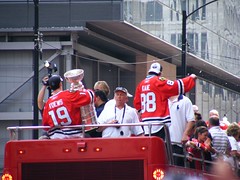
Toews with Stanley Cup


Toews with Stanley Cup
Originally uploaded by ricklibrarian.
Bonnie and I attended the Blackhawks Victory Parade today. The news is saying two million other people were there. I do not know about that. We stood for two hours across from the Daley Center waiting for the parade. The wait was made more bearable by there being a giant screen showing the Mexico-South Africa game starting the World Cup. It did get a bit crowded just before the parade. A woman close to us fainted in the heat. We suspect that it was much more populous along Michigan Avenue and toward the presentation stage. We did not even attempt to get there. Everything went well for us. We got a train just when we wanted coming in to Chicago and going home. We heard that some people had to wait two hours to get on a train home.

This is the only picture that I got of the Stanley Cup. I would have had a better shot with Toews holding the cup high, but someone's arm went up in front of me. There are other pictures at my Flickr site. Click on the photo to get there.

Historical Fiction II: A Guide to the Genre by Sarah L. Johnson

When I was offered a Library's Unlimited readers' advisory title of my choice as a thank you for writing about the Public Library Association Conference in Portland for Reader's Advisor Online Blog, I asked for a copy of Historical Fiction II: A Guide to the Genre by Sarah L. Johnson. I am glad I did. It was a good choice, as it is filled with recent titles and much advice about selecting reading in an apparently very hot genre. We are adding it to our reading advice center. I hope some of our readers take it home and come back to the library with their reading lists. I'm sure we will have to do a lot of ILL, for there are more titles in this book than most libraries could ever hope to own.

How many titles, you ask? In her introduction, Johnson says that there are 3,800 titles published between 1995 and 2008 mentioned in the book. Most of the main entries are for historical fiction titles published between 2004 and 2008. Looking through the chapters and checking the indexes, it appears that the coverage of history is quite wide. The possibilities of matching novels to real history books in paired readings (using other sources to find the nonfiction) is almost endless. Someone who is inclined could devote the rest of his or her life to reading the titles reviewed in Historical Fiction II.

As you might guess from the title, Historical Fiction II is a sequel to Historical Fiction: A Guide to the Genre, published in 2005. It might be the largest of the volumes in the Genreflecting Advisory Series. I was quite surprised by its size. Will another be coming in four or five years? I hope Johnson gets a vacation.

Johnson, Sarah L. Historical Fiction II: A Guide to the Genre. Libraries Unlimited, 2009. 738p. ISBN 9781591586241.

Wednesday, June 09, 2010

Reflections of a Reference Librarian by Susan J. Beck

In her final column for Reference & User Services Quarterly, Susan J. Beck, outgoing president of the Reference and User Services Association, does more than reflect on the year and say thanks. She has used the column to present a sort of "This I Believe" statement about her commitment as a librarian. Being a contemporary, entering the field just a year and a half before Beck, I read "Reflections of a Reference Librarian" (Summer 2010, Volume 49, Number 4, pp. 305-9) with interest, nodding my head throughout.

I agree with Beck on many counts. Understanding cataloging seems essential to reference work. Fewer people are sharpening pencils. Library students shouldn't hesitate to ask reference librarians for help. Reference librarians are still needed in the digital information age.

On the third page of her piece, Beck issues a challenge "I actually read library literature - do you?" She suspects that many librarians do not, a suspicion I share. I think that many can still do their jobs adequately without constant study, for they have inborn qualities that make them good service providers, and as reference librarians, they can look up what they do not know. And I admit that I read selectively, choosing what interests me and sometime ignoring more management oriented articles from which I might benefit. But "good enough" and "adequate" are not really good enough for our survival. No matter how long we have been around the profession, reading the literature for new ideas and inspiration is essential.

I read her thoughts about volunteering on professional committees with a little regret. I feel I have never done quite enough of this myself. There is a balance that needs to be maintained, keeping the reference desk staffed and also getting away to advance the profession. In the past, librarians in small libraries sometimes could not get away enough to really be committee people. Time, distance, and expenses were at issue. With new ways of meeting via the Internet, more people can be involved. Let's hope librarians avail themselves of the opportunities and not later regret their reluctance.

Beck hints about retirement - "declining years of my career." From what she says, I doubt she is declining as she still seems to aspire to learn and improve. I hope her article inspires old and young librarians to keep up with her.

The column does not appear to be online as I write. Watch for it on the RUSQ website.

Monday, June 07, 2010

Mrs. Adams in Winter: A Journey in the Last Days of Napoleon by Michael O'Brien

Being left in St. Petersburg, Russia in 1815 when her husband John Quincy Adams was made ambassador to France, Louisa Catherine Adams (1775-1852) decided to take a risky journey with her young son through war-torn Europe to join him in Paris. Selling off furniture and arranging for their possessions to be shipped later, she began the trip in deepest winter, when sleds provided better travel over the frozen ground than wagons, and arrived forty days later in Paris, just as Napoleon dramatically retook command of the French government after escaping from his exile on the island of Elba. Historian Michael O'Brien recounts Mrs. Adams's adventure with its annoyances and dangerous encounters in Mrs. Adams in Winter: A Journey in the Last Days of Napoleon.

O'Brien does more than just describe a trip. Using the forty days as a frame, he flashes back to Mrs. Adams childhood, courtship, marriage, and family life, all made difficult by the constant travel and the bankruptcy of her father. Though the child of an American tobacco salesman, she was born in London and spent her youth in Europe; she first saw America after her marriage to a future president, making her the only foreign-born first lady. Her mother-in-law Abigail Adams opposed the marriage, and many Americans suspected that she was unsympathetic to American causes. Through use of her letters and manuscript memoirs, O'Brien depicts her as woman who overcame shyness to tactfully stand up to border guards, innkeepers, bureaucrats, generals, and, ultimately, her own husband.

How Louisa related to John, who often made decisions without consulting her, is examined through the book. He was admittedly not a romantic man, who rarely even mentioned her in his diaries. The trip that she initiated and planned was a turning point in her relationship with him, showing that she had strength that he had discounted.

Mrs. Adams in Winter is also a history of a moment in Europe when nations were splintered and travel was dangerous. Tensions were high at many borders, and Mrs. Adams's command of languages helped her in several tight situations. While there were many criminals and rouge soldiers on the road, she was able to find sympathetic people, some of whom she knew from her husband's previous stations, who helped her exchange diverse currencies, get her passports approved, find trustworthy coachmen, and choose safest routes. History readers will find firsthand observations of a difficult time in this adventure biography.

O'Brien, Michael. Mrs. Adams in Winter: A Journey in the Last Days of Napoleon. 2010. Farrar Straus and Giroux. 364p. ISBN 9780374215811.

Friday, June 04, 2010

Billy Elliot: The Musical

Last night we celebrated a belated Mother's Day by taking Bonnie to the Oriental Theatre in Chicago to see Billy Elliot: The Musical, book and lyrics by Lee Hall and music by Elton John. Of course, as it worked out, Bonnie booked the tickets herself and identified which train for us to catch to get there. She also found our restaurant. I did pay for the meal and train tickets. So Laura and I did not have to work very hard on this Mother's Day present, but Bonnie got what she really wanted, and we enjoyed the evening with her. Billy Elliot is fantastic.

We arrived at the theater to find we were sharing the balcony with many high school students. They must have come by the busload. The ushers at the door threatened nearly every one of them with confiscation of cameras and cellphones if they dared to take a picture. I must not have looked menacing as I did not get the warning. Ironically, having forgotten my camera, I sat wishing I could snap a few pictures of the mythical creatures decorating the theater walls.

I thought after the first few scenes that we might have a rather long night. The British accents were very thick in the opening - I hardly understood a word of the coal miners calling for a strike- and the comic scene of Billy at boxing lessons was not really very funny. Then the full company sang and danced to Elton John's pounding "Solidarity." With police facing off against the striking miners and the little ballet girls and Billy in between, I was hooked. It was both menacing and comic. I particularly liked how the police and miners ended up wearing each others helmets.

The next dance with Billy and his good friend Michael, who likes girls' clothes, has a lot of surprising set changes, that I do not want to reveal. I will say that eye-popping elements of the staging prepare theater goers for the opening song of the second act, "Merry Christmas, Maggie Thatcher."

Billy Elliot with its language of a coal mining village is not a show for sensitive viewers. It is at times violent and crude, but it is also sweet and sentimental and has great dancing. We saw high energy fourteen year old Tommy Batchelor as Billy. He must have been exhausted after all the ballet, tap, and contemporary dance. He alone was worth the price of admission. Father's Day is coming up. It is tempting to go again.

You may see scenes from Billy Elliot at the tour website.

Thursday, June 03, 2010

The Readers' Advisory Handbook, edited by Jessica E. Moyer and Kaite Mediatore Stover

Here is more good advice on how to give reading advice. Jessica E. Moyer and Kaite Mediatore Stover have collected twenty-two articles from practicing librarians into their recent The Readers' Advisory Handbook, published by ALA Editions. Divided into five sections, these practical pieces help librarians learn to evaluate materials and collections, write reviews, and get books into the hands of readers. They also push the definition of readers' advisory way past the one-on-one client transaction. The pieces near the end of the book suggest new and special services. I am particularly inspired by David Wright's article "Adult Storytime" in which he describes running storytimes for grownups at the Seattle Public Library, showing how these programs promote short story reading. I'd like for my library to adapt his ideas.

I am not involved in service to prisoners, but others are, including the newly formed Chicago Deskset, which raised money to get books for the residents of the Juvenile Temporary Detention Center. The members of this group may benefit from reading and contemplating "Readers' Advisory for Incarcerated Populations" by Kate Pickett and CJ Sullivan. These Kansas librarians distinguish between the residents of treatment centers and inmates in prisons and jails, identifying the different problems librarians face in connecting readers and books in these institutions. In all cases, the librarians have to convince facility administrators and staff of the good of providing books to their wards and then navigate through institutional rules that may limit what they offer. Pickett and Sullivan's thought may help activist librarians succeed.

My library needs to plan how it writes and distributes booklists better. It has been a recurring problem. Several articles in the middle of the book address the issue, showing many types of lists that can be written and various media for distributing them. These articles also identify websites that feature already made lists that librarians can tap as needed or adapt to promote their own collections.

While The Readers' Advisory Handbook may be used in library schools, I foresee it being of the greatest help to frontline librarians trying to improve their services. In this valuable guide, they will find RA advice procedures, forms to use in RA service, and sample titles and authors to suggest to readers. Novices and seasoned librarians can benefit from consulting The Readers' Advisory Handbook.

The Readers' Advisory Handbook. ALA Editions, 2010. ISBN 9780838910429.

Tuesday, June 01, 2010

Life on the Mississippi by Mark Twain

I'm still in my Mark Twain phase. I'm sure I will get over it soon, but I have just enjoyed listening to Life on the Mississippi read by Norman Dietz. The audiobook box reads "performed by Norman Dietz," which captures the effect well. I felt Mark Twain was speaking directly to me as I enjoyed 14 and a half hours of recollections and yarns about his days on steamboats and an account of a journey to revisit his youth.

Twain has always divided librarians. In his day, a few quality-conscious librarians thought his works were not appropriate for library collections - you would not want youth following his poor examples of behavior. Until the 1980s and wide application of newer cataloging rules, librarians disagreed on whether to file his catalog cards under Clemens or Twain. In various libraries still, I notice how inconsistently the Twain's memoirs/travel adventures are treated. Sometimes they are shelved as nonfiction in the biography or literature sections, but they often are grouped with the novels in the fiction section. I'm sure Twain would himself be amused by all the trouble he is still causing.

Several cases can be made for Life on the Mississippi, Innocents Abroad, and Roughing It being shelved with fiction. Twain was far more committed to humor than truth, often telling outright lies about his past; Twain created in himself a character that resembled the real person but with extra adventures that can not be true. With the popularity of Library of America publications and other collections, the novels and memoirs are often lumped together in volumes. You might as well put those and all the individually bound memoirs in fiction where they will more easily be found.

Life on the Mississippi is a worthy book no matter where you put it. It starts with a bit of recollecting and then several short chapters on the history of the river. After joyfully noting every fact and story about Mississippi geography, exploration, and commerce that he could find, Twain returned to his own past and told about being an apprentice pilot learning all the dangers of the river. He made fun of his own ignorance and laziness and all the lessons he had to learn about life as well as piloting. The Civil War ended his river life. The last half of the book is an account of returning to the river in the 1880s as a famous author trying to be anonymous while he examined how the people, towns, cities, and river had changed. He started in St. Louis, wandered down to New Orleans, and then headed north to St. Paul and Minneapolis, with many stops along the way.

Amid the reporting, Twain inserted stories about riverboat gamblers, boat races, floods, murders, and ghosts. He also provided much "how-to" information for navigating the river and making a life along its shores. It is the Moby Dick of the Mississippi without the tragic ending. Classes in nineteenth century American history could use the book as the centerpiece of their study. Put it with Walt Whitman's Leaves of Grass, and you have a lot of American social history.

Twain, Mark. Life on the Mississippi. Recorded Books, 1997. ISBN 1419310895

Dover Thrift edition, 2000. ISBN 0486414264