Wednesday, September 29, 2010

The Literary Ecosystem and Keir Graff at Thomas Ford

In Booklist Online editor Keir Graff's presentation "How I Kept My Day Job and Became a Published Author - And You Can, Too!" at the Thomas Ford Memorial Library last Friday, I was particularly struck by his description of the "literary ecosystem," a network of readers, writers, publishers, publicists, reviewers, booksellers, and libraries that make the writing and reading of books possible. The term makes obvious sense, but I did not remember ever encountering it. So I decided (being a reference librarian) to see what prior uses of the term I could find. A quick websearch revealed way too much and in no useful order, so I turned to our library databases, which need more use anyway.

Through Academic One Search, I found "The African Writer's Tongue," an article by Akinwumi Isola in the Spring 1992 issue of Research in African Literatures. The article discusses the disconnect when African authors switch from writing in their local languages to English. They lose local readers who may not have learned English. The author of the article uses the term "literary ecosystem" throughout the article that poses that readers and writers must keep languages alive to preserve the literary heritage and the local culture.

Searching the New York Times, I found "On Getting and Spending, Reading and Listening: As a Century Dies, a Puzzling Concern with 'Community' " by Kennedy Fraser, an article from November 24, 1997 about how author readings were very popular in New York but he feared that the golden moment might soon pass. Near the end of the article he described the Unterberg Poetry Center at the 92nd St. Y, which he said was the oldest subscription series of reading in the city. "The poetry center, which began in 1939, sustains a valuable literary ecosystem: readers, writers at all stages of their careers, famous writers adding ballast in the program for those who are less so, living writers honoring dead ones."

The term seems to be used only once in the ERIC database. The term is found in an article "A Whole-School "Read" Creates a Reading Community" in Middle School Journal, September 2008, pages 4-11. A trio of authors discusses the effect of having the students of Hand Middle School in Columbia, South Carolina help keep the books and media from the school's media center in circulation during the year that the center was closed for remodeling. "In this unlikely setting, they created a kind of literary ecosystem in which equilibrium between the community of construction and the community of learning was maintained, creating a balance between bedlam and books, between renovations and reading."

Having seen these and other uses of "literary ecosystem," I sensed that no agreed upon definition existed, a notion which I tested in a search for definitions through Google and Bing. (The term is not in the Oxford English Dictionary.) I did find a use in an older article "Twin Perspectives and Multi-Ecosystems: Tradition for a Commonwealth Writer" by Edwin Thumboo in World Englishes, July 1985. Like Isola in 1992, Thumboo was concerned with African languages. (I can not see the actual use of the term in this case without paying for the fulltext.) The term is also used on the website Willa Cather Archives to indicate a network of literary voices.

Keir said he had no source for his use of the term but that the concept as he described it just made sense to him. I would agree. Writers, readers, publishers, librarians, and booksellers all need each other. Maybe Keir can write up his literary ecosystem theory, use his clever illustrations, and become famous as a literary ecoscientist. Maybe the term will even be added to the OED.

By the way, twenty-one people, many of them aspiring authors, came to the library on a Friday evening to hear Keir describe the many paths to getting published, none of which are easy. I was pleased to see people who do not regularly attend our programs. Several stopped afterwards to thank me for bringing Keir to the library.


(Photo by Sean Graff.)

Monday, September 27, 2010

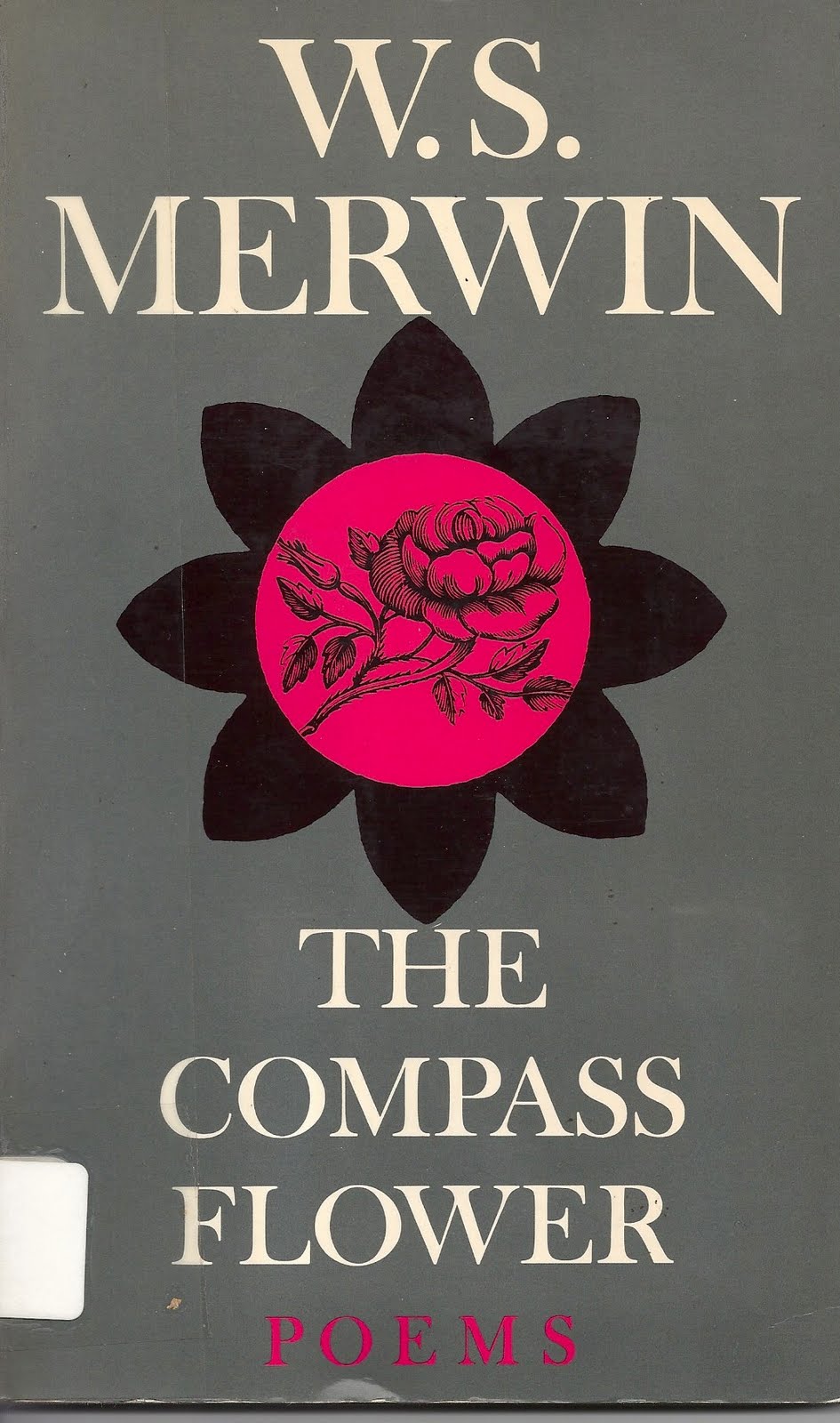
The Compass Flower by W. S. Merwin

I have been pleasantly surprised by our readers interest in poetry. Since July when W. S. Merwin was been named Poet Laureate, I have been waiting to check out one of my library's copies of his books. We have only a few of the many that he has written, and they have been on loan constantly. Finally, I got an older title The Compass Flower from 1977 to see if his poems are truly as accessible as the poems of Billy Collins and Ted Kooser.

The Compass Flower has four numbered but not titled sections. I am not sure why they are grouped as they are, though it seems that the poems near the front of the book refer to city living and those in the back half seem to be set in the countryside or wilderness. Whether urban or rural, they all seem to be concerned with nature, including the weather, plants, and birds. They also frequently mention lovers, as the poet describes the sharing of experiences, specifically the moments captured in the poems. As I read, I imagined that Merwin lives a life of leisure, as he often seems to be pursuing pleasure and not working. Being in woods or mountains appeals to me, so I liked the latter part of the collection better than the first.

Is Merwin as accessible as Collins and Kooser? Judging by only reading one book written twenty something years into his over fifty year poetry career, I would say not. I often felt a little lost in his poems which seemed so personal. These poems also are not as witty as those of Collins and Kooser. Still, I enjoyed many of the vivid images and his thinking about nature. I especially liked "The Windows" on page 88 with its child's perspective. I remember as a boy looking at everything while hanging upside down.

I'll try another Merwin book soon. This one did not take long to read, and maybe we will click if I try again.

Merwin, W. S. The Compass Flower. Atheneum, 1977. ISBN 0689107684.

Friday, September 24, 2010

Welcome: A Film Written and Directed by Philippe Lioret

We have begun another year of film discussions at Thomas Ford. On Friday night, September 17, fourteen people gathered in our community room to view Welcome, an award-winning French film written and directed by Philippe Lioret. Jamie Kallio, my partner in running our film series, made an excellent choice when she scheduled Welcome, which we received from our Film Movement subscription. Not only did the attendees seem to appreciate this contemporary film, they wanted to talk for over half an hour.

Lioret made the film in response to recent changes in French law that have criminalized helping illegal immigrants. The director went to troubled Calais where the shores of England can be seen across the English Channel. There he learned of the desperation of many Middle Eastern and African immigrants gathered along the wharfs and the official harassment of the sympathetic French individuals offering assistance to refugees. Hearing that one young illegal was training to swim the channel, he had a plot from which to develop his film about the consequences of French and English immigration policy. Because the same problems trouble other countries, the film has international relevance.

Welcome focuses on two characters. Bilal is a seventeen-year-old Kundish refugee who left Iraq hoping to join his girlfriend in England. After three months of walking and riding freight trains, he has reached the English Channel at Calais. After being captured trying to stow away in a cargo truck boarding a ferry, he begins swimming lessons so that he can swim the channel. Simon is a former French swimming champ who tries to dissuade Bilal on one hand but gives him lessons and a wetsuit on the other. Both are hopelessly in love with women who are somehow unobtainable. Neither is willing to surrender his romantic dream. Their acting and the cinematography are excellent. Welcome won Grand Prize at the Heartland Film Festival and was nominated for ten Cesar Awards (the French equivalent of the Academy Awards).

The Film Movement provides discussion questions and an interview with the director on its website. I recommend Welcome for film discussions at libraries and for current affairs discussions at schools and churches.

Welcome. Film Movement, 2009. 110 minutes. ISBN 9781449815219

Wednesday, September 22, 2010

An Egret's Day by Jane Yolen

As an amateur birdwatcher, who has difficulty deciding what it is that I see, I appreciate spotting a Great Egret. This graceful large bird is so distinctive that I can name it with confidence. It is also so good about being out in the open, usually along an unobscured shore, so I even know where often to find one. Its bright white feathers stand out against the blue of the water or the green of plants. Jane Yolen obviously also likes the Great Egret about whom she writes in her children's book An Egret's Day.

In her book Yolen matches her short poems and descriptions with colorful photographs by Jason Stemple, passing on a lot of information about the bird very economically. But Yolen's concern is not fact-based. Her verses are filled with love and wonder. She wants to raise young naturalists.

Of course, adults have permission to check out An Egret's Day from the library, too.

Yolen, Jane. An Egret's Day. Wordsong, 2010. ISBN 9781590786505.

Tuesday, September 21, 2010

Integrated Advisory Service: Breaking Through the Book Boundary to Serve Library Users, edited by Jessica E. Moyer


While I was downstairs reading, the doorbell rang this afternoon. I heard a truck driving away as I reached the front door. Looking down, I found a book size package on the step, which I brought inside and cut open. Inside, as I suspected, I found Integrated Library Service: Breaking Through the Book Boundary to Serve Library Users, edited by Jessica E. Moyer. I wrote Chapter 5 "Everything Popular Science" for this book that promotes helping library users choose all types of media at the library.

It is an honor to see my name among a group of well-known librarians, including my colleague Heather Booth. TWO CHEERS FOR THOMAS FORD. Lots of other cheers, too.

Now I need to take a little time looking it over. More later.

I made the on-the-fly catalog card using John Blyberg's Catalog Card Generator - just for fun.

Monday, September 20, 2010

Roseanna by Maj Sjöwall and Per Wahlöö

Bonnie is a lifelong mystery reader whom I trust for judgments about which books I might enjoy. She told me that Maj Sjöwall and Per Wahlöö are considered the pioneers of the modern Swedish police procedural. Seeing that their Martin Beck novels have been reprinted (and liking Swedish writer Henning Mankell's Wallander series), I decided to try Sjöwall and Wahlöö's now legendary mysteries. The Edgar prize winner The Laughing Policeman was recommended by a column that I recently read (I forget where) but all the copies in our library system were checked out (others must have read the same column), so I decided to go back to the begining and got Roseanna (the original 1967 American edition).

As I age, I find I like fewer novels every year and often get only a few pages into those I try before stopping. Roseanna, however, sucked me right in. A body without any identification is found in a canal. Clues as to cause of death, scene of the crime, motive, and likely suspects are missing. Police don't really know where to start other than perform an autopsy. The detectives are initially on the spot because the press demand quick answers (Is there a killer on the loose?), but the media soon loses interest, and Martin Beck and his collegues are left to puzzle over the crime - if there was one.

The authors reveal the character of Detective Martin Beck rather slowly, more through his actions than through descriptive statements. He's not an easy man to judge. His dedication to work is unquestioned, as he neglects his family responcibilities to solve crimes and catch criminals. He knows Sweden well. As readers, we get to travel all around country as Beck interviews witnesses.

One of the characters turns out to be a librarian, but I do not want to spoil the mystery by saying too much. I will, however, thank the authors (Wahlöö is deceased) for not stereotyping the profession.

Sjöwall and Wahlöö wrote a total of ten Martin Beck mysteries. So I now have another list to add to my many books-to-read lists. What was that saying about too many books?

Sjöwall, Maj and Per Wahlöö. Roseanna. Pantheon Books, 1967. no ISBN. Reprint: Vintage Books, 2008. ISBN 9780307390462.

Friday, September 17, 2010

Patchouli at Friday at the Ford

"You've always wanted to play music in the library," injected Julie Patchouli, amid the chorus of tambourines, maracas, cow bells, and drums during the final song of the Patchouli concert at the Thomas Ford Memorial Library. "Admit it." I'm not sure many people heard her. The capacity crowd at the September 10th Friday at the Ford concert was having too much fun. The percussive play was a fitting end to an electrifying concert of voice and acoustic guitars.

Julie and Bruce Hecksel performed at our library in 2006 and certainly merited a return to our coffeehouse series. They played mostly original compositions that featured (regardless of whether they were vocal or instrumental) energetic virtuoso guitar work. With five glossy guitars on stands, you saw what they were about when you entered the room. One was a new Spanish guitar of which Bruce was particularly proud. Flamenco is probably one of Patchouli's strong influences, as is the love of the outdoors. Julie sang two of their standards "Hide" and "The Woods" which I remember from their previous appearance (and from my CD that I bought back then) with a mixture of newer songs. Nearly half the concert was instrumental. I particularly liked their new piece "Flamaluna."

After the concert, many people thanked me for the Library offering the concert, which was sponsored by our Western Springs Library Friends. Many also bought CDs from Julie. Patchouli has thirteen CDs, some of which are mostly vocal and some totally instrumental. I have several of the CDs loaded onto my iPod and by clicking shuffle can get a mix similar to the concert.

Many people took our flyers listing upcoming concerts, so I expect we will continue to have full houses at Friday at the Ford through May.

Wednesday, September 15, 2010

End of the Earth: Voyages to Antarctica by Peter Matthiessen

Peter Matthiessen has been around the world many times seeking rare birds and checking on environmental conditions. In 1998 and in 2001, he boarded ships bound for Antarctica with the staff of Victor Emmanuel Tours and a flock of serious birders, hoping to see penguins, other sea birds, marine mammals, and the icy world in which they live. The first trip began in Punta Arenas, Argentina and headed for the Antarctic Peninsula, while the second trip left from Hobart, Tasmania and headed for the western edge of Ross Ice Shelf. Matthiessen describes both expeditions in his 2003 book End of the Earth: Voyages to Antarctica.

At the time of Matthiessen's travels, tourist excursions to Antarctica were still very new. Even today not many people can set aside the time or afford to join these grand expeditions. So reading Matthiessen's account is as close as many of us will ever get to Antarctica. While not his primary focus, the author does describe the boats, the meals, and company, but mostly to contrast with the travels of historic Antarctic explorers, including Amundsen, Shackleton, and Scott, who were ever in his mind as he gazed at the icy shores of the continent at the bottom of the globe. Readers learn that should they now go on such a trip, they would have good food and warm showers, but they would still suffer from the high rolling in the frequent storms of the Southern Ocean and within the Arctic Circle. A few of the passengers were rarely seen until the ships reached calmer sheltered waters.

Matthiessen needed both trips to see all the birds on his list. On the first voyage, ice blocked them from getting to the emperor penguin colonies of the Antarctic Peninsula. The second trip was on an icebreaker that owned the record for getting further south than any other ship ever. His voyage set no records but did reach the emperor penguin colony below Mount Melbourne. With special guides to protect the penguins from too much human curiosity, Matthiesen and his fellow travelers got to visit remote colonies and witness penguin lives up close.

Matthiessen's strength is in reporting what he sees with added reflections on environmental issues. When he starts to get preachy, he apologizes and moves on. In End of the Earth and other books, the author's commitment to wildlife and wild places is evident. Sympathetic readers will also enjoy Birds of Heaven, his book about trekking to see endangered cranes in their remote habitats.

Matthiessen, Peter. End of the Earth: Voyages to Antarctica. National Geographic, 2003. 242p. ISBN 0792250591.

Monday, September 13, 2010

Corduroy Mansions by Alexander McCall Smith

Most novelists writing continuing stories stick to one or two series. With the publishing of Corduroy Mansions, Alexander McCall Smith now has five series. But wait, you might say, doesn't there have to be a second book before you call it a series? Readers in the U.S. don't have it yet, but there is a second book The Dog Who Came in from the Cold in print in Great Britain. And the third book A Conspiracy of Friends begins serialization in the Daily Telegraph today. You can arrange to get a chapter a day from now into December through email or by podcast. McCall Smith even considers reader feedback as the story progresses

I just finished listening to Corduroy Mansions read by actor Simon Prebble on CDs. I enjoyed the somewhat slow development of the story with frequent tangental philosophical discussions. Readers of the 44 Scotland Street series will know what to expect - many subplots and lots of unexpected twists. In this new series, McCall Smith has set up Oedipus Snark, a particularly self-center member of Parliament, as a target of scorn. Even his mother is writing an expository memoir. A mild mannered aging wine merchant seems to be our hero, and many readers are going to love with Freddie de la Hay, a terrior who wants to wear a seatbelt in the car but may not really be a devoted vegetarian despite his former owner's claim.

I am looking forward to more fun.

McCall Smith, Alexander. Corduroy Mansions. Recorded Books, 2010. 9 discs. ISBN 9781440750045

Friday, September 10, 2010

Downfall, a film by Oliver Hirschbiegel

Summer 2010 was a terrible season for movies. The only movie Bonnie and I remember seeing at a theater was Toy Story 3, which we enjoyed. Looking at the dismal listings in the newspaper this summer, we sometimes questioned whether we had turned into old folks who don't like anything contemporary, but we just have to look at our DVDs-to-see list to see that this is not true. We have a growing list of films that did not appear at our suburban theaters. Most are independent or foreign films, and it sometimes takes us years to make time to see them. This past weekend we finally saw Downfall, a 2005 German film about Adolf Hitler's final days.

I think that I have a good grasp of history, but Downfall challenged some of my "I never really thought about it" assumptions. When I hear the word "bunker," I think of small concrete enclosure built into a hillside or on the cliffs over a beach. Hitler's bunker in central Berlin was a huge fortified basement, which seemed to have had multiple entries and a vast network of rooms. I also assumed that Hitler had a small number of important people with him. In Downfall, he is surrounded by scores of military leaders, other advisors, aids, secretaries, Eva Braun and even the family of Joseph Goebbels. Many of these people are sitting around with nothing to do but listen to their Fuhrer describe impossible military tactics utilizing nonexistent troops and scream about how his generals had betrayed him. The cast is huge, and I found identifying every character difficult, but I am not complaining. Downfall seems an realistic depiction of the chaos and confusion of the last days of Nazi Germany.

Viewers who enjoy great acting should try Downfall. Bruno Ganz is mesmerizing as Adolf Hitler, a complex character who can be gentle with a child one moment and raving to his aids about how the German people have let him down the next. Corinna Harfouch is memorable (will I have nightmares?) as Magda Goebbels, the mother who "loves her children so much" that she will not let them live in a world without National Socialism. The rest of the cast is excellent, too. After viewing the film I was surprised to learn it was 155 minutes. I had never tired of following the many-facetted story.

If you are like me, you'll need to talk to someone after the film, which was based on the books Inside Hitler's Bunker: The Last Days of the Third Reich by Joachim Fest and Until the Final Hour: Hitler's Last Secretary by Traudl Junge and Melissa Mueller. I recommend the for discussion groups.

Downfall. Sony Pictures Home Entertainment, [2005]. ISBN 140498760.

Wednesday, September 08, 2010

Brilliant: The Evolution of Artificial Light by Jane Brox

Having enjoyed Jane Brox's memoirs about living in Maine several years ago, I was intrigued this summer when I read reviews recommending her new microhistory Brilliant: The Evolution of Artificial Light. Expecting to enjoy the new book, I ordered it for the library and placed my hold. Now I am happy to report that it is as good as I had hoped.

If you are like me, you enjoy learning about how things used to be in historical times. I read for the details as well as the overall descriptions of daily life. Brox satisfies on both counts. She takes her story all the way back to the cave painters in Lascaux, France, describing how the ancient artists used small limestone lamps filled with animal fat to illuminate small portions of the cave walls while they painted horses, deer, bison, and other animals that they hunted forty thousand years ago. These cave painters were never able to illuminate entire walls to see the total effect of what they had done as we can today. It would have taken thousands of the tiny lamps to create as much light as we can with a single light today.

I never really thought about how much trouble artificial lights were in the years before electricity. Whale oil lamps required frequent wick-trimming and were smoky and smelly. Making candles was a lengthy process, and candles had to be relit if the wax drowned the wick. Fire was a constant danger. Light was weak. The price of both candles and whale oil were beyond many people. Night was darker then than we can easily imagine now.

In Brilliant, Brox shows great sympathy for the people of history, especially laborers. She describes how difficult coal mining was before battery-powered lighting. Because there was always a danger of setting off explosive gases in mines, only the slightest protected flames were used. Miners were mostly working in the dark. Fowl air, coal dust, heat or cold, dark, constant danger - coal mining was terrible work that paid very little.

I did not realize before reading Brilliant that coal gas was used in gas lamps of the nineteenth century - not modern natural gas. Fittings were often poor and the fowl smell permeated some neighborhoods near gasworks. The gas companies, of course, argued that the smell of gas had been proven to be healthy for people. There were also devastating fires, sometimes destroying entire neighborhoods.

Brox details the history of electric lighting from the first batteries made by the ancient Greeks to the promises made by Jeffrey Skilling of Enron that deregulation of electricity would bring consumers less expensive power. In doing so, she highlights the struggle between Edison and Tesla, the corporate delays in getting electricity to rural areas, and the replacing of incandescent bulbs with higher efficiency alternatives. She ends with discussions of light pollution masking the night sky and the health risks of never getting the dark needed for sleep.

Brilliant is a great addition to a growing library of microhistories about technology and its impact on people.

Brox, Jane. Brilliant: The Evolution of Artificial Light. Houghton Mifflin, 2010. ISBN 9780547055275.

Monday, September 06, 2010

The Girls of Murder City: Fame, Lust, and the Beautiful Killers Who Inspired Chicago by Douglas Perry

When I saw the film version of the musical Chicago a few years ago, I had no idea that the story was drawn from true cases. I thought it was just sensational entertainment, a perception that would probably distress playwright Maurine Watkins. Watkins was a Chicago Tribune court reporter in 1924 who covered a string of highly-publicized cases featuring women who murdered men. In these cases, if the women were beautiful, they were found innocent; if not so pretty, the men in the jury found them guilty. Watkins was so profoundly troubled by these events that she wrote a play. Her drama Chicago was intended to shock audiences with the injustice and spectical created by the courts and newspapers. The 1926 play was a hit on Broadway and then toured the nation.

Author Douglas Perry tells about Watkins and the attention-seeking murderesses in his new book The Girls of Murder City: Fame, Lust, and the Beautiful Killers Who Inspired Chicago. While he recounts the crimes of five women, he focuses on two - Beulah Annan and Belva Brown. Filmgoers will recognize Beulah as the model for Roxie Hart in the play and the later musical. Like Roxie, Beulah shot her lover in her appartment and called her fawning husband to ask what to do. To the police and reporters she wavered between claiming innocence and admitting her guilt. Called by the newspapers "Beautiful Beulah" and the "prettiest murderess," at no point did she seem the least bit distressed that her lover died. She hoped the publicity from the case would help her become a movie star.

Before her murder case, Belva Brown was known as the dance hall girl who had married a rich older man and then divorced him dramatically. Like Beulah, she enjoyed sitting with a circle of reporters spinning tales about what she did and her future plans. She was also the woman who advised all the other women in the Cook County Jail how to dress for their court appearances. Just as in the movie, these jailed women seemed to be at liberty to visit each other and entertain guests in their cells.

In The Girls of Murder City, Perry describes 1924 Chicago as a city wracked with crime, much related to breaking Prohibition laws. Citizen wanting to witness all the lurid events flock to court hearings and funerals. Newspapers were the hot media of the time.

The Girls of Murder City joins Devil in the White City and Sin in the Second City as a sort of trilogy about classic Chicago crime. All are great reading narratives that may attract fiction readers to cross over the nonfiction line.

Perry, Douglas. The Girls of Murder City: Fame, Lust, and the Beautiful Killers Who Inspired Chicago. Viking, 2010. ISBN 9780670021970

Friday, September 03, 2010

The British Invasion: The History of British Rock

I borrowed the first three of nine discs of The British Invasion: The History of British Rock from the Downers Grove Public Library last week. I have borrowed them before, but I bet it has been ten years. I see from the stamps on the booklet to disc one that the library has had it since 1994. The booklet looks a little worn, but the disc has held up well. More importantly, The Kinks (in photo), the Searchers, Chad & Jeremy, Freddie & the Dreamers, and their contemporaries still sound pretty good to me.

Anyone with memory or knowledge of mid-1960s British rock will, of course, notice right away that the Beatles and the Rolling Stones are not represented. I am sure Rhino Records could not swing a deal to add any of their songs, but that is alright. There were many great songs from other groups - few solo acts getting much attention at the time. This collection helps point them out to now aging boomers who are the listeners most likely to appreciate these discs. Their children may just find many of the songs to be very silly. Only a boomer can remember "Do the Freddie" and smile.

There are good reasons that some of these songs have been forgotten. "Hello Little Girl" by the Fourmost" makes me cringe, and "Hippy Hippy Shake" by the Swinging Blue Jeans seems to be a reworking of "Twist and Shout" without any of the spark of the original. But the Kinks "You Really Got Me" and the Zombies "She's Not There" are classics that still sound fresh. Both are on disc one.

Highlights from disc two are "All the Day and All of the Night" by the Kinks, "Do Wah Diddy Diddy"by Manfred Mann, "Catch the Wind" by Donovan, and "Tell Her No" by the Zombies. I'd rather forget "I Like It" by Gerry and the Pacemakers, "Bad Time" by the Roulettes, "Poor Man's Son" by the Rockin' Berries, and "I Love You" by the Zombies.

Disc three has some gems, including "Love Portion Number Nine" by the Searchers, "Tired of Waiting for You" by the Kinks, "I'll Never Find Another You" by the Seekers (not the Searchers), and "Wild Thing" by the Troggs. Cuts that do not sound as good as they may have way back then include "Tossing and Turning" by the Ivy League, "True Love Ways" by Peter and Gordon, and "I'll Keep Holding On" by the Action.

Have you guessed that I liked the Kinks? I also want to go on record as liking Chad & Jeremy better than Peter & Gordon. The latter duo's songs often seemed over-produced and too dramatic compared with the lighter songs of the former, such as "A Summer Song" and "Willow Weep for Me."

Honestly, I am glad that these discs have a mix of good and bad, representing the time more realistically than cream of the crop collections. Check them out to form your own impression of British contribution to the Rocking Sixties.

Wednesday, September 01, 2010

50th Anniversary of First Grade and Reading

Today is the fiftieth anniversary of my starting first grade at the Reagan County Elementary School in Big Lake, Texas. Having been to kindergarten (it was not required at the time), I knew my alphabet but I was not really reading yet. I was soon. So I am going to declare this as the 50th anniversary of my learning to read, a skill and pleasure that I appreciate more and more as I age.

I remember the excitement of that first day. One of the first formalities was getting desk assignments. For first graders, our school had two student desks with shelves dividing the space under the desk. If my memory is true, I shared a desk first with Caron Johnson. We were given jumbo size crayons, big pencils, and paper with lines to help us learn to write our letters. I remember also that my cousin Hub was added to the class later in the day. Pete, Mike, and I probably walked home together after school, as we would many days. It was only four short blocks (two east and two south) and hard to get lost in Big Lake.


I wish there were some pictures of that first day. Of course, there were no digital cameras then and my immediate family did not even owned a Brownie Instamatic at the time. I bet many families had no cameras back then, which made school pictures truly valuable. I wish that I knew where my first grade class picture was. My sister found my 3rd grade class picture* among some of her things a few years back. Many of these same students were in both classes. So imagine them two years younger.

I remember we were soon assigned into reading groups and started reading the famous Dick and Jane books. "See Dick. See Jane. See Spot. See Spot run." I liked the books a lot. They were really easy to read. Actually, everything was easy. We wrote our letters, started addition and subtraction, and drew many pictures. The only thing hard for me was staying still during nap time. I always hated lying on a mat on the floor with my eyes closed when there was so much more I could be doing. I would appreciate a daily nap now.

I'm not sure whether my classmates will appreciate me pointing out that it has been so long since we started school, but I wish to celebrate. Thanks to the Reagan County Library which verified the date in the Big Lake Wildcat.


*I think it is third grade because I think the teacher is Mrs. Wade and the kids in back look so old, but then again the kids in front look so young. Maybe that is Mrs. Nun and we are first graders.

By the way, when I showed this picture to a few people at work, no one could pick me out. No beard and my hair is now darker. I am in the front row, second from the right, between Olivia and Carrie, in a cowboy shirt that my mom made. I don't remember the girl second from the left in the front row, but I can name everyone else.