Friday, October 30, 2009

J.R.R.Tolkien and Agatha Christie

J.R.R. Tolkien and Agatha Christie were authors who kept to very different parts of England geographically, occupationally, and socially. I have seen no evidence that they ever met or even spoke about each other. Their books are separated by more than the letters D through S in the alphabet. Yet, having just read Tolkien: The Authorized Biography by Humphrey Carpenter and Duchess of Death: The Unauthorized Biography of Agatha Christie by Richard Hack, I am struck by similarities.

Both Tolkien and Christie were born in the 1890s: Christie in 1890 and Tolkien in 1892.

Both lost parents in childhood: Christie's father died when she was eleven, and Tolkien lost his father at four and his mother at twelve.

Christie's once well-to-do family was always in debt and lived beyond their means during her childhood, while Tolkien's family was truly poor; he and his brother were taken in my priests who paid for their schools.

Both attended many schools, never really settling long in any.

Both saw the horror of World War I firsthand: Tolkien as a soldier and Christie as a nurse's helper.

Neither really intended to write novels for profit: Christie wrote her first mystery on a dare, while bedtime stories that Tolkien told his sons led to a few short stories and The Hobbit.

Both authors were very private and hated the idea that people would want to know about their lives. They avoided most interviews and said that they wanted no biographies. Of course, that only made readers more intent on learning about them. Tolkien tired of having fans just showing up at his house in Oxford, so he kept his new address private when he and his wife moved to a retirement apartment near Bournemouth. Christie had large estates to which to escape.

Both most enjoyed quiet work on ancient studies: Christie helping her second husband with his archeological digs in Iraq and Tolkien with his studies of myths and ancient languages.

Tolkien died in 1973, while Christie died in 1976.

Despite the subtitles, "authorized" and "unauthorized," the biographies are similar. Both accounts are sympathetic without excusing some of the subjects' faults. Christie neglected her daughter at times, while Tolkien spent much time with his children but neglected his wife, who never was comfortable in Oxford. In both books I most enjoyed reading about childhoods, early careers, and first books. Carpenter's account of Tolkien's drawn out period of writing The Lord of the Rings effectively conveys how frustrating it must have been to be his editor; readers may want to skim over this part. Hack's brief telling about the publication of every Christie mystery gets a bit repetitive. Both books become compelling in describing their subjects' final years, when writing and daily living become more difficult.

Books by both Tolkien and Christie are readily found in abundance in homes, bookstores, and libraries today. There are about 100 Christie titles in print. Tolkien wrote much less, but his major books are widely held, and since his death his son Christopher has released over a dozen titles from his father's unpublished manuscripts. With interest in these authors still high, their biographies belong in most public libraries.

Carpenter, Humphrey. Tolkien: The Authorized Biography. Houghton Mifflin, 1977. ISBN 0395253608

Hack, Richard. Duchess of Death: The Unauthorized Biography of Agatha Christie. Phoenix Books, 2009. ISBN 9781597776202

Thursday, October 29, 2009

Digital Books Service from Library of Congress in Illinois

The Autumn 2009 issue of the Talking Book News from the Voices of Vision Talking Book Center announces that visually or physically impaired readers may now qualify to receive free digital book players and downloads from the Library of Congress. The newsletter tells how and provides a form that may be mailed to the Illinois State Library. It also explains who gets priority in receiving the limited number of players, starting with veterans of the US Armed Forces, centenarians, and clients who cannot handle a standard cassette player.

The letter notes that all current talking book users will be automatically be issued digital readers once supplies are adequate.

For more information on this service in Illinois, call one of the following, depending on your region:

  • Chicago Public Library Talking Book Center, 800-757-4654
  • Voices of Vision Talking Book Center, Geneva, 800-227-0625
  • Mid-Illinois Talking Book Center, East Peoria, 800-426=0709
  • Southern Illinois Talking Book Center, Carterville, 800-455-2665
  • Illinois State Library Talking Book and Braille Service,Springfield, 800-665-5576

Wednesday, October 28, 2009

The World of Saki

No, this is not about a Japanese rice-based alcoholic beverage. That's "sake." This is Saki, the pen name of Hector Hugh Munro (1870-1916), a journalist, historian, and writer of short stories. It's the short stories for which he is famous. I remember that we studied him when I was in high school. I had not read any of his works since until I needed an audiobook for weekend gardening. The World of Saki gave me nearly three hours of pleasure.

In the introduction to the short story collection, the announcer states that Saki was "witty." "Witty" is an understatement. I was laughing hard at times at the wicked humor pointed at shallow, vain Edwardian aristocrats. Lady Bastable, Clovis, Mrs. Packletide, and the boy Conradin are all characters with no conscience, ready to lie, cheat, and steal to satisfy their whims. I am not so sure if I find them so funny because they are impossibly absurd or whether they are almost real. Clovis shows up in many stories. His ability to rattle on and slyly insult anyone foolish enough to engage him in conversation is highly entertaining.

Strange things happen in Saki stories, most of which last ten minutes or less. Hyenas escape from menageries, cats learn to speak, and pigs trap unwanted guests in paddocks. In almost all of the stories, people act badly. Readers may decide that Saki had a very poor opinion of humanity. Then there is the story "Easter Egg," in which a cowardly man does something immensely brave. Perhaps even Saki had a glimmer of hope for a better world. He died on a battlefield in France in 1916 at age 45.

Listening to Alexander Spencer read these stories is a pleasure that I recommend.

Saki. World of Saki. Recorded Books ; Made available electronically by NetLibrary, 2005.

Tuesday, October 27, 2009

My Father's Bonus March by Adam Langer

Recently I was asked to review for The Internet Review of Books. After I sent a profile of the types of books that I would prefer reviewing, the editor sent me My Father's Bonus March, a new memoir by the novelist Adam Langer. I enjoyed it immensely. You can now find my review of the book here.

The Internet Book Review is a monthly posting of reviews and interviews, covering fiction and nonfiction. A few bestsellers get reviewed, but most of the reviews seem to be written about books that are getting less publicity.

I read the galleys and did not see this cover, which I do not like. It seems vague and unappealing, which is not at all true to the book. Langer's quick reading story about his father is very entertaining. My Father's Bonus March should do well in the Chicago area where most of its scenes are set.

Langer, Adam. My Father's Bonus March. Spiegel & Grau, 2009. ISBN 9780385523721

Monday, October 26, 2009

The Intellectual Devotional: Health: Revive Your Mind, Complete Your Education, and Digest a Daily Dose of Wellness Wisdom

An effective way of strengthening a belief system is providing daily reminders. Religious groups have known this since some time long before recorded history. Believers pray, meditate, join together for ceremonies, and carry symbols of their belief to broaden and strengthen their mindset. The book of daily devotional readings has been a part of this regimen for devout Christians for centuries.

Today "living healthy" has gone beyond being just being smart about eating, exercising, and avoiding vices. It has become an almost spiritual lifestyle that counts millions of people as adherents. To support the cause, to broaden the understanding of the science behind health and medicine, there is now a daily book, The Intellectual Devotional: Health: Revive Your Mind, Complete Your Education, and Digest a Daily Dose of Wellness Wisdom by David S. Kidder, Noah D. Oppenheim, and Bruce K. Young, MD. It is no surprise that the publisher is Rodale, Inc., which is a long time supporter of organic gardening, alternative energy, alternative medicine, and like causes. What might surprise some readers is how mainstream its daily essays about health and wellness are. I see little for conventional medical practitioners to challenge.

Everything about The Intellectual Devotional: Health is smart and practical. Each of the 365 essays drawn from seven broad topical area takes a single page, and a ribbon is sewn into the binding to serve as a bookmark. The seven areas of concern are:

  • Children and Adolescents
  • Diseases and Ailments
  • Drugs and Alternative Treatments
  • The Mind
  • Sexuality and Reproduction
  • Lifestyle and Preventive Medicine
  • Medical Milestones

Week by week, these themes are repeated in rotation. In the process of reading, the devoted reader is introduced to (or reminded of) many medical topics, such as amino acids, white blood cells, Apgar scores, Valium, memory, natural childbirth, and Alzheimer's disease. My favorite essays are those with historical information, including "Edinburgh Medical School and Grave Robbers," "Trepanation: Ancient Incan Brain Surgery, " and "Influenza Epidemic of 1918."

While it makes more sense for individuals to have their own copies of The Intellectual Devotional: Health (libraries will not check it for a year), it has ready reference value and could still be used in public libraries. An index makes the concise essays easy to find. Still, its better place is on nightstands or desks. With the new year coming, it is a good gift for a wellness-minded friend.

Kidder, David S., et. al. The Intellectual Devotional: Health: Revive Your Mind, Complete Your Education, and Digest a Daily Dose of Wellness Wisdom. Rodale, 2009. ISBN 9781605299495

Saturday, October 24, 2009

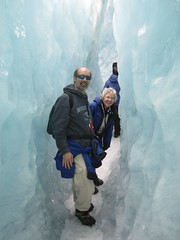
Rick and Bonnie in an Ice Cave

Our daughter Laura sent us this photo that she took of us going into an ice cave formed by melt water on Franz Josef Glacier in New Zealand. This cave had only opened a couple of days before and would not last many more. The ice had a frosty blue color. A trickle was running below our feet, shod in boots with crampons. The hike across and rocky river bed to get to the glacier was harder in a way than the hike across the ice itself on this day. Paths had already been forged and stairs cut into the ice. We were quite hungry when we got back to the village. I think I ate an extra dessert.

Friday, October 23, 2009

God's Long Summer: Stories of Faith and Civil Rights by Charles Marsh

Over forty years after the events of the Civil Rights Movement, it is difficult to imagine Mississippi of the 1960s. We still have extremists in our country who would use violence to impose their social order if they could, but we believe that we have them cornered and that our fair-minded majority would never allow them to dominate a town, much less a region of our country. God's Long Summer: Stories of Faith and Civil Rights by Charles Marsh is a reminder that the Ku Klux Klan and other racist groups terrorized a part of our country in the recent past. It is also an examination of the religious beliefs of five prominent figures from both sides of the battle for Mississippi.

Marsh shocks the reader with the brutality of local Mississippi police in the first chapter, which focuses the life of Fannie Lou Hamer, an elder black woman who was beaten for trying to register to vote. The severity of the case and the acquital by an all-white jury of the four police officers that beat Hamer were eventually splashed across national news. Hamer was irrepressible, believing that she was chosen by God to be a witness to the gospel and a champion of civil rights. She even became a noteworthy challenger to the seating of delegates at the 1964 Democratic National Convention. Hers is the one inspiring story in the book.

The most troubling story is that of Sam Bowen, Imperial Wizard of the White Knights of the Ku Klux Klan. About thirty years after the events, Marsh interviewed Bowen, the man that many believed to be behind many church burnings and who was convicted of conspiring in the death of civil rights workers Michael Schwerner, James Chaney, and Andrew Goodman. Bowen was unapologetic, believing that God commanded him to eliminate anyone who threatened the supremacy of white power. Marsh examines Bowen's life, looking for the sources of his prejudice and anger and explaining KKK theology.

Other chapters profile prominent Baptist minister Douglas Hudgins, who seemed appathetic when blacks were jailed for trying to attend his church; Methodist minister Ed King, whose enthusiasm for civil rights protest seemed to annoy both his allies and his enemies; and Cleveland Sellers, a well-intentioned religious black who helped found but lost control of the Black Power Movement. In each profile, Marsh recounts the subject's faith journey and role religion played in the civil rights struggle.

Mixing history and religious studies, God's Long Summer has been used as a college textbook since its first publication in 1997. It was reissued with a new preface in 2008. It will interest serious history readers.

Marsh, Charles. God's Long Summer: Stories of Faith and Civil Rights. Princeton University Press, 2008. ISBN 9780691130675

Wednesday, October 21, 2009

Bookshares Making Books Accessible

After the furor over the Kindle 2 having text-to-voice conversion built in, you might have thought that the visually-impaired had no other access to print books and newspapers. The Kindle 2 did simplify the access and widen the offering for people unable to read traditional books, but there are other sources of reading materials. One is Bookshare, a project supported by the U.S. Department of Education Office of Special Education Program. Bookshare provides assistive technology and texts to physically, visually, and learning disabled people. Clients get devices that turn text files into either voice or braille.

A good explanation of how Bookshares works is found at http://www.bookshare.org/about/howBookshareWorks.

The cooperation of publishers makes some titles readily available for the project, while an exception to copyright law makes all titles legal for inclusion. Volunteers buy books, scan them, proof them, and assist distribution. There are many opportunities to help explained on the Bookshares website.

Monday, October 19, 2009

Death Becomes Them: Unearthing the Suicides of the Brilliant, the Famous, and the Notorious by Alix Strauss

Do people watch celebrity news to gain insight into personal relationships and learn from others mistakes? No, they often watch to marvel at how people with great beauty, talent, and wealth can misbehave extravagantly. So, would a book about celebrity suicides be helpful to people wanting to seriously understand the psychology of suicide? Maybe yes. These are the suicides that get the most public exposure. Most suicides of not-famous people without some lurid aspect are treated gingerly by the press, respecting the feelings of relatives and friends. Only celebrity suicides get splashed across newspapers and television with all their details revealed. Whether celebrities represent the public at large is a debatable question, but in the open forum celebrity suicides are the specimens most available for examination.

In Death Becomes Them: Unearthing the Suicides of the Brilliant, the Famous, and the Notorious, Alix Strauss tries to elevate the subject of celebrity suicide above yellow journalism. She tells the death stories of actors, artists, writers, rock stars, and other famous people sympathetically (even Adolf Hitler is discussed as a person with insecurities) and looks for the trends that foster understanding. She tries to differentiate the use of a rope from the use of poison, guns from knives, and drownings from jumping off buildings. She discusses the privacy of the act and the leaving of suicide notes. She also points out the prevalence of alcohol and addictive drugs in suicide. Every eight to twelve page profile includes statistics, putting the case into a general context. Near the end of the book, Strauss speculates on whether some seemingly accidental deaths may have been suicides, bringing Judy Garland, Elvis Presley, and John Beluschi into the discussion.

Whether the reader gains any insight from Death Becomes Them depends on the reader. The subjects are famous cases that have been repeated and often sensationalized, such as the suicides of Ernest Hemingway, Sylvia Plath, Kurt Cobain, Vincent Van Gogh, and Abbie Hoffman; readers may just treat the book as more celebrity literature. The book holds some reference value as a collection of suicide stories with statistics and can be used as an starting point for term papers. It might also interest mystery readers who enjoy the study of dysfunctional psychology.

Strauss, Alix. Death Becomes Them: Unearthing the Suicides of the Brilliant, the Famous, and the Notorious. HarperCollins, 2009. ISBN 9780061728563

Friday, October 16, 2009

Sequels: An Annotated Guide to Novels in Series by Janet G. Husband and Jonathan F. Husband

Since 1982, librarians Janet G. Husband and Jonathan F. Husband have been helping librarians and readers everywhere identify fiction books in series with their reference books. Now in 2009, the couple have finished the 4th edition of their Sequels: An Annotated Guide to Novels in Series, published by the American Library Association. Of course, the guide has grown much in the ensuing years. The first edition was 361 pages; the latest is 782 bigger pages.

Contemporary readers might think that mystery fiction would dominate the guide, as crime solving series are exceedingly popular now, and the authors have included many mystery series, from Margery Allingham, Agatha Christie, and Dorothy Sayers to Nevada Barr, Janet Evanovich, and Alexander McCall Smith (alphabetized as Smith). There is, however, much more than mystery series. William Faulkner's Yoknapatawpha County stories, Doris Lessing's Children of Violence quintet, Anne McCaffrey's many dragon tales, Paul Scott's novels of India, Janette Oke's Christian fiction series, and Mary Stewart's Arthurian novels are just a few of the literary, science fiction, fantasy, romance, and historical fiction series included.

The book is especially helpful for sorting out the confusing mix of comic novels by P. G. Wodehouse. Many readers know his famous characters Bertie Wooster and his man Jeeves, but finding a good list of the books in the series is not easy. The Husbands identify fifteen titles. They also identify many of the recurring characters, including Stiffy Byng, Gussie Fink-Nottle, Bingo Little, Madeleine Bassett, and the always feared Aunt Agatha. Wodehouse wrote four other comic series that fans might also want to read. Sequels, of course, provides the titles and brief plot statements.

The entry for J. R. R. Tolkien will interest newcomers to The Lord of the Rings literature. The authors not only describe the trilogy and explain that it follows The Hobbit, but they identify books edited by Tolkien's son Christopher Tolkien subsequent to the author's death. It falls a little short by not identifying Narn i Chin Hurin: The Tale of the Children of Hurin, which was published in 2007. Perhaps content collecting ended sometime in late 2007 or early 2008, for I see only a few 2008 and no 2009 titles in this edition. I suppose with a print work as huge as Sequels, some lag time has to be expected.*

I used Sequels once while I was examining it at the reference desk. A reader asked me about the Discworld books by English author Terry Pratchett. Sequels explains the series and identifies thirty-two titles - just what the reader needed. We're going to keep the book with our other most used readers' advisory titles. I imagine it will be helping us for a long time.

Husband, Janet G. and Husband, Jonathan F. Sequels: An Annotated Guide to Novels in Series, 4th ed. American Library Association, 2009. ISBN 9780838909676


*For up-to-date series information, also try the Kent District Library's What's Next Books in Series website.

Wednesday, October 14, 2009

A Short History of New Zealand by Gordon McLaughlan

How much did I know about the history of New Zealand when I landed there a few weeks ago? Not much. I knew that when James Cook "discovered" the island, there were already Maori people living on the two big and several smaller islands of New Zealand, that British settlers brought lots of sheep and European farming methods, that Kiwi soldiers died with Australian soldiers at Gallipoli in World War I, and that many Antarctic explorations departed from Christchurch. I also knew a little about species extinction in New Zealand from watching years of natural history programs on PBS. Other than that, I had much to learn, so when seeing the attractively illustrated A Short History of New Zealand by Gordon McLaughlan in a Queensland bookstore, Bonnie bought it for me. *

McLauchlan is a well-known Kiwi newspaper columnist and historian, who has also written The Farming of New Zealand and The Life and Times of Auckland. In his history of the country, he takes a somewhat casual tone, including a few autobiographical and ancestral notes, keeping the account light and entertaining. This is not to say that he avoids serious controversies in the country's history. He clearly states when he thinks New Zealanders were unjust to indigenous people, farmers, laborers, or immigrants, and he tells several good stories about greed and political corruption. Because New Zealand history is comparatively tame and sensible, it is mostly a positive story which McLauchlan is proud to tell.

As most readers might expect, the short history has a mostly chronological arrangement, starting with some natural history and the origins of the Maori, who seem to have come from Polynesia long after the settling of Hawaii and other distant islands. Some archeologists reckon the arrival of Pacific islanders to be only 800 years ago, making New Zealand the last large islands in the world to be settled, even after Greenland. McLauchlan describes the theories of how and why Polynesians set out on dangerous and desperate voyages. Being colder and richer in resources than most Polynesian islands, New Zealand required the new settlers to evolve a new culture, which thrived in isolation. According to the author, the Maori also withstood the arrival of Europeans better than many other Pacific peoples.

New Zealand was also late being colonized by the British and benefited greatly by the timing. Britain had already forsworn slavery when the first large wave of settlers arrived, and the government tried to shield the Maori with treaties which protected titles to their land. These treaties, however, had loop-holes and the Maori had no concept of private property. Ambitious settlers took many opportunities to take land and natural resources. Wholesale slaughter and enslavement of the Maori was avoided, but they still became an impoverished people with no political power. In the late twentieth century, they finally made political and economic progress.

McLauchlan advances the history up to 2008, pointing out many highs and lows. New Zealand was the first nation to extend the vote to women, doing so in 1893. In 1917, the sale of liquor was forbidden after 6 p.m., with the result that many men became drunk in the late afternoon but made it home to be with their families. The law lasted until 1967 with pubs reluctant for reform of the law that had allowed them to reap large profits without having to maintain evening hours. In 1905, New Zealanders cheered the All Blacks, the national rugby team, which visited Great Britain and beat all challengers except Wales. Kiwi rugby became more controversial on several occasions when South Africa demanded Maoris be removed from the team before the All Blacks played in tournaments; in each case the New Zealand prime minister made a different decision, bring either pride or shame to the country.

MacLauchlan's history of New Zealand was an eye-opener for me. It would be a good addition to any public library history collection.

McLauchlan, Gordon. A Short History of New Zealand. Auckland: Penguin, revised 2009. ISBN 9780143011231

*We used Bonnie's credit card with its lower foreign exchange fee. Her card from a credit union charges one percent, while mine from a major credit card company charges three percent. Check your fees before you go overseas.

Tuesday, October 13, 2009

Thingology Post about Ebook Economics and Libraries

Tim Spalding at Library Thing has been thinking about how ebooks are going to be bad for libraries. He spells out what they think in Ebook Economics: Are Libraries Screwed? He'd love to hear that he is wrong.

Monday, October 12, 2009

The Hand Guide to the Birds of New Zealand and The Slater Field Guide to Australian Birds

Because of its long isolation from the other continents of the earth, Australia has many birds found nowhere else. The same holds for New Zealand, which floats in the Pacific Ocean across the Tasman Sea from Australia. There would be even more if immigrating people had not introduced predators (rats, snakes, dogs, cats, etc.) and competing species (starlings, house sparrows, Canada geese, etc.) Habitat destruction has also reduced the numbers of some species. Defenseless ground-dwelling birds have suffered and are mostly extinct or endangered. Many coastal, desert, and savanna species, however, have thrived. Along the coasts of the Southern Ocean (what we call the Antarctic Ocean) there are even penguins. To identify them can at times be challenging and requires good guidebooks.

Bonnie and I looked at several guidebooks that she had ordered through interlibrary loan before our trip, but we waited until we were in the lands down under before we bought our own books. After looking at bookstores and gift shops at zoos and sanctuaries, we settled on The Hand Guide to the Birds of New Zealand by Hugh Robertson and Barrie Heather with illustrations by Derek Onley and The Slater Field Guide to Australian Birds, second edition, by Peter Slater, Pat Slater, and Raoul Slater with Sally Elmer. Both are small enough to take into the field easily and feature color artwork, which I find easier to use in identification than photographs that often suffer from difficult lighting conditions. As you would expect, the guide for New Zealand is the smaller of the two with slightly under 300 species. It uses a traditional taxonomic arrangement, starting with brown, greater spotted, and little spotted kiwis. It has one index integrating common and scientific names, which directs readers to plates. It also has nice maps of the northern and souther islands inside the front and back cover. The Australian book has about 850 species and uses a habitat arrangement, starting with petrels and albatrosses. Common and scientific names are in separate indexes, which direct readers to pages. The inside back cover includes a centimeter ruler in case you get close enough to measure a bird.

We, of course, will not be going back to Australia and New Zealand any time soon, so the books become mostly souvenirs from our trip, which we will set out when we have our friends over to see our pictures. They will also be handy when we watch nature documentaries and when we read Aussie or Kiwi memoirs and novels. If neighborhood children have bird projects for school, we have sources. They will sit nicely on a shelf beside our guides to African and American birds.

Robertson, Hugh, and Heather, Barrie. The Hand Guide to the Birds of New Zealand. Auckland: Penguin Books, 1999. 9780140288353

Slater, Peter, et. al. The Slater Field Guide to Australian Birds, second edition. Sydney: Reed New Holland, 2009. ISBN 9781877069635

Sunday, October 11, 2009

The Lord of the Rings Location Guidebook, Extended Edition by Ian Brodie

"New Zealand is Middle Earth." You see this on a sign soon after arriving in Christchurch. It also appears in brochures. Other travelers say it to you. And it is essentially true, for the landscape of New Zealand is as beautiful and dramatic as viewers of Peter Jackson's The Lord of the Rings films imagine.

Today is the tenth anniversary of the first day of shooting for The Lord of the Rings. On October 11, 1999, Jackson and his camera crew set up outside Wellington on the north island to film Frodo, Sam, Merry, and Pippin hiding under the roots of an old tree to escape the notice of the Nazgul. In the next three or four years, the cast and crew traveled all over country shooting scenes in forests, meadows, riverbeds, and mountains. You are never far from a The Lord of the Rings location in New Zealand.

Seeing how the movies would draw people to his country, Ian Brodie put together a series of guidebooks, the latest being The Lord of the Rings Location Guidebook, Extended Edition, published in 2004 and reprinted in 2008. The guidebook includes descriptions and directions to locations where scenes were shot. Brodie adds whether locations are open to the public, a few stories about cast and crew, and lots of pictures. Of course, being five years old, there are some out of date details. The Lord of the Rings store in Queenstown has closed, and some of the packaged tours have changed. Still, the book can be used effectively to lead fans to hallowed ground. It is worth having just for the pictures taken by Brodie, Viggo Mortensen, Pierre Vinet, New Line Productions, and other sources.

The Lord of the Rings Location Guidebook can easily be found in almost any gift shop in New Zealand, but that is a very long flight from almost anywhere other than Australia. Fans and libraries catering to them will have to buy their copies online. Once you get your copy and book a flight to New Zealand, you too can visit the Kawarau River (shown above) and become one of the Pillars of the Kings.

Brodie, Ian. The Lord of the Rings Location Guidebook, Extended Edition. Auckland: HarperCollins, 2004, 2008. ISBN 9781869505301

Friday, October 09, 2009

Riders of the Purple Sage by Zane Grey

Above a collection of house plants on the built-in shelves in the paneled and enclosed back porch of my paternal grandmother's house were dozens of old Western novels, including several by Zane Grey. I can not report that I read them as a boy. I was not a dedicated reader at the time, being more prone to watching The Man from U.N.C.L.E. or Mission Impossible. So I grew up with some mistaken assumptions about Zane Grey's books.

With a need for cheap and easily-packed reading for our vacation to Australia and New Zealand, I picked up a paperback copy of Riders of the Purple Sage. The cover proclaimed it to be "The Only Uncut, Uncensored Edition." I thought I would just be getting an action-packed cowboy story. Instead I found I had a fairly thick book reminiscent of novels by James Fenimore Cooper. Like the author of The Last of the Mohicans, Zane Grey loved to set scenes in great detail before describing action. When characters cross wide sage-covered plains and climb up mountains in Utah, readers go with them step by step, fording streams, listening to the wind, noting dust or smoke on the horizon, and always watching for wrestlers and gun-toting Mormons.

If Riders of the Purple Sage is a reliable witness, Zane Grey disliked Mormonism. In this restored edition are several sympathetically portrayed Mormons, but most of the followers of Utah's dominant religion are in league to keep nonbelievers from owning property and settling in their communities. They tolerate Gentiles when they need laborers, but they pay badly and confine the drifters who wander into their towns. The Mormon elders also brainwash their women. According to editor Jon Tuska, Grey's publishers sanitized the text by removing many passages dealing with Mormonism in early editions of the novel.

I was also surprised by all of the romantic elements in Riders of the Purple Sage. (Spoiler alert!) Two unlikely couples are brought together by the events of the story. When the gunman known as Lassiter is not heading off a stampede or tracking stolen cattle, he is talking his reluctance to love with Jane Withersteen, the heiress to a ranching empire. When the cowhand Berne Venters is not climbing into secret canyons or shooting wrestlers, he is nursing a young woman that he regrets having shot. The characters all seem to discuss relationships as though they are sensitive to the emotions of the opposite sex.

Riders of the Purple Sage is a curious work, easy to criticize for its one-dimensional characters and casual acceptance of violence (gun them down before they come after you), important as evidence of historical conflicts and attitudes. It also has an intriguing story with plot twists that surprise readers who avoid reading the Foreword until after reading the novel.

Grey, Zane. Riders of the Purple Sage. Leisure Books, 2006. ISBN 0843956011

Wednesday, October 07, 2009

Biography at the Melbourne University Bookstore

Bonnie and I are just back from three weeks in Australia and New Zealand, where we saw our daughter who is spending a semester abroad at the University of Melbourne. We took our trip to take advantage of Laura's two week spring break. While in the countries, I went into a number of bookstores, including one at the University of Melbourne. I checked out the biography section to see if I would recognize any of the subjects or the books themselves. I wondered if Australians are reading what Americans are reading, just like they seem to be listening to much of the same music.

I found a few familiar titles, but many of the books and their subjects were new to me. Of nineteen biographies or memoirs on display (on stands to show them prominently), I recognized six as titles on the American market. This included True Compass by Edward Kennedy and Horse Boy by Rupert Isaacson. I did not know Living Large: The World of Harold Mitchell or Pioneer Women of the Bush and Outback. Being in a university bookstore, most of the books that I did not recognize were about Australian historical or political figures. Later in bookstores aimed at more general readers, I noticed a similar mix with a large number of books about Australian celebrities and sports figures.

In fiction, the Australian and American markets were more similar. Every book shop had a stack of new Dan Brown books. There were also many vampire novels on display, as well as the third book in Steig Larsson's Girl with the Dragon Tattoo series.

I also noticed that most new books in both Australia and New Zealand are paper bound. There are few hardcovers being published, even in bestselling fiction.

I will be adding photos from our trip to my Flickr site as I organize them. You may click the link in the right column of this blog.

I'm glad to be home but I would go right back down under if offered a trip.