Thursday, May 31, 2007

Bread & Steel: Illinois Poets Reading from Their Works

I am listening to Bread & Steel: Illinois Poets Reading from Their Works. This is my fourth time through the twenty-four poems on the CD, and at this point I am developing favorites. The lead track "Benediction" by Stuart Dybek is mighty fine, full of sharp images, flash and sound. I marvel at how in "Oceans of Grass" Edward Hirsch can tell such a moving story in only sixty-eight seconds. "Bath" by John Knoepfle remembers a story about Abraham Lincoln, very appropriate for an Illinois poetry collection. In "Sufficiency of the Actual" Kevin Stein tells us the lessons we can learn from injured crickets and the members of the rock group The Who. Martha Vertreace-Doody brings Chicago and Bagdad dangerously together in "Walking under Night Sky."

Bread & Steel reminds me of a sample record album I acquired from Atlantic Records when I was a teen. On it were songs by Otis Redding, Aretha Franklin, Cream, the Young Rascals, and others. Like that album, Bread & Steel has a variety of voices, rhythms, moods, and messages. Like the album, I enjoy listening over and over again. I hear something new every time.

For centuries, poetry has been collected in and retrieved from books. Since poetry should be read aloud and heard, it seems to me the audio-formats deliver what books can not. Perhaps, at this point in history, publishers should start to include a CD of the poet reading with every print volume of poetry. We could all listen while we drive or garden.

In the meantime, public libraries, especially in Illinois, should get Bread & Steel, which is for sale by Bradley University.

Tuesday, May 29, 2007

Now Batting, Number ...; The Mystique, Superstition, and Lore of Baseball Uniform Numbers by Jack Looney


As we get deeply into the major league baseball season and our favorite teams sink in the standings, it is a good time to turn our attention away from the daily games and toward some baseball books. New at my library is Now Batting, Number... by Jack Looney, a big book about uniform numbers.

Now Batting, Number ... may be intended as a reference book, but I recommend circulating it to readers, for they will need more time to look at it than they will be willing to spend in the library. The main section of the book is "Team Rosters," a team-by-team, year-by-year list showing every player that wore a uniform number, 1916-2005. Other reference sections of the book are "Retired Numbers," which lists for every team the uniform numbers that have been removed from use to honor great players, and "Players by the Numbers," which lists every player and his numbers. The book also includes some sections that are intended for reading, including "Early Innings: A Brief History of Uniform Numbers" and "The Caretakers: Equipment Managers."

Browsing the book, I realize that not many players ever get through their careers with only one uniform number. The great players who stick to one team, such as Stan Musial and Carl Yastrzemski, and the "one cup of coffee" players get only one. Some players who move to a second team late in their career, such as Robin Yount and Eddie Murray, have the clout to demand their favorite numbers, but most have to take new numbers with new teams. Some greats, such as Cal Ripken and George Brett, only got their good low numbers after a couple of seasons wearing high numbers.

Larry Yount (Robin's brother), who only went to the pitching mound once, where he injured himself throwing warm up pitches, who never actually played in a game, wore two numbers in his short season with the Houston Astros.

Don Zimmer has worn fourteen uniform numbers as a player, coach, and manager.

If you you want to continue with the subject of baseball uniform numbers, seek out Baseball's Retired Numbers by Thomas W. Brucato, which includes data about about players in both the major and minor leagues. If you want to see how the uniforms have changed through time, check out Baseball Uniforms of the 20th Century by Marc Okkonen, which shows the designs for all the major league teams.

Looney, Jack. Now Batting, Number ...; The Mystique, Superstition, and Lore of baseball's Uniform Numbers. New York: Black Dog & Leventhal Publishers, 2006. ISBN 1579125751

Monday, May 28, 2007

The Impressionists: A BBC Miniseries

When Monet, Renoir, Bazille, Manet, Degas, and Cezanne revolutionized painting in the nineteenth century, they were ridiculed by the French press and rejected by the judges of the Salon, the most prestigious of France's art exhibitions. Because few art dealers would buy their paintings, they were always in debt, often buying paints before paying their landlords and grocers. Recognition and admiration were decades away.

Seen on BBC and PBS television, The Impressionists is a three episode miniseries full of light and color, just like the paintings of these impressionist painters. Based on letters, diaries, and interviews of the time, this dramatization shows an aged Monet (played by Julian Glover) remembering the lives of his friends. Much of the film appears to have been shot at historic locations (or good recreations), as viewers are shown both settings and the resulting masterworks throughout the presentation.

Teachers might consider showing the miniseries to their students, as the characters discuss their methods and philosophies. Viewer learn much art history effortlessly. One of my favorite scenes has a young Monet (played by Richard Armitage) at his easel in a field painting his family standing among the wildflowers; they will not stay put while he works, so he paints them in two spots on the canvas. I also really liked the scene of Monet running from canvas to canvas as the light changed on haystacks.

Readers who enjoyed The Judgment of Paris by Ross King should see this three hour miniseries. Viewers might also like Un Dimanche à la campagne (A Sunday in the Country), a beautiful French film about an aging impressionist painter remembering his life work.

Impressionists. Koch Vision, 2002. 2 DVDs. ISBN 1417229527.

Sunday, May 27, 2007

Our New Camera Captures Hudson the Polar Bear


Bonnie and I took our new camera to the zoo today to see Hudson the Polar Bear, a cub who was born late last year. He was in the water entertaining the crowd. Here he is pouncing on his red toy. Having upgraded from a 3x to a 10x zoom, we were able to get much better polar bear pictures than ever before.

To see all the photos of Hudson that were worth keeping, go to the Hudson the Polar Bear set on my Flickr site. You may view as a slide show if you like.

The increase zoom and faster shooting time is going to make a big difference in our photos. The camera is ready for our trip to the American Library Association Annual Conference in Washington, DC next month. We will have lots of photos.

The Teammates by David Halberstam

The reference staff at the Downers Grove Public Library recently discussed sports books at one of its weekly department meeting. For its continuing staff nonfiction genre discussions, Bonnie read and reported on The Teammates by the late David Halberstam. Knowing my love of good baseball books, she then recommended it to me. She said that I would like it, and she was right.

After Ted Williams died in 2002, Halberstam sought out the former Boston Red Sox outfielders' closest friends. Among the former Red Sox players that the author visited were Dominic DiMaggio, Bobby Doerr, and Johnny Pesky, men with whom Williams had been friends for over sixty years. Using these interviews and research for his 1989 book Summer of '49, Halberstam wrote this portrait of the quartet, telling about their origins, careers, and families. Readers will notice how strongly the author admired the four men and see how DiMaggio, Doerr, and Pesky lent stability to the emotionally explosive Williams.

The Teammates is a book about lasting friendship, and baseball is simply the setting. Vintage photographs and career statistics were added for sports fans, but loving sports is not a requirement to enjoy this book, which is widely available in public libraries.

Halberstam, David. The Teammates. New York: Hyperion, 2003. ISBN 140130057x

Saturday, May 26, 2007

Update on the Saturday Chicago Tribune Book Section

This is the second week of "Books" in the Saturday edition of the Chicago Tribune. Already the number of pages has fallen from sixteen back to twelve. It still looks really nice because there is essentially no advertising. Several of the reviews get a full page and photographs. There is a good regional flavor to the issue.

There are two more things that I notice about this week's issue.

  • Almost all of the reviews are for books whose authors will be at the Printer's Row Book Fair, which the Tribune sponsors, June 9 and 10.
  • The first four big nonfiction book reviews are negative. The reviewers are ultimately disappointed or unsatisfied.
So, I wonder if the authors at the book fair will be defending their books.

Friday, May 25, 2007

Core Biography Survey Results

Maggie of Maggie Reads reminded me that I have not reported the results of my survey about biographies in the public library. Six weeks ago I asked, "what famous persons should have books in the biography section?" I suggested a few important people and posted a survey box for readers to submit other names.

Thirteen people accepted the invitation and submitted 108 names. Sacagawea, Golda Meir, Nelson Mandela, Stephen Hawking, Malcolm X, Sigmund Freud, and Jim Henson are just a few of the interesting names. Some readers agreed, so Cleopatra, Joseph Stalin, Andy Warhol, Al Gore, Frank Sinatra, and Benjamin Franklin were submitted more than once.

Click here to see the Zoho Creator table with the names.

I will keep these names in mind as I work on further biography projects. Thanks.

Founding Mothers: The Women Who Raised the Nation by Cokie Roberts

When I went to the University of Texas many years ago, I was impressed with the variety of U.S. history classes, which all took the same eras and portrayed them in different ways. There were social histories, diplomatic histories, ethnic histories, etc. I enjoyed studying colonial and early U.S. history over and over again and met my academic requirements without ever getting past the Civil War. Later I realized that the same variety lives in U.S. history books, and some of those classes that I took were versions of my professors' books. With that in mind, I listened to Founding Mothers: The Women Who Raised the Nation by Cokie Roberts, which tells what women were doing for the cause during the American Revolution and early years of the nation.

The women were very busy. Abigail Adams was running the farm and dealing with John's legal affairs. Mercy Otis Warren was ghost writing pamphlets and plays in support of liberty. Eliza Pickney was managing cotton and indigo plantations. Martha Washington was feeding and comforting the American troops. Many were advising their husbands on national affairs. They were all raising children.

Some women in New Jersey were even voting. The New Jersey constitution passed in 1776 made no reference to gender in requiring voters to be worth 50 British pounds. Single women and widows who owned property discovered that they had the right to vote and no one stopped them until 1807 when the members of the state legislature passed an act to limit voting to men.

Founding Mothers is somewhat chronological, so each woman's story is started, suspended, and continued in the many chapters. Readers who know their names well already will have no trouble, but other readers might benefit by keeping a list of characters.

Being a National Public Radio fan, I felt very comfortable listening to Roberts read. Though the chapter are longer than any of her radio reports, they had the same "this is what I've learned and it's a really good story" quality. Listeners can tell that she is enjoying reading the book.

Library Thing members are not as positive about the book as I am, giving it only a 3.23 out of 5 rating. I give it 4 stars.

Librarians should recommend Founding Mothers to readers of history, biography, and women's studies. The audiobook is a good companion in the car or the garden.

Roberts, Cokie. Founding Mothers: The Women Who Raised Our Nation. New York : William Morrow, 2004. ISBN 0060090251

6 compact discs. New York, NY : HarperCollins Publishers, c2004. ISBN 0060527870

Wednesday, May 23, 2007

Virginia Woolf's Nose: Essays on Biography by Hermione Lee

"Biographers Gone Bad" could have been the title of this book. Instead, Hermione Lee chose Virginia Woolf's Nose, reflecting her complaints about how Woolf is portrayed in the book and film versions of The Hours by Michael Cunningham. She argues in the second of four essays in this book on literary biography that Woolf was actually a humorous, charming person, not Cunningham's drab, unappealing character. She rues that The Hours has now colored the author's public reputation adversely.

In the first essay in the volume, "Shelley's Heart and Pepys's Lobsters," Lee berates biographers for omitting vital facts from their books to simplify their narratives to conform the biographers' viewpoints. She uses many stories of what became of the poet Shelley's heart after his death and cremation to illustrate her point. She also shows how biographers use a Samuel Pepys quote without ever giving it proper context.

In the third essay, "Jane Austen Faints," the essayist tells about how the Austen family controlled the portrayal of the author successfully for a century by having relatives write biographies. With most of the evidence of the author's life destroyed intentionally, modern biographers now speculate on her life, often unfairly.

In the final essay, "How to End It All," Lee shows how biographers bend the truth in telling death scenes to make the final moments sum up their lives tidily.

Virginia Woolf's Nose is an entertaining book that should make readers very cautious.

Lee, Hermione. Virginia Woolf's Nose: Essays on Biography. Princeton: Princeton University Press, 2005. ISBN 0691120323

Tuesday, May 22, 2007

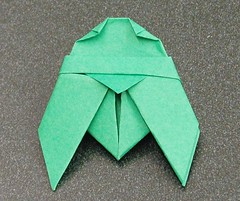
Origami cicada


Origami cicada
Originally uploaded by ricklibrarian.
Anne, our director, brought us instructions to make origami cicada today. She made plenty of copies and put them at the reference desk with paper squares in many colors. Knowing that clients may ask for help, I made two in advance. This photo shows the second attempt, which came out much better than the first. Now I am taking a copy of the instructions home to my daughter. We have some nice origami paper there, which we can use for some fancier cicada.

Watch here for more cicadamania.

Today's Word: tulle


Tulle [tool] n. - Hard to find netting made of acetate, nylon, or rayon, rumored to be available in Chicago area fabric stores. Useful for wrapping young trees and shrubs during an outbreak of seventeen year cicada to keep the cicadas from laying eggs in pencil thin limbs. When brightly colored tulle is used to wrap trees, landscapes are transformed ala Christo.

The cicadas have come today as predicted. As I drove this morning , I saw three kids and a mother examining the trunk of a trees that had cicada crawling upward. I have seen several dozen so far. There will be more. Many more.

Welcome, Overnight Visitors

One of my early morning routines is to check on this blog at Sitemeter. I am alerted if anything has gone wrong or right in the night. Also, I can see in a general sense who has been reading the posts while I slept. What I particularly like about the early morning list is its international flavor. This morning's list has a really good mix of visitors from around the globe.

Here are a few overnight highlights:

Someone in Bulgaria read my review of A Long Way Gone: Memoirs of a Boy Soldier by Ishmael Beah.

Someone in the Philippines read about the Thomas Ford library staff tour of the Marion E. Wade Center, a special library focusing on C. S. Lewis and his friends.

Someone in Switzerland read my review of A Country Year by Sue Hubbell.

Someone in New Zealand read my review of An Ordinary Man by Paul Rusesabagina.

Someone in Australia read my review of the 6th edition of Genreflecting by Diana Tixier Herald.

Someone in Belarus read about the new Saturday edition of the Chicago Tribune Books Section.

Someone in Hong Kong read my review of The Good Women of China by Xinran.

Someone in Turkey came to the blog's main page.

Americans are often criticized for being ignorant of the rest of the world. We sometimes fear people from other countries who we assume have different beliefs and values and want to keep them away from us. We really do not know what interests them. What I think my overnight visitors show is that we have much in common. We are all reading.

It is time to look beyond our nationalities and consider ourselves citizens of the world. It is easy when we go out via the Internet. It is also time to share some more good books. Everyone is invited to read.

Sunday, May 20, 2007

Librarian's Book Revoogle for Your iGoogle Page

I am trying to make the Librarian's Book Revoogle more available to users. If you click on the button below, you can add a gadget to your iGoogle page, which will let you use the customized search engine without seeking either its page or coming to my blog.

Add to Google

The Librarian Book Review is a customized search engine for finding book reviews written by librarians, library staff, or readers invited to post reviews on library websites.

Of course, you have to have an iGoogle page for this to work. You may have to be logged in to Google for it to work.

Let me know if you have any trouble adding this gadget.

Sailing the Wine Dark Sea: Why the Greeks Matter by Thomas Cahill

Should you read or listen to Sailing the Wine Dark Sea by Thomas Cahill and fall under its spell, here is what you should do:
  • Book a flight to Athens.
  • Read the Iliad and the Odyssey in the days before the trip.
  • Read the plays of Aeschylus, Sophocles, and Euripedes on the plane.
  • Visit the Agora below the Acropolis to walk where Socrates walked.
  • Catch a bus to Delphi. Read Herodotus as you speed through the plains and hills. Take lots of pictures out your window.
  • Stand at the center of the universe listening for the Delphic Oracle.
  • Take a cruise of the Greek Islands. Read the lyric poets in the Greek sunshine.
  • Like Odysseus, take the long way home.

Cahill loves his subject, and his enthusiasm is infectious. I loved hearing about all the Greek gods, heroes, poets, sculptors, philosophers, dramatists, and politicians. I also enjoyed learning stray facts. Did you know that "symposium" means "drinking party?" Did you know the Athenians had to remove a peak and level the Acropolis before they built its campus of sacred buildings? Cahill peppers the book with interesting stories and observations.

He also tells you the bad stuff. Slaves and women were treated horribly. War was brutal. Citizens were ostracized. As centuries passed, the civilization declined

Because the Greeks laid the foundation for the educational, political and cultural institutions we have today, and our ways of thinking are much like theirs, we should learn as much as we can about them. This book is a good starting place.

Cahill, Thomas. Sailing the Wine Dark Sea: Why the Greeks Matter. New York : Nan A. Talese/Doubleday, c2003. ISBN 0385495536

Saturday, May 19, 2007

The Chicago Tribune's Saturday Book Section

The Chicago Tribune rolled out its new Saturday book section today, as it announced weeks ago. The good news is that Books has expanded to sixteen pages, up from twelve. The bad news is that it is in the Saturday paper, which has many fewer readers than the Sunday paper. The good news is that it looks really sharp, with more books reviewed in a layout that resembles the New York Times Book Review. The bad news is that it looks so good because there is very little advertising to clutter the pages; the penny counters in the newspaper's business office certainly won't want to continue a section that does not raise advertising revenue.

Today's book section has an interesting mix of titles, including serious and light fiction, a couple of large biographies, history, true crime, and children's books. Several of the books have Chicago area appeal. The book that I am putting on my reading list is Everything Conceivable: How Assisted Reproduction is Changing Men, Women, and the World by Liza Mundy. I am glad to see my library has it and someone is already reading it.

Just three weeks ago the New York Times ran an article about the death of book sections in newspapers across the country. Will the Chicago Tribune book section long survive? Let's hope for a miracle.

The Biography Book: A Reader's Guide to Nonfiction, Fictional, and Film Biographies of More Than 500 of the Most Fascinating Individuals of All Time

I am seeking a core list of biographies . My purpose is to identify famous people whose biographies should be in most public libraries. I wonder if anyone has ever prescribed such a list by famous name, not by book title. I have not found such a list yet, but I have found The Biography Book by Daniel S. Burt.

The Biography Book's content is very impressive. For each of the 509 historical figures, all deceased, Burt provides a one paragraph profile, notes autobiographical and primary sources, and identifies recommended biographies (usually two or three), other biographies (often not as comprehensive as the recommended titles), biographical novels, fictional portraits, juvenile biographies, and films and plays portraying the figures. In his introduction, the author says that he chose the figures by searching through the catalogs of the public and academic libraries of Connecticut. The historical figures that made his book had at least thirty books about "their lives, work, or achievement" in these libraries. He included only biographical titles in this reference book. Books of literary criticism, histories of political administrations, and illustrated art books were excluded.

I think the resulting list must reflect the academic collections in Connecticut more than the public collections, as there are numerous figures I do not consider necessary for small public libraries. Names that surprised me included Aubrey Beardsley (English illustrator and writer), Coco Chanel (20th century fashion designer), Thomas de Quincey (19th century English essayist), Michel de Montaigne (16th century French essayist), and Ivan Turgenev (19th century Russian novelist). The list includes many writers, artists, classical musicians, and English monarchs.

I was surprised also by some names that are not included. Presidents James Polk and James Buchanan, the explorer Meriwether Lewis, sports figures Babe Ruth and Jim Thorpe, actors Mary Pickford and John Wayne, and musician Louis Armstrong. I expect students and general readers to ask for biographies of these famous people.

To be fair, most essential names that I checked are in this reference book. It can be used to study library collections, but librarians will have to use their good judgement whether biographies should be acquired. Readers' advisory librarians also could use Burt's book to create some interesting booklists matching biographies with novels.

The book has title, nationality, occupation, time period, and subject indexes. It should be in academic and large public libraries.

Burt, Daniel S. The Biography Book: A Reader's Guide to Nonfiction, Fictional, and Film Biographies of More Than 500 of the Most Fascinating Individuals of All Time. Westport, Connecticut: Oryx Press, 2001. ISBN 1573562564

Friday, May 18, 2007

Buildings of the District of Columbia by Pamela Scott and Antoinette J. Lee

By this time last year, I had reviewed four books about New Orleans. This is my first look at Washington, DC books in preparation for attending the American Library Association Annual Conference in late June. My own need for study is a little less this year, as I have been to DC in the past and have seen most of the major sites. Still I want to be an informed visitor, so I plan to read and skim a few books in the next month.

I am starting with Buildings of the District of Columbia by Pamela Scott and Antoinette J. Lee, published in 1993. Of course, there are new buildings in Washington since that date, such as the Holocaust Museum, but most of the architecture of the city is old and preserved for the citizens and visitors to see. This book, which includes both public and residential buildings, is still useful for tourists with architectural interests. It is arranged by neighborhoods, starting with the Mall, and describes hundreds of buildings, some in great detail.

For example, Scott and Lee devote about three pages to the Thomas Jefferson Building of the Library of Congress, 1871-1897. They tell readers that it was "the first building in Washington to express fully the tenets of the Beaux-Arts system of architecture." They explain that the architects modelled the building on the Paris Opera House of 1861-1875, replacing the theater with a reading room. They also describe the external and interior ornamentation, saying that like many Victorian era buildings, the art and sculpture is very symbolic. In the end, they state that the decoration is overdone and criticize the columns on some staircases as being poorly proportioned.

Black and white photos and maps are included. A glossary of architectural terms is included, just before the index.

Buildings of the District of Columbia was the first book in the Society of Architectural Historians Buildings of the United States series. The series is intended to be a comprehensive survey of all the architecture of the Unites States with a volume for every state and Washington, DC. Fourteen years later, there are ten volumes, adding Alaska, Colorado, Iowa, Louisiana, Michigan, Nevada, Rhode Island, Virginia, and West Virginia. The Virginia volume appears to be only a portion of the state, so there may ultimately be more than fifty-one volumes.

I purchased three volumes for our library back in 1996, thinking that we would build the set. Because our Iowa and Michigan books have never been borrowed, I have refrained from buying more. In our small library we do not have the readers to match with these books. The set, if ever completed, should be added to large city, college, and university libraries. Most public libraries should get their own state. This volume for Washington, DC may have more appeal than most other volumes.

Pamela Scott and Antoinette J. Lee. Buildings of the District of Columbia. New York: Oxford University Press, 1993. ISBN 0195061462

Good Poems for Hard Times Selected and Introduced by Garrison Keillor


A funny thing happened at our book group last night. As I sat down on the couch, I discovered that my school bus yellow book jacket stuck out among those of dark blue. I read the wrong book! What's funny is a moment later two others came in with the same wrong book. As it worked out, it was not a problem. In fact, it made the evening better.

The assigned book was Good Poems selected and introduced by Garrison Keillor. What three of us read was Good Poems for Hard Times, a sequel with a whole new collection of poetry.

After a few laughs, Nancy, our host, read portions of two book reviews from the April 2004 issue of the journal Poetry. In "Title Tells All" Dana Gioia of the National Endowment of the Arts admires the book as "slightly subversive" and "an admirable mix of familiar and unfamiliar poems." He commends the collection for "quality, freshness, and diversity." It is okay with him that the book will appeal to many readers who usually do not like poetry. Then Nancy read from "No Antonin Artaud with the Flapjacks, Please" by the poet August Kleinzahler. He suggests that American forces in the Middle East use audiotapes of Keillor reading poetry as a weapon against terrorists. The collection "isn't poetry at all but prose arbitrarily broken into lines masquerading as poetry." He complains about wholesomeness and whimsy. Kleinzahler says that Keillor's "boosterism" will sell books but do nothing to turn "the better animals in the jungle" to poetry.

Of course, being the average Midwesterns that we are, we all liked the books. We spent the evening reading and discussing our favorite selections. After Amy read "The Summer-Camp Bus Pulls Away from the Curb" by Sharon Olds, I said that I really enjoyed it. Monique observed, "You have a daughter going off to college. That's why." She was right. I find the poem reassuring, which, despite Mr. Kleinzahler, is okay.

Poems in both collection were read by Keillor on his five-minute program The Writer's Almanac. Postcasts are available daily.

Both collection should be in most public libraries.

Good Poems. New York: Viking, 2002. ISBN 0670031267

Good Poems for Hard Times. New York: Viking, 2005. ISBN 0670034363

Thursday, May 17, 2007

Changing Call Numbers on Books: The Evolution from "Never" to "Right Away"

You might think that I am a dinosaur. I got into libraries just before computerized circulation systems became popular. I worked for two libraries during data entry projects for their first computers. I remember their microfilm-based checkout systems; it took these libraries six months to notice an item had not returned, develop the microfilm record of the checkout transaction, and send an overdue notice.

I am actually one of the small mammals that saw the dinosaurs die off. Opportunists, we evolved into a dominant species, computer-savvy librarians. Computers and their software led us to change more than just our library practices and procedures. They let us change our attitudes.

When I started working in libraries, few librarians would ever consider changing the call number on a book. Too much work had gone into assigning the call number and processing the item. Changing it would require not only slapping a new label on the spine, but also pulling all the catalog and shelflist cards, using buff-colored whiteout on the old numbers, lining up the cards in a typewriter to type new numbers, and refiling all the cards. The prevailing attitude was that libraries had to live with the old call numbers no matter how bad they were.

I think the seeds of change were planted by word processing software. The idea that a document could be saved and easily modified at a later date was revolutionary thinking. The real opportunity for change came when libraries closed their card catalogs.

Here is what I have seen. I will not name libraries as my intention is not to criticize. Many libraries were like them.

In my first job I worked in a city library system with numerous branch libraries. All cataloguing was done in the central library and catalog cards were filed in two buildings (the central library and the appropriate branch). Every six months branch libraries received two floppy book catalogs (produced from punch cards run through a mainframe computer). The two large paper-covered books let readers browse (if they were up to the effort) for authors or titles in libraries throughout the city. In this situation, no one would ever request a call number change. The paperwork would take months.

In my second job the situation was similar. The library served three counties, and there was a three month cataloguing/book processing backup in the best of times. No one had time to change a call number.

My third job was in a moderately small suburban library that was part of a growing consortium that was building a computerized checkout system. Call number data had not been entered into the system. The small library had its own cataloguer, who was willing to change call numbers if requested, but it was still a lot of work pulling and refiling catalog cards. We changed numbers rarely, but we did actually do it to update several call numbers that Dewey authorities had changed.

Fast forward past this increasing tedious litany to the exciting present.

The Thomas Ford Memorial Library was Library 2.0 user-friendly before the label was ever used. In the mid-1990s we began slowly changing call numbers when we found our books on topics shelved in numerous Dewey locations. Our thinking that was that our collection was too small to allow us to leave the books separated. When we had only two or three books on a subject, we needed them together. Our readers needed them together so they would find them. We did this even when it meant editing cards, refiling, and updating a computer record.

When we disposed of the card catalog, we increased our effort. We massively changed call numbers in the literature section to simplify access. Now all poetry books by an American author are at 811 with no era-related decimals added. (We took the idea from the Downers Grove Public Library.) We reorganized the books on painters, which were a mess. Claude Monet had had three call numbers. We also reworked the gardening and landscaping areas. Before this effort readers could find books on roses under four call numbers. Thomas Ford staff has been great throughout the effort. We discuss what needs to be done and then do it. Current technology makes it possible, so "Why not?" We have a developed a "right away" staff culture, which goes beyond just changing call numbers.

I said that we have seen the dinosaurs die off. I am not sure that they have all died as yet. Are you a dino or a quickly evolving mammal? How are your library's call numbers?

Wednesday, May 16, 2007

The Longest Journey by E. M. Forster

This is the centennial year for The Longest Journey by E. M. Forster, an early novel by the author of A Room with a View (1908), Howard's End (1910), and A Passage to India (1924). Though it is less known today than these other novels, Forster often said that it was his favorite work. Through the characters of Frederick (Rickie) Elliot and his friend Stewart Ansell, he works some of his own school and writing experiences into fiction and expresses his misgivings with the British class structure.

Forster took his title from the Shelley's poem "Epipsychidion," which suggests people sometimes live out their lives with the wrong partners and companions. He could have titled the novel No Great Expectations, as in youth the lame Elliot is sheltered by his mother, who intends just to keep him home. Once she and her estranged husband die, Elliot is sent to live with an aunt, who sends him to day school. He finds his first friends later at Cambridge University, where he is a mediocre student, and after graduating he marries more for pity than love. He tries to write little stories while teaching at a second rate school. Family revelations worthy of a soap opera follow, and the end is slightly heroic but tragic. E. M. Forster fans will love it.

As in other Forster novels, action revolves around moments of misunderstanding and betrayal. Scenes are well-drawn and characters are complicated. It should be adapted for Masterpiece Theater. I listen to an audiobook version read by Nadia May. It was a good companion while gardening.

Forster, E. M. The Longest Journey. New York: Vintage Books, 1993. ISBN 0679748156.

9 compact discs. Ashland, OR : Blackstone Audiobooks, p2000. ISBN 0786197323.