From today it is two months until publishing day! June 30, 2009 is the date my book Real Lives Revealed will be officially unveiled. You may now find it for pre-orders on Amazon, Baker & Taylor, and Barnes & Noble. I look forward to seeing it on display at the Libraries Unlimited exhibit at the American Library Association Annual Conference in Chicago, July 11-14.
In the meantime, I plan to post several pieces about and around the subject of biography. I'll start by identifying some top biographers. As with any literary genre, there are men and women who repeated write biographies. I identify dozens of them in the second appendix in my book. Here are three samples.
Fraser, Antonia (1932) – Popular mystery writer who also writes novel-like biographies of British and French monarchs.
· Mary, Queen of Scotts (1969)
· Cromwell: The Lord Protector (1973)
· King James VI of Scotland, I of England (1975)
· Royal Charles: Charles II and the Restoration (1979)
· Warrior Queens (1989)
· Wives of Henry VIII (1992)
· Marie Antoinette: The Journey (2001)
· Love and Louis XIV : The Women in the Life of the Sun King (2006)
Authors to try: Stephen Coote, Benita Eisler, Robery K. Massie, Nigel Saul, Claire Tomalin, Alison Weir, Derek Wilson
Macintyre, Ben (1963- ) – Journalist who writes about flamboyant historical characters.
· Forgotten Fatherland: The Search for Elisabeth Nietzsche (1992)
· The Napoleon of Crime: The Life and Times of Adam Worth, Master Thief (1997)
· The Englishman's Daughter: A True Story of Love and Betrayal in World War I (2002)
· The Man Who Would Be King: The First American in Afghanistan (2004)
· Agent Zigzag: A True Story of Nazi Espionage, Love, and Betrayal (2007)
Authors to try: Andrew Cook, Laurence Bergreen, Mary S. Lovell, Charles Nicholl, Jack Repcheck, David S. Reynolds, Kenneth Silverman
Spoto, David (1941- ) – Celebrity biographer interested in film directors who has recently also begun to write about religious figures.
· Stanley Kramer, Film Maker (1978)
· The Dark Side of Genius: The Life of Alfred Hitchcock (1983)
· The Kindness of Strangers: The Life of Tennessee Williams (1985)
· Falling in Love Again: Marlene Dietrich (1985)
· Lenya: A Life (1989).
· Madcap: The Life of Preston Sturges (1990)
· Blue Angel: The Life of Marlene Dietrich (1992)
· Laurence Olivier: A Biography (1992)
· Marilyn Monroe: The Biography (1993)
· A Passion for Life: The Biography of Elizabeth Taylor (1995)
· Rebel: The Life and Legend of James Dean (1996)
· Notorious: The Life of Ingrid Bergman (1997)
· Diana: The Last Year (1997)
· The Hidden Jesus: A New Life (1998)
· Jacqueline Bouvier Kennedy Onassis: A Life (2000)
· Reluctant Saint: The Life of Francis of Assisi (2002)
· Enchantment: The Life of Audrey Hepburn (2006)
· Joan: The Mysterious Life of the Heretic Who Became a Saint (2007)
· Spellbound by Beauty: Alfred Hitchcock and His Leading Ladies (2008)
Authors to try: Charlotte Chandler, Anne Edwards, Fred Lawrence Guiles, C. David Heymann, Charles Higham, Kitty Kelley, Andrew Morton, Sally Bedell Smith, Tom Santopietro, J. Randy Taraborelli
These and the other top biographers entries may be used to develop readalike lists.
Thursday, April 30, 2009


Wednesday, April 29, 2009
The Poe Shadow: A Novel by Matthew Pearl
 Sometimes I feel as though I have let Edgar Allan Poe down. Though a big fan as a youth, I have not returned to his writings, though they are still on my to-read-sometime list. Also, I have failed him as a tourist. When visiting Richmond, Virginia back in 2002, I arrived at the Edgar Allan Poe Museum just as it was closing and failed to get in. That same year I went to Baltimore where I uncharacteristically got lost and never found the Edgar Allan Poe House and Museum. If I am ever invited to read at a poetry program, I plan to perform "The Raven" in the manner of Vincent Price, but it has never happened.
In The Poe Shadow: A Novel by Matthew Pearl, Quentin Clark of Baltimore was determined that he would not fail the poet, whom he had never actually met. Clark had sent Poe several letters expressing his appreciation of the author's poems and short stories. Poe had ignored most of these but just before his death had responded with a suggestion that he would like Clark to be his attorney for an upcoming publishing venture. Clark was honored and eagerly waited for the day that never came. Poe mysteriously died and was quietly buried in Baltimore in October 1849.
When muckraking newspapers began to speculate about Poe's movements during his last week and why he had died, Clark began his own investigation. His law partner and great aunt immediately tried to stop him, which, of course, egged him on. As the newspaper accounts became more lurid and contradictory, Clark became more determined and began neglecting his practice, fiancee, and home. He then went to Paris to contact the French detective whom he was certain was Poe's model for C. Auguste Dupin in The Murders in the Rouge Morgue. If anyone could solve the mystery, it was Auguste Duponte.
The Poe Shadow is just the kind of fiction that appeals to me, for I most like to learn about other times and places. Pearl has cleverly used a true mystery as a basis for this literary novel. As he explains in the "Historical Notes" in the back of the book, nearly every character, except for Clark, his partner, his aunt, his fiancee, and two Frenchmen who pose as the true Dupin, was an associate of the real Edgar Allan Poe. Pearl explains the details of the case that he utilizes. He even claims to have made a few significant discoveries of his own during his Poe research.
I chose to read Pearl's book after hearing about his new title The Last Dickens: A Novel. He has also written a novel about Dante. All of these books should be in most public libraries.
Pearl, Matthew. The Poe Shadow: A Novel. Random House, 2006. ISBN 1400061032
Monday, April 27, 2009
Juvenile Biographies for All Ages
At the bottom of the back stairs, around the corner, on an A-frame shelving unit in the Youth Services room in the Thomas Ford Memorial Library, you will find new children's books, audiobooks, and DVDs on display. Whenever I visit that area, I glance at the offerings. Thinking about how Will Manly said in a recent column in Booklist that he enjoys juvenile biographies, I took three and read them this past week.
 The first biography that I borrowed had just a woman's face on the front cover. Upon seeing it, I thought I recognized her, but I wasn't quite sure. She looked younger than in the standard depictions of a very famous person. Turning to the title page, I was affirmed; it was Eleanor Roosevelt. Eleanor, Quiet No More: The Life of Eleanor Roosevelt written by Doreen Rappaport and illustrated by Gary Kelley is a handsome picture book about a woman who is remembered as a pioneer for women's rights and an activist for world peace. With a minimum of words, Rappaport describes Roosevelt's long life filled with both privledge and sacrifice. The author recounts the major events of the First Lady's life, even telling about her struggles with her mother-in-law and the hurt that she suffered when people described her as ugly. I enjoyed Kelley's soft, muted colors, which evoke the black-and-white world of the Depression and World War II eras. I think the page with Marian Anderson singing before the Lincoln Memorial would make a great poster.
 The Many Rides of Paul Revere by James Cross Giblin was the second juvenile biography that I borrowed. I would not describe Giblin's book as a picture book, for there is quite a bit of text and even an index. Clearly it is aimed at students with assignments as much as pleasure readers. The primary message of this book is that Paul Revere did much more for the Revolutionary cause than one midnight ride. He was sent out by the Sons of Liberty on several occasions, traveling as far as Philadelphia to deliver messages. He was also a silversmith of renown, an early industrialist, and an articulate and respected member of his community. While looking at the many drawings and photographs, I enjoyed thinking about my family's past visits to Boston, including a visit to the Revere House, which is right off the Freedom Trail. Giblin's book is a substantial introduction to Revere for any age reader.
 The third biography that I read was Seven Miles to Freedom: The Robert Smalls Story by Janet Halfmann and illustrated by Duane Smith. In this book, Halfmann tells about a slave who in late 1863 spirited several African-American families across the Civil War battlefront by stealing a Confederate paddle boat. Posing as a white captain in the early morning light, he calmly guided the boat past several Confederate forts to the Union blockade of the Charleston, South Carolina harbor. In the afterward, the author tells how Smalls served five terms in the U.S. Congress. I liked Smith's broad brush illustrations dramatizing the bold escape.
I see now why Will Manly is enjoying juvenile biographies, which he has been reading with his grandchildren. The books are attractive, stories are compelling, and the research is substantial. More adults should notice these books with something to offer to all ages.
Rappaport, Doreen. Eleanor, Quiet No More: The Life of Eleanor Roosevelt. Disney Hyperion Books, 2009. ISBN 9780786851416
Giblin, James Cross. The Many Rides of Paul Revere. Scholastic Press, 2007. ISBN 9780439572903
Halfmann, Janet. Seven Miles to Freedom: The Robert Smalls Story. Lee & Low Books, 2008. ISBN 9781600602320
 The first biography that I borrowed had just a woman's face on the front cover. Upon seeing it, I thought I recognized her, but I wasn't quite sure. She looked younger than in the standard depictions of a very famous person. Turning to the title page, I was affirmed; it was Eleanor Roosevelt. Eleanor, Quiet No More: The Life of Eleanor Roosevelt written by Doreen Rappaport and illustrated by Gary Kelley is a handsome picture book about a woman who is remembered as a pioneer for women's rights and an activist for world peace. With a minimum of words, Rappaport describes Roosevelt's long life filled with both privledge and sacrifice. The author recounts the major events of the First Lady's life, even telling about her struggles with her mother-in-law and the hurt that she suffered when people described her as ugly. I enjoyed Kelley's soft, muted colors, which evoke the black-and-white world of the Depression and World War II eras. I think the page with Marian Anderson singing before the Lincoln Memorial would make a great poster.
 The Many Rides of Paul Revere by James Cross Giblin was the second juvenile biography that I borrowed. I would not describe Giblin's book as a picture book, for there is quite a bit of text and even an index. Clearly it is aimed at students with assignments as much as pleasure readers. The primary message of this book is that Paul Revere did much more for the Revolutionary cause than one midnight ride. He was sent out by the Sons of Liberty on several occasions, traveling as far as Philadelphia to deliver messages. He was also a silversmith of renown, an early industrialist, and an articulate and respected member of his community. While looking at the many drawings and photographs, I enjoyed thinking about my family's past visits to Boston, including a visit to the Revere House, which is right off the Freedom Trail. Giblin's book is a substantial introduction to Revere for any age reader.
 The third biography that I read was Seven Miles to Freedom: The Robert Smalls Story by Janet Halfmann and illustrated by Duane Smith. In this book, Halfmann tells about a slave who in late 1863 spirited several African-American families across the Civil War battlefront by stealing a Confederate paddle boat. Posing as a white captain in the early morning light, he calmly guided the boat past several Confederate forts to the Union blockade of the Charleston, South Carolina harbor. In the afterward, the author tells how Smalls served five terms in the U.S. Congress. I liked Smith's broad brush illustrations dramatizing the bold escape.
I see now why Will Manly is enjoying juvenile biographies, which he has been reading with his grandchildren. The books are attractive, stories are compelling, and the research is substantial. More adults should notice these books with something to offer to all ages.
Rappaport, Doreen. Eleanor, Quiet No More: The Life of Eleanor Roosevelt. Disney Hyperion Books, 2009. ISBN 9780786851416
Giblin, James Cross. The Many Rides of Paul Revere. Scholastic Press, 2007. ISBN 9780439572903
Halfmann, Janet. Seven Miles to Freedom: The Robert Smalls Story. Lee & Low Books, 2008. ISBN 9781600602320
Friday, April 24, 2009
Do I Dare Disturb the Universe?: From the Projects to Prep School by Charlise Lyles
 One of the benefits of having a book review blog is getting an occasional free book. I look at each one that shows up in my mailbox, but, being under no obligation, I do not read and review every one. With plenty to read already, an unsolicited book has to somehow "speak to me" to get my attention. Do I Dare Disturb the Universe?: From the Projects to Prep School by Charlise Lyles succeeded. I enjoy coming-of-age memoirs and am very interested in civil rights stories.
Lyles new book is actually an old book rewritten. She published a first edition in 1994. In it she told about growing up in a dangerous public housing project in Cleveland, her up-and-down experiences in public school, and her search for her errant father. In the new edition she revised the story of her early experiences and added a section about her three years in Hawken School, an exclusive prep school in the Cleveland suburbs. I can hardly imagine the book without the final section, which completes her adolescence story and shows why she successfully left poverty behind her.
I like how Lyles begins the book at the point when her life is about to change dramatically. She has won a scholarship to attend Hawken School. She is not totally sure that she should accept because she will leave the known dangers of the African-American projects for the unknown dangers of the highly competitive and mostly white prep school. She seeks to find her missing father 1) to show him that she has done quite well without him, 2) to see if he is really as bad as her mother and older sister contend, and 3) to get a sign from him that she is doing the right thing. She finds him amid his piles of books in a dark and dreary apartment.
Lyles then goes back in time to describe her elementary and middle school years, showing how unlikely a candidate for prep school she was. She had even repeated the third grade. Readers also learn why she felt compelled to leave her Black Power stronghold and accept the scholarship. The final section recounts the difficulties and success of her Hawken School years.
Do I Dare Disturb the Universe? arrived at just the right time. My Library is featuring coming-of-age stories in our adult summer reading program. Lyles memoir of Cleveland in the 1960s and 1970s will be an appealing title to add to the display and booklist. I recommend it to other public libraries.
Lyles, Charlise. Do I Dare Disturb the Universe?: From the Projects to Prep School. Gray & Company, 2008. ISBN 9781598510416
Thursday, April 23, 2009
Book Review Podcasts
I have been listening to several book review podcasts for a couple of months now. Each week I connect my iPod to my computer on Saturday, and iTunes loads episodes of The Washington Post Book World (Friday), The New York Times Book Review (Friday), and NPR Books (Thursday). I then usually listen to them while I cook one of the weekend meals. As I prepare dinner, I keep a pencil and pad nearby to jot down titles and authors. I later check whether my library owns the books and place reserves for the titles that interest me.
My favorite of the three programs is The Washington Post Book World with Rachel Hartigan Shea, which usually begins with some book news, is followed by two author interviews and a poetry reading, and then ends with a litany of author events in the D.C. area for the coming week. This week the news included a brief recap of the Amazon sales rankings controversy and quick announcements of literary prizes. The first interview featured Warren St. John discussing his new book Outcasts United, an investigative report about a soccer team composed of foreign refugees living outside Atlanta, Georgia. St. John recounts how the players and their coach came to be living in the American South after fleeing their homelands. The second author interviewed was with Barbara Moran, who wrote the forthcoming book The Day We Lost the H-Bomb. She described a mid-air collision between a B2 bomber and a fueling tanker in 1966 that resulted in the U. S. Air Force losing a hydrogen bomb in the Mediterranean Sea off the coast of Spain. The entire program was about twenty-six minutes.
The weekly podcasts with Sam Tanenhaus for The New York Times Book Review also feature two author interviews along with book news and a report on the weekend's NYT bestseller lists. With only fifteen minutes and more emphasis on the other features, the interviews are briefer than those in The Washington Post Book World. This week's NYTBR report on Amazon's troubles was more detailed than that in the WPBW. Tanenhaus draws reports from several of his paper's editors each week. The program is a pleasant companion while I chop vegetables and stir the soup.
NPR Books varies greatly from week to week. Unlike NPR Science, this podcast has no hosts introducing the stories and reviews. This week the podcast had three stories, including an interview with Romi Lassally of True Mom Confessions: Real Moms Get Real, each taken from All Things Considered or other NPR broadcast programs. The podcast lasted about fourteen minutes. Some weeks the podcast lasts nearly thirty minutes. Any type of book may be featured. NPR is more likely to have an obscure book than WPBW or NYTBR.
All of the podcasts refer listeners back to their websites for more information on books and publishing. Readers who enjoy getting background on how books are written and hearing about book trends will appreciate these lively programs.
My favorite of the three programs is The Washington Post Book World with Rachel Hartigan Shea, which usually begins with some book news, is followed by two author interviews and a poetry reading, and then ends with a litany of author events in the D.C. area for the coming week. This week the news included a brief recap of the Amazon sales rankings controversy and quick announcements of literary prizes. The first interview featured Warren St. John discussing his new book Outcasts United, an investigative report about a soccer team composed of foreign refugees living outside Atlanta, Georgia. St. John recounts how the players and their coach came to be living in the American South after fleeing their homelands. The second author interviewed was with Barbara Moran, who wrote the forthcoming book The Day We Lost the H-Bomb. She described a mid-air collision between a B2 bomber and a fueling tanker in 1966 that resulted in the U. S. Air Force losing a hydrogen bomb in the Mediterranean Sea off the coast of Spain. The entire program was about twenty-six minutes.
The weekly podcasts with Sam Tanenhaus for The New York Times Book Review also feature two author interviews along with book news and a report on the weekend's NYT bestseller lists. With only fifteen minutes and more emphasis on the other features, the interviews are briefer than those in The Washington Post Book World. This week's NYTBR report on Amazon's troubles was more detailed than that in the WPBW. Tanenhaus draws reports from several of his paper's editors each week. The program is a pleasant companion while I chop vegetables and stir the soup.
NPR Books varies greatly from week to week. Unlike NPR Science, this podcast has no hosts introducing the stories and reviews. This week the podcast had three stories, including an interview with Romi Lassally of True Mom Confessions: Real Moms Get Real, each taken from All Things Considered or other NPR broadcast programs. The podcast lasted about fourteen minutes. Some weeks the podcast lasts nearly thirty minutes. Any type of book may be featured. NPR is more likely to have an obscure book than WPBW or NYTBR.
All of the podcasts refer listeners back to their websites for more information on books and publishing. Readers who enjoy getting background on how books are written and hearing about book trends will appreciate these lively programs.
Tuesday, April 21, 2009
The Inside Scoop: A Guide to Nonfiction Investigative Writing and Exposés by Sarah Stadz Cords
 I am not unbiased in the reviewing of this book. I know Sarah Statz Cords. More importantly, my upcoming book about biography is the second in the Real Stories series. Sarah's book, The Inside Scoop: A Guide to Nonfiction Investigative Writing and Exposés, is the first.
The Real Stories series edited by Robert Burgin will be a group of books to help readers and librarians find nonfiction books to read. Volumes about autobiographies and memoirs, women's nonfiction, true adventure, travel, environmental writing, true crime, and sports books are being written or planned. The series will be a sort of Genreflecting for nonfiction.
It is fitting that Sarah's book start the series, as her previous book, The Real Story: A Guide to Nonfiction Reading Interests (Libraries Unlimited, 2006), is the model from which the other books are drawn. In that book, you learn of her interest in investigative writing, a genre based more on a style of writing than on a common theme. She expands a chapter in that book into six chapters in The Inside Scoop: In-Depth Reporting, Exposés, Immersion Journalism, Character Profiles, Political Reporting, and Business Reporting. Within these chapters are short reviews of hundreds of books collected in sub-sections, such as "Government Exposés," "Science Reporting," and "Hot-Button Issues."
If you are having trouble imaging the titles included, here are some that you may know:
- The Soul of the New Machine by Tracy Kidder
- Uncommon Carriers by John A. McPhee
- The Outlaw Sea: A World of Freedom, Chaos, and Crime by William Langewiesche
- The Great Deluge: Katrina, New Orleans, and the Mississippi Gulf Coast by Douglas Brinkley
- The Lemon Tree: An Arab, a Jew, and the Heart of the Middle East by Sandy Tolan
- Stiff: The Curious Lives of Human Cadavers by Mary Roach
- Friday Night Lights: A Town, a Team, and a Dream by H. G. Bissinger
- The Good Rat: A True Story by Jimmy Breslin
- The Long Road Home: A Story of War and Family by Martha Radatz
These titles are all in the first section, In-Depth Reporting. Most are from the last few years, though there are some older works, such as Working by Studs Terkel. The other five chapters are also filled with well-known and waiting-to-be-rediscovered books.
The idea behind The Inside Scoop and the other titles in the series is that a reader or librarian look up a known title to find other titles to read. Each review includes four to eight recommendations for what to read next. For example, if you look up The Age of Turbulence: Adventures in a New World by Alan Greenspan, Sarah suggests memoirs by Donald Trump and Bill Clinton, biographies of Ronald Reagan, Richard Nixon, and Henry Kissinger, books on economics by Thomas Friedman and Tim Hartford, and even the novels The Fountainhead and Atlas Shrugged by Ayn Rand.
Sarah thinks beyond just books in The Inside Scoop, including lists of documentary films and magazines of investigative writing in the appendices. I believe libraries wanting to build their nonfiction readers' advisory service will want this smart new guide.
Cords, Sarah Statz. The Inside Scoop: A Guide to Nonfiction Investigative Writing and Exposés. Libraries Unlimited, 2009. 449p. ISBN 9781591586500
Monday, April 20, 2009
The Shawnees and the War for America by Colin G. Calloway
 In the litany of American wars, the Indian Wars are often overlooked. They are not celebrated and memorialized with the American Revolution, the War of 1812, the Civil War, and the world wars of the twentieth century. Americans several generations removed from the events forget that there even were wars between European settlers and Native Americans in the eighteenth and nineteenth centuries. Violence on the frontier is just remembered as "trouble." "There was trouble with some Indians." Rarely is it admitted that whites fought a war to eliminate (exterminate) Native Americans.
Perhaps these wars are forgotten because we are unable to reconcile our Constitutional commitment to justice with the apparent crimes of our ancestors. We would rather forget.
It is difficult now to imagine a time when the spread of Europeans across the continent of North America was not seen as inevitable. We now wonder why the Shawnees and other tribes would have bothered to fight.
As Colin G. Calloway makes clear in The Shawnees and the War for America, there were wars. The Shawnees and other tribes thought that they could win. Some whites feared the Indians might prevail. In response, the U.S. government sent military forces to the frontier repeatedly over the course of 100 years. Sometimes there were battles, but at other times there were peace settlements. The Indians actually won some of the battles, but they always lost the peace, as the whites repeatedly violated the treaties.
Calloway's concise history of the Shawnees, whose lands ranged from the Great Lakes to the Gulf of Mexico, is on the surface a calm, respectful story, but I sense underneath a rage at the atrocities committed by both whites and Indians. But, perhaps, that feeling comes from me, the reader.
The Shawnees and the War for America is the second volume of The Penguin Library of American Indian History. The Cherokee Nation and the Trail of Tears by Theda Perdue and Michael D. Green was the first. Public libraries should get them all.
Calloway, Colin G. The Shawnees and the War for America. Viking, 2007. ISBN 9780670038626
Friday, April 17, 2009
I Read You, You Read Me: A Poem
I have noticed many jabs at social networking lately in cartoons, columns, and editorials. Some of the jokes are funny, many are exaggerated, some are unfair. It is an irresistible target. Here's my shot in verse for National Poetry Month.
I read you,
You read me,
We both read endlessly.
Our Facebook pages suit us most.
Please wait a moment,
I have something to post.
*****
Nosy people want to know
Just where it was you planned to go.
Why did we see you on THAT street?
Just who was it you planned to meet?
We noticed you were so neatly dressed,
You tie was tied and your pants were pressed.
Your hat was tipped on your head so low.
Just where was it that you planned to go.
Nosy people want to know.
*****
So now where were we?
Is it time to read?
I'm going to log off now
And check my Twitter feed.
*****
___________________________________________________41
If I turn into chocolate and melt in your hand, will you remember my sweetness and say I was grand?
*****
I read you,
You read me,
We both read electronically.
Our digital footprints are spread so wide.
Listen folks, we have nothing to hide.
I read you,
You read me,
We both read endlessly.
Our Facebook pages suit us most.
Please wait a moment,
I have something to post.
*****
Nosy people want to know
Just where it was you planned to go.
Why did we see you on THAT street?
Just who was it you planned to meet?
We noticed you were so neatly dressed,
You tie was tied and your pants were pressed.
Your hat was tipped on your head so low.
Just where was it that you planned to go.
Nosy people want to know.
*****
So now where were we?
Is it time to read?
I'm going to log off now
And check my Twitter feed.
*****
___________________________________________________41
If I turn into chocolate and melt in your hand, will you remember my sweetness and say I was grand?
*****
I read you,
You read me,
We both read electronically.
Our digital footprints are spread so wide.
Listen folks, we have nothing to hide.
Thursday, April 16, 2009
A History of Reading by Alberto Manguel
 If it were not for the desire to read other books, I might never have finished A History of Reading by Alberto Manguel. As it was, I read a little at a time over about five weeks. I had to renew the book once. I could have renewed it again, as no one is waiting for it. The title is sort of drab and not promising of thrills, but once I got into the book, I thoroughly enjoyed all the arcane details about people, places, and eras that I know so little about.
For instance, on page 55, I read that Petrarch carried a pocket-sized edition of the Confessions of St. Augustine wherever he went. Petrarch lived in the 13th century and predated Gutenberg. I was surprised to learn there were pocket-editions of books even then.
On page 226, Manguel tells us about women of 1st century Greece who spent their time reading romance novels. Greek men thought that would keep them servile and out of mischief. Little did the men know that the women found ways to broaden their learning and gender communications through the supposedly safe literature. You can't keep readers down.
"The Silent Readers" is a particularly interesting chapter. In ancient times, reading was expected to be aloud. Reading quietly was thought of as sinister and diabolical. Only someone with evil purposes would not share with others their interaction with text.
Perhaps Manguel should have called the book A History of Readers as every chapter tells about individual persons and their experiences reading. Some are names that you will recognize, such as Franz Kafka, Colette, Gutenberg, or Charles II, King of England. In some ways, the book is autobiographical, as we learn about Manguel's education, work, and travels. In some other ways, it is about all of us and our habits of reading.
A History of Reading, with its nice type and many illustrations, is definitely a book for serious book lovers. Are you one? There are lots of copies on library shelves just waiting for you.
Thanks to Christine Pawley for recommending A History of Reading in her article on Readers' Advisor News.
Manguel, Alberto. A History of Reading. Viking, 1996. ISBN 0670843024
Wednesday, April 15, 2009
Thames: The Biography
 Thanks to Bonnie and Citizen Reader, I read Thames: The Biography by Peter Ackroyd. It had been on my big list of many titles that I would like to read someday, but with their recommendations, I moved it to the front of the queue. Because it is a big book and I was busy with my other projects, I spent a month reading it, which may have been a blessing. It is a great book to read slowly, a little at a time.
If you have not seen it, Thames: The Biography has 441 pages of actual narrative divided into many chapter, some as small as six pages. Each of the 45 chapters is an essay about some aspect of the history of the great English River around which many of the most important events in British history have occurred. Ackroyd must love the river immensely to put so much effort and thought into this fascinating book. Reading it makes me want to return to England badly.
Thames: The Biography is truly mostly about the river and its life. Ackroyd seems to have thought of every topic historical, cultural, religious, environmental, political, and literary. Readers who have narrower interests could well chose only the chapters that appeal to them and still enjoy a full reading experience. The book is almost an encyclopedia, but do not guess that it is dry and academic. I can imagine Ackroyd telling me about his river in the comfort of a den with a blazing fire and hours to spend in good conversation.
I loved some of the place names, especially Horseferry Place, Long Wittenham, Little Wittenham, Bablock Hythe, Iffley, Twwickenham, and Isle of Dogs.
While reading, I often visualized scenes that I have seen in movies, in BBC programs, or in my own travels. When Little Dorret went to the riverside in the recent Masterpiece Theater production by the same name, I noticed everything I could about the sand, the tide marks, and who was doing what by the water. Thames: The Biography is a book that will wake you up to the world around you. And you will wish it was the Thames.
Ackroyd, Peter. Thames: The Biography. Doubleday, 2007. ISBN 9780385526234
Tuesday, April 14, 2009
Steve Justman at Friday at the Ford
 Singer/guitarist Steve Justman's roots are folk music. You might guess so from his play list at the April 10 performance at Friday at the Ford at the Thomas Ford Memorial Library. He began with a lively rendition of Tom Paxton's classic "I Can't Help But Wonder Where I'm Bound." After a less-known song by Jo Mapes, he also showed his love for old country music, singing "Someone I Used to Know" by Nashville's Porter Wagonner. Add Hank Williams, the Kingston Trio, the Weavers, Dean Martin, Steve Goodman, Johnny Cash, and more Tom Paxton. Steve took us on an entertaining tour of the musical world of the 1950s and 1960s that had members of the audience tapping their feet.
I enjoyed Steve's banter between songs almost as much as the songs themselves. I know it is tough for some performers to play alone, as he does, and keep the listeners engaged. He seems a natural.
Steve reports that he enjoys playing libraries, where he says he is always warmly received. It is a logical market for him, as his wife is head of technical services at a library in the north Chicago suburbs. To find more about Steve and his programs, visit his website, where he has audio files for several of the songs that he played at Thomas Ford.
Monday, April 13, 2009
Update on Real Lives Revealed
Having worked six days last week, I had today off. So, I spent almost the entire day proofing Real Lives Revealed: A Guide to Reading Interests in Biography, which is due to publish June 30, 2009. It's looking really good. I found only a couple of dozen corrections to make.
Real Lives Revealed is now listed both on Amazon and on Baker and Taylor. Amazon says that it is 348 pages. The book actually is 491 pages without the chronological, author/title, and subject indexes. I can hardly wait to see how many pages it will have in the end. I do like the statement about the book on Amazon, which urges you to ask the publisher to put out a Kindle version. For a roving readers' adviser, it might be nice on a Kindle.
The book is not listed on Barnes in Noble yet. If you search my name, the first result is the anniversary DVD of the Ten Commandments. Search my title and you find A-Rod: The Many Lives of Alex Rodriguez.
I am very excited by the prospect of actually holding the book soon. I am also very indebted to the team of people who have helped. There is a full page of thank yous in the book. You'll find them in the front, before the 491 pages.
- Some Zs with accent marks disappeared.
- One editing command printed on the text.
- A couple of singular/plural problems.
- See references to books that I had dropped from the text.
Real Lives Revealed is now listed both on Amazon and on Baker and Taylor. Amazon says that it is 348 pages. The book actually is 491 pages without the chronological, author/title, and subject indexes. I can hardly wait to see how many pages it will have in the end. I do like the statement about the book on Amazon, which urges you to ask the publisher to put out a Kindle version. For a roving readers' adviser, it might be nice on a Kindle.
The book is not listed on Barnes in Noble yet. If you search my name, the first result is the anniversary DVD of the Ten Commandments. Search my title and you find A-Rod: The Many Lives of Alex Rodriguez.
I am very excited by the prospect of actually holding the book soon. I am also very indebted to the team of people who have helped. There is a full page of thank yous in the book. You'll find them in the front, before the 491 pages.
Thursday, April 09, 2009
"Why I'm Happy" by Will Manley
I had to smile at Will Manley's "Why I'm Happy" essay for his column "The Manley Arts" in the April 1, 2009 issue of Booklist. He is enjoying retirement, and a big part of that is his time with his grandchildren Connor (three) and Sophia (one). Physical play has gotten him "in the best shape of my life." For his mind there is going to the library, where he is reading children's books, especially biographies. He has been pleasantly surprised by the wide variety of subjects on the shelves of the children's library.
I can relate. I had a great time for six years as a stay-at-home dad. I still enjoy reading books froom my favorite children's authors. I would, however, caution him against going down enclosed slides. They are not made for adults. The sliding is not the problem. Getting out of them sometimes is. Don't hurt your back, Will.
I can relate. I had a great time for six years as a stay-at-home dad. I still enjoy reading books froom my favorite children's authors. I would, however, caution him against going down enclosed slides. They are not made for adults. The sliding is not the problem. Getting out of them sometimes is. Don't hurt your back, Will.
Sunday, April 05, 2009
How the Proofs Compare with an Elephant
I have not blogged for a few days because I received the proofs for my book, Real Lives Revealed. You can see just how big the package was in the photo. I have been reading them and creating the index. It is going to be another couple of weeks worth of work to complete the tasks.
Without the index, the book is 491pages. There is also an introduction of some 30 pages with Roman numerals. There are about 600 biographies described with recommendations for further reading in the main section. I also identify leading biographers and biographical series, as well as biography awards. I can hardly wait to see the book in print. It will be soon.
I promise to resurface later this month. Enjoy poetry month.
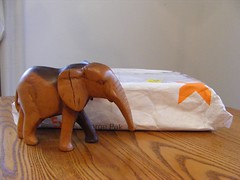
Without the index, the book is 491pages. There is also an introduction of some 30 pages with Roman numerals. There are about 600 biographies described with recommendations for further reading in the main section. I also identify leading biographers and biographical series, as well as biography awards. I can hardly wait to see the book in print. It will be soon.
I promise to resurface later this month. Enjoy poetry month.
Wednesday, April 01, 2009
Biography Beat, April 2009
Here is another roundup of biography news.
Biographies of Authors Dominate Recent New York Times Book Review Podcasts
The producers of the New York Times Book Review Podcasts with Sam Tanenhaus have repeated chosen to interview biographers with new books about American authors to lead their programs lately. In the past month, the podcast has featured Donald Barthelme, Flannery O'Connor, and John Cheever biographies. These fifteen minute podcasts can be found on the New York Times website or at the Apple Store.
The University Press of Mississippi Features Country Singers in Its American Made Music Series
In May, the University Press of Mississippi is publishing Eddy Arnold: Pioneer of the Nashville Sound by Michael Streissguth. Arnold was the top-selling country performer of the 1940s and 1950s, but his career faded with the emergence of rock-and-roll in the 1960s. Streissguth has also written books about Jim Reeves and Johnny Cash.
The new title joins Hank Williams, So Lonesome by Bill Koon and Jimmie Rodgers: The Life and Times of America's Blue Yodeler by Nolan Porterfield in the publishers American Made Music Series. While the appeal of these books may be limited nationally, they will be appreciated by older audiences in regions where country music is popular.
Midwest Memoirs Hot at Thomas Ford
During the month of March, we featured memoirs from Midwestern authors in one of our display bins at the Thomas Ford Memorial Library. They went out well, and we had to keep restocking. Here are some of the titles we displayed:
- Dewey by Vicki Myron
- Little Heathens by Mildred Armstrong Kalish
- Man Killed by Pheasant by John Price
- Population 485 by Michael Perry
- Truck by Michael Perry*
- Summer of Ordinary Ways by Nicole Lea Helgut
- Books and Islands in Objiwe Country by Louise Erdrich
- Barefoot Heart by Elva Trevino Hart
*Michael Perry has a new book coming out in May! Coop: A Year of Poultry, Pigs, and Parenting. ISBN 9780061240430. We could have used it for the display.
Comic Book Biographies of American Women
On March 11, Bluewater Productions issued two comic book biographies that sold better than expected, according to its publisher Darren G. Davis. The subjects were women from opposite ends of the political spectrum - Hillary Clinton and Sarah Palin. The 32-page graphic novels selling for $3.99 are the first titles in the publisher's Female Force series. Michelle Obama and Caroline Kennedy are soon to come.
Manga Biographies
Here is a similar story about more illustrated biographies for grade school readers. A Korean publisher named Dasan Books is releasing The Obama Story: The Boy with the Biggest Dreams in April as the first of fifty manga-style biographies aimed at eight to twelve year old readers. Publishers Weekly has the story.
Subscribe to:
Posts (Atom)


