Friday, January 30, 2015

Mearra, Selkie from the Sea by Linda Marie Smith

Chicago singer/songwriter Linda Marie Smith seems to think big. When she writes songs, she write song cycles. On her 2006 album Artemisia, she performed 14 songs that she wrote for a show about the 17th century Italian painter Artemisia Gentileschi, a rare woman among the men of Renaissance art. Her show was filled with music and images from the paintings by the artist. We had the show at our library. It was mesmerizing.

Now she has a new album and show, which we will present at the Thomas Ford Memorial Library in May. I have been listening to the album Mearra, Selkie from the Sea as we prepare to write our library newsletter and plan other publicity. There are 11 beautiful and varied songs about a magical seal who longs for love and life as a human. The show promises to have a mixture of live music, lights, and animation. I am sure it will be a special evening, if the wonderfully melodic songs of the album are evidence.

Smith says that she was influence by the music of Carole King and Carly Simon, and she has been compared with Lucinda Williams, Sarah McLachlan, and Natalie Merchant. She has won a Billboard songwriting award and recognition from the Illinois Arts Council and National Endowment for the Arts. She teaches at Chicago's Old Town School of Folk Music.

I am amazed that we can offer music of this caliber at the library. There is so much talent in the Chicago area, and Smith is on a roll.

Smith, Linda Marie. Mearra, Selkie from the Sea. 2014.

Wednesday, January 28, 2015

All the Stories of Muriel Spark

In late December, I noticed on the old librarian's desk that we use for displays several complete-short-stories-of-an-author-in-one-volume books. Several tempted me, but I chose All the Stories of Muriel Spark, having had a personal Muriel Spark reading phase between 2004 and 2005. I had then intended to read much more of her work, but other books and authors were also calling to me. I read Spark's autobiography Curriculum Vitae in 2005 and the wickedly funny The Abbess of Crewe in 2008, but I had not really gotten back on track to reading the whole oeuvre. Reading all of the short stories was an important step toward my goal, so I borrowed the volume.

It took me nearly a month to finish, having other reading commitments as well as other reading opportunities. Spacing the reading of the 41 stories has let Spark's writing style and wit sink in deeper than if I had whipped quickly through them. It also seemed more polite to take time. It took the author most of her writing career to write the collection. I could surely give her a month of my attention.

The month was time well spent. All the Stories of Muriel Spark is an entertaining collection with great variety. I especially like the stories set in Africa drawn from Spark's experience in Southern Rhodesia in the late 1930s and early 1940s. These include the story that she wrote to get prize money "The Seraph and the Zambesi," which launched her career in fiction, and my favorite "The Go-Away Bird." The latter, the longest story in the book at 52 pages, tells the tragic story of Daphne du Toit, an orphaned daughter of Afrikaner and British parents, who fails to escape a fate that the reader foresees. One of Spark's great talents was to tell readers how a story will end in her opening sentences and charm into reading every word.

All the Stories of Muriel Spark is a great companion to Curriculum Vitae, the autobiography mentioned above, as she wrote stories that reflect every stage of her life. The fun is then in trying to decide how much of her fiction was about her long and unconventional life. Ask for a renewal if the book is due before you finish.

Spark, Muriel. All the Stories of Muriel Spark. New Directions, 2001. 398p. ISBN 081121494X.

Monday, January 26, 2015

The Prime of Miss Jean Brodie by Muriel Spark

When I borrowed The Prime of Miss Jean Brodie by Muriel Spark to read for a book discussion, I thought that I had not read it, despite having read a lot of Spark's books between 2004 and 2005. As I read and got halfway through the book, my memory had not changed, but I did go to my reading spreadsheet to remind myself what Spark's titles I had read. I discovered that I had read this book about the flamboyant teacher at a private girls school in 1930s Edinburgh. To the end, I still had no recall, which is strange because I think now that The Prime of Miss Jean Brodie is such a strikingly memorable book.

This short novel about Miss Brodie and her girls proved to be a great choice for a book discussion. We shared a great variety of interpretations and feelings about the teacher who was determined to shape the lives of her chosen girls. No one considered her simply well-meaning, but the degrees to which we judged her self-centered and sinister differed. She is a complex character, as is her student Susan Stranger (Spark was known for picking indicative surnames).

An interesting part of the discussion was comparing the book to the 1969 movie, which won an Oscar for Maggie Smith in 1970. The six girls were reduced to four, some of Miss Brodie's characteristics were exaggerated, and key facts were changed. If you have only seen the movie, you will be surprised how different the book is.

If you have not read any works by Muriel Spark, I recommend starting with a different book, either Memento Mori, The Girls of Slender Means, or one of the short story collections. I will review her short stories in my next post. As good as The Prime of Miss Jean Brodie is, many readers will find more to like in other titles.

Spark, Muriel. The Prime of Miss Jean Brodie. J. B. Lippincott, 1962. 187p.


Saturday, January 24, 2015

What We Lost by Ben Bedford

I've said it before. A benefit of running a concert series is performers or their booking agents send us music CDs. It does not seem to matter that we have only five concerts per year and cannot hire the majority of the acts. Perhaps we get more CDs because the acts have to impress us.

I have been listening to a very well-produced album by singer/songwriter/guitarist Ben Bedford called What We Lost. I won't use the work "slick" in my assessment because that word can have a negative tone. There is nothing to fault in the making of this CD recorded in Nashville. Bedford and his producer have chosen an excellent variety of songs that flow together well. The brightest, possibly most memorable is "Cahokia," an anthem in celebration of a small Illinois town. There was a time it could have been a top 40 hit. It has sticking ability.

Images of the Midwest run through many of the songs. There are also Bible themes, especially in the songs "John the Baptist" and "Cloudless." Like many singers in the folk or country tradition, Bedford evokes travel and getting back to people and places that he loves. There is even current events. Close listeners will find much embedded in his stories. What We Lost is worth seeking.

Bedford, Ben. What We Lost. Waterbug, 2012.

Wednesday, January 21, 2015

The Sweetness at the Bottom of the Pie by Alan Bradley

I recently saw a review of the seventh Flavia De Luce mystery by Alan Bradley, which I later found Bonnie reading (the book not the review) at home, just as I came home with book one The Sweetness at the Bottom of the Pie. Bonnie was surprised I had not read it. She has read all the books in Bradley's mystery series and encouraged me to get started. I did that night.

With heightened expectations I opened the book to the first chapter to discover eleven-year-old Flavia describing how dark it was in the closet where her two older sisters had tied her and presumably left her to die of starvation. Knowing escape tricks, she was already plotting her revenge, a plan involving her great knowledge of chemistry. I could see right away that Flavia was not a typical child.

In The Sweetness at the Bottom of the Pie, set in 1950s rural England, Flavia vividly recounts how she solves the mystery of why a tall red-headed man died in her family's cucumber patch. Her efforts required a lot of bicycle riding, reading stacks of old newspapers in the village library (housed in an outbuilding of an old garage), and interviewing elderly neighbors. She also meets a police inspector who is willing to bend a few rules.

With an eleven-year-old sleuth, you might think The Sweetness at the Bottom of the Pie would be a juvenile title, but it is marketed to adults and shelved with adult mysteries in public libraries. I do not see any reason a good younger reader willing to take on a few Latin phrases and quotes from Shakespeare could not tackle it. Flavia's spunky attitude and the fact that adults are trying to hog the book might make it even more attractive to youth.

Bradley, Alan. The Sweetness at the Bottom of the Pie. Delacorte Press, 2009. 373p. ISBN 9780385342308.

Monday, January 19, 2015

Law of the Jungle: The $19 Billion Legal Battle Over Oil in the Rain Forest and the Lawyer Who'd Stop at Nothing to Win by Paul M. Barrett

In the middle of Law of the Jungle: The $19 Billion Legal Battle Over Oil in the Rain Forest and the Lawyer Who'd Stop at Nothing to Win by Paul M. Barrett, I was struck by obvious surface similarities between the book about a series of environmental lawsuits and Bleak House by Charles Dickens. I suspect other readers have made the same observation. Both cases stretched over two decades and enriched many lawyers. Late in his book Barrett even calls the case Dickensian.

The set of cases that began with Maria Aguinda v. Texaco Inc. and may have ended with Chevron Corp. v. Steven R. Donziger is a fascinating legal battle, and Barrett devotes more text to the legal issues than Charles Dickens did with Jarndyce v. Jarndyce. Instead, Dickens had sympathetic characters to develop in his complicated story line. Barrett did not have that option. Almost everyone in Law of the Jungle is guilty of something. The only people for whom the readers can express sympathy are the rarely considered poor Ecuadorian peasants for whom the legal battle was initiated. Corporations, politicians, and lawyers make and lose huge sums of money, while the peasants get no relief from the soil, air, and water pollution of their rain forest caused by the oil industry.

I started Law of the Jungle because it was recommended to me by a reader to whom I have often suggested books. I was leery of it, for it sounded so depressing, which it is, but the story is gripping and important. We should know what it going on in our world. There is a big fight over all the world's natural resources. Barrett tells you how it is being fought and the possible consequences.

Barrett, Paul M. Law of the Jungle: The $19 Billion Legal Battle Over Oil in the Rain Forest and the Lawyer Who'd Stop at Nothing to Win. Crown Publishers, 2014. 290p. ISBN 9780770436346.

Friday, January 16, 2015

The Lunchbox, a Film by Ritesh Batra

Friday night January 9, 2015 was a historic occasion for the Thomas Ford Memorial Library, as we showed our first film with our newly-installed projection and sound system. While that is not news that made the Chicago Tribune, it was a big deal for us. Our film fans will have a better viewing experience, and our staff will be saved many set-up hours each year.

I was grateful for the seven people who braved the bitter cold to come see and discuss The Lunchbox, a very fitting film for our upgrade debut. We specialize in showing independent and foreign films. The Lunchbox is a critically-acclaimed 2013 film from India set in Mumbai where a very efficient delivery system drops many thousands of lunch boxes on desks in offices daily. Many of these lunches are lovingly made by wives or other family members and carefully packed in stacking tins zipped into thermal cases. It is unlike anything we see in the United States.

Though the Harvard Business School has studied and held up the Mumbai lunchbox deliveries as a model worth emulation, in The Lunchbox, the unthinkable has happened. A lunch has been delivered to the wrong person. The ensuing situation connects two lonely people of different generations. Will a romance develop? Is there just more heartache ahead? In his first film, director Ritesh Batra builds dramatic tension as the young woman and older man deal with difficulties of their lives.

It was all thumbs up at the film discussion and the discussion was lively. It was worth bundling up and coming out in the cold to see.

The Lunchbox. Sony Pictures Classics, 2014. 105 minutes.


Wednesday, January 14, 2015

Salt: A World History by Mark Kurlansky

When I see articles about nonfiction readers' advisory or attend a workshop on that topic, I invariably notice a plug for the now considered-classic title Salt: A World History by Mark Kurlansky, published in 2002. Even librarians who mostly tout fiction seem to say they enjoyed it. It has been on my wishlist for years, and I finally borrowed it as an audio download in the final days of 2014. Was it really going to be as good as everyone said?

One positive for the audiobook is that it is read by the very talented Scott Brick. I have listened to numerous books by him. He can put life into a telephone directory. Luckily for Brick and for listeners, Kurlansky has filled his wide-ranging book with history from seemingly every place and period, noting many interesting facts, making intelligent observations, and providing recipes for food items that most people just buy at the store. Can you imagine adding 12 and a half ounces of salt to 25 pounds of sturgeon eggs to make your own caviar? Much of the text is entertaining, and the idea that salt has played a large role in agriculture, industry, commerce, cuisine, diplomacy, and empire-building is fascinating.

Still, I found the book at times more a historical litany than a plot-driven story. I considered dropping out at several points, but then I would be re-engaged by some country, person, or issue in which I have continuing interest.

I am glad to have stuck with Salt: A World History as the final chapters are some of the most engaging, including a section on the Morton Salt company of Chicago. Kurlansky addresses our current salt economy at the end. Another good reason staying the course is seeing that l there is a consistent thread through world history - something that is more than salt but revealed by salt.

I am sure that I will be noticing links to the salt trade in history books and in my travels for years.

Kurlansky, Mark. Salt: A World History. Walker and Company, 2002. 484p. ISBN 0802713734.

Audiobook: 14 compact discs. Phoenix Books, 2006. ISBN 1597770973.

Monday, January 12, 2015

Minnesota Days: Our Heritage in Stories, Art, and Photos

When Laura and Luke, who live in Minneapolis, asked what I might like for Christmas, I suggested a book about Minnesota. I have been to the state 10 or 15 times since Laura moved there in 2011 and like the place. So I suggested something about its history, land, and culture. Minnesota Days: Our Heritage in Stories, Art, and Photos covers all three of those topics well.

Minnesota Days is a beautiful book filled with short pieces written by notable Minnesotans illustrated by Minnesota art works and photographs. Readers from any state will recognize some of the authors, including F. Scott Fitzgerald, Sinclair Lewis, Laura Ingalls Wilder, Gordon Parks, and Garrison Keillor. Others journalists, historians, and novelists will be new to non-Minnesotans. Having read this book, I would like to read more by Grace H. Flandrau, Bill Holm, and Jon Hassler.

You can learn much just looking at the pictures, some of which are by famous Minnesotan photographers and artists. They show landscapes, wildlife, people, cities, and cuisine. I particularly want to call your attention to the topical map on page 106, "Minnesota Principle Hot Dishes by Region." Cheese scalloped potatoes, corny burger bake, wild rice casserole, German pork chop casserole, and jiffy tuna hot dish all appeal to me. A wandering tour of "the Land of Sky Blue Water" would be caloric.

If you are not in Minnesota, your library may not have Minnesota Days. Ask for an interlibrary loan. I am lucky to have my own copy. Thanks you, Laura and Luke.

Minnesota Days: Our Heritage in Stories, Art, and Photos edited by Michael Dregni. Voyageur Press, 1999. 160p. ISBN 0896584216.

Friday, January 09, 2015

The Book with No Pictures by B. J. Novak (A Review with No Pictures)

I have seen lots of books with no pictures, but they are not aimed at young readers. So The Book with No Pictures by B. J. Novak is unusual.

You could easily write a easy book for kids with no pictures and have it be nothing special. Maybe it could be a little story, such as how dust settles under furniture or which trees lose their leaves first in the autumn. Maybe it could be instructive, telling how to tie shoe laces or how to sharpen pencils. Maybe a book listing all of your cousins and their favorite colors would be interesting. Of course, all of these books would be better with some pictures.

The idea behind The Book with No Pictures is that it has to be read aloud (every word) by one person to another person. You might assume that would be an adult to a child. That would be fun. It might also be fun to listen to a child read it to another child.

The first time you read it should be aloud to someone else without having any idea what will be on the next page. This is the way to maximize dramatic tension.

There are some colored parts and larger than normal words.

I do not want to say too much and give anything humorous away. Try it.

Novak, B. J. The Book with No Pictures. Dial Books for Young Readers, 2014. ISBN 9780803741713.

Wednesday, January 07, 2015

The Port Chicago 50: Disaster, Mutiny, and the Fight for Civil Rights by Steve Sheinkin

With Black History Month in February, now is a good time to read The Port Chicago 50: Disaster, Mutiny, and the Fight for Civil Rights. This mostly forgotten story about segregation in the military during World War II recounts events that preceded the well-reported integration of major league baseball in 1947 and the civil rights protests of the 1950s and 1960s. The author Steve Sheinkin poses that the courage of the black sailors who refused to load ships Naval ships with bombs and ammunition days after an explosion that killed 320 black sailors gave direction to later civil rights efforts.

On July 17, 1944 at San Francisco Bay's Port Chicago, only black sailors died because only black sailors were on the docks loading Naval ships at the port. Many of them had wanted to be on battle ships in the Pacific, but the Navy had refused to assign them. Instead, they were assigned to very dangerous work for which they had no formal training. White commanders pressed them to load heavy weapons with increasing speed. According to some accounts, disaster was inevitable.

Few whites noticed the story of the disaster in newspapers filled with other war stories. Black newspapers and the NAACP noticed. The latter sent its attorney Thurgood Marshall to defend the 50 sailors who refused to load ships until safety issues were addressed.

A key part of The Port Chicago 50 is the military trial with examination of witnesses and impassioned arguments by the prosecutors and defending attorneys. After weeks of proceedings, the 50 were all found guilty within minutes and sentenced to 15 years of hard labor. Sheinkin recounts appeal efforts and how the men were very quietly released after the war ended.

The Port Chicago 50 is aimed at young readers by the same author who won awards for The Bomb. It is worth reading in print with illustrations or as an audiobook by readers of all ages.

Sheinkin, Steve. The Port Chicago 50: Disaster, Mutiny, and the Fight for Civil Rights. Roaring Brook Press, 2014. 200p. ISBN 9781596437968.

audiobook: Listening Library, 2014. 3 compact discs. ISBN 9780804167444.

Monday, January 05, 2015

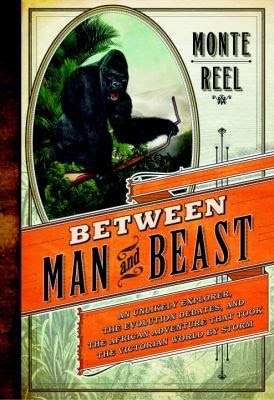
Between Man and Beast: An Unlikely Explorer, the Evolution Debates, and the African Adventure That Took the Victorian World by Storm by Monte Reel

I had never heard of the African explorer Paul Du Chaillu. According to author Monte Reel, few people have, which was part of the appeal for him to write a book. Writing about Du Chaillu also gave Reel a vehicle for exploring the Victorian Age and its controversies and prejudices. The result of his research is Between Man and Beast: An Unlikely Explorer, the Evolution Debates, and the African Adventure That Took the Victorian World by Storm.

That Du Chaillu is called an African explorer can be interpreted a couple of ways. The obvious is that he explored Africa. He took two extended journeys into the interior from coastal Gabon in the 1856 and 1863 and is thought to be the first European to see a live gorilla. Before that only gorilla skeletons and skins had been collected and sent to the scientific societies in the capitals of Europe, where there was much skepticism of such an animal truly existing. After his first expedition, Du Chaillu took preserved gorillas to New York and London to both great acclaim and charges of fraud.

Du Chaillu's origins were obscure. His father was French and his mother was rarely mentioned. He said at different times that he was born in France, in New Orleans, and in French colonies. Many of his supporters believed him to be dark skinned from his years in the Africa sun. In fact, he was part African, born on the island of Reunion east of Madagascar. The author poses that perceptions of Du Chaillu's race factored in his failure to impress men of science with his observations, stories, and specimens. Though his books sold well initially, his fame was short-lived.

Reel's sympathetic account of Du Chaillu's brief career is filled with big names in science, including Sir Richard Burton, Richard Owen, Roderick Murchison, Charles Darwin, and Thomas Henry Huxley. They and others used Du Chaillu's accounts in their arguments over evolution. The explorer tried to stay neutral but others implied his allegiance or opposition. After two African trips, he gave up gorilla studies and devoted himself to less volatile Scandinavian topics.

Readers who enjoy history of exploration and science will appreciate Between Man and Beast. If you library does not have it, request an interlibrary loan.

Reel, Monte. Between Man and Beast: An Unlikely Explorer, the Evolution Debates, and the African Adventure That Took the Victorian World by Storm. Doubleday, 2013. 331p. ISBN 9780385534222.