Friday, April 29, 2011

Every Day by the Sun: A Memoir of the Faulkners of Mississippi by Dean Faulkner Wells

Dean Faulkner Wells never knew her father, Dean Swift Faulkner, who died in an airshow accident in 1935 four months before her birth. Feeling very much responsible for his death because he urged his younger brother to fly and even bought him the plane, author William Faulkner promised Dean's mother that he would always provide for his niece. It was a promise he kept, according to Wells in her memoir Every Day by the Sun: A Memoir of the Faulkners of Mississippi.

Keeping the promise was not easy. William Faulkner had published several well-regarded novels before Dean was born, but sales were poor for the cerebral Southern writer. He and his wife regularly overspent their income, much of it for clothing, furniture, horses, alcohol, and special pipe tobacco. To make ends meet, he accepted a job writing movie scripts for MGM in Hollywood, so he was often gone from the family's Oxford, Mississippi home. Dean's mother soon remarried, apparently relieving William Faulkner of responsibility for Dean. Her stepfather, however, quickly proved to be a violent alcoholic who could not hold a job. He took the family to Memphis and then Chicago, where they lived in poverty. William Faulkner had to rescue Dean and her mother at least twice. Her stepfather eventually died drunk on a sidewalk in Chicago.

Dean grew up living with various relatives, including her paternal grandmother, maternal grandparents, and her mother, when her mother had the means. Occasionally, she resided at William Faulkner's family at Rowan Oak, the mansion that he had purchased in Oxford, Mississippi. Even when she was not there, the author was providing her with money for school or a trip to Europe. Dean's early years were an odd mixture of poverty and privilege.

Of course, in her memoir, Wells is sympathetic in her description of her famous uncle, but she is not blind. She tells about his alcoholism, infidelities, depression, and anger, but these failings are offset by his care for his mother, his brothers, his daughter, and all the nephews and nieces. She describes the games he devised for the children and the silly tricks that he played on them. She also admired his sense of racial justice and concern for the poor and mentally ill. He was also a gracious and generous host who threw lavish holiday parties.

Wells' Every Day by the Sun is an easy introduction to one of the most complicated of Southern writers. It will also be appreciated by Faulkner's devoted readers.

Wells, Dean Faulkner. Every Day by the Sun: A Memoir of the Faulkners of Mississippi. Crown, 2011. 271p. ISBN 9780307591043.

Wednesday, April 27, 2011

Atlantic: Great Sea Battles, Heroic Discoveries, Titanic Storms, and a Vast Ocean of a Million Stories by Simon Winchester

Wouldn't it be great to be Simon Winchester and travel around the world seeking the original locations of famous stories? Wouldn't you enjoy finding evidence of a shipwreck along the Skeleton Coast of Namibia or hiking around the rocks of Gibraltar to see the cliffs of Morocco across the strait? Just getting there would be an adventure. Winchester also seems to read all the classics of literature and visits great libraries to research the Viking settlements of Newfoundland, Portuguese and Spanish explorers, the trans-Atlantic slave trade, plate tectonics, the fishing of the Grand Banks, British Navy battles, and life on the great ocean liners. He regularly assembles all his experiences, research, and thoughts into books, such as Atlantic: Great Sea Battles, Heroic Discoveries, Titanic Storms, and a Vast Ocean of a Million Stories.

I spent about two weeks listening to Winchester read his book Atlantic. He began by telling how in 1963 as a teenager he had become fascinated with the ocean when he took his first cruise from England to America on liner The Empress of Britain. As he tells it, he was already a student of history and knew of the ships and explorers who had already travelled his route. He was particularly interested in how emergency medicine was delivered by airplane to the ship mid-ocean. Later in the book he recounts a flight of his own across the northern portion of the ocean, remembering the pioneering flights of the early twentieth century. He seemed constantly aware of his location and the closest airports, should the jet engines fail.

In Atlantic, Winchester shows how we take the ocean for granted now, forgetting what a large role it has played in the development of our civilization. It was a source of wealth, not just a barrier that separated us from other continents. He shows how little we know about the oceans, pointing out that aquatic micro-organisms only discovered in the 1980s produce oxygen that make our lives possible. He warns that when we foul the waters we risk our own lives. Like Tim Flannery in Here on Earth, he warns that the oceans are being over-fished and will be rising as polar ice melts.

Like author Bill Bryson, Winchester is a free-flowing font of wide-ranging information and stories. Both can weld scientific descriptions to human adventures effortlessly. Both can entertain while pointing out the folly of humankind. Winchester is a bit more serious. Curiously, Bryson is an American who now lives in Great Britain, while Winchester has left his homeland to live in Manhattan.

In Atlantic, Winchester presents a biography of the ocean in seven sections corresponding to the ages of man to which Shakespeare refers in his "all the world is a stage" speech. Many readers might call his book a natural history. How ever you classify it, Atlantic is worth a few weeks of reading.

Winchester, Simon. Atlantic: Great Sea Battles, Heroic Discoveries, Titanic Storms, and a Vast Ocean of a Million Stories. HarperCollins, 2010. 495p. ISBN 9780061702587.

Also, HarperAudio, 2010. 13 discs. ISBN 9780061866128.

Monday, April 25, 2011

Here on Earth: A Natural History of the Planet by Tim Flannery

"As our experience with social Darwinism illustrates, we need to be eternally on guard against the siren song of self-interest if we wish to live in a fair and equitable society."

"In sports, winners can survive only if losers do too; otherwise, there'd be no game. Our planet is similar. If a sufficiently superior and arrogant species arose and pursued a winner-take-all philosophy, it would be game over for all of us."

"The tendency to discount the future helps explain why people sometimes act to destroy their environment, whether by cutting down rain forests, continuing to pollute the atmosphere or destroying biodiversity. And people without prospects are created in a number of ways - through grinding poverty, through greatly unequal societies and through war, famine or other misfortunes. If you're concerned about our future, it's not just desirable that we eradicate poverty in the developing world, create more equal societies and never let ourselves fight another war; it's imperative, for the discount factor tells us that failure to do so may cost us the Earth."


Three quotations at the beginning of a book review is a bit much, I know, but I found Australian naturalist Tim Flannery very quotable in his latest book Here on Earth: A Natural History of the Planet. There are still more purple post-its hanging from the book, but I will spare you having to consider more for the moment. Ironically, the title seems somehow inadequate. Flannery's definition of "natural history" is not just about water, air, earth, and wildlife. He scrutinizes our whole way of life and the way it effects our environment, and he seems as concerned with social justice as water purity. Only if we live in a just society, he reasons, will we work together to become a healthy superorganism.

Flannery explains the idea of the superorganism in the third section of this wide-ranging book. In biological groups, whether it be insects, fish, birds, or mammals, individuals who remain solitary or in small groups must perform many functions to survive, including find or grow food, find or build shelter, and procreate. Some species, however, work together in mass, such as termites, bees, and some fish, and the members all specialize. Flannery holds that humans began showing superorganism tendencies when we adopted agriculture and formed cities. In our global modern economy, we all specialize, and it is now not possible for us to really fend for ourselves without others in the community. We would be particularly out of luck if the people who keep us supplied with electricity disappeared. We have not as yet reached a societal accord as regulated as a beehive, however. As a result, we have many problems, particularly because there are so many of us.

Flannery comes close but never says that there are too many of us. What good would it do to just complain? There are seven billion of us, and we have to cope. He is an optimist by necessity. If we do not find a new way to accommodate all of the excess people in an environmentally sound way, we are doomed. He does point to the rich as a problem, for they are using more than their share of resources, often demanding unsustainable products for their sole consumption.

As you can see, Here on Earth is not your typical "we have to reduce global warming" book. Flannery argues that we have to end war, save endangered species, end poverty, and find sustainable methods to power and feed the world, too. It would be a great choice for book discussion groups.

Flannery, Tim. Here on Earth: A Natural History of the Planet. Atlantic Monthly Press, 2011. ISBN 9780802119766.

Friday, April 22, 2011

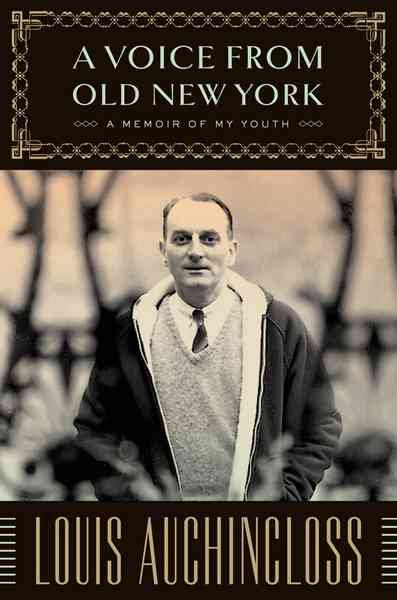
A Voice from Old New York: A Memoir of My Youth by Louis Auchincloss

With Endpoint and Other Poems, John Updike said goodbye to his readers through poems of reflection and old age. Louis Auchincloss was not so overt in A Voice from Old New York: A Memoir of My Youth, but like Updike, he was obviously saying things he felt needed saying before he ran out of time. Unlike Updike, he focused more on his youth instead of his old age in his final statements. He was especially concerned about memories of his family. He wanted to express his love for his mother, sister, and childhood maid, each of whom were hurt by the narrow-minded following of social conventions and ideas about what was proper for women. His eloquently expressive mother, who enjoyed literature, felt that she had no right to write. Letters and pieces written for the family showed Auchincloss her natural writing talent. His sister Priscilla was hidden away during her bouts of severe depression. She received what was considered the best and most expensive care of the time, but the author regrets how unsympathetic he was. She recovered enough to rejoin society, but Auchincloss never was as close with her as he felt he should have been. Finally, near the end of the book, he tells about Maggie, the Irish maid assigned to watch him and his sister. Maggie spent a couple of decades in service to the family, treated as almost family but paid poorly for her work. Once the children were grown, she simply disappeared without a pension. Auchincloss never found her.

Auchincloss also wanted readers to know that he felt some depictions of early 20th century New York misrepresented the old New York families from which he came. While they lacked understanding of anyone who was not "one of them," they were not crass and uncaring. They just failed to see outside their circle. It was partly a lack of imagination. They also failed to see the end of their economic and political prominence.

Being from a well-connected family and attending exclusive schools, Auchincloss crossed paths with many men and a few women who distinguished themselves in business, politics, and literature. As he grew, he seemed to retain a conservative political viewpoint but seemed to be quite open socially to mix with people who came from outside the city and even the country. His network peaked during the Kennedy and Johnson administrations when his former classmates were diplomats and national security advisors (making terrible mistakes) and his aunt's daughter by a previous marriage, Jackie Bouvier, was married to the president.

At the time of his death in January 2010, Auchincloss had written over sixty books. Most were fiction, but he also wrote history, biography, and literary criticism. He had quite a career for a son whose mother thought he had no writing talent. A Voice from Old New York is a graceful and intimate goodbye, which should interest anyone who enjoys reading about bygone days.

Auchincloss, Louis. A Voice from Old New York: A Memoir of My Youth. Houghton Mifflin Harcourt, 2010. ISBN 9780547341538.

Wednesday, April 20, 2011

My Baseball Card Story

In the April 1, 2011 issue of Booklist, Bill Ott (whom I almost called Mel Ott) tells how reading the new memoir Cardboard Gods, in which Josh Wilker's tells how collecting baseball cards helped him through a difficult childhood, sparked Bill's memory of collecting sports cards. Bill and his friend Rob once traded some expendable comic books for several boxes of highly-prized baseball and football cards. The friends took the football cards and played games with them on his friend's dining room floor. Boys being boys, they got into a "brawl," many of the best of the best were damaged, and Bill and Rob learned they were not natural-born documents conservators. Glue and Scotch tape did not mend their cardboard heroes.

Though not as dramatically violent, my baseball card story also involves games played on a floor. I spent a year living on a ranch nine miles south of Big Lake, a small town in West Texas, often with no companions for play. On Saturdays, or evenings, or through the long summer between fourth and fifth grade, I reorganized my baseball cards. I might put them into order according to the card numbers, starting with my 1964 Topps cards, then the 1963s, and then then 1962s. Then I might sort them into team sets. Sometimes I alphabetized them, put all the players together by positions, left-handed and right-handed, and once even sorted them by birth dates. I like to think that I learned then the attention to details that I needed later to become a reference librarian.

At some point I devised a game that involved removing all the rubber bands and pouring all the cards onto my bedroom floor. I stirred and tossed the cards to mix them and then put them into big piles. Then, dealing from the top, I ran team races from one end of the room to the other. Each team advanced one spot with each player card added to its stack. First team to get twenty cards won. Often a team I disliked, such as the Yankees or the Reds crossed the finish line first, so I'd run the race again, hoping to get a better result. More stirring and tossing, dinging edges and bending corners of the thin cardboard rectangles.

While Bill seems slightly penitent, I do not regret the rough demands that I made on the cards. They were meant for play. Those were good days before adults made baseball cards into collectibles. Looking for mint-condition old cards and trying to get rich speculating on future Hall-of-Famers is not nearly so much fun as having your team beat the Yankees in a race across the floor.

Monday, April 18, 2011

Endpoint and Other Poems by John Updike

I pulled the book that was obviously on the wrong shelf, Endpoint and Other Poems by John Updike. The call number on the spine label was in error. Updike was an American, not British author. He may have spoken the same English language as Keats and Shelley, but we believe in geographically-correct nationalism in our Dewey-committed library. I would take the book down to the technical process department (two people in our small library) and get the catalog corrected and a new label made.

But I decided to look at the book first. It was National Poetry Month, and I had not read any poems yet this year. I had not really cared for Updike's novels, but I really am not a contemporary novel reader, so it may have been more my taste instead of his writing that made me stop after five pages last time I tried. I think that I enjoyed his short stories long ago.

I started the title poem "Endpoint" and was immediately hooked. The poem is Updike realizing that he is nearly out of time and saying a long goodbye. He describes how his body is failing even as we sees the beauty around him in the New England woods, Atlantic shores, and Tucson mountains. Written in short bursts, some on his birthdays, starting in March 2002, he reflects on his life and work.
A thousand dollars then meant we could eat
for months. A poem might buy a pair of shoes.
My life my life with children, was a sluice
that channeled running water to my pan;
by tilting it, and swirling lightly, I
at end of day might find a fleck of gold.

He remembers events and people, while seeing change. He goes to Best Buy to get a new laptop and struggles to get oleanders to grow in the thin desert soil. Eventually he is admitted to Massachusetts General Hospital.
I lived in Boston once, a year or two,
in furtive semi-bachelorhood. I parked
a Karmann Ghia in Back Bay's shady spots
but I was lighter then, and lived as if
within forever. Now I've turned so heavy
I sink through twenty floors to hit the street.

The last verses are from December 22, 2008. Updike died January 27, 2009.

The other poems take on a variety of topics, some of which interest me, too - the paintings stolen from the Isabella Stewart Gardner Museum still not found, the renewed appreciation of Doo-Wop, the difficulty of playing the seemingly lazy game of baseball, and travel to numerous cities. Often witty and nostalgic, the poems are clear and need no decoding. I read a handful at a time.

Funny how being out of place made this a book worth considering, like birds storm blown to distant continents.

Updike, John. Endpoint and Other Poems. Alfred A. Knopf, 2009. ISBN 9780307272867.

Friday, April 15, 2011

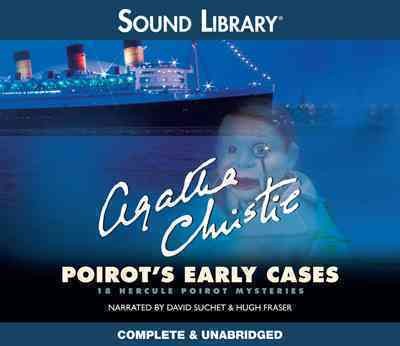
Poirot's Early Cases by Agatha Christie

The weather turned nice enough last weekend for me to spend several hours each day in the yard clearing flower beds and pruning shrubs, which regular readers of this blog know means that I listened to an almost equal number of hours of audiobooks. Bonnie had brought me a nice supply titles from the Downers Grove Public Library. To start my new gardening season, I chose Poirot's Early Cases: 18 Hercule Poirot Mysteries by Agatha Christie, read by David Suchet & Hugh Fraser, actors known to many for their portrayals of Hercule Poirot and his friend Captain Hastings. Seeing their names, I wondered if they read together. I could imagine Fraser as Hastings reading the bulk of a story with Suchet supplying the voice of Poirot - Christie had Hastings reporting the cases much like Dr. Watson reporting Sherlock Holmes's adventures in her early stories - but that was not the case. Fraser read some stories and Suchet others. Both created an array of distinctive voices for their characters, but it is Suchet's Poirot that is unforgettable.

Christie's stories in audio ran between 20 and 30 minutes in length, each recounting a crime that seemed to be at first glance unremarkable. Hastings and Inspector Japp of Scotland Yard quickly found clues that led to obvious suspects, but Poirot was always unsatisfied. Could a thief really drop two incriminating items at the scene of the crime? Why would a meticulous gardener not finish the oyster shell border? What would the obvious suspect gain from the crime? The easy solutions unravelled, and using his little gray-cells and a bit of psychology, Poirot unmasked the true criminal.

The seriousness of the crimes in these stories varied greatly. Some of the cases that I liked best were about petty thefts that Poirot dealt with discretely. British national security, the reputations of the lords and ladies, and the lives of debutantes were sometimes at stake. Throughout, Poirot kept his mustache waxed and his shoes shined, and the meticulous Belgian was quick to correct any careless person who called him "French." It was all great fun.

Christie, Agatha. Poirot's Early Cases. BBC Audio, ISBN 9780792769644.

Thursday, April 14, 2011

Memoirs and Biography on New York Times Nonfiction Best Seller List

I was struck by the April 17, 2011 Nonfiction Best Seller List from the New York Times. I know that it is only April 14 as I write, but the newspaper has a crystal ball approach to the list. It isn't really the date that jumps out but its titles. This is what I see:
  • 9 memoirs
  • 3 biographies
  • 1 history book
  • 1 science book
  • 1 sociology book

The history book is Sarah Vowell's Unfamiliar Fishes, which is about Hawaii but probably has a lot about Vowell in it as well. You could say that 13 of 15 books on the list are biographical. I don't I have ever seen a list quite like it.

Wednesday, April 13, 2011

Off Main Street: Barnstormers, Prophets, & Gatemouth's Gator by Michael Perry

I enjoy autobiographical books by Michael Perry, and I enjoy reading essays. So, why had I not read Off Main Street: Barnstormers, Prophets, & Gatemouth's Gator, Perry's collection of essays published in 2005? The "too many books, too little time" excuse seems insufficient. We make time to do things we want to do. I knew I'd like these essays. Perhaps last week was my appointed time to enjoy what I knew I would like. And I did. How could I not like passages such as this about a funeral in the essay "Catching at the Hems of Ghosts"?

... and then we all joined in on Hymn 495, as posted. Your average Wisconsin Lutheran can turn "Sweet Georgia Brown" into a funeral dirge, so the appropriate mournful tones were achieved without great difficulty, although we did tend to thin out and break down a little when we hit the high parts; but like an old farm truck wheezing over a hill, we'd pick up speed and volume on the downslope.


You can see a lot about Perry right in this passage. He is a Wisconsonite, raised in a religious home on a farm, now a respectful doubter with a good sense of humor. He loves music and knows a lot about truck. He knows "although" is better than "though." His three memoirs Population: 485, Truck: A Love Story, and Coup let you know much more about all of this. What I particularly enjoyed about Off Main Street was reading another side of Perry, the freelance writer on assignment. He traveled across the U.S. with truckers, hung out with country musicians in Nashville, and ventured into Central America. He was on a quest, on the surface to practice his craft of writing, but ultimately to discover what was real and moral.

Off Main Street did not get nearly as much attention as Perry's other works, which puts it in a good position to be a welcome find for his fans and others who enjoy essays. Librarians should put it on display.

Perry, Michael. Off Main Street: Barnstormers, Prophets, & Gatemouth's Gator. Perennial, 2005. ISBN 0060755504.

Monday, April 11, 2011

Odessa: Genius and Death in the City of Dreams by Charles King

"With hundreds of thousands of head of livestock coming through the city each harvest season, dust and mud were constant features of Odessan life."

I was born in Odessa, Texas, and this quote from Odessa: Genius and Death in the City of Dreams by Charles King might well describe early Odessa when it was stop on the Texas and Pacific Railroad. There was probably more dust than mud, but it must have rained a couple of times a year when there was not a drought. King, however, is describing Odessa on the Black Sea, a city that was founded in 1794 by a Neapolitan captain in the Russian Army whose father was Spanish and mother was Irish. Just a village named Khadjibey when the Russians took the area from the Ottoman Turks, Catherine the Great wanted it to be a great ice-free port near the mouth of the Danube River and three other major rivers. Although ice did form occasionally, Catherine mostly got her wish posthumously. Odessa became one of the great ports of the 19th century when Ukrainian grain and meat fed much of Europe.

With quickly accumulated wealth, Odessa built an impressive port, government buildings, cathedrals, libraries, and an opera house. People from all over Europe rushed in to make their fortune, and for a while it was a cosmopolitan and very tolerant city. Being far from the seat of Russian government in St. Petersburg, Odessa became very independent and attracted criminals and spies from across Europe and the Middle East. The population far exceeded any planning. Epidemics of plague, cholera, and Typhus were frequent. The tolerance failed as world markets failed and Odessans had to compete with each other for the remains of their economy. As was the case in many areas of Eastern Europe, Jews were blamed for most problems.

As described by the author, much of Odessa's 20th century was bleak. Wheat from Kansas and Nebraska undercut Ukrainian wheat on the world markets and the Turks limited the passage to the Mediterranean Sea. Many people died in a succession of power changes following the Bolsheviks murdering of the czar in 1917. In World War II, Odessa fell to the Romanians, who executed most of Odessa's remaining Jews. Only after the death of Stalin did life in Odessa get better, as it became a favorite vacation destination for Communist Party leaders and workers alike.

I did not know much of this before I read Odessa, but I was able to make many connections to history that I did know thanks to the author's storytelling. He introduced many familiar characters, including American naval captain John Paul Jones, humorist Mark Twain, French expatriate Armand de Richelieu, Russian poet Alexander Pushkin, Soviet film maker Sergei Eisenstein, and Jewish story teller Isaac Babel. I am left with an appreciation for a place that with better luck could have become the Black Sea's San Francisco. Maybe it still can be, just dustier.

King, Charles. Odessa: Genius and Death in the City of Dreams. W. W. Norton, 2011. ISBN 9780393070842.

Friday, April 08, 2011

Young Victoria and Bright Star

The King's Speech is not the only recent film to depict events in British history. Bonnie brought home two gorgeously romantic films focused on early nineteenth century Britain that should please many Anglophiles like me.


The first was Young Victoria, starring Emily Blunt as the princess (born 1819) who became the longest reigning British monarch. It is a coming of age story about Victoria who as heir to the throne first fought her mother to avoid the control of ambitious John Conroy, the strict comptroller of the duchess's household, and then as a young queen struggled to overcome the manipulations of her advisers, especially the well-meaning Lord Melbourne. In the background, her uncle King Leopold of Belgium groomed her cousin Albert as a suitor that he thought that he could control. Both Victoria and Albert proved to be strong-willed, able to eventually take command of their would-be controllers. It's a great story and visually stunning.


At just about the time that Victoria was born, poet John Keats was lodging in Hampstead outside London with his friend Charles Armitage Brown. Keats was totally without money but had just published a volume of poetry which received mixed reviews. In his early twenties, he attracted the attention of Fanny Brawne, a local girl who enjoyed sewing, dancing, and flirting. Keats was rather serious about writing and did not like to dance. Their unlikely romance is depicted in Bright Star. Of course, if you know your literary history, you know the film is going to end sadly, but with all the poetry and beautiful countryside, it is a pleasure to watch.

Young Victoria. Sony Pictures, 2010. ISBN 9781435996335.

Bright Star. Sony Pictures, 2010. ISBN 9781435996366.

Wednesday, April 06, 2011

The Order of Myths, A Film by Margaret Brown

One of the attractions of running a film discussion group at a public library is getting to show works that were not widely distributed. Not all of our out-of-the-mainstream offering draw a crowd, though we have regulars who trust our selections. It was quite satisfying to get our largest attendance of the year so far for a film with possibly the least name recognition of our series, The Order of Myths, a documentary by Mobile, Alabama native Margaret Brown about her city's 300 year-old of Mardi Gras.

When people think about Mardi Gras, they usually think about New Orleans. No one at our discussion was aware before our publicity for the program that Mobile even had a Mardi Gras much less the oldest in the country. The film puts any doubts about the event being minor to rest. Mardi Gras in Mobile is a huge event with spectacular costumes and floats, and the society balls are spectacularly expensive. Some people work year-round preparing for the next season, and huge warehouse store the floats. It's a grand tradition, and people in Mobile love their traditions.

Racial separation is also a tradition in Mobile, as it is across much of the U.S. Throughout the film, which follows the events of one Mardi Gras season, many whites comment about how there is no problem between races in Mobile. Some blacks agree, and some blacks do not. Brown lets them all have their say in her thoughtful documentary. Viewers are left to judge for themselves whether the status quo is working well for everyone.

Thanks to Brown's reserve, The Order of Myths is a great film for discussion, as the viewers do not all reach the same conclusions. It is also very entertaining for viewers who like behind-the-scenes looks at unusual communities. More libraries should add the DVD to their collections.

The Order of Myths. Cinema Guild, 2009. ISBN 9781567304923.

Monday, April 04, 2011

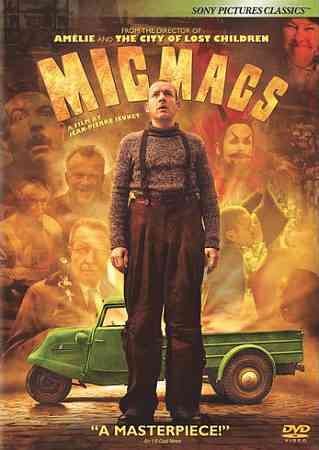
Micmacs, a Film by Jean-Pierre Jeunet

I have neglected film lately in this blog, so I am devoting this week to catching up with films that I have enjoyed recently.

In a world of troubles, we all seem so small. How could any of us ever confront the gigantic forces of evil that propagate violence for the sake of corporate profits? A person would be crazy to even try.

In his comic film Micmacs, French director Jean-Pierre Jeunet has created just the man to do the unlikely, Bazil, the victim of a street shooting. With a bullet lodged in his brain and remembering that his father was killed three decades earlier by a land mine, Bazil is eager to destroy the companies that made the bullet and the land mine. Discovering the rival company headquarters facing each other across a busy Paris street, his bullet-damaged brain hatches a plan. He and his new friends, recycling outcasts living under a refuse heap under a freeway, will trick the arms makers into destroying each other.

For the sake of comedy, the director makes the security personnel for both companies rather easy to fool. Bazil and his team progress quite far with their high jinks before their plans unravel. Then it is time for plan B, which is more elaborate and complicated than all the preceding action. I found it all delightfully unpredictable.

Jeunet is an obvious student of film. In its review, National Public Radio described Micmacs as a cross between Mission: Impossible and Toy Story. One of the members of our film discussion group compared it to Roadrunner cartoons. Another remarked how every one of Bazil's friends - Slammer, Calculator, Elastic Girl - was a down-and-out superhero; the efforts of each was needed to achieve the goal. I was reminded of The Sting, as even the audience is tricked by the film.

Micmacs is a fantasy with a longing for justice, questioning the ethics of wealthy nations prospering from the violent conflicts they enable. Available in DVD, it has slowly develop a great following and may become a cult classic. It is worthy.

Micmacs. Sony Pictures Home Entertainment, 2010. ISBN 9786313898503.

Friday, April 01, 2011

Women Heroes of World War II: 26 Stories of Espionage, Sabotage, Resistance, and Rescue by Kathryn J. Atwood

One of the many benefits of working as a adult services librarian in a public library is meeting lots of nice people. I met Kathryn Atwood when I booked her and her husband John, collectively known as the History Singers, to present one of their programs at Thomas Ford. They have several programs linking history to songs of the past, and we've invited them back to the library several times. Now Kathryn has proven how they are as serious about the history as the music, for she has written an excellent book, Women Heroes of World War II: 26 Stories of Espionage, Sabotage, Resistance, and Rescue.

In her new collective biography, Kathryn recounts the heroic actions of women in the European theater of battle of World War II. Each quick-reading story profiles a woman who decided that surviving the war was insufficient and that active opposition to Nazi troops and agents was necessary to overthrow the menace of Hitler's regime. Some wrote and distributed anti-Nazi literature, others sheltered Jews and Allied soldiers, and still others became spies and saboteurs. All endangered their own lives. German, Polish, French, Dutch, Belgian, Danish, British, and American women are included.

Women Heroes of World War II is an admiring and nicely illustrated tribute that may be enjoyed by many ages. Seniors who remember the time will appreciate Kathryn's attention to the stories from their youth, baby boomers can learn about what shaped their parents, and younger readers can gain some knowledge of what will probably seem to them like the distant past. The immediacy and drama of the stories should hook even reluctant readers. School and public libraries should consider Women Heroes of World War II for teen and adult collections.

Kathryn is coming to Thomas Ford to discuss her book this summer. We'll post details later.

Atwood, Kathryn J. Women Heroes of World War II: 26 Stories of Espionage, Sabotage, Resistance, and Rescue. Chicago Review Press, 2011. 266p. ISBN 9781556529610.