Monday, January 31, 2011

Twain's Feast: Searching for America's Lost Foods in the Footsteps of Samuel Clemens by Andrew Beahrs

Mark Twain and his family took an extended tour of Europe in 1879, lodging at hotels across the continent. To his chagrin, he found most of the food edible but without much flavor. As the months went by, he began to yearn for prairie hens from Illinois, oysters from San Francisco, Philadelphia terrapin, lake trout from Tahoe, and more. These were foods that he had eaten as a young man piloting a riverboat on the Mississippi, trying to make his fortune in California, or touring the East Coast as a new author. Being a man of many words, he wrote a list with eighty items, which he published in his travel memoir A Tramp Abroad. Coming across this list, anthropologist and novelist Andrew Beahrs had this idea: take Twain's list on the road across America and see if he could find dishes in their original regional recipes. The result is his book Twain's Feast: Searching for America's Lost Foods in the Footsteps of Samuel Clemens.

Not all of the foods that Twain longed for really merited Beahrs attention, so he skipped over radishes, mashed potatoes, catsup, and some other fairly common foods and instead concentrated on regional specialities, including those I mention in the first paragraph. To the amusement of his wife, he made few dishes at home, but then hit the road. Each chapter features a trip. For example, to eat possum and raccoon, he went to the annual Coon Supper in Gillett, Arkansas (and his wife most pointedly stayed home). Being an anthropologist, he discusses not only Twain's memories of hunting and the current Arkansas feast, which draws hundreds of people including politicians, but also the history of African slaves brought to America who ate raccoon as a supplement to their meager meat allowance. The chapter has recipes and he assures us that raccoon does not taste like chicken.

My favorite chapter may have been the one on maple syrup. At the time Twain was writing, the manufacturers of maple sugar were trying to compete with beet and cane sugar producers for a share of the all purpose sugar market. The ideal maple syrup was thought to be a clear and tasteless liquid - a product that when reduced to sugar would not interfere with the taste of the food being sweetened. Beahrs visited maple syrup farmers in Connecticut who showed him the old and new ways to harvest and manufacture the sap.

Readers wanting to focus on Twain will be a little disappointed in Twain's Feast. Twain's love of food is really just the inspiration for the book. Most of the book could be called either a travel memoir or a work of natural history. Beahrs handles these subjects with skill and a bit of humor. I enjoyed it.

Beahrs, Andrew. Twain's Feast: Searching for America's Lost Foods in the Footsteps of Samuel Clemens. Penguin Press, 2010. ISBN 9781594202599.

Saturday, January 29, 2011

Candy Bomber: The Story of the Berlin Airlift's "Chocolate Pilot" by Michael O. Tunnell

"Suddenly, out of the mist came a parachute with a fresh Hershey chocolate bar from America."

If you were a child in Berlin in 1948, you were already a toughened survivor. The Nazis had drained the city of everything it had to offer their war effort, and the Allies had bombed sections in its siege of the city. The occupying Soviet forces had blocked all land transportation into the city, trying to get the U.S., Great Britain, and France to cede their sections of the city to them. All the German citizens were hungry, and children had not seen candy in years. American, British, and French forces began flying food into the free sections of the city in an effort now known as the Berlin Airlift.

One of the airlift pilots was U.S. Air Force Lieutenant Gail Halvorsen. On his day off, he caught a ride into the city so he could tour its ruins. Noticing a big group of German children behind a fence watching the supply planes land and take off, Halvorsen went to talk to them. They knew more English than he knew German. They expressed their delight of watching the planes bring them food. Halvorsen had only two sticks of gum in his pocket, but he broke them and handed them to the closest children. Instead of the lucky kids grabbing the gum, they passed the pieces around for everyone to smell. Halvorsen was touched and promised that he would drop them candy on his next flight. Asked how they would know his plane, he said he would "wiggle" the wings. He thus became known as "Uncle Wiggly Wings."

In Candy Bomber: The Story of the Berlin Airlift's "Chocolate Pilot", Michael O. Tunnell tells how Halvorsen's small gesture grew into huge effort involving many service personnel, civilian volunteers, and donors from around the world, all intent on bringing some cheer to the children of Berlin. At 110 pages, this generously illustrated history, which has been chosen a Junior Library Guild Selection, should appeal to boys and girls in upper elementary schools and to adults who like a good story. We have it in our children's room.

Tunnell, Michael O. Candy Bomber: The Story of the Berlin Airlift's "Chocolate Pilot". Charlesbridge, 2010. ISBN 9781580893367.

Friday, January 28, 2011

Double Indemnity: A Film Discussion

Despite icy sidewalks and a temperature of about three degrees Fahrenheit at showtime, nine people came to the library last Friday evening to see and discuss the second classic in our Film Noir series, Double Indemnity with Fred McMurray, Barbara Stanwick, and Edward G. Robinson. Most impressively, they stayed over half an hour discussing the merits and the aging of the film. I like to think they stayed not just to keep from going back out in the cold. Almost everyone contributed to the lively discussion.

Most of the viewers thought the acting was good, even if not demanding much range of emotions. As an insurance salesman, McMurray seemed to have a good command of policy lingo. Stanwick seemed suited to be an unhappy housewife who wanted her husband killed. The cast delivered their lines in the snappy fashion of the times, especially Robinson, who really rattled out sharp statements with his distinctive voice. McMurray, however, did not really look like he was driving in the car scenes; his eyes didn't seem to move.

The plot was clever but not really convincing. There did not seem to be any real bond between McMurray and Stanwick, and how they could have ever had an openly acknowledged relationship was never addressed. The motivation of greed was used to cover lack of forethought.

The passing of time made some parts of the film unintentionally humorous. There was a lot of giggling when McMurray described the mansion as a $30,000 house. Everyone also thought having insurance agents discuss actuarial tables when smoking like chimneys ironic. Physical relationships and language stayed very stiff as not to offend the Hays Commission, which oversaw the morality of 1940s films. As it was, the film barely got passed the commission.

Everyone admitted being entertained and enjoying the stylish cinematography. There was the nicely restored black and white images, long uninterrupted single camera shots, and great use of shadows. The director lingered at tense moments letting the characters (and audience) sweat. A few details were off, such as McMurray wearing a wedding ring through the whole film despite his character being a bachelor, and a lamp disappeared during a scene. Some people thought Stanwick's wig was awkward. But, in general, it was an artistically-made film and a nice thing to see on a cold winter's night.

Wednesday, January 26, 2011

At Home: A Short History of Private Life by Bill Bryson

"I hardly need point out that history of any kind tends to sprawl." Bill Bryson

After nine days at about fifty pages a day, I have finished reading At Home: A Short History of Private Life by Bill Bryson. I have had fun reading and have half a dozen post-it notes sticking out of the book. These mark entertaining bits that I shared with Bonnie or my Facebook friends or someone at the library. Bryson tells wonderfully obscure stories that show how greedy, clever, gullible, philanthropic, prejudiced, and heroic that humans can be. While many of the stories have humorous twists, tragedy stakes a big claim on much of this text about - (pause for dramatic effect) - What is this book about? What is "private life"?

After coming to the end of At Home, I went back to the introduction to seek the glue that holds the book together. That's when I saw the quotation above. I didn't realize its significance first time through. It jumped at me on second reading. It explains everything.

At Home is a history that embarks from observations about a house, specifically a Victorian parsonage in England in which the Bryson family lives. While each chapter is named for a room or the gardens, Bryson never keeps us there. Instead, he takes us around the world and through time to consider crucial events of history that contributed to existence of that kind of room being in houses in Europe or the Americas. The chapter on the scullery and larder discusses the lives of British servants before the twentieth century, while the chapter on the dressing room includes Bryson's thoughts about men wearing powdered wigs back in the eighteenth century. The chapter on the nursery includes history of infant mortality and child labor laws. Premature burial is discussed in the chapter on the bedroom. As Bryson points out, history sprawls.

Bryson will wear some readers out with this expansive book. Others who do not mind rambling may enjoy it immensely.

Bryson, Bill. At Home: A Short History of Private Life. 2010. ISBN 9780767919388.

Monday, January 24, 2011

On Elephants and Relatives

For nearly sixty years, Dame Daphne Sheldrick has been caring for orphaned wildlife of Kenya, raising everything from dik-diks to rhinoceroses. What she is most known for, however, is raising orphaned elephants. Through the David Sheldrick Wildlife Trust, she and her devoted staff care for dozens of young elephants with the goal of reintroducing them to the wild. The Trust runs several camps in Kenya (the Naibori Nursery, Ithumba Unit, and Voi Unit), which can be visited by well wishers when touring the country. She has become quite famous and was recently featured on NBC News and the Today Show. Because many people want to follow the orphaned elephants' progress, she writes monthly letters that can be received through email.

Bonnie is a sponsor and receives the emails, which she passes on to me. These letters from Dame Daphne remind me of the letters that I used to get from my grandmother. My grandmother had eight siblings, and my grandfather had four siblings, and I think they all had children. Three of my great aunts lived in or near Big Lake, Texas when I was a boy and more relatives were in San Angelo, Ozona, Alpine, Ft. Davis, Lubbock, Midland, and Austin. She was constantly getting cards and letters from the relatives, as well as visits. When I left for college and jobs in other states, Grandmother sent letters that reported on the lives of my great uncles, great aunts, and cousins to many degrees. I had tremendous trouble keeping them all straight.

Dame Daphne's letters are longer and include even more names on average than those I received from my Grandmother. She and her organization are probably not taking care of more elephants than I have cousins, but she tells us more about them. Most letters start (unfortunately) with a story about an elephant rescue. Then we learn who is at each camp, who is comforting younger elephants, who is leading the daily walks, and who's joined the wild herds of their own accord. We also learn who's playing with whom. I think the elephants are closer and have more fun together than my relatives ever did (at least at the cousins level).

Like any good family, there are photos to see. Bonnie often prints some with the monthly letters. I get to see the latest shots of Zurura (above), Bonnie's elephant, who has grown into a mischievous and rowdy boy who likes pushing games but also is a devoted to his friends. He was a constant companion to a dying elephant last year.

You have to love elephants when you read Dame Daphne's letters. Learn more at the David Sheldrick Wildlife Trust website.

Friday, January 21, 2011

Awkward Family Photos by Mike Bender and Doug Chernack

I think I know these people. Though I am not actually in Awkward Family Photos by Mike Bender and Doug Chernack, I might as well be. I knew lots of discomfort and embarrassment in my youth and adolescence. You, too? (Of course, we have been models of sophistication and good taste since we grew up.)

I first noticed Awkward Family Photos on display at Prairie Lights Book Store in Iowa City and might have read the whole thing while standing there if I had not had a concert to attend. The book drawn from a website by the same name is filled with cringe-inducing images. Some of the "best" (should that be "worst?) from the web are gathered in chapters in this book, including "The Family Portrait," "Mom and Dad," Vacation," and "Weddings." Many need no comment, but Bender and Chernack usually put some witty words below the pictures. They also include some notes sent by the submitters. These tell stories that I think I'd want to forget but which are surely unforgettable to witnesses.

The photos are not dated, but I guess they range across the last half-century, making them a sort of history of baby boomer life. They show the worst clothes, hairdos, wallpaper, furniture, and camera techniques of the time. While these may make you cringe, it is the facial expressions and strange postures that will make you gasp. Poor people. (Better them than me.)

Bender, Mike and Doug Chernack. Awkward Family Photos. Three Rivers Press, 2010. ISBN 9780307592293.

Wednesday, January 19, 2011

They Called Themselves the K.K.K.: The Birth of an American Terrorist Group by Susan Campbell Bartoletti

Author Susan Campbell Bartoletti writes about grim historical topics for younger readers. The lives of coal miners and their families, the Irish Potato Famine, and the Hitler Youth are among the subjects of her award-winning books. Now, after looking at thousands of pages of Congressional hearings, newspapers, and personal accounts, she has written They Called Themselves the K.K.K.: The Birth of an American Terrorist Group. While most of the book focuses on the 1860s and 1870s, it retains its relevance, as the Ku Klux Klan and other hate groups have never gone away. Found on page 149, the photo of a Klan rally taken by the author in 2006 is chilling.

Documentation is Bartoletti's strength. Her book is filled with quotations from both Klan members and their victims, as well as dozens of illustrations from nineteenth century magazines, especially the drawings of Harper's Weekly, which championed the rights of freed African-Americans throughout Reconstruction. Bartoletti does little open editorializing. At several points, she includes content that is sympathetic to the plight of the men who became the Klan, but she ultimately lists so many crimes against humanity that the reader can not mistake her intention to discredit Klan apologists. She follows her text with a civil rights highlights chronology, research notes, and references.

Young readers may have difficulty believing that the shocking events described are true. How could our country ever been like this? This is precisely why having such books in school and public library is so important.

Bartoletti, Susan Campbell. They Called Themselves the K.K.K.: The Birth of an American Terrorist Group. Houghton Mifflin, 2010. ISBN 9780618440337.

Monday, January 17, 2011

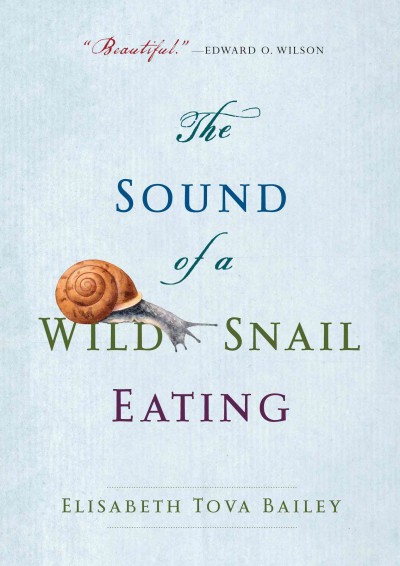
The Sound of a Wild Snail Eating by Elisabeth Tova Bailey

"The snail has been a true mentor. Its tiny existence has sustained me." Elisabeth Tova Bailey

If I were rich, I would buy a copy of The Sound of a Wild Snail Eating by Elisabeth Tova Bailey for each of my friends. I'm not sure that every one of them would appreciate it, but I think it has a wonderfully profound story. Bailey was literally laid flat by an unknown disease twenty years ago. She did not have the energy to sit up. To relieve the boredom of her convelescence a friend brought her a terra-cotta pot of field violets with a snail. Asked why the snail, the friend replied, "I don't know. I thought you would enjoy it." She was not really sure the snail was alive. It proved to be very alive.

For much of the next year, Bailey watched the snail venture forth from the flower pot. She learned how the snail could suspend itself upside down, glide across moss, and cut square holes in paper. Later, when she had a friend set up a terrerium for the snail, she watched it explore and choose sleeping spots. In the near silence of her life, Bailey could even hear the snail eating. Bailey noticed that the snail did everything with a slow determination - an apt example for a woman with autoimmune dysautonomia and chronic fatigue syndrome brought on by mitochondrial disease.

It has taken Bailey twenty years to write her memoir filled with personal observation and a healthy serving of gastropod science. For the reader, it was worth the wait.

Bailey, Elisabeth Tova. The Sound of a Wild Snail Eating. Algonquin Books of Chapel Hill, 2010. ISBN 9781565126060.

Friday, January 14, 2011

We Are the Ship: The Story of Negro League Baseball by Kadir Nelson

When I saw my library had We Are the Ship: The Story of Negro League Baseball by Kadir Nelson as an audiobook, I was puzzled. Nelson is known for his wonderful illustrations in children's picture books. I had already read We Are the Ship, and the pictures of the baseball players are still fresh in my mind. I could hardly imagine separating the text and illustrations. Needing an audiobook, I borrowed it anyway.

To my surprise, it worked very well just as an audiobook. I had forgotten how Nelson had written his history of the Negro Leagues as if he was one of the players, giving the story a warmth and immediate appeal, and the text that seems so simple is really quite complex. What seems likes an off-hand telling weaves in so much detail, and the stories seem as though they are firsthand. It makes a great audiobook. I only hope that the author interview appended makes listeners go find the print edition as well.

Nelson, Kadir. We Are the Ship: The Story of Negro League Baseball. Brilliance Audio, 2008. ISBN 9781423375364

Wednesday, January 12, 2011

The Heavens Are Empty: Discovering the Lost Town of Trochenbrod by Avrom Bendavid-Val

"There once was a town called Trochenbrod ... "

So begins The Heavens Are Empty: Discovering the Lost Town of Trochenbrod by Avrom Bendavid-Val, whose father was born and raised in the small Jewish town that unfortunately sat in the path of Polish, Ukrainian, Russian, and German army conquest. Far from any main roads, the town with only one street was self-sufficient when isolated. Jewish artisans and shopkeepers produced shoes, hats, furniture, bread, and beer for trade while producing potatoes, onions, milk, and eggs in their big backyards. It is remembered fondly by survivors. Few, however, survived the Holocaust.

As a child, Bendavid-Val heard little about Trochenbrod from his father, but the author decided on a whim to visit when he was already in Poland for business in the 1990s. Finding only a broken monument on the site, no trace of buildings, he was intrigued. The result of his seventeen years of research is this fond tribute filled with stories from survivors who are now scattered around the world. For student or general reader, the author has helpfully added a glossary of Jewish terms and a chronology of the events of the ill-fated town. History readers should especially appreciate this quickly read book, which would also be appropriate for school libraries

Bendavid-Val, Avrom. The Heavens Are Empty: Discovering the Lost Town of Trochenbrod. Pegasus Books, 2010. ISBN 9781605981130.

Monday, January 10, 2011

Nocturnes: Five Stories of Music and Nightfall by Kazuo Ishiguro

Just before Christmas, aware that I had somehow let my stack of books dwindle, Bonnie brought me Nocturnes: Five Stories of Music and Nightfall by Kazuo Ishiguro. Having already enjoyed three of his novels - The Remains of the Day, When We Were Orphans, and Never Let Me Go, I was disposed to like the short story collection for two reason - I like Ishiguro's storytelling and I like the brevity of short stories. The five stories did nothing to disappoint me. Ishiguro shows that he can write short fiction as well as novels. They may even be better.

In each of the stories in Nocturnes, a barely-making-it musician recalls an incident in which he became involved with someone who seemed to have been a success but somehow lost momentum. A guitarist in Venice accompanied an over-the-hill pop singer in a gondola to serenade the latter's wife, and later a brilliant but homely saxophonist undergoing reconstructive facial surgery (for which he was still bandaged) wandered through the banquet halls of a five star hotel through the night seeking to return stolen trophies with the former wife of the same over-the-hill pop singer. The stories share characters and minor details, suggesting they are all part of a larger drama. Each story is filled with comic details, but no one is laughing. The story-telling musicians are still puzzling over their experiences at the time of the telling.

Each Ishiguro book creates a totally new world unlike those in his previous books. Nocturnes is no exception. Readers do not know what to expect from the author - except that the story will be good.

Ishiguro, Kazuo. Nocturnes: Five Stories of Music and Nightfall. Alfred A. Knopf, 2009. ISBN 9780307271020.

Friday, January 07, 2011

Jane Goodall: A Twentieth-Century Life by Sudipta Bardhan-Quallen

Of all the people I have heard speak at public events, my favorite has to be Jane Goodall. Bonnie and I attended her lecture at Navy Pier in Chicago four or five years ago, at which she spoke about the human and ape relationship, ethical primate reserch, and the effort to conserve habitats for primates and other wildlife. She reported findings from throughout her career and told what her foundation plans. I was spellbound.

Having heard Goodall, read her articles in National Geographic, and seen numerous documentaries, I know her story fairly well. Still, when I found Jane Goodall: A Twentieth-Century Life by Sudipta Bardhan-Quallen in our teen biography section, I was eager to read more. At only 218 pages including the notes, bibliography, and index, the book is a compact biography telling just the central part of Goodall's long career as a primatologist. Sudipta Bardhan-Quallen tells how a young woman who grew up moderately poor in the Depression and World War II was able to break into the field of wildlife research with Kenya's famous scientist Louis Leakey. She tells how Goodall conducted her research in the Gombe Stream Chimpanzee Reserve in Tanzania and became on advocate for primates. The author is obviously a fan as well, but she does not shirk from telling about Goodall's faults and failures. Goodall seems more to be admired for having had difficulties.

With biography assignments on the increase in middle schools in our area, our library needs to have a good collection "middle size" biographies to serve our community. Heather Booth and I have spoken about this countless times. With oversize bindings and a reliance on photos, too much of what we find retains a children's book look that turns off middle school teachers trying to prepare their students for high school. More book like Up Close series title are what we need.

Bardhan-Quallen, Sudipta. Jane Goodall: A Twentieth-Century Life. Viking, 2008. ISBN 9780670062638

Wednesday, January 05, 2011

Faces of America: How 12 Extraordinary People Discovered Their Pasts by Henry Louis Gates, Jr.

"Think how many lives we carry around with us. Everything that they learned, everything that wounded them, everything that made them stronger, everything that made them happy, we carry in our little corporeal selves." Meryl Streep

Several people told me earlier in the year that I should see Faces of America, the Henry Louis Gates, Jr. genealogy series that ran on public television. I agreed with them that the series appeared to be something that I would enjoy, but many months later I still have not viewed it. It is among the many books and DVDs still on my "someday" list. I did, however, find the companion book sitting on the library's new book shelf just before Christmas when I needed something to read. I have now read about the ancestors of twelve prominent Americans whom Gates chose to represent as a cross section of our country. The book seems to tell a pretty complete story, so I may not need to see the series now, but I have placed a library request. The stories were good and merit a bit more of my attention. Someday will come soon.

It is hard to say which of the stories in Faces of America: How 12 Extraordinary People Discovered Their Pasts I liked best. It might have been the last, in which Gates reports on his research into the ancestry of actress Eva Longoria, who grew up in south Texas on land that her family has held for centuries. Having grown up in Texas myself, I know that some historically-ill-informed Anglos think all Hispanics are recent arrivals in the United States, but the Longorias have been in Texas since 1749, when the area was part of New Spain. Like many early settlers, they had to defend their legal holdings against the later arriving land hungry Anglos. As he does with each case but one, Gates adds DNA testing. The surprise for Longoria is that she is mostly European genetically - she had suspected more Native American ancestry - and she has common ancestors with Meryl Streep and Yo-Yo Ma. Ma's ancestry is totally Asian but so is the DNA of most Native Americans.

Anyone who has spent time looking up family trees, discovering the prominent citizens and criminals in their ancestral past will appreciate the stories Gates tells, as he reveals the individuals with the context of their times. Most of his subjects report feeling more connected to history after getting the documentary and DNA reports. An appendix further explains the DNA testing for those who might like to try the process themselves.

Gates, Henry Louis, Jr. Faces of America: How 12 Extraordinary People Discovered Their Pasts. New York University Press, 2010. ISBN 9780814732649.

Monday, January 03, 2011

The Last Empy Places: A Past and Present Journey Through the Blank Spots on the American Map by Peter Stark

Would you take your young family on a week-long canoe trip through the most remote section of Maine, paddling through the rain and shooting through rapids? How about leading them on a four-day hiking trip through the Gila Wilderness Area in New Mexico, waking to frozen shoes and fording icy streams? Wouldn't the kids complain about the all day treks and being away from their friends, games, and shows? If you are Peter Stark, the answers are "yes," "yes," and "no." According to his book The Last Empy Places: A Past and Present Journey Through the Blank Spots on the American Map, his son Skyler and daughter Molly are real troopers, having been on adventure vacations since infancy. Molly does once ask if they can stay in a four star hotel once they reach their destination, but she bravely paddles on.

In The Last Empty Places, Stark tells his family nature travel stories as a frame from which to hang his history of the American conservation movement. Each of his four essays features a trip to a "blank spot" on the U.S. map, the story of a great American naturalist, and stories about environmental abuse from the speculators, settlers, and industrialists who wanted to tame the land. His featured locations are in Maine, Pennsylvania, Oregon, and New Mexico. His heroes include Henry David Thoreau, William Bartram, John Muir, and Aldo Leopold. His villains include the British Army, U.S. Forest Service, and Spanish explorer Francisco Vásquez de Coronado.

The point of Stark's elegant essays, of course, is that the empty places on maps often preserve what is truly worthwhile in life. The Last Empty Places promotes both reading classic authors of natural history and looking for wild places in your own region.


Stark, Peter. The Last Empy Places: A Past and Present Journey Through the Blank Spots on the American Map. Ballantine Books, 2010. ISBN 9780345495372.

Saturday, January 01, 2011

My Reading Resolutions 2011

At the Thomas Ford Memorial Library, we have started a blog Western Springs Reads to reflect what our clients are reading. We have preloaded it with book reviews written by last year's summer reading participants and are now adding client and staff reading resolutions for 2011. We put a just-for-fun poll on tables around the library and online to see what our clients plan to read in the new year. As they tell us, we will add the information to the blog.

This made me think about my own plans. In the past, I have made some ambitious reading resolutions that have fallen to the wayside. About a decade ago I had the idea of devoting a year to the literature of one nation and then another nation the next year. Eventually, I'd get around the globe. I started with the U.S. and read twenty of so great American authors, such as Irving, Cooper, Twain, Hemingway, Steinbeck, etc., that year. At the end of the year, it did not seem one year was enough as there were still so many American authors, so I chose the U.S. for a second year. Then I spent a year concentrating on English authors, such as Austen, Dickens, Trollope, etc. Then I was diverted and am only now thinking again of world literature merry-go-round.

Because I noticed many biographies about French authors while I was writing my biography readers' advisory book, I am going to put a slate of French novels and essays into my plan for 2011. I know that I will want titles by Rousseau, Voltaire, Sand, Flaubert, and Camus.

I know I want to start Paradise Lost by John Milton. I don't yet know whether I will finish it.

I also know that I will be reviewing popular science books for Booklist. I may be getting 18 or 20 advanced copies, which will be mostly natural history and animal stories if the past year is a clue for this year. Enjoying these books, I will probably read other natural history titles just for fun.

Of course, I plan to read several dozen biographies and memoirs, as well as histories and other books that appeal to me. It should be a good year.

Do you have a reading resolution?