Monday, August 30, 2010

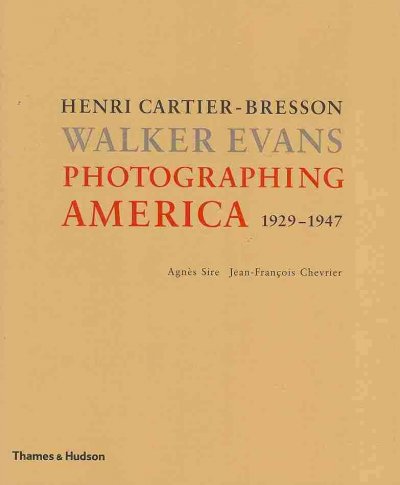
Photographing America, 1929-1947 by Henri Cartier-Bresson and Walker Evans

Several weeks ago, Bonnie and I went to the Art Institute of Chicago to see the photographic exhibit Henri Cartier-Bresson: The Modern Century. No special tickets were needed for the exhibit, which we founded only lightly attended on the day that we were there. That worked well for us as we spent an hour and a half or longer looking at the black-and-white images that retold much of what happened around the world between 1930 and 1970. Cartier-Bresson took his camera to many of the world's hot spots, witnessing the Communist Revolution in China, Ghandi's funeral march, and the Civil Rights movement in the United States. He also took scores of now famous portraits of prominent people. There were hundreds of images on the exhibit walls and many original copies of Look, Life, Paris Match, and other international photo-magazines in display cases. It is a great collection that can be viewed through October 3, 2010.

Wanting to see more by the photographer, I checked out Photographing America, 1929-1947 by Henri Cartier-Bresson and Walker Evans. In the introduction, Agnes Sire explains how in 1929, Evans spent eight months touring the United States with the goal of photographing the state of the nation. Some of his photographs from this trip went into his influential book American Photographs (1938). In 1946, Cartier-Bresson set out to do much the same thing. While he took many great photographs, especially in New Orleans and Chicago, the book deal fell through and many images were never published until now. In an essay "A Dialogue?", critic Jean-Francois Chevrier then explains the friendly relationship and similar sense of purpose that the photographers shared. The text gets a little dry. Readers more interested in seeing the photos should read just a little and then skip to the plates beginning on page 51.

While the editors mix photos from both photographers' trips to show artistic similarities and differences, it is perfectly acceptable to look at the pictures just to get a sense of American history or just because you like pictures. Both men were sympathetic to the poor and oppressed, so their vision may not match the memories of some people who grew up in the time. Particularly shocking is how one Mississippi used car dealer used lynching as a theme in a sales campaign. Photographing America, 1929-1947 does not make you long for the old days. Evans and Cartier-Bresson were realists uncovering rifts in the social fabric. No history reader should miss this book.

Cartier-Bresson, Henri and Walker Evans. Photographing America, 1929-1947. Thames & Hudson, 2009. ISBN 9780500543702.

Wednesday, August 25, 2010

Pearl Buck in China: Journey to the Good Earth by Hilary Spurling

As a student in the sixties and early seventies, I am certain that I read bits of Pearl Buck's writings from literature textbooks. She was a living author and not as forgotten then as she is now. I think we discussed her in Mr. Wallace's sophomore English class in high school. I've long had a vague sense that she was an interesting woman. I finally read and mostly enjoyed The Good Earth several years ago (though it was a bit long). So I welcomed getting Pearl Buck in China: Journey to the Good Earth by Hilary Spurling.

Being the daughter of impassioned Christian missionaries who were set on converting China, you wouldn't think that Pearl would end up being so sympathetic to common Chinese people and their traditions. The rural peasants and village merchants to whom her father tried to preach mostly ignored him, except at times of political rebellion when they sough to kill him and his family. Someone always saved the Bucks, hiding them or helping them flee. They seemed to lose their meager possessions and need to be bailed out by the missionary society frequently. Why would Pearl identify so with these people? Spurling explains that as a girl, Pearl's busy mother often left her in the care of her Chinese housekeeper. Pearl played with Chinese children, and her mother got her a local scholar as a tutor. Pearl was already eight when she discovered that she was not Chinese.

Pearl's upbringing did not really prepare her for life in the West. While she excelled at college and was awarded prizes, she never fit into campus life. When she first married, she was not really interested managing a house with furniture and lots of possessions. She was always awkward socially. Her best times were reading and writing alone.

Spurling's biography of Pearl Buck focuses mostly on the novelist's life in China, her subsequent longing to get back to her adopted land when she was exiled, and the way that she recreated her China in her novels and memoirs. While having read Buck's books might help, Spurling helps readers with plenty of plot descriptions and quotations. Biography readers and those interested in history of the 20th century will enjoy this quick-reading book.

Spurling, Hilary. Pearl Buck in China: Journey to the Good Earth. Simon & Schuster, 2010. ISBN 9781416540427.

Monday, August 23, 2010

Ghosty Men: The Strange But True Story of the Collyer Brothers, New York's Greatest Hoarders by Franz Lidz

I can understand how hoarding starts. The rubber bands on celery are reusable. Newspapers have more articles than you can read today. Plastic milk jugs seem too good to throw away or even recycle. Swizzle sticks come in a variety of shapes and colors; how many you wonder? There are so many good books at used book sales really cheap. You have every episode of I Love Lucy and Lassie on VHS. Neighbors are leaving really good things by the curb on clean-up day. That old PC might be a collector's item some day. There is always a little more room for a few choice items in the house or apartment.

Some hoarders take their obsession to extremes. Franz Lidz writes about three such men in his compact book Ghosty Men: The Strange But True Story of the Collyer Brothers, New York's Greatest Hoarders. As the subtitle indicates two were Homer and Langley Collyer, about whom E. L. Doctorow has also written a recent novel. The third hoarder was Lidz's own Uncle Arthur Lidz. By mixing chapters about the Collyers, celebrities after stories ran in all of the New York newspapers about their bizarre hoarding in 1930's-1940's Harlem, with chapters about his uncle, the author makes the subject more immediate and almost understandable. Readers may even notice similar behaviors in their own friends and family or even themselves.

Lidz also shows that the lives of hoarders do not have to end as tragically as those of the Collyers. Families will, however, have to learn when to tolerate and when to intervene to protect their kin. There are no easy answers, but Lidz's book may help some concerned readers. For others, Ghosty Men will be a memorable and well-told story bound to keep them up late.

Lidz, Franz. Ghosty Men: The Strange But True Story of the Collyer Brothers, New York's Greatest Hoarders. Bloomsbury, 2003. ISBN 158234311X.

Friday, August 20, 2010

Our Quick Peoria Vacation

August might not be the best time to visit Peoria for a long weekend, but Bonnie and I enjoyed our hot but entertaining stay. It might have seemed hotter, but clouds and breezes helped, as well as being out early each morning. Summer heat does not hold us back.

Why Peoria? Bonnie and I have been members of the Brookfield Zoo for 27 years and used to read about the zoo's grounds outside Peoria for breeding endangered species. We always wanted to go see it. Well, in the meantime, it was transformed into a Wildlife Prairie State Park, a sort of zoo for animals native to Illinois. We still kept it on our list of places to visit before we die. We went Friday morning last week, accomplishing our first objective for a Peoria vacation. While at the state park, we saw wolves, bison, elk, red tailed hawks, and a bobcat. Best of all, we spent twenty minutes watching sandhill cranes. There were also keeper talks. One keeper had a peregrine falcon that we saw up close, and another had a bald eagle, but he stayed a little farther back. The wild animal park has huge enclosures for its animals, which are at times difficult to spot. We missed the black bears and the river otters. Still, we had a great time. It is amazing to think that the place had once been a strip mine for coal. It is a true conservation success.

Our second objective was to see a Peoria Chiefs baseball game. We arrived at the stadium about an hour before game time, thinking we might see batting practice, but no one was on the well-manicured field. I got a tasty BBQ sandwich, and we looked around park. I liked seeing all the old photos of Peoria's former minor league and college baseball stars. Then a storm with its dramatic clouds rolled in. The temperature fell from 88 to 65 degrees, and buckets of rain fell. About half an hour past scheduled game time, the team called the game off. We went to Panera for hot chocolate.

The third objective was to see the
Peoria Zoo in Glen Oak Park. We enjoy visiting small zoos to see what birds and animals they might have. Bonnie had done her homework and knew, but I was quite surprised how nice the place was. Just this summer the Peoria Zoo open its new Africa! exhibit with large enclosures for the animals and great viewing decks for the visitors. The Red River hog had four little piglets (hoglets?) scurrying around her, the tortoise was slowly walking around his enclosure, the Thompson's gazelles were locking horns (though they had no females over which to fight), and the rhinoceroses were taking mud baths. The colobus monkeys were off exhibit, so we missed them just as we had twice on trips to Africa. In the small animal house was a small colony of bright yellow weaver birds, as well as really big snakes. It was just getting hot when we broke for lunch. It had been a really great morning.

The afternoon did not go as well. We went to take a tour of a historic house near Bradley University, but the curators/docents never showed. Bonnie had called ahead to verify the hours. It was quite a disappointment. Then we went back to Glen Oak Park to tour the Luthy Botanical Garden, close to the zoo. The gardens are beautiful and I would like to spend more time there on a cooler day. I particularly liked the shady Woodland Garden, which had some tall old trees.

Needing something cool, Bonnie spotted Emack and Bolio's Ice Cream Shop in Peoria Heights. We had never heard of the establishment, but it had rich creamy ice cream and microbrewed sodas, as well as classic 1960s rock posters and great music. The franchise seems to be mostly in Massachusetts and New York. The only Illinois shops are in Peoria Heights and Normal. I wish one would come to our area.

We then took a short hike at Forest Park Nature Center. It was fairly pleasant under the thick green trees along the Valley Trail. In the nicely air conditioned visitors center, I liked the photos from 1930s and 1940s showing the Girl Scout camp that had been on the location.

For dinner, we returned to the Bradley University area and got a table at One World Eats & Drinks. The decor is definitely hip college-town, but the clientele included as many families as students. I enjoyed a Southwest salad and tiramisu, both of which I recommend.

Driving around Peoria is very easy for someone used to Chicago traffic. Some one way streets and dead ends near the downtown ramps to the Interstate confused us a little, but we got where we wanted fairly quickly. I'd still like to see a ballgame in Peoria. If we visit again, we'll try to make it late spring or fall.

Wednesday, August 18, 2010

Hunger Games by Suzanne Collins

Our copies have been out all summer. The requests keep coming. One of the local schools assigned The Hunger Games by Suzanne Collins for summer reading. Some of the young readers have even liked it well enough to ask for the sequel Catching Fire. I felt that I should read the teen novel, too, to learn what it was all about. So I got the audiobook and listened while doing yard work and household chores.

Within the first half hour, the caution flag was waving high. I sensed Lord of the Flies in the background. I was wondering whether I should continue. Brave reader that I am, knowing that all those teens were having to read it, I did. The results of my decision are mixed.

The Hunger Games is a pretty well told story. With fifty years of reading behind me, I was able to predict the outcome of each characters' roles, but some of the details of the story were surprisingly clever. (I almost typed "cleaver" which would fit this gruesome story, too.) The mixing of action and thought worked well, and I wanted to know what came next.

But I was unhappy at the end. Nothing was resolved. Some characters had temporarily escaped peril with their lives, but the unexplained evil that brought about the games was still in place. The stage was just set for sequels that I do not want to read.

I am not opposed to sequels, but there has to be some glimmer of hope at the end of the first book. We are given no reward for making it to the end. There is just a promise of more dreariness.

Still, I would rather continue The Hunger Games than The Girl with the Dragon Tattoo. I suspect both will be popular for years to come, but I'd prefer to read something less dismal.

Maybe the schools can free their students from assigned readings next summer.

Collins, Suzanne. The Hunger Games. Scholastic Press, 2008. ISBN 9780439023481

Monday, August 16, 2010

Nelson Mandela: A Life in Photographs

How do we consider Nelson Mandela from America? I think our general opinion of him is positive, but I would bet that most of us really know very little about him other than there was a long campaign to get him freed from South African prisons during the decades of Apartheid and that he became the president of his country after reform of voting laws. Most of us know little of his background and why he was imprisoned. Few of us could quote from his speeches. Instead, he is a well-liked personality to rank with George Washington or Martin Luther King - beloved but not really understood. He deserves more of our attention.

As a famous person, he is the subject of several photobiographies, including Nelson Mandela: A Life in Photographs from 2009. Most of this book is filled with large photographs of the subject at many stages in his life. Understandably, more than half were taken after his release in 1990, as he has been in the public eye constantly since then. The photos tend to be just Mandela at his best, ever smiling and greeting others with warmth. Only so much can be learned from them. Luckily for readers, the editors also included six of Mandela's most famous speeches. In these, especially "No Easy Walk to Freedom" from September 21, 1953 (page 11) and "An Ideal for Which I Am Prepared to Die" from April 20, 1964 (page 55), we get to read what the subject has to say about himself and his country. Without them, this book is a bit shallow. With them, it serves as a good introduction to a long life.

The editors obviously just considered this a coffee-table book to be purchased by the modestly affluent. They did little to help its reference value, as there is not even a table of contents to help readers find the speeches, much less an index to find Mandela at court, in prison, abroad, or as president. It will help students looking for pictures, but it could have been much more.

I am not certain what to recommend for someone wanting to really study Mandela. Certainly Mandela's own memoir Long Walk to Freedom (1994) should be considered, and In His Own Words, a collection of speeches might be added. Mandela: The Authorized Biography by Anthony Sampson is well regarded; Kirkus seemed to think it was objective. Mandela: A Critical Life by Tom Lodge is a well-reviewed modest size book that might better fit a busy reader. Otherwise, there are countless juvenile biographies. It seems that in a world with dozens of books about George Bush (father and son), Barack Obama, Princess Diana, every Kennedy, Elvis, and Michael Jackson, there should be more on Mandela.

Nelson Mandela: A Life in Photographs. Sterling Press, 2009. ISBN 9781402777073

Friday, August 13, 2010

Life from BBC Earth

For the past several weeks, Bonnie and I have been watching episodes of Life, a nature series from the BBC narrated by David Attenborough. Life is much like its predecessor Planet Earth in that there are many spectacular landscapes and it shows many amazing organism behaviors. While Planet Earth was organized around habitats, Life episodes focus on species categories, such as birds, mammals, and insects. There is also an introductory episode on the challenges faced by living things. A later episode investigates the behaviors of hunters and their prey.

While being dazzled by the beauty of jungles, mountains, and seascapes, I enjoyed listening to David Attenborough relate each organism's story. He always seems so happy to be telling us what researchers have discovered and filmed for the first time. Some segments reminded us of classic scenes from Attenborough programs that we have been watching for decades. Bonnie particularly remembered how he favored male bowerbirds of New Guinea who build fantastic structures from grasses, mushrooms, feathers, rocks, and other natural or found materials to attract mates.

Each episode ends with a special "On Location" segment that explains how the Life cameramen and camerawomen got their difficult shots. The best two may have been in the plants and the primates episodes. The plants episode "On Location" explains an elaborate time lapse shot combining a rocky formation and studio shots. The primates "On Location" explains how a camerawomen patiently waited for chimpanzees to exhibit tool using behaviors. The final shot of the series shows chimps walking in a row, each turning in recognition of the camera as they pass. The effect is stunning. They are totally aware of being observed.

The primary message of Life seems to be that species adapt through experiment and thought. While instinct may guide individual organisms to a point, there always seems to be surprising innovations. We are not the only intelligent life forms on the planet, and our neighbors deserve respect. But the message is always understated and never preachy, making Life is pleasure to watch.

Life. BBC Worldwide, 2010. 10 episodes on 4 discs. ISBN 1419888579.


Wednesday, August 11, 2010

The Great Silence: Britain from the Shadow of the First World War to the Dawn of the Jazz Age by Juliet Nicolson

"In 1919 there were ghosts in every town and village of the country - the ghosts of those who had fought for their country and who had been denied the burial and homecoming that their relations knew was their due. The Silence had aroused old feelings just as receding memories had begun to settle. Some wished for a more permanent silence. Others chose to carry on dancing." The Great Silence by Juliet Nicolson, p 149

Throughout the long years of World War I, many in Great Britain held out the hope that if the war would just end, their lives could once again be as they had been. As Juliet Nicolson recounts in The Great Silence: Britain from the Shadow of the First World War to the Dawn of the Jazz Age, this wishful thinking was in vain. Too many men had died and the social fabric of the country had been torn. Former butlers, stablemen, and gardeners were no longer willing to spend their lives in service to landed families. Maids, cooks, and nannies had enjoyed better pay in munitions factories, hospitals, and dance halls. Wartime shortages continued. Many laborers were out of work. Too much had changed for Great Britain to turn back the clock.

The Silence mentioned above was a planned national two minutes of quiet to be observed on the first anniversary of the end of the war. It was to be simple and dignified. Prime Minister Lloyd George had hoped it would signal the end of the period of mourning. His hopes that people would turn their attention to the future, however, were dashed. Not enough had been done to help the country heal.

Uncertainty and lack of closure were serious problems for many. Early in the war the British military had decided for logistical and sanitary reasons that bodies of the dead would not be returned to their families. Instead, many would go into the fields near the battle trenches in France. Reporting was slow. Many bodies were unidentified. Having seen no bodies of husbands, brothers, and sons, many family members refused to believe them dead.

Some battle survivors wished that they had died. Many soldiers suffered severe facial injuries that required they wear masks or go through years of cosmetic reconstruction. Others lost arms and legs. Some felt guilt for surviving. Use of alcohol, morphine, and opium rose, as did suicide. Amid the hardships, some people, including the author's grandparents Vita Sackville-West and Harold Nicolson, still enjoyed the privileges of having big houses and gardens at which they entertained members of their class. According to the author, many of their parties were very elaborate and went well into the night, as celebrants tried desperately to be happy again.

Nicolson knows her topic, having heard stories from her family and interviewed many of the subjects or their children. While she profiles many celebrities, writers, soldiers, and politicians of the time, I particularly liked reading how several more common women coped with their losses. The author packs a lot of issues into this fairly quick reading book about the consequences of war. Recommended to readers who enjoy books about short historical periods.

Nicolson, Juliet. The Great Silence: Britain from the Shadow of the First World War to the Dawn of the Jazz Age. Grove Press, 2009. ISBN 9780802119445

Monday, August 09, 2010

Invitation to a Beheading by Vladimir Nabokov

Reading one book often leads to another. With Reading Lolita in Tehran by Azar Nafisi, it is leading to several - but not Lolita itself. Nabokov's Invitation to a Beheading, a title I did not recognize, was his book that called to me.

Now that I have read Invitation to a Beheading, I am a bit confused. What was it about? How did it end? I read the ending pages twice trying to work it out. Typical reader that I am, I want to understand.

Despite being unsure of Nabokov's intent, I can see why students in Iran could appreciate his tale. The main character Cincinnatus is arrested, tried, and convicted for charges that are only vaguely described as being out of step with everyone else. He is repeatedly accused of being difficult, uncooperative, and trying to disappear. His jailer and the prison director seem to notice whenever Cincinnatus begins to dream about how life could be better; they intervene to keep him from breaking the expressly-stated prison rules against dreaming. False accusations, unjust sentences, self-congratulating officials - the plot sounds a lot like Nafisi's Iran under the Shah and after the Islamic Revolution.

For not being like everyone else, Cincinnatus was sentenced to be beheaded, but no date of execution was announced. Discovering the date and time for his death became his obsession. It also became his excuse for never starting any projects, such as writing his memoir. What if he had not enough time to finish? He chose never to start. Of course, he came to regret that he had not done anything with all the time he wasted. His excuse: if only he had known when he would die, he would have used his time well.

What is Invitation to a Beheading? Time and space and physics are a bit bent. Is the book magical realism? Farce? Satire? Though written in the 1930s (translated into English by Nabokov's son in 1959) and seeming to be set in a small Russian community, the newspapers that Cincinnatus reads are filled with color illustrations. Does this mean the story is set in the future? Why does Nabokov continually bring us back to the spider in Cincinnatus's cell? There is much to wonder about.

Conversations about Invitation to a Beheading can go in many directions. It is a good selection for book clubs that likes challenges.

Nabokov, Vladimir. Invitation to a Beheading. G.P.Putnam's Sons, 1959.

Wednesday, August 04, 2010

Reading Lolita in Tehran by Azar Nafisi

Iran has been a hot topic in American news publications and broadcasts for over three decades. The Islamic Revolution, a hostage crisis, the execution of intellectuals, an ayatollah calling for the death of Salman Rushie, women losing their rights to work and dress as they please, a war with Iraq, reform movements, reform movements backtracking, the development of nuclear weapons, the expulsion of diplomats, the stoning of adulteresses, and on and on. Never a warm and friendly story as a headline from Iran. From a distance, it might seem that there are no friends of the West left in Iran.

In Reading Lolita in Tehran, Azar Nafisi testifies that there is and has always been opposition to the Islamic rule that has dominated for thirty years. Many people may have supported the overthrow of the Shah in the late 1970s, but they wanted an end to tyranny and corruption. What they got was more of the same but worse. Nafisi was one of the demonstrators against the Shah longing for justice. She quickly became disillusioned as she saw how women suffered from laws that reversed decades of liberalization. As an intellectual and professor of English literature in a country claiming that all things Western are evil, she was always close to censure and arrest. Only a fairly low profile kept her from danger.

Nafisi lost her position at the University of Tehran after breaking too many rules - mostly concerning the use of her scarf. She quit before being fired, but the expulsion was coming. In response, she invited some of her best students to come to her apartment for a highly illegal class about Western novels, including Lolita, The Great Gatsby, Daisy Miller, and Pride and Prejudice. For two years, seven young women came one morning a week, removed their burqas, reveal their jeans and dangerously painted fingernails, and debated the merits of characters and ideas in books that had disappeared from Tehran bookstores. In time they also began to tell about their troubles and dreams; the scheduled two hour classes sometimes became all-day affairs.

Listening on a Playaway, I never did get all of the women straight. That probably does not actually matter, as Nafisi says upfront in her introduction that she renamed them and masked their identities to protect those who still live in Iran. They represented many positions that women take in a repressive country. Some were agnostic and long for Western freedom. Others were devout Muslims who felt that their government was not truly Islamic. Together they formed a loose bond that lasted until Nafisi herself left the country.

While Reading Lolita in Tehran is on the whole a serious book, there are lighter moments. I had to laugh about how often Nafisi turned to pastries, ice cream, and chocolates to entertain or seek solace. The women also spent significant time joking about the awkward and repulsive men who sought to be their suitors. The author even pokes fun at herself at some of the most stressful moments. In one revealing scene, Nafisi allowed Iranian police in her home as they watched the house next door; instead of worrying about her neighbor, she tried to hide her illegal satellite dish.

When I picked out the Playaway, I thought I had a good 8.5 hour audiobook for my gardening and housework. Later, examining more closely, I saw the seam of the plastic pocket on the case hid a 1. After 18.5 hours of listening over 10 days, I have no regrets. I have now put Nafisi's Things I've Been Silent About on my reading list.

Nafisi, Azar. Reading Lolita in Tehran. Recorded Books, 2004. Playaway ed. ISBN 9781428141117.

Monday, August 02, 2010

Nine Lives: In Search of the Sacred in Modern India by William Dalrymple

India is a mysterious land. While economic development has transformed its cities and suburbs into modern centers of commerce that resemble urban areas around the world, its villages and countryside seem fundamentally untouched by the secular electronic age. In rural places, some people live much as their ancestors did 100, 500, or even 1000 years ago. In his travels across the Indian subcontinent, author William Dalrymple has identified nine people living timelessly. In his new book, Nine Lives: In Search of the Sacred in Modern India, Dalrymple profiles each within the context of Indian culture.

I started reading Nine Lives wondering whether it would qualify as a collective biography. While each of the nine chapters contains a story of an individual living a life that reflects the past in the present, the author spends much of his effort setting the stage and philosophizing on the meaning of lives. While immersed in reading about the landscapes and traditions, I sometimes forgot who we were following. This is fitting, as Dalrymple's book is not really about individuals. His subjects have all surrendered themselves to lives in service to their beliefs.

Dalrymple's subjects include a Jain nun, a ritual dancer, a temple prostitute, and a blind minstrel. All align with Hindu, Muslim, or Buddhist faiths in some way, but they are not all particularly pious. Some are seeking purity and peace, while others are just doing the jobs that they born to do. Some still travel by walking, begging for food along the way and sheltering in holy places. All are somewhat revered for serving their societal functions by communities who see no conflict keeping the old ways while living in the 21st century.

The author includes a ten-page glossary in the back to define many unfamiliar concepts and identify many of Hindu's gods and goddesses. Because he defines pretty well throughout the text, I did not need the glossary often, but it was still good to have. Readers who enjoy the unfamiliar will appreciate Nine Lives.

Dalrymple, William. Nine Lives: In Search of the Sacred in Modern India. Alfred A. Knopf, 2009. ISBN 9780307272829.