Monday, August 31, 2009

The Hemingses of Monticello: An American Family by Annette Gordon-Reed

I have finally finished listening to the highly acclaimed family biography The Hemingses of Monticello: An American Family by Annette Gordon-Reed. At thirty-one hours thirty minutes on twenty-five compact discs, which I listened to over the course of three weeks, the audiobook is as long as some college classes. I wonder if I can apply for credit. I feel that I learned as much or more than I did in some of my classes.

You might wonder why I might commit that much time to one book, which in print is 798 pages. I usually would not, as I really prefer my books to stay under 300 pages. I was intrigued by how it was repeatedly named on best books lists for 2008, and now marketing myself as a biography expert, I felt compelled to give it a shot. Audio sounded liked a good option, as I could drive, cook, and garden while listening to the detailed account of the slave family owned by Thomas Jefferson from the death of his father-in-law John Wayles in 1773 until his own death in 1826.

Listening to the audiobook, I sometimes wondered whether it was properly named, as there were sections in which Gordon-Reed discussed Jefferson without even mentioning the Hemingses. Chapters that focused on Sally Hemings, her mother Elizabeth Hemings, or her brothers James, John, Martin, and Robert, however, never failed to mention Jefferson, which I suppose is unavoidable in light of slave-master relationships. I can accept the title because "Monticello" is the name of a world created by and maintained for Jefferson. The Hemingses were fully absorbed into and trapped by that world. I would estimate the book is 50% Jefferson, 20% Sally Hemings, 20% James Hemings, and 10% everybody else.

Read by Karen White, The Hemingses of Monticello is mesmerizing, but not because there is a flowing narrative. Gordon-Reed takes time and is very thorough in examining the issues of every aspect of lives of Jefferson with his slaves. For example, the arrival of Sally Hemings as the companion of Jefferson's daughter Mary, also known as "Polly," to the London home of John and Abigail Adams after crossing the Atlantic in 1787 gets thirty minutes on the audiobook. The author discusses how Jefferson had asked for a different companion, the precarious nature of the trip, the Adams's assessments of the slave girl, and Jefferson's failure to come from Paris personally to retrieve the pair of young girls. It is only around disc 16 that Jefferson and his party return to America from France. I decided while listening that Gordon-Reed would be an excellent expert witness in a court of law.

It would be interesting to know how the book affects public opinion of Jefferson. Gordon-Reed seems very evenhanded, describing how self-centered and hypocritical the slave-owner could be, but also putting him into the context of his day. Virginia laws made it very difficult to free slaves, and life as freemen was full of dangers for blacks in all of the American colonies. Life under Jefferson seems to have been better than many other possibilities but still maddeningly wrong.

Taking up The Hemingses of Monticello is not to be done lightly. Allow plenty of time. If you do start, don't worry about writing down names. You'll know them all in the end.

Gordon-Reed, Annette. The Hemingses of Monticello: An American Family. Tantor Audio, 2009. 25 compact discs. ISBN: 9781400109753

Also, W.W. Norton, 2009. 798p. ISBN: 9780393064773

Friday, August 28, 2009

Eco Barons: The Dreamers, Schemers, and Millionaires Who Are Saving Our Planet by Edward Humes

When people say "biography," many think about big books, such as Lincoln by David Herbert Donald or John Adams by David McCullough. Readers of biography, however, do not always have to devote days or weeks to big books to get the pleasure of learning about celebrated characters. Though they do not often get much notice, collective biographies have long been an option for biography readers. We Are Lincoln's Men by Donald and Brave Companions by McCullough are notable examples. Even Senator Kay Bailey Hutchinson has tried her hand at collective biography, having written American Heroines and Leading Ladies. Now, Pulitzer Prize winning journalist Edward Humes offers Eco Barons: The Dreamers, Schemers, and Millionaires Who Are Saving Our Planet.

If I were a great follower of the business pages in newspaper and magazines, I might have known more about the subjects profiled in Eco Barons before I picked it to read. Doug Tompkins, who supports many environmental organizations and is buying vast reserves in Chile, started the North Face camping equipment and clothing company and then made a fortune selling fashionable clothes under the Esprit label. Roxanne Quimby began selling her Burt's Bee's products at craft fairs and ended up with millions of dollars in land in rural Maine. Terry Tamminen advanced from cleaning swimming pools for the rich and famous to becoming California governor Arnold Schwarznegger's secretary for the environment. Of course, I did know Ted Turner, the media mogul who started Turner Broadcasting and CNN, who has bought vast ranches in the West to turn into wilderness preserves.

As you might expect, rich people turning vast areas into wilderness does not always please area residents who earn their livings from industries that exploit natural resources. Tompkins and Turner in particular seem to have upset many people with secretive purchases and sudden announcements that their lands were closed to mining, lumbering, hunting, fishing, off road vehicles, and development. They have also fought the building of roads and the damming of rivers. Humes also profiles aggressive environmental lawyers, including Kieran Suckling and Peter Galvin of the Center for Biological Diversity, who have used the Endangered Species Act to halt clear cutting of forests and force various governmental administrations, Democratic and Republican alike, to enforce environmental laws. All of these people have received death threats from opponents. While the author's profiles of these men and women are mostly admiring, he does show how some have lacked basic understanding of their opponents. The most inspiring story may be that of Quimby who found listening and speaking with the people affected by her plans, offering them some reassurance, helped her save more land.

Humes's very readable profiles range from 20 to 80 pages and include quotes from the subjects, their colleagues, and opponents. Because Eco Barons includes much economic and scientific information, most libraries are shelving it in their ecology section, though it could justifiably be kept with biographies.

Humes, Edward. Eco Barons: The Dreamers, Schemers, and Millionaires Who Are Saving Our Planet. Ecco, 2009. 367p. ISBN 9780061350290

Tuesday, August 25, 2009

Satchel: The Life and Times of an American Legend by Larry Tye

When I think of legends, I think of St. Patrick or Pocahontas. These legendary figures lived in less documented times that allowed oral embroidering of their stories. Some of their well-told tales are, of course, improbable or impossible, such as St. Patrick chasing all the snakes out of Ireland. Because these stories are so good and speak to human emotions, however, they survive - at least until some biographer comes along, digs into the historical records, and reveals a more likely story. (Notice that I did not say the "true" story.) While debunking legends may sound like a formula for dismal reading, it has in fact yielded some fascinating books, such as St. Patrick of Ireland: A Biography by Philip Freeman and Pocahontas: Medicine Woman, Spy, Entrepreneur, Diplomat by Paula Gunn Allen. These books have a bit of mystery, a dose of author sleuthing, and surprisingly good characters revealed.

Modern times are not conductive to the emergence of new legends. To find any, the seeker has to get away from well-documented life and into overlooked places where "left behind" people gather. The ballparks of Negro League Baseball during the 1920s to 1940s were just such places, breeding grounds for many legendary characters. According to journalist Larry Tye in his book Satchel: The Life and Times of an American Legend, Leroy "Satchel" Paige was the most famous of the legendary black ballplayers. He certainly spawned the greatest number of folktales.

Did Satchel Paige really wave his outfielders away and then strike out three opposing batters with the bases loaded? Yes, several times in varying circumstances against different opposing teams. Did he ever get burned by his flare for the dramatic? Yes. Did the fans adore him? Yes, even when he behaved poorly. Did he truly follow his rules for staying young? Now there is a really good question. The proponent of clean living was often seen with a drink and smoke.

While fans and many teammates worshiped Paige, managers often wanted him off the team. He broke almost every team rule without regret, as owners often paid manager-imposed fines for him. The managers usually got their ways eventually, as Paige would skip out. He never saw a contract he couldn't break.

In Satchel, Tye has succeeded in making Paige a likeable character without overlooking his many faults. There is enough game detail to please the sports reader without boring the biography reader. The book should be in most public libraries for years to come.

Tye, Larry. Satchel: The Life and Times of an American Legend. Random House, 2009. ISBN 9781400066513

Sunday, August 23, 2009

Nobody Knows, a Film by Kore-Eda Hirokazu

Taking care of our children is a responsibility that most of us assume willingly. We are with them each morning as they wake and put them to bed at night. We provide food, clothing, shelter, and whatever they need for school and play. If we have several children, we may teach the oldest to help us with the younger ones. If, however, we are very poor and need to work outside the home at odd hours, the normal routine may be altered, and the older child sometimes is asked to do more than is fair and reasonable. This is the case to the extreme in a shocking film from Japan, Nobody Knows, directed by Kore-Eda Hirokazu.

In Nobody Knows, an unmarried mother of four moves her family into an apartment with rules against young children. In the opening scenes, she introduces only Akira, a teenage boy, to her new landlord. She sneaks her other three children into the apartment, the two smallest in suitcases, which were sent with the moving van! As a viewer, you know immediately that something is wrong.

Negligence is followed with abandonment in this film based on actual events. While it happened in Toyko, it could and probably is happening in Chicago, Los Angeles, Mexico City, Paris, and other large cities where people do not know their neighbors. I am especially reminded of Paris, as there are scenes very reminiscent of those in films by Francois Truffaut, who featured children in The 400 Blows and Small Change. Like Truffaut, Hirokazu has managed to film children being children with no traces of fiction.

At two hours and nineteen minutes, the film seems slightly long. I was riveted but emotionally drained during the last half hour. If not for the length, I would recommend it very strongly for film discussion groups. I'm sure the film group at my library would have a lively discussion after viewing. In any case, it belongs in collections that feature foreign films.

Hirokazu, Kore-Eda. Nobody Knows. MGM DVD, 2005. ISBN 0792867394

Friday, August 21, 2009

Letters from Eden: A Year at Home, in the Woods by Julie Zickefoose

Listening to podcasts is lengthening my books-to-read list. It is easy to understand how listening to book review podcasts would do that, but they are not alone in driving the book push. I am finding many titles through science and even birding podcasts. One title that was recommended is Letters from Eden: A Year at Home, in the Woods by Julie Zickefoose.

Letters from Eden is a collection of Zickefoose's columns from Bird Watcher's Digest. They are rearranged in seasonal groups to tell the story of a "year" at her home in rural southeastern Ohio in the northernmost reaches of the Appalachian foothills. There she is well situated to see a cross-section of birds from eastern and midwestern zones. She describes the birds and their behaviors over a number of years.

I have fallen for Zickefoose's writings. She is what she describes as a "science monkey," always observing all the life around her. There are, of course, many observations of birds, but there is also more. One of the most memorable stories is about her raising and then parting with a bullfrog, whom she witnesses eating her songbirds.

I enjoy her enthusiasm and drive, as expressed in this paragraph, written after her second child started school:

... I was alone with the silence of the house. I knew it was heaven, but it was too quiet. ... I needed something else to care for. The orchids and greenhouse and the bonsais and gardens and aquarium and fishpond and macaw and bird feeders and hummingbirds and house and husband and (momentarily absent) kids just aren't enough.


So she wanted to get chickens, too. Zickefoose is certainly not a person to make excuses about being too busy to take on new challenges.

Letters from Eden is a great book that nearly no one knows. There is only one copy in the Metropolitan Library System's SWAN catalog of eighty plus libraries. That one library strangely has put it in the juvenile collection, where it certainly does not belong. I suspect a children's librarian bought it when it was recommended to her by client. Maybe a cataloguer quickly put it there because it has Zickefoose's beautiful drawings and watercolors. It is hard to believe so many of us missed this book. None of the major review journals seems to have reviewed, despite it being from a major publishing house. We have to look past the journals to find good books.

Zickefoose, Julie. Letters from Eden: A Year at Home, in the Woods. Houghton Mifflin, 2006. ISBN 9780618573080

Thursday, August 20, 2009

Virtual Author Tour for Inheriting the Trade

When I think of book blogs and websites, I think of the content as spontaneous, created on the spot for the moment. I should shelve that idea. These sites are now established and somewhat planned, as evidenced by Thomas DeWolf's virtual author tour to support his book Inheriting the Trade: A Northern Family Confronts Its Legacy as the Largest Slave Trading Dynasty in U.S. History. A look at his website shows a schedule for interviews and other events to be posted on website, such as Bookzillion, Powell's eNewsletter, and Library Thing. He is tireless in his effort to address our country's racial past and present.

We will be reading DeWolf's book at Thomas Ford this fall, too. Our book discussion group is focusing on it at our October 7 meeting, and our film discussion group will be viewing his cousin Katrina Browne's Traces of the Trade: A Story from the Deep North on October 30. Anyone in the area is welcome to come.

Wednesday, August 19, 2009

Wildflower: An Extraordinary Life and Untimely Death in Africa by Mark Seal

Recognition of known places is an appeal factor that Mark Seal probably discounted in writing Wildflower: An Extraordinary Life and Untimely Death in Africa. Most American readers have not been to Africa, except via wildlife documentaries, such as the ones produced by Alan and Joan Root in the 1950s, 1960s and 1970s. In this heart-wrenching biography, Seal recounts the life of Joan Root, her marriage to Alan, a brilliant but reckless cinematographer, and her tragic murder against the background of Africa's Great Rift Valley, a place of stunning scenery and desperate people. The exotic setting will be a plus for many readers.

However, I have been to Tanzania and Kenya and was taken back there by the story. I know the dining room in the lodge above the Ngorongoro Crater where Alan first met Joan. I was sick the long hour that I sat there sipping tonic water, which may have burned the room into my memory. I also know the switchbacks that they descended to get into the crater for a game drive on their "first date." Throughout the book are great places I have visited - the Serengeti, Samburu, Mt. Kenya, Lake Nakuru, Tsavo, and Arusha - as well many others that I would someday like to visit. So for me, the appeal is familiarity.

In Wildflower, Seal offers readers a sympathetic look at a woman who was very loyal to an unworthy husband. Joan did everything for Alan and never really gave up her hope that he would some day return. I found her very admirable, but it would be interesting to know how other readers react.

Most importantly, Wildflower is a riveting story with elements of adventure, romance, and crime narratives. Because he tells about his visits with her friends and includes many quotes from Joan's letters to her mother, the account also has an intimate feel. I think readers will enjoy this quick reading book.

Seal, Mark. Wildflower: An Extraordinary Life and Untimely Death in Africa. Random House, 2009. ISBN 9781400067367

Tuesday, August 18, 2009

The Reference Equation: What I Really Want

I had a dream a few nights ago that a decorating committee from the board of trustees got rid of the reference collection without consulting me. The reason given was they did not "look so good anymore." All the bookshelves were taken away. Big potted plants were put around the open room, and a few plasma screens were mounted on the walls. The screens were touch activated and had no "unsightly" keyboards. To get to them, clients had to get around the plants. The dream still haunts me.

In reality, I am the one who has gotten rid of bunches of reference books that are no longer being used. Not wanting what remains to follow quickly, I have been urging the other reference librarians and public to remember and use them.

At the same time, I am very excited about our joining a consortium of libraries to acquire dozens of databases in a big group purchase. To make this really good deal really good, I am urging all the reference librarians to remember them and use them. Click here to see what we now have. It is an impressive list.

It occurred to me that there is some an unstated desire behind my urgings, which might be seen as contradictory. How can you use both the books and the databases more. It becomes clearer when I put it in an equation.

More use of reference books + more use of database = more reference questions answered.


The problem with this equation is that "more reference questions" is stated as the result. This is actually backwards.

More reference questions asked = more use of reference books + more use of databases.


That's what I really want. I want the whole community to rise up because they know how good we are at what we do and ask us more questions. I want us to be in place, at the desk and around the collections and on the phone and on the web, available and eager to answer the many questions coming our way. And I want us to enjoy the pleasures of opening those great reference books and searching those powerful databases.

Oh, am I still dreaming? Maybe. Don't wake me.

Monday, August 17, 2009

Now the Drum of War: Walt Whitman and His Brothers in the Civil War by Robert Roper

As the American Civil War began, Walt Whitman was known by literate society of New York, New England, and Washington, D.C., but he could still walk the streets and woods mostly unrecognized, despite his height and great beard. Some of those walks would have been with or to see his male lovers, but he seems to have sought solitude often. He had published three editions of Leaves of Grass, written and edited for several newspapers, including one in New Orleans, met Emerson and Thoreau, and made a little money building houses in Brooklyn. In his early forties as the war began, he had his family much on his mind, according to Robert Roper in his book Now the Drum of War: Walt Whitman and His Brothers in the Civil War.

Walt Whitman was the second of six brothers. He also had two sisters, one still at home in the early 1860s. His older brother Jesse was said to be the brightest, but he hit his head falling from a mast as a sailor; he suffered years of mental illness, sometimes in a hospital, but often kept in the Whitman home. During the war, Whitman's mother cared for this sometimes violent man, as well as his brother Andrew, dying from some uncertain disease (syphilis?) that mustered him out of the Union army, and his brother Edward, who was born with physical and mental disabilities. Also in the home were brother Jeff, who was struggling to find steady work as an engineer, Jeff's wife and two young daughters, and a family of unhappy renters, who had control of the only faucet. By 1863, the mood in the house was sometimes explosive.

In Now the Drum of War, Roper tells how the steady presence of Mother Whitman and the letters and money from the two brothers away from home supported the family. Brother George was with the New York 51st, a regiment that fought in many of the bloodiest battles of the war. News of his injury at an early stage of the conflict is what got Walt out of Brooklyn. Finding that his brother was hardly hurt, Walt returned from the front by way of Washington and discovered the many hospitals filled with war casualties could use a poet willing to sit with dying men. He remained there through most of the war, though he did take several important trips back to Brooklyn.

As you might guess, Now the Drum of War is not a standard birth-to-death biography. It fits in the more contemporary trend of slice-of-life or defining-moment biography. Because enough of the text is about the many Whitmans, especially George and Mother Whitman, it might also be shelved with family biographies, if a library has such as shelf. Still, Walt Whitman and his many-faceted personality is the central focus of this enjoyable book. Don't be surprised if reading it gives you the urge to write your mother.

Roper, Robert. Now the Drum of War: Walt Whitman and His Brothers in the Civil War. Walker & Company, 2008. ISBN 9780802715531

Friday, August 14, 2009

Woodstock: Peace, Music & Memories by Brad Littleproud and Joanne Hague

Tomorrow is the 40th anniversary of the first day of the Woodstock Music and Art Fair, also known as the Aquarian Exposition in White Lake, New York. Because attendees began arriving a day early, as you learn in Woodstock: Peace, Music & Memories by Brad Littleproud and Joanne Hague, you could argue that today's the day. No matter what day you choose, the event is worth remembering for its music, mud, mishaps, and myths.

No one really knows how many people attended Woodstock. According to the authors of Woodstock: Peace, Music & Memories, no one ever took the tickets. Because the festival was moved at a late date out of Wallkill, New York, where a half-finished stage sat for years, construction at Yasgur's Farm was never completed. No one ever built the ticket booths. It would not have mattered, as the fences were not finished either and there were far too many people to send through narrow gates. It is estimated that only one third of the attendees had tickets, which they kept and now sell on eBay.

Several new books about Woodstock have been published. What I like about Woodstock: Peace, Music & Memories is that it features the young fans who came much more than the musicians who played. The book is filled with their snapshots and memories, giving readers a good sense of what it was like to be out in the field at the festival. Despite the rain, mud, lack of food, and distribution of bad drugs, most had a wonderful time. The bands played super long sets through the day and even the night, since no one could actually leave and come back as originally planned. People did start to leave on Sunday. By the time Jimi Hendrix played his famous final set on Monday morning (long past the planned closing time), only 40,000 people remained.

Readers wanting more about the performers should try Back to the Garden: The Story of Woodstock by Pete Fornatale. Most of the chapters in this history focus on the rock stars, telling how they got to Woodstock, how and when they performed, and what being at Woodstock meant to their careers. Many played poorly, which is not surprising with the rain, technical problems, long delays, hunger, and drugs. Others rose to the occasion and are still remembered for peak performances. Fornatale's book can be read to see who won and lost at Woodstock.

Littleproud, Brad, and Hague, Joanne. Woodstock: Peace, Music & Memories. Krause, 2009. ISBN 9780896898332

Fornatale, Pete. Back to the Garden: The Story of Woodstock. Touchstone, 2009. ISBN 9781416591191

Thursday, August 13, 2009

Joyce Sarick's Fiction Genre First Sentence Quiz

I was skeptical. Joyce Saricks said that I would get a perfect score on her fiction genre quiz, but I was very sure I would disappoint her. How could I tell what genre to assign a book by reading the first two sentences? With certainty that I would fail, I started the quiz, which is on page 27 of the August 2009 issue of Booklist.

I read the twelve quotes and thought "This is impossible. I know nothing." Then I read them again and decided that I could get at least two of them, the mystery and the western. Actually, the legal thriller jumped out, too. I decided that another quote read like a gentle read and fifth like suspense. Two quotes seemed to reflect the past, so I assigned them as historical romance and historical fiction. Eventually, I had classified each two-sentence quote and was ready to turn the page upside down to see how badly I had done.

Joyce was right! Though I read very little fiction these days, I got them all right.

You try, too.

***

Also look at page 101. There is the first ad that I have seen for my book Real Lives Revealed!

Wednesday, August 12, 2009

Biography Beat, August 2009

As summer winds down, the fall book season approaches.

Library Buying Alert

Included in this fall's books with large print runs, as reported in the June 29 issue of Publishers Weekly, are some memoirs and biographies.

On September 29, Hyperion will be releasing two million copies of Have a Little Faith by Mitch Albom, in which he recounts his friendships with a dying rabbi and a minister working among the poor in Detroit.

On October 6, a publisher called Twelve will issue 1.5 million copies of True Compass: A Memoir by Senator Edward Kennedy.

On November 9, Knopf is releasing 750,000 copies of Open: An Autobiography by Andre Agassi.

Doubleday is printing 600,000 copies of Where Men Win Glory: The Odyssey of Pat Tillman by Jon Krakauer for release September 15. At this point in time, it is beating the three other books in advanced orders on Amazon.

Here are other large print run titles:

  • On the Line by tennis star Serena Williams (300,000)
  • Barack and Michelle by Christopher Andersen (200,000)
  • Manhood for Amateurs: The Pleasures and Regrets of a Husband, Father, and Son by Michael Chabon (200,000)
  • How to Be a Movie Star: Elizabeth Taylor in Hollywood by William J. Mann (100,000)
  • The Queen Mother by William Shawcross (200,000)

More Celebrity Books Coming

It is said that hard economic times support escapist reading and a focus on celebrities. Maybe.
  • Moon River and Me by Andy Williams (Viking, October)
  • My Life Outside the Ring by Hulk Hogan (St. Martin's, October)
  • I Am the New Black by Tracy Morgan (Spiegel & Grau, October)
  • Robert Redford: The Biography by Michael Feeney Callan (Knopf, November)
  • American on Purpose by Craig Ferguson (Harper, September)
  • American Rebel by Marc Eliot (Harmony, September) About Clint Eastwood
  • High Society by Donald Spoto (Harmony, Novemeber) About Grace Kelly
  • Finding It: And Satisfying My Hunger for Life Without Opening the Fridge by Valerie Bertinelli (Free Press, November)
  • Does the Noise in My Head Bother You? by Steven Tyler (Ecco, November)
  • House of Versace by Deborah Ball (Crown, December)


Einstein Again

What more can there be? Walter Isaacson's 2007 biography Einstein: His Life and Universe is a big book that seems to cover the physicist's life in great detail. But there must be more, as Isaacson has written another book Einstein: The Life of a Genius to be published in November by CollinsDesign.


What I Want to Read

My tastes usually shy away from blockbusters. Here are the books that interest me:

  • The Lady Queen: The Notorious Reign of Joanna I, Queen of Naples, Jerusalem, and Sicily by Nancy Goldstone (Walker & Company, November)
  • Molly Ivins by Bill Minutaglio and W. Michael Smith (Public Affairs, November)
  • A Mighty Long Way: My Journey to Justice at Little Rock Central High School by Carlotta Walls LaNier (September)
  • Two Coots in a Canoe: A Story of Friendship by David E. Morine (GPP, September)
  • David Crockett in Congress: The Rise and Fall of the Poor Man's Friend by James R. Boylston and Allen J. Wiener (Bright Sky Press, October)
  • Jumping Through Fires by David Nasser (Baker Books, October)

Start buying books.

Tuesday, August 11, 2009

Reference in the Small Affluent Library: Outsourcing

Today's Points of Reference post is called Reports from the Front. In it, Mary Ellen Quinn quotes reference librarian Michaela Haberkern about what is happening in reference at the Hinsdale Public Library, my library's next door neighbor. Like Western Springs, Hinsdale is an affluent community with well educated clients with high expectations/low expectations. High in that they want a lot but low in that they suppose sometimes that their small libraries will be insufficient. I was struck by her comment that her clients outsource much of what they do in life: "investing, law, genealogy, cooking." I would add auto repair to that and maybe even child care. If the community is keen on outsourcing, as people are in another neighboring affluent community, Oak Brook, you can see why the idea for outsourcing the library comes up, as it did in Oak Brook. CEOs who have sent millions of jobs overseas live in these communities.

Michaela says that her clients are self-reliant, keeping the reference statistics down. This influences reference budgets, keeping them low. Then with a small collection, you get even fewer questions. This spirals down.

Luckily, we do still have people who love us in our small libraries. Perhaps they can sustain us while we reinvent what we do.

Monday, August 10, 2009

What the Heck Are You Up To, Mr. President? Jimmy Carter, America's "Malaise," and the Speech That Should Have Changed the Country by Kevin Mattson

I remember 1979 well. I was in the first year of my first job as a librarian. Though my salary was low enough that I would have qualified for public housing, I was quite optimistic about the future. Double-digit inflation and OPAC prices for oil did not worry me. I agreed with President Carter that it was time to conserve, develop alternative energy sources, and reassess our consumer expectations. I did not want lots of stuff or a big house to put it in. I was even hoping to get rid of my car. I thought it was a great time to be alive, to be at the beginning of a social and political transformation. In What the Heck Are You Up To, Mr. President? Jimmy Carter, America's "Malaise," and the Speech That Should Have Changed the Country, author Kevin Mattson describes that turbulent year and why an opportunities for change were lost.

In reading a book like What the Heck Are You Up To, Mr. President?, I have to confront how my value system is so different from that of many other Americans. Many people want big houses, big cars, and lots of stuff. And they want it all at discount prices. Jimmy Carter was as out of the mainstream as I was (and am). He was also not in control of his staff and cabinet, who were sabotaging his message frequently. His popularity ratings had fallen below that of Richard Nixon during the Watergate scandal. People were fighting in long lines to get scarce gasoline for their cars and talking about invading the Middle East. The stage was well set for Ronald Reagan to promise the world on a platter to every one who would vote for him.

Trying to reverse the slide of his presidency into stagnation, Jimmy Carter spent ten days at Camp David, meeting many advisers, experts, and regular citizens. With the comments he gathered, he shaped a speech to the American public calling for a new vision and resolve to build an efficient and just country. According to Mattson, the speech was initially praised, but neoconservatives quickly began attacking it. Soon, many people remembered Carter saying things that he hadn't actually said, including the word "malaise." Carter then insured the failure of his initiatives by firing his entire cabinet.

At the end of his book, Mattson reprints the speech that Carter delivered on July 15, 1979. I was struck by how well it describes 2009. We still are relying heavily on foreign oil, using up the earth's resources, and wasting our incomes on self-indulgent consumer goods. There is an even larger gulf between white collar and blue collar incomes. The rich are richer, and the poor are poorer. Perhaps, as Mattson suggests, the American people have made many terrible political and personal choices in last thirty years, but as he points out in his very readable history, blaming the people never helps.

Mattson, Kevin. What the Heck Are You Up To, Mr. President? Jimmy Carter, America's "Malaise," and the Speech That Should Have Changed the Country. Bloomsbury, 2009. ISBN 9781596915213

Sunday, August 09, 2009

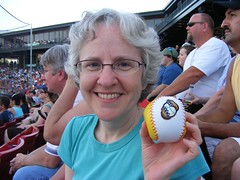
My Favorite Photo from the Weekend

Some times you have to put down the books and have some fun. Bonnie and I went to a Kane County Cougar Game on Saturday night and sat just above third base. Between innings, the Cougars have lots of crowd pleasing promotions. I actually caught one of the softballs that were thrown into the stands. Bonnie has the proof.

Friday, August 07, 2009

The Thing Around Your Neck by Chimamanda Ngozi Adichie

The plight of women in contemporary Nigeria is the central concern in twelve stories in The Thing Around Your Neck, a new book from Chimamanda Ngozi Adichie. The situation for many is bleak, as they are restricted by tribal and religious strictures that say whether they can marry for love, choose their friends, have careers, or control their own fertility. One woman's birth name means "father's wealth," referring to the payment he will receive when he "sells" her to a husband. As Adichie shows, it is dangerous to challenge the rules of husbands, boyfriends, fathers, and even grandmothers. Yet, they do and some succeed at great cost.

In The Thing Around Your Neck, Nigeria is a corrupt and violent place, a once-promising country spoiled by military strongmen and bad bankers. In a nod to modernity, many women are allowed educations, but then they are expected to accept subservient roles. In "Jumping Monkey Hill," a promising Nigerian author attending a writers' workshop reads her story about after getting her degree being given a bank job that expected her to sleep with bank clients. In "Tomorrow is Too Far," a grandmother always favors the grandson over a grandaughter, ignoring the latter's talent. In "The Arrangers of Marriage," an orphan is forced to marry a hapless Nigerian medical student doing his residency in the United States. In this and some other stories, Nigerians immigrate to America, but they always take a good bit of the fatherland with them.

These stories could simply be depressing, but Adichie's narration compels readers to continue past every injustice to see which women succeed and which fail. And not every father and husband in these quick reading stories is an enemy. The Thing Around Your Neck will appeal to readers of literary fiction who appreciate psychological insight and advocacy for social reform.

Adichie, Chimamanda Ngozi. The Thing Around Your Neck. Knopf, 2009. ISBN 9780307271075

Wednesday, August 05, 2009

The Earth Moves: Galileo and the Roman Inquisition by Dan Hofstadter

In many accounts of the 1632 papal proceedings against Galileo Galilei, the astronomer/mathematician/philosopher is cast as a defender of science and truth, and Pope Urban VIII is vilified as a backward church father, unwilling to face modernity. Galileo insists the sun is the center of our part of the universe, while the pope retains the belief in the earth as the center of creation. In The Earth Moves: Galileo and the Roman Inquisition, however, Dan Hofstadter shows the case was a bit more complicated than it has often presented to be.

Having seen the now available papal transcripts of the inquisition, not really a "trial" by modern standards, Hofstadter revises the story. The real charge was disobedience, not heresy. The pope was most upset that Galileo used deception to get a imprimatur on a book about a forbidden topic. The irony is that in a previous decade, when still a cardinal, the pope urged Galileo to write a book about the Copernican view of the universe. Scientific evidence to support or disprove Galileo's vision of the universe was never presented in the inquiry. In the end the pope was almost willing to just forgive the old astronomer after the latter confessed, but behind the scene papal politics intervened. Galileo lived the rest of his life on parole.

Hofstadter's story may actually be more disturbing than the often-told tale. Urban VIII understood the science and knew that Galileo was right, but the church was filled with people who could be described as "biblical neoconservatives." Galileo's theories threatened not only the belief in Bible infallibility but also the belief in astrology. If the planets were moved, seers had no basis for their astrological readings. The pope understood these constituents and ruled according to their prejudices in ruling against science and Galileo. Hofstadler also suggests that family and city-state rivalries and envy were really behind the charges. The Galileo affair was a skirmish in a much larger cold war. The author proposes that someone else should research and write a longer book about this assertion.

With its sections about Galileo's upbringing and education and about his work with telescopes, The Earth Moves serves as a quick reading profile of the astronomer. I enjoyed reading about how Galileo described his experiments in pre-Newtonian language. His descriptors for motion were "inclination," "repugnance," "indifference," and "violence." Because algebra had not yet been invented, his calculations of planetary orbits are particularly amazing.

Readers who enjoy human drama may get a little bogged down in the middle section of the book, which includes technical details about telescopes and various theories about the arrangements of planets, stars, and comets. The first and final sections have faster flowing narratives that should please many history readers.

Hofstadter, Dan. The Earth Moves: Galileo and the Roman Inquisition. W.W. Norton, 2009. ISBN 9780393066500

Monday, August 03, 2009

The Legend of Sigurd and Gudrún by J.R.R. Tolkien

J.R.R. Tolkien has another new book, The Legend of Sigurd and Gudrún. His son Christopher continues to find writings that interest his father's devoted fans. This new volume includes some early Tolkien translations and commentaries of Norse legends concerning the Völsungs, descendants of Sigmund. Tolkien in verse retells the Elder Edda, the oldest of the collections of the myths, which are also retold in the Icelandic Völsung Saga, the Middle High German Nibelungenleid, and Richard Wagner's series of operas, Ring of the Nibelungs.

I skipped the introduction to see if I could understand the legends without first being told what I was reading. I did fairly well. Tolkien describes a world of forests and highlands where kings travel by swift horses. These kings and queens produce offspring who become future kings and queens, if they live. A serpent is slain with a well-forged sword to capture the creature's treasure of gold. A king lusts to possess a powerful ring. Sins of fathers pass on to their sons. Many people die to satisfy the greed of a few. It's just what you expect from mythology.

My favorite line: "Wives oft are wooed by worthless men."

There are lots of names to keep straight: Gudrún, Gunnar, Grimhild, Gjúki, Sigmund, Sigrlinn, Siggeir, Signý, and Sigurd are just a few of the characters. Readers may want to create scorecards to keep the players straight. Names that disappear for dozens of pages appear again when old crimes are remembered. Keeping alliances straight is difficult, partly because of the betrayal of allies. It does not end well for anyone.

Thus glory endeth,
And gold fadeth,
On noise and clamours
The night falleth.
Lift up your hearts,
Lords and maidens
For the song of sorrow
That was sung of old.


Read The Legend of Sigurd and Gudrún if you want to know Tolkien's sources and enjoy ancient mythology.

Tolkien, J.R.R. The Legend of Sigurd and Gudrún. Houghton Mifflin Harcourt, 2009. ISBN 9780547273426