Sunday, December 28, 2008

A Supremely Bad Idea: Three Mad Birders and Their Quest to See It All by Luke Dempsey

When I first picked up A Supremely Bad Idea: Three Mad Birders and Their Quest to See It All by Luke Dempsey, I wondered whether it would be like The Big Year: A Tale of Man, Nature, and Fowl Obsession by Mark Obmascik. The latter book also has three birders traveling across the United States trying to see every bird that resides in or migrates through the country. But there is a big difference. In the new book, the birders are friends, not rivals. They even have a pact to not count a bird unless all three identify it, either by sight or sound. They join together for long weekends and vacations, hauling binoculars, scopes, and cameras, and listening to bird songs on an iPod.

Why these people are friends is the question I struggled with. Dempsey tells us how he met Don and Donna Graffiti, a couple who coax him to go out birding. Once they start traveling together, however, all their eccentricities are revealed and tempers flare, but just when the group looks like it might break up, someone spots a ringed kingfisher or an eastern meadowlark. Luke tolerates the horrible motels that Don books, and Donna and Don forgive his penchant for sudden tactless statements to the people they meet. Their common love for the birds holds them together.

I tired of the soap opera aspects of the book but read on for the descriptions of birds and details of how the trio spotted them. Going out into remote areas, such as lonely stretches of the Rio Grande in Texas, brought the friends into contact with some dangerous characters. They'll never know why the smuggler (drugs or people?) backed off after demanding their cameras.

Overall, A Supremely Bad Idea is an entertaining read that makes me long for some warmer weather and time in the wild.

Dempsey, Luke. A Supremely Bad Idea: Three Mad Birders and Their Quest to See It All. Bloomsbury, 2008. ISBN 9781596913554

Friday, December 26, 2008

The Man Who Loved China by Simon Winchester

Englishman Joseph Needham was a Cambridge-trained biochemist with supreme confidence that he could accomplish anything he set his mind to do. He was also a nonconformist, naively enchanted by communist rhetoric, who both loved his English wife and Chinese mistress passionately. During the darkest days of World War II, he jumped at the chance to serve as a diplomatic envoy to China, where he spent years visiting many remote regions, taking needed books and supplies to university scientists around the Asian country. After learning a few facts about China's forgotten early dominance in science, he resolved to write a definitive history about Chinese scientific and technical achievement. According to popular British author Simon Winchester in The Man Who Loved China, Needham spent the rest of his long life writing the many volumes of Science and Civilization in China.

Winchester credits Needham with changing the way that European people thought about China, which before the 1940s was viewed by many as just poor and backward. What Needham never resolved, however, is how China fell from being the most advanced nation on earth, with claims to many scientific firsts, to being poor and complacent. The mystery is still called the Needham Question in academic circles.

Needham was shunned by many in academics and diplomatic circles for his championing China even after the rise of the communist government Mao Zedong. He once met Mao, who asked him whether the Chinese should replace their bicycles with automobiles. Needham recommended sticking to the bikes. For years, he was denied visas to the United States as a undesirable, despite the acclaim in universities for his monumental history of China. Winchester recounts Needham's single-minded devotion that was eyed suspiciously by both western governments and Chinese authorities.

I enjoyed listening to The Man Who Loved China on an unabridged audiobook, read ably by Winchester himself. It is a great choice for readers of adventure and science biography.

Winchester, Simon. The Man Who Loved China. Recorded Books, 2008. ISBN 9781436107129

Wednesday, December 24, 2008

Laura's Sculpy Nativity


Laura's Sculpy Nativity
Originally uploaded by ricklibrarian.
Merry Christmas!

Every year we get out all the family decorations, which includes some that we made ourselves. Laura made this little nativity set when she was in her Sculpy Period, back in elementary school. I always thought it was brilliant, as any dad would. It is colorful and nails the characters simply. I wish I were as clever.

I hope you, too, add to your warm memories this holiday season as you gather with family and/or friends.

Peace for everyone.

Rick

Tuesday, December 23, 2008

ricklibrarian Books That Matter 2008 and Other Awards

It is that time again - the end of the year. All the major reviewing publications are issuing their best books lists, and bloggers are keeping pace with their more personalized lists. Here is what I really liked in 2008. Happy Holiday Reading!


Recent Nonfiction

At Large and At Small: Familiar Essays by Anne Fadiman

Daring to Look: Dorothea Lange's Photographs and Reports from the Field by Anne Whiston Spirn

Freedom for the Thought That We Hate: A Biography of the First Amendment by Anthony Lewis

Giants: The Parallel Lives of Frederick Douglass and Abraham Lincoln
by John Stauffer

The Legend of Colton H. Bryant by Alexandra Fuller

The Man Whom Made Lists: Love, Death, Madness, and the Creation of Roget's Thesaurus by Jashua Kendall

Mr. Adams's Last Crusade: John Quincy Adams's Extraordinary Post-Presidential Life in Congress by Joseph Wheelan

True Enough: Learning to Live in a Post-Fact Society by Farhad Manjoo

Warm Springs: Traces of a Childhood at FDR's Polio Haven by Susan Richard Shreve

The World Without Us by Alan Weisman


Recent Fiction

The Absolutely True Diary of a Part-Time Indian by Sherman Alexie

Armageddon in Retrospect by Kurt Vonnegut

For the Relief of Unbearable Urges by Nathan Englander

A Guide to the Birds of East Africa by Nicholas Drayson

The Jew of Home Depot and Other Stories by Max Apple

My Fellow Americans by Keir Graff

Unaccustomed Earth by Jhumpa Lahiri


Great Old Books

The Abbess of Crewe: A Modern Morality Tale by Muriel Spark (from 1974)

Jordan County by Shelby Foote (from 1954)


Children's Books

Planting the Trees of Kenya: The Story of Wangari Maathai by Claire A. Nivola


Audiobook

Brother, I'm Dying by Edwidge Danticat, read by Robin Miles

The Lodger Shakespeare: His Life on Silver Street by Charles Nicholl

The Long Road Home: A Story of War and Family by Martha Raddatz


Book Review Blog

Blogging for a Good Book


Library Science

Serving Teen Through Readers' Advisory by Heather Booth


Movies

Chop Shop, directed by Ramin Bahrani

Riding Alone for Thousands of Miles, directed by Yimou Zhang


Music

Raising Sand by Robert Plant and Alison Krauss


Performance

Jeeves Intervenes: A Play from First Folio


Presentations at Conferences

Andrew Carnegie with a Yak

Monday, December 22, 2008

A Guide to the Birds of East Africa by Nicholas Drayson

When asked what I like best in novels, I say that I like getting to visit another place and time. A bit of gentle humor and sympathetic characters also help. Throw in some plot twists and I am very happy indeed. This all describes A Guide to the Birds of East Africa by Nicholas Drayson.

Drayson's title will probably cause some confussion for years to come. I can imagine readers looking for bird guides getting it from the shelf and saying, "What's this? Where are the color photos?" Each chapter does start with a characture of a bird above the chapter number, but these pen and ink drawings are not really organized for bird spotting.

A Guide to the Birds of East Africa is, despite the title, a novel set in and around present day Nairobi, Kenya. In its first chapter, the characters meet on a bird walk near the car park outside the Nairobi Museum. Rose Mbikwa is a Scottish expatriate who leads the weekly bird walks. Mr. Malik, owner of Jolly Man Manufacturing, is a third generation Indian, whose grandfather immigrated to help build the Kenyan railroad. Mr. Malik is a quiet admirer of Rose and has bought tickets to the annual Hunt Club Ball, but he hasn't the courage to ask her to accompany him to the ball. While he stalls, a playboy from the Indian community, back after years abroad, decides that he will invite Rose. Over drinks at the Asadi Club, their mutual intentions are discovered and friends recommend a birding contest to win the right to ask Rose to the dance.

The week long bird contest with its surprising difficulties takes much of the book. In the process, Drayson reveals many of the joys and sorrows of the struggling African nation and depicts its multi-ethnic community. He also includes many quick bits about the amazingly rich bird life of East Africa. Readers with Zimmerman's Birds of Kenya and Northern Tanzania can look up each colorful bird as its spotted.

Readers looking for a good book while waiting for the next Alexander McCall Smith title will enjoy A Guide to the Birds of East Africa.

Drayson, Nicholas. A Guide to the Birds of East Africa. Houghton Mifflin, 2008. ISBN 9780547152585

Saturday, December 20, 2008

Walking the Wrack Line: On Tidal Shifts and What Remains by Barbara Hurd

I enjoyed Barbara Hurd's collection of essays Stirring the Mud: On Swamps, Bogs, and Imagination so well that I read it twice. Her new collection Walking the Wrack Line: On Tidal Shifts and What Remains is just as good. Hurd takes readers with her to beaches around the world, not for idle recreation, but to see what washes up from the sea. The "wrack line" is the high water mark, the top of the tide, where driftwood, shells, jellyfish, kelp, and garbage are deposited. Hurd always finds something interesting there. What's more, she then always learns something interesting about herself.

Hurd is very quotable. I noted several passages to reread. In "Lime Sea Glass: Transformations," she tells about debris near a long time garbage dump in California. For many decades in the middle of the 20th century, people threw old furniture, refrigerators, and lots of glass and pottery off a cliff into the Pacific Ocean. The constant battering of the waves reduced the broken glass and pottery to pebbles of many colors that are still washing up on a nearby beach. Jewelry makers frequent the multicolor beach. To this, Hurd states the following:

We know now that what's discarded doesn't disappear and that what's in friction with the world - and what, including us, is not? - can be both shattered and smoothed.
In "Bottle and Feather: A Different Question," she finds a feather and contemplates the myth of Icarus flying too near the sun while thinking of her mother recovering from a heart attack. Because her mother can not visit the beach that she can see from her hospital bed in Florida, Hurd agrees to report what she finds. Like in a novel, she finds a bottle with a note inside. The paraffin that seals the bottle is unmovable, so the pair have to decide whether to break the beautiful emerald green bottle to read the note.

One more quote:

Never begin what you can't finish, my father once insisted. I was ten: we were standing over an outdoor rabbit pen I was trying to fashion out of chicken wire. Stumped by my inability to make the cage escape-proof, I nodded my head. But if he were alive now I'd want to ask him how can I ever tell what's finishable, what's not? How can I always know at the outsetthat this is something I can bring to completion or will have to give up on, discard in midform? Even as an adult, I'm drawn to so many things that I might never complete - writing a novel, playing a Bach partita, planting a garden of constant white blooms. And though I tend to keep my false starts and failed attempts private, I'm aware that to never begin such things would likely cause more angst than to leave them half undone.
Walking the Wrack Line is a difficult book to classify but easy to enjoy. I recommend it highly.

Hurd, Barbara. Walking the Wrack Line: On Tidal Shifts and What Remains. University of Georgia Press, 2008. ISBN 9780820331023

Friday, December 19, 2008

Troubles for Reference Librarians

I see that the Winter issue of Reference & Users Services Quarterly from RUSA arrived in my mail yesterday. Just this week I finished reading the Fall issue, which I thought had an unusually high number of articles with findings and ideas that I want to contemplate. Perhaps the most serious observation of them all, the one needing the attention of reference librarians everywhere, is found on page 72, on the fifth page of the article "Subject Searching Success: Transaction Logs, Patron Perceptions, and Implications for Library Instruction" by Karen Antell and Jie Huang*. Here is the part of the quote with the disturbing news:

For the twenty-nine unsuccessful topic searches, students were asked what they would do next if they were actually looking for this information. In twelve cases, students said they would simply stop looking or give up, assuming that no information on the topic was available. Other responses included "go to Google," "go to a database," "browse books on the shelf," "go to the law library," and "get advise from my professor." In three cases, the student was unsure what he or she would do next (see figure 5). Notably, not one student mentioned asking a library staff member for assistance.


I see two red flags here. The first is the idea that if a search does not find what is sought that there is nothing to find. At the risk of sounding old fashioned and crotchety, let me say that this sounds like the result of having had too much easy success in the past and settling for just enough. I think we as librarians should work to make our tools as easy to use as possible, with the goal of connecting clients and information/content that they seek, but we should convey that the tools are not perfect. I think some of our marketing that says "Hey, use this , it's easy!" backfires on us. Students and other clients believe us and then assume that if the easy search does not find anything, there is nothing to be found. How we can have positive and encouraging promotions that are still realistic is tricky. We need to think about this.

The second red flag is that none of the students thought of consulting a librarian. Here we may need to make it easy for them. Every catalog station in the library should have a "Librarians Can Help" notice prominently attached. Every search page and results page in the catalog should also offer librarian assistance. I do not know how we do this latter suggestion in a consortium shared catalog, but it seems needed to me if in a test no catalog user remembers that reference librarians could help.

We can not just sit tight after reading this paragraph. If clients can not remember that we are there, we must reintroduce ourselves. Be visible.

*I could not find this article on the RUSA website this morning. Perhaps the Fall 2008 issue needs reloading into the archive. Previous issues are available on the site.

Wednesday, December 17, 2008

The Georgian Star: How William and Caroline Herschel Revolutionized Our Understanding of the Cosmos by Michael D. Lemonick

If you know the names of astronomers William and Caroline Herschel, there is a good chance that you have a telescope which you bring out on clear nights to scan the stars. The brother and sister who were born in Hanover in eighteenth century Germany, the region from which the British monarchs of their time came, have been forgotten by recent general science textbooks. With The Georgian Star: How William and Caroline Herschel Revolutionized Our Understanding of the Cosmos, author Michael D. Lemonick aims to restore their fame.

The Herschels were quite famous in their time. William was a talented musician who migrated to Bath, England to play in orchestras that entertained the rich tourists who came to "take the healing waters." After several prosperous years and making prominent friends, he got the chance to look in a telescope and was hooked on the hobby of scanning the heavens for comets. Fairly soon he thought that he had found an unnamed comet, but it turned out that he instead discovered the planet Uranus, which he named Georgium Sidas in honor of George III, who then granted him a pension. He gave up music and moved to Windsor to be at hand when the king needed an astronomer to entertain his evening guests.

Caroline often helped her brother with his night scans as his scribe, recording his findings. She spelled him at the telescope as he tired and when he had other commitments. In the process, she became better than he at finding comets. In time, she too got a pension from the king and honors from the Royal Society and other science societies.

William and his brother Alexander built most of their telescopes, some of which they sold to rich patrons. They were almost killed in the collapse of one of their larger constructions. William and Caroline remapped the night sky, finding thousands of stars not yet plotted, as well as identifying the moons of Saturn. William coined the term "asteroid" and challenged the then prevailing belief that stars were spread uniformly across the universe.

William firmly believed that there were people on all the planets. He argued that God had no reason to make an uninhabited planet. He also believed that someday astronomers would find planets around all the stars. Only in the last two decades have they proven him right on the last count.

The Georgian Star is an entertaining quick read that may lead readers to other books in the Great Discoveries Series. More public libraries should have these books.

Lemonick, Michael D. The Georgian Star: How William and Caroline Herschel Revolutionized Our Understanding of the Cosmos. W. W. Norton, 2009. ISBN 9780393065749

Monday, December 15, 2008

How Not to Die: Surprising Lessons on Living Longer, Safer, and Healthier from America's Favorite Medical Examiner by Jan Garavaglia

I have not seen Dr. G: Medical Examiner because we do not get Discovery Health in our cable television package, but it sounds like an interesting program. Autopsies are always attention getting in drama series. Reenactments by a real medical examiner must be riveting. Jan Garavaglia describes some of what she does on the show in How Not to Die: Surprising Lessons on Living Longer, Safer, and Healthier from America's Favorite Medical Examiner. Mostly, however, she tells stories with a recurring theme - the dead who landed in her morgue often did not have to die prematurely. Sensible living and a little care could have saved many of them. Of course, many people will never live sensibly - especially men. She has an entire chapter devoted to how men die younger due to a combination of genes, hormones, and stupidity.

Every chapter starts with a mysterious death that Garavaglia needs to solve so the police will know if there is a crime and/or the family (if there is one) can understand why their loved one died. After the story, the medical examiner puts the story into a cultural context and tells why the death was preventable.

The message strikes home with me. As I grew up in a small West Texas town, there were frequent deaths from road and oil field accidents. I graduated small high school in a class of 56. Of those 56, five men had died by their mid-40s: one auto accident with speed and alcohol involved, two deaths from AIDS, one from a rare leukemia, and one from an epileptic seizure. Garavaglia would score at least three of those as preventable.

Garavagia's book is somewhat like the driver's ed films that show bloody automobile crashes, but it is more entertaining. It does have some shock value, as she describes handling the decaying tissues of people who lived miserable lives. Perhaps that is what is needed. I think maybe I'll get that medical exam I've been putting off.

Garavaglia, Jan. How Not to Die: Surprising Lessons on Living Longer, Safer, and Healthier from America's Favorite Medical Examiner. Crown Publishers, 2008.

Saturday, December 13, 2008

Week in Review


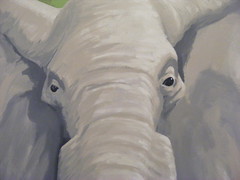
Elephant Eyes
Originally uploaded by ricklibrarian.
Several significant things happened this week.

1. I learned that my book is now officially in production. I will still have to proof from the galleys and complete the index. The release date is not yet set.

2. My friend Aaron Schmidt has a new job. He tells about the new position on his blog Walking Paper.

3. Thomas Ford had an in service day on Friday, at which we visited the La Grange Public Library's new building which is so much nicer than its old building. The elephant is a detail from its children's story hour room. I was impressed by the room for the teens and the attractive way back issues of magazines are displayed.

Friday, December 12, 2008

1001 Books You Must Read Before You Die

If you let it, 1001 Books You Must Read Before You Die can leave you very depressed. There are so many books that look good, and it reminds you that the clock is ticking. You only have so long left to read until you'll no longer be able to lift a book and turn a page. While the dust jacket suggests the pleasure of reading on vacation, the illustration across from the title page is of a skeleton. Tick, tick, tick.

Could I have a casket with a perpetual audiobook player?

Flipping through the pages, looking at the author photos and illustrations of original dust jackets, I see lots of books that I have read already. Crime and Punishment, The Great Gatsby, Gulliver's Travels, 1984, Babbitt, Catcher in the Rye, The Hours, White Teeth, ... I have even read the two final books in the list, Saturday by Ian McEwan and Never Let Me Go by Kazuo Ishiguro. So I have a head start. But maybe I'd like to reread some of those.

If I read 20 books per year (allowing plenty of time to read something else), I'd need to live to be 104, which would be alright with me. If I only worked at these 1001 book, maybe I could finish in 8 to 10 years. But I do not want to give up reading and writing about nonfiction. Why is there no nonfiction in this book? Hmmm, someone want to write 1001 Nonfiction Books to Read While You're Still Living?

At Thomas Ford, we have been rearranging our public spaces and creating more displays. At some point we will have an area for coffee and conversation. I'd like to see a prominent shelf of popular readers' advisory books in that area. 1001 Books You Must Read Before You Die would go well there.

1001 Books You Must Read Before You Die. Universe, 2006. ISBN 9780789313706

Wednesday, December 10, 2008

Giants: The Parallel Lives of Frederick Douglass and Abraham Lincoln by John Stauffer

I complain sometimes about how many biographies there about high-interest historical and cultural figures. Upon finding starred reviews of new books about John F. Kennedy, Franklin Roosevelt, Elvis Presley, Princess Diana, or Marilyn Monroe, I often sigh with exasperation as I think of the crowded shelves and the dollars that I could use to get books about somebody else. Sometimes I do pass initially on buying new books about these market-dominating lives, knowing that we already have plenty of books about them, hoping the reading public will not notice, but I then get title requests and have to buy the books anyway. You would think that I would learn.

Every season seems to bring out several more books about Abraham Lincoln, and with the bicentennial of his birth in 2009, the flow of books is even higher than normal. With our budget and obligation to build a balanced collection meeting the needs of a diversity of readers, I can not buy them all. So, again, I mutter my annoyance.

The irony is that I actually enjoy reading about Abraham Lincoln. His life can be (and is) interpreted so many ways. To one author he is a hero and to another a tyrant or perhaps only a victim of circumstance. There never seems to be an end to the possible ways of looking at Lincoln. In this light, I have found Giants: The Parallel Lives of Frederick Douglass and Abraham Lincoln by John Stauffer to be worth a bit of my book budget as well as my time.

In the title, Stauffer does indicate his subject - the comparison of Douglass and Lincoln. Douglass and Lincoln were both self-made and self-educated men, born in poverty, denied schooling, large men forced to work from early ages, who somehow became eloquent speakers and leading voices of conscience at a time when America was bent on the accumulation of wealth and land. The first chapter highlights their similarities, but then the book progresses to show how the two men developed and eventually crossed paths.

Stauffer meets his obligation as an author to portray the light and dark sides of the two leaders. At points I thought Douglass was being touted as the greater man and then I thought the portrayals reversed. In the end, Stauffer seems to judge them both favorably, noting that they succeeded together in ending slavery and failed together at really improving the lives of blacks in North or South. They were helpless in swaying the racist attitudes that kept blacks poor and disenfranchised for another 100 years after the Civil War.

Stauffer is a good story teller who weaves the lives together well. Among the many Lincoln books on the market, Giants is a good selection for libraries.

Stauffer, John. Giants: The Parallel Lives of Frederick Douglass and Abraham Lincoln. Twelve, 2008. ISBN9780446580090

Sunday, December 07, 2008

Panic in Level 4: Cannibals, Killer Viruses, and Other Journeys to the Edge of Science by Richard Preston

Science journalist Richard Preston practices "on the spot" reporting. When told that a person does not have to get into the boiling soup pot to understand the soup, he disagrees. He believes that experiencing danger replaces speculation with insight. In one of his stories in Panic in Level 4: Cannibals, Killer Viruses, and Other Journeys to the Edge of Science, he tells how he risked his life to get close to a deadly virus. He took the precautions of wearing a pressurized space-age suit and working with training medical professionals, but he did look straight into the petri dishes filled with viruses capable of killing him quickly and violently. It is riveting reading.

The cover illustration, title, and description of Panic in Level 4 will probably scare away some readers. A glance at the cover leads one to think the book is totally gruesome. This is unfortunate, as there are six of Preston's New Yorker articles collected in this book, not all dealing with disturbing topics. He describes Russian mathematicians seeking to find the exact number Pi, the work to save American trees from Asian parasites, the competition to discover all the gene sequences in human DNA, and work to restore the Unicorn tapestries at the Cloisters in New York. He then ends the book with a story about Lesch-Nyhan syndrome, a genetic disorder that causes young men and boys to mutilate themselves.

I listened to Panic in Level 4 read by James Lurie, who is great at voices. I could hardly stop listening and finished the 8 hours in only 3 days.

Librarians recommending Panic in Level 4 might advise readers that stories 1 and 6 include some graphic descriptions of human bodies experiencing trauma. Preston's words are as effective as photographs in medical textbooks. Some readers may abandon these stories, which is unfortunate, as the stories are fascinating. This book should be in most public libraries.

Preston, Richard. Panic in Level 4. Books on Tape, 2008. ISBN 9781415949672

Friday, December 05, 2008

American Home Front 1941-1942 by Alistair Cooke

A few weeks ago, Bonnie and I saw The Unseen Alistair Cooke on PBS Masterpiece. The program highlighted recently discovered 8mm films that Cooke made while traveling around America by car and train in the 1930s and 1040s. In both black and white and later in color, he captured the look of the country before the great transformation brought about by World War II and post-war prosperity. It was great program describing the life of the longtime journalist and television host of Masterpiece Theater. It should be on DVD but does not yet seem to be.

Wanting to know more, I checked our library catalog to see what we had. I found several books, including The American Home Front 1941-1942, which Cooke wrote during the war but never published. In the foreward to the book, Harold Evans reports that the manuscript was rediscovered in 2004, just months before Cooke died.

Unlike Alexis de Tocqueville, Charles Dickens, and Oscar Wilde, Alistair Cooke traveled around America quietly, not intentionally drawing attention to himself. Unlike these European observers, he was not really an outsider, having by the time of his 1941-1942 trip become an American citizen. Still he had an unusual perspective, having grown up in World War I Britain. People did, of course, recognize that he was not "from around these parts." Still, he had a talent for easing people from any station in life into conversation.

Cooke has always been praised for his ability to describe scenes vividly. He also seemed to have had the good fortune to be on the spot for many historic events. He began his trip around America in Washington, D.C., arriving there on December 6, 1941, positioning himself perfectly to witness the governmental response to the Japanese attack on Pearl Harbor the next day. Cooke even got into the Capitol to report on Franklin Roosevelt's speech to Congress.

War time shortages and restrictions began right away. Getting a car for his trip was not difficult but getting tires for it were. Cooke spent days searching before finding some old tires that he then had retread. As he drove around the country, he was often alone on the road, often going long distances without meeting any other cars. When he arrived in towns and cities, he found local people who told him how the war was impacting the community. Within months after the declaration of war, there were communities without labor to plant crops or run local businesses. Likewise, there were boom towns building factories for war manufacturing where people were sleeping in tents.

According to Harold Evans in the Foreword, Cooke felt after the war that there was no longer a reason to publish the book, which was not published during the war because of shortages and restrictions. We are lucky that it was available to be rediscovered, as it thoroughly depicts a time that is almost forgotten. It makes a great addition to the viewing of Ken Burns' The War. More public libraries should add this fascinating book.

Cooke, Alistair. The American Home Front 1941-1942. Atlantic Monthly Press, 2006. ISBN 9780871139399

Wednesday, December 03, 2008

Chop Shop, a Film by Ramin Bahrani

The turnout was small on the evening after Thanksgiving, but our discussion was lively after our library's showing of Chop Shop, an independent film by director Ramin Bahrani. Even our local critic who usually pans every film (often to get a reaction) praised the film.

Chop Shop is set in the Willet's Point corner of Queens, across the expressway from Shea Stadium*, which provides a bright, prosperous contrast to the rusty, dilapidated auto-body shops in which most of the story takes place. Along the broken, flooded street, cars idle bumper to bumper, while drivers negotiate cheap repairs. Twelve-year-old Ale is one of a number of boys waving drivers into shops.
Chop Shop is a film that has a very strong documentary feel, though it is obviously fiction. It just starts and just ends. Viewers never learn how Ale and his sisters came to be orphans living in a rough neighborhood where every kindness is really a calculated act of self-interest. The setting seems like it could not possibly be a movie set. The actors seem like they must be playing themselves.

The film seems so simple, but it drew a strong, mostly sympathetic reaction. While the audience discussed the plight of children, crime, corruption, the economy, and other topics suggested by the film, they mostly wanted to fill in the human story. Some of our viewers were convinced that Ale would soon land in prison, while others thought he would survive and thrive. We spent half an hour in contemplation of what the director intended. Everyone was thankful that they did not live in Willet's Point.

I recommend Chop Shop for library collections and film discussions.

*Of course, Shea Stadium is itself a rundown ballpark, but it seems to glow from afar.

Monday, December 01, 2008

Bookforum, Dec/Jan 2009, Volume 15, Issue 4

When I was in Iowa City a couple of weekends ago to pick up my daughter Laura for Thanksgiving break, we visited Prairie Lights Bookstore. After looking at books and drinking hot chocolate, as we started to leave, I noticed a tall stack of the December/January 2009 issues of Bookforum. I think I might have heard of the publication before, but I am not sure - there are so many "Book Something" publications. Whatever, it looked interesting, so I bought a copy.

Nine days late, I can report that I have enjoyed Bookforum and its reviews, featuring a lot of books for readers who like something a bit more challenging and deeper than bestsellers. Of particular interest to me was a full page (large page) article reviewing Hitler's Private Library by Timothy W. Rybeck. The review writer Trevor Butterworth quotes Rybeck's depiction of of Hitler as an insecure man who defended his positions with books and used his vast knowledge of books to intimidate. Rybeck asserts, however, that while Hitler remembered much of what he read, he was unable to think critically and distinguish truth from lies. Hitler was an admirer of American automaker Henry Ford and required all his staff to read Ford's books.

Allen Barra wrote a two-page review of The World Is What It Is: The Authorized Biography of V. S. Naipaul by Patrick French. "Authorized" is the interesting word here, as French was given free access to all of Naipaul's papers and is very critical of the novelist. According to the agreement, Naipaul could have required changes to the text but did not. The reviewer tries to make sense of a man full of jealousies and contradictions who would so easily agree to such a portrayal.

In "Grave Doubts: Reckoning with Mass Mortality after the Civil War," T. J. Jackson Lears discusses two books about the extreme amount of violence and death during the American Civil War. He asserts that most accounts of the war gloss over the horror, hiding it behind stories of gallantry and honorable purpose. He thinks the rhetoric of the glory of war that arose as a coping defense has made us too willing to fight in subsequent wars.

In the short reviews, the book that look most interesting to me is Fifty Miles from Tomorrow: A Memoir of Alaska and the Real People by William L. Iggiagruk Hensley. Hensley tells about growing up in the far north and his career as an advocate for his native people.

Throughout the book review are ads for art books, which seems odd until you discover that the review is a sister publication of Artforum.

Bookforum will appeal to readers who enjoy The New York Review of Books. Larger public libraries and those with literary readers should consider adding a subscription.